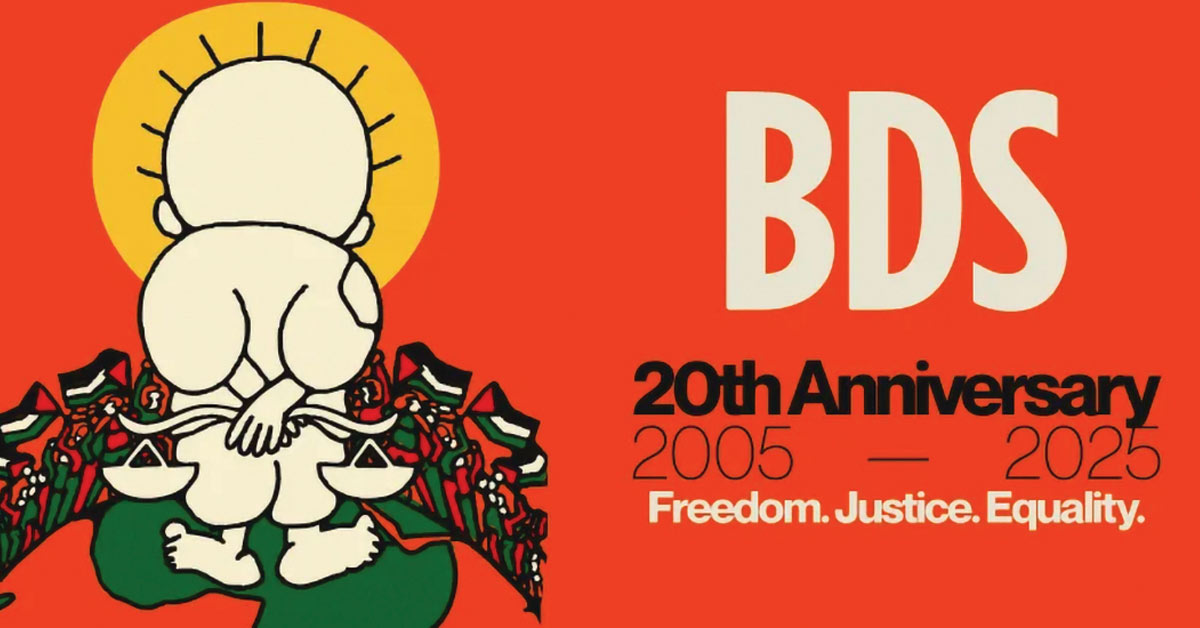
BDS at 20
Jay Tcath
This summer marked the 20th anniversary of the official launch of the Boycott, Divestment, and Sanctions (BDS) movement against Israel.
The BDS campaign targets a broad range of societal sectors: the UN and other international fora; national and local governments; academia and cultural institutions; trade unions; sports; political parties; and advocacy groups for many causes-LGBTQ+, climate, racial, Indigenous peoples, and more.
But its self-described focus is economic: to make Israel pay such an unsustainable financial price that it will have no choice but to accept every Palestinian political demand.
This strategy exploits the moral example of the BDS campaign against South Africa by analogizing Israel to apartheid. And this strategy asserts that just as it was only BDS’ economic toll that brought down apartheid, the same will happen with Israel.
The South African example provides BDS supporters with an additional utility: it associates Israel with the evil of apartheid. The net effect is that if BDS doesn’t win economically, it still brands Israel as a pariah state, eroding its very legitimacy.
Unfortunately, BDS has had progress on that propaganda score.
Not so much on the economic front.
In the two decades since BDS was launched, Israel’s Gross Domestic Product (GDP) increased from $147 billion to $583 billion, and Annual Household Income per Capita increased from $9,300 to $24,500. Its trade with the U.S. jumped from $24 billion to $37 billion, and the margin of Israel’s trade surplus with the U.S. increased 40%.
These numbers are that much more impressive when considering the toll the current almost two-year war(s) against Hamas, Hezbollah, Iran, and the Houthis have wrought on the Israeli economy.
Israel’s resilience to BDS’s economic pressure was also evident here in Illinois, one of the country’s BDS hotbeds. Between 2005 and 2015, Illinois exports to Israel increased by over two-thirds, and Israel’s exports to Illinois were up over 15%.
That good news, though, is no cause for us who oppose BDS to take a victory lap or become complacent, on either the economic or the public relations front.
A year ago, the Chairman of the Israeli Export Institute said, “BDS and boycotts have changed Israel’s global trade landscape…economic boycotts and BDS organizations present major challenges, and in some countries, we are forced to operate under the radar.”
BDS supporters dishonestly claim credit whenever a company does less business with Israel. Yet in most cases, it is the usual ebb and flow of commerce and not anti-Israel animus that drives such business decisions.
For example, Starbucks’ closing its six Tel Aviv stores after an unsuccessful two-year trial was trumpeted as a success by BDS supporters (and too many BDS opponents). But they closed for no more sinister a reason than Israelis have distinct palates for their cups of Joe. [PS: The closure happened in 2003, two years before BDS was even launched.]
Similarly, the BDS movement claims credit for McDonald’s periodic global sales declines, “forgetting” to comment when they invariably rise, usually higher than the earlier decline.
However, there are corporations, especially in Europe, that are adopting BDS. Most significant are the sovereign wealth and union pension funds that have divested their holdings in publicly traded Israeli companies.
High-profile BDS cases, like Ben and Jerry’s decision to stop selling ice cream in the West Bank, grabbed headlines. This example also highlights the duplicity of the BDS movement: they claimed credit for the decision, though it fell far short of their demands to stop all trade with all Israel, within and beyond Israel’s 1967 borders.
Another BDS front requiring greater attention is that of companies issuing socially responsible ratings- a.k.a. Environmental, Social, and Governance (ESG)- for publicly traded companies. Several such companies have been found to base their ratings on biased criteria. With Bloomberg Intelligence estimating that ESG-related investments will surpass $50 trillion this year, the importance of this battlefield in the BDS war must not be underestimated.
If 20 years constitute a generation, then BDS’s first generation can be judged a failure on the economic front, but a scary and still-growing success on the public relations front.
In this, as in so many other aspects of Israel, the cup is both half full and half empty. We supporters have key roles to play, helping ensure that the cup doesn’t run dry, but rather runneth over.
The Times of Israel ran an extended version of this piece on Aug. 11, 2025.
Jay Tcath is JUF’s Executive Vice President.
In this issue
-

An ‘awesome’ new fellowship for teens
AKLA Chicago will be a free, five-week experiential experience for ages 12–14
Read more -

-