Breaking the cycle
Jennifer Brody
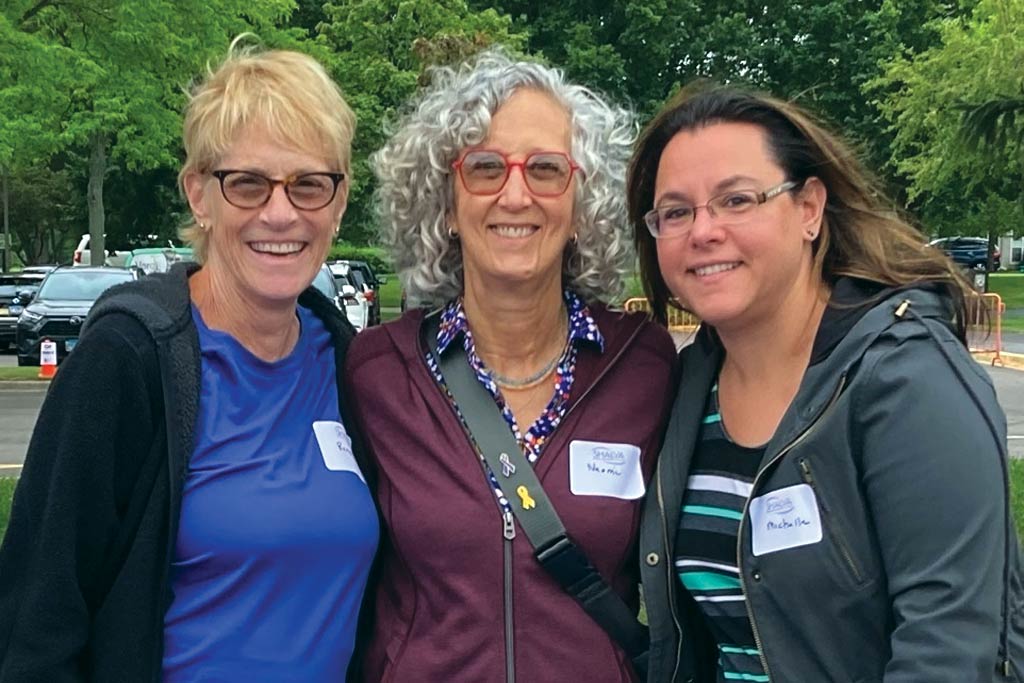
At the 2024 National Night Out, Naomi Senser (center), SHALVA’s Immediate Past President, and Volunteers Renee Suss (left) and Michelle Fetter (right) shared information about the agency’s services with the North Shore community. (Photo courtesy of SHALVA)
In 1985, Fayge Siegel was not an activist—until a private meeting changed everything. While helping arrange a Shalom Bayis lecture in Chicago featuring Rabbi Yaakov and Rebbetzin Dena Weinberg of Baltimore, Siegel and several other women were asked to gather 10 community-minded women for a private talk after the program.
There, Rebbetzin Weinberg spoke candidly about domestic violence in Jewish homes. “If it’s in Baltimore, then it’s in Chicago. Now you have to do something about it,” she told them.
Siegel remembers her disbelief. “I was extremely unknowledgeable. I thought, ‘What? How can this be?’” she recalled.
That initial shock turned into sustained resolve. Siegel and the other founding mothers of SHALVA educated themselves about domestic abuse, consulting experts before launching outreach in synagogues and schools. What began as a small gathering of concerned women would become a full-service agency in 1986.
Now celebrating its 40th anniversary, SHALVA (Hebrew for “tranquility”) is the oldest independent Jewish domestic abuse agency in the United States. It provides trauma-informed counseling and other services to people of all genders, socioeconomic backgrounds, and Jewish denominations.
Back in 1989, Sherry Dimarsky (then Berliner), the agency’s first Executive Director, began speaking to Jewish day school students about the red flags of unhealthy dating. For one senior at Ida Crown Jewish Academy, the message sparked a painful realization: She had grown up in an abusive home.
“She didn’t ask questions that day, but she internalized the message,” Siegel said. “A few years later, when she got engaged, she called SHALVA because she realized what was happening in her home was not okay.” It turned out the young woman wanted to learn how to build a different kind of home with her fiancé.
Barbara Siegel has witnessed the agency’s evolution firsthand. She joined the staff as a therapist in 1996 and became Clinical Director three years later, helping to expand services as demand grew. “I believe we have come an unbelievably long way,” she said.
In the early years, “outreach” meant showing up anywhere the community would listen. “We would go to any synagogue that would have us,” she recalled. “Even in the dead of winter, if only three people showed up, that was three more people that knew about us.”
She believes that therapy and education plant the seeds for healthy relationships. Some women call the confidential helpline unsure whether what they’re experiencing is abuse. “Maybe is fine,” she said. “That’s where we begin.”
One of the agency’s key prevention efforts is the Seven Circles program, launched in 2022. Created by Director of Community Education Jordyn Scorpio, the interactive, self-guided curriculum guides committed couples through exercises designed to strengthen their relationships. A rabbinically endorsed version for married Orthodox couples is also in development.
Seven Circles is “about understanding yourself, understanding your partner, and learning to recognize the difference between healthy and harmful relationship patterns,” said Scorpio.
More than 60 couples have participated, including Maris Rosenfeld and Ben, her boyfriend of six years, who comes from a different religious background. The curriculum addresses communication styles, conflict navigation, finances, religion, and children—conversations many couples postpone. “It’s not couples therapy,” said Rosenfeld, who is now SHALVA’s Community Outreach and Education Coordinator. “It’s about having conversations you should be having before you get married.”
The program affirmed how well they knew each other—and revealed a few surprises. Rosenfeld had long wondered whether her boyfriend truly felt comfortable at her family’s Rosh Hashanah and Passover gatherings. Through Seven Circles, she learned he did.
SHALVA’s prevention work also includes outreach to young adults ages 18 to 24—a population the CDC identifies as at highest risk for unhealthy relationship patterns.
At a JUF Young Leadership Division Shabbat dinner, Rosenfeld introduced guests to SHALVA’s free, confidential resources. On another evening at Base Hillel in Logan Square, she facilitated a discussion on intimacy in the Torah and intimate partner violence.
“I aim to give young people the tools to name their relationship as unhealthy and know what to do about it,” she said. “If their relationship is healthy, they have the knowledge to help a friend.”
If you or someone you know is experiencing abuse, Shalva’s confidential Help/Crisis Line is available 24/7. Call 773-583-HOPE (4673).
Jennifer Brody is a freelance writer based in the Chicago area.