Cognizant creations: Golems and artifical intelligence
BETSY GOMBERG
In a special issue on artificial intelligence, Moment Magazine recently speculated on the relation between AI’s rapidly evolving technology and the golem legends that have appeared in Jewish texts for centuries.
Golems, if you aren’t familiar, are creatures made of mud or clay, brought to life to protect Jews in times of peril. Like AI, which gains knowledge through large language models (LLMs), language is key to a golem’s ability to exist and evolve.
I asked ChatGPT what it had to say about golems and AI, and it articulated a clear difference. Here’s an excerpt: “A golem is a mythical creature brought to life by the inscription of Hebrew words on its body. Although powerful, a golem operates on the instructions of its creator, without the ability to learn from experiences. On the other hand, artificial intelligence refers to computer systems that perform intelligent tasks, learn from data, and exhibit a degree of autonomy.”
I think that Chat GPT needs to read more golem stories, including the wonderful array of golem novels that have appeared over the last decade. In these books, golems most definitely learn and have agency. In fact, they pass as human, seek romance, learn English by binge-watching Curb Your Enthusiasm , and set out on their own to seek revenge.
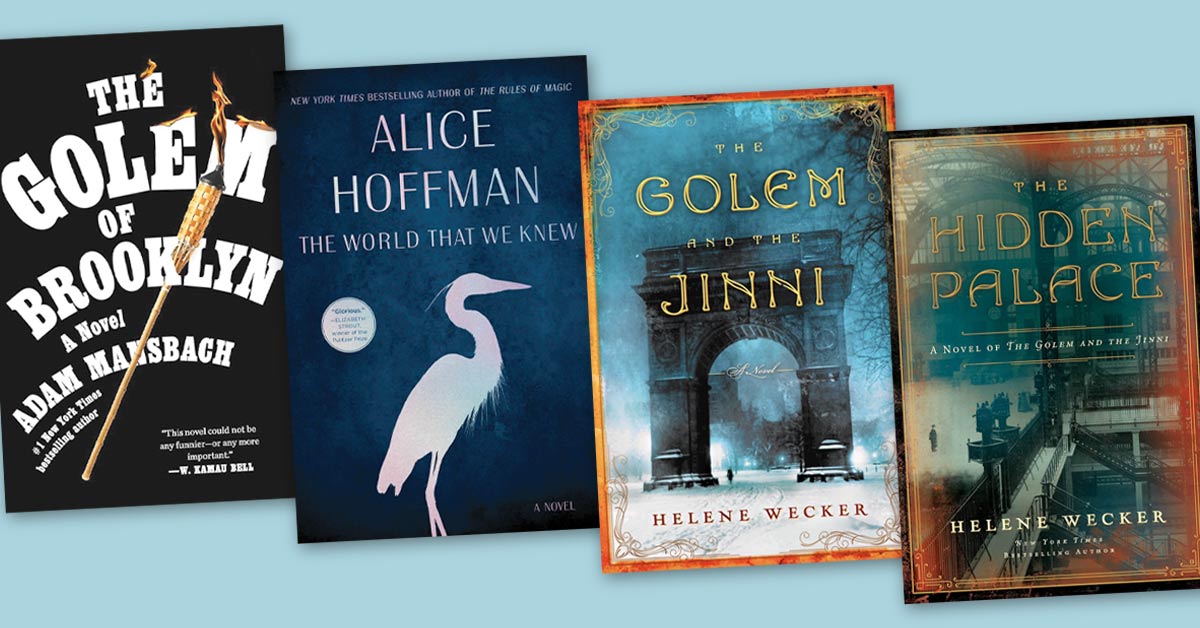
The Golem of Brooklyn by Adam Mansbach
So recent that characters refer to “Jewish space lasers,” The Golem of Brooklyn, was written by the author of Go the F*ck to Sleep. It follows art teacher Len Bronstein, bodega clerk Miri Apfelbaum… and the golem Len creates of pilfered clay and instructions from the internet. When the golem demands to know who he must destroy, Miri shows him a video of white nationalists chanting “Jews will not replace us,” setting off a rage-fueled romp across America.
The World That We Knew by Alice Hoffman
In The World That We Knew, a Jewish mother in 1941 Berlin desperately seeks to get her daughter Lea out of Germany. As options narrow, she uses hidden family heirlooms and two extra train tickets to gamble that a golem might help. The book becomes a journey across Nazi-occupied France. In addition to Lea and her golem, characters include a rebellious rabbi’s daughter, a mathematician’s sons, their family’s maid, a heron, members of the French resistance, and the Angel of Death, providing several opportunities to grapple with what qualities imbue someone-or something-with humanity.
The Golem and the Jinni and The Hidden Palace
In Helene Wecker’s magical, cross cultural The Golem and the Jinni and its sequel, The Hidden Palace , an immigrant golem forges her own path in turn-of-the-20th-century New York, along with a free-spirited Syrian-born jinni who must begrudgingly exist in human form. Despite their differences, Chava and Ahmad-the golem and jinni of the book’s title-lean on each other to conceal their fantastical natures, until they can’t help but use their powers to alter the world around them.
__
To learn more about Critical Conversations, visit spertus.edu/conversation to make your reservation.
Betsy Gomberg reads (and sometimes writes about) Jewish books. She is Spertus Institute’s Director of Marketing & Communications.