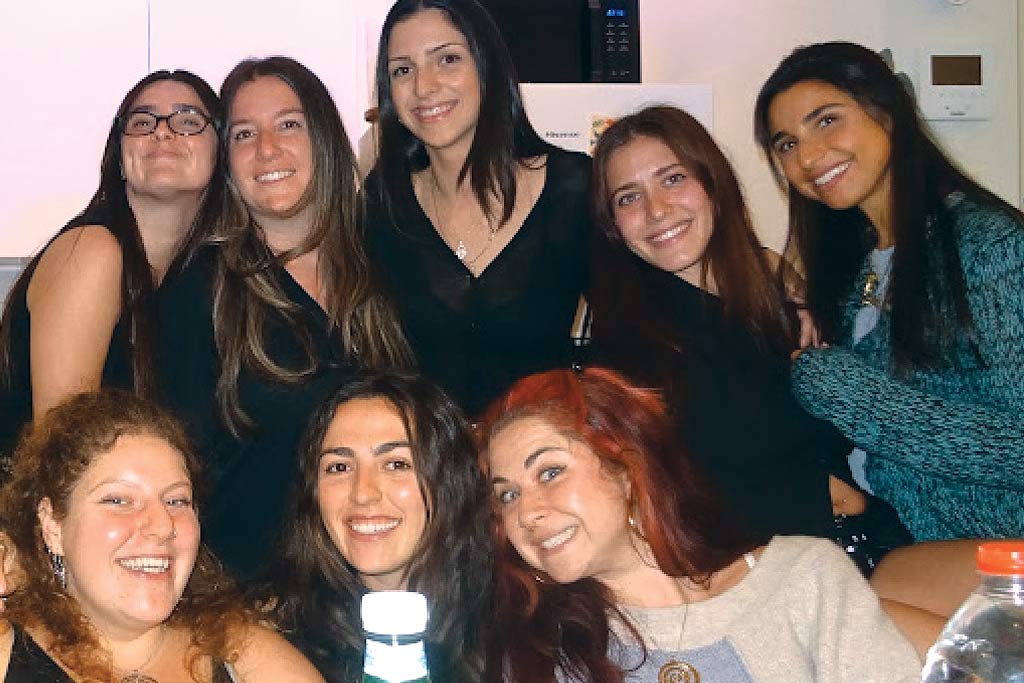
The author hosting a dinner party with friends at her home in Tel Aviv.
There is a moment, just before stepping into a bomb shelter, where everything slows.
It feels like entering another world, like a diver, turning around to wave goodbye, taking their last deep breath before disappearing underwater. The climate is different, dark, and disorienting, and they are simply forced to adjust to a new reality.
There is a specific type of connection that takes root with the people around you in this climate, when war becomes the metronome for daily life.
Familiar faces at the coffee shop each morning. Neighbors in pajamas, in the middle of the night, huddled into stairwells and shelters. Strangers who you’ve never seen before, running alongside you while an air raid siren blares. Friends, like you, whose families are far away.
These connections have become essential. The airspace isn’t closed but it may as well be. Getting out is nearly impossible. There is no quick flight, just distance, 6,180 miles, bobbing quietly between me and the people I love most in the world.
There is a quiet, shared understanding that right now, we need each other more than usual. That when your people are far away, the people beside you become critical, in a more immediate way. And I’ve started to notice what I do have here instead of what I’m missing:
People I can lean on. The kind that show up without asking for anything, who make endlessly long days that all bleed into one another feel more manageable. People who can make you laugh so you don’t cry. Again.
And it reminds me of what Mr. Rogers’ mother told him when he saw scary things on the news: “Look for the helpers. You’ll always find people who are helping.”
In looking for the helpers, I think I’ve also become one. While running from bombs together. While taking care of ourselves and each other, even while sleep deprived. While offering a hand to the 85-year-old woman—somebody’s grandmother—on the steep concrete stairs to a shelter. While showing up for one another, again and again, as many times as it takes.
And from afar, there are helpers too. There are reassuring check-ins with family across those 6,180 miles. There are hugs and kisses sent through screens on FaceTime calls with the light of my life, my niece, Aviv, that come at just the right time. There are flowers and food deliveries, gifted in generosity, from people who can do nothing else but feed you. These are steady reminders that, even from a distance, with missiles pouring down like rain, you are not alone.
That’s what war has felt like. Like a diver coming up for air; lungs tight, disoriented. There is a moment just beneath the surface where everything feels suspended, where you’re not quite sure what you’re about to step into. And then you break through the surface, over and over again. You reach out instinctively, not even thinking. Just knowing you need something to hold onto, to steady yourself.
And there it is. A familiar face. A hand, not pulling you out yet, not rescuing you completely but anchoring you long enough to breathe again.
And maybe that’s what this moment is asking of us:
To lean on each other, to hold onto one another. To know that the dark will eventually break, that we will not be underwater forever. To believe that there is oxygen at the surface, even when our lungs can’t take enough of it in. That together, we will surface, and breathe again.
Kayla Kirshenbaum, who currently lives in Tel Aviv, is a freelance writer and strategic communications professional with experience in public affairs at JUF.