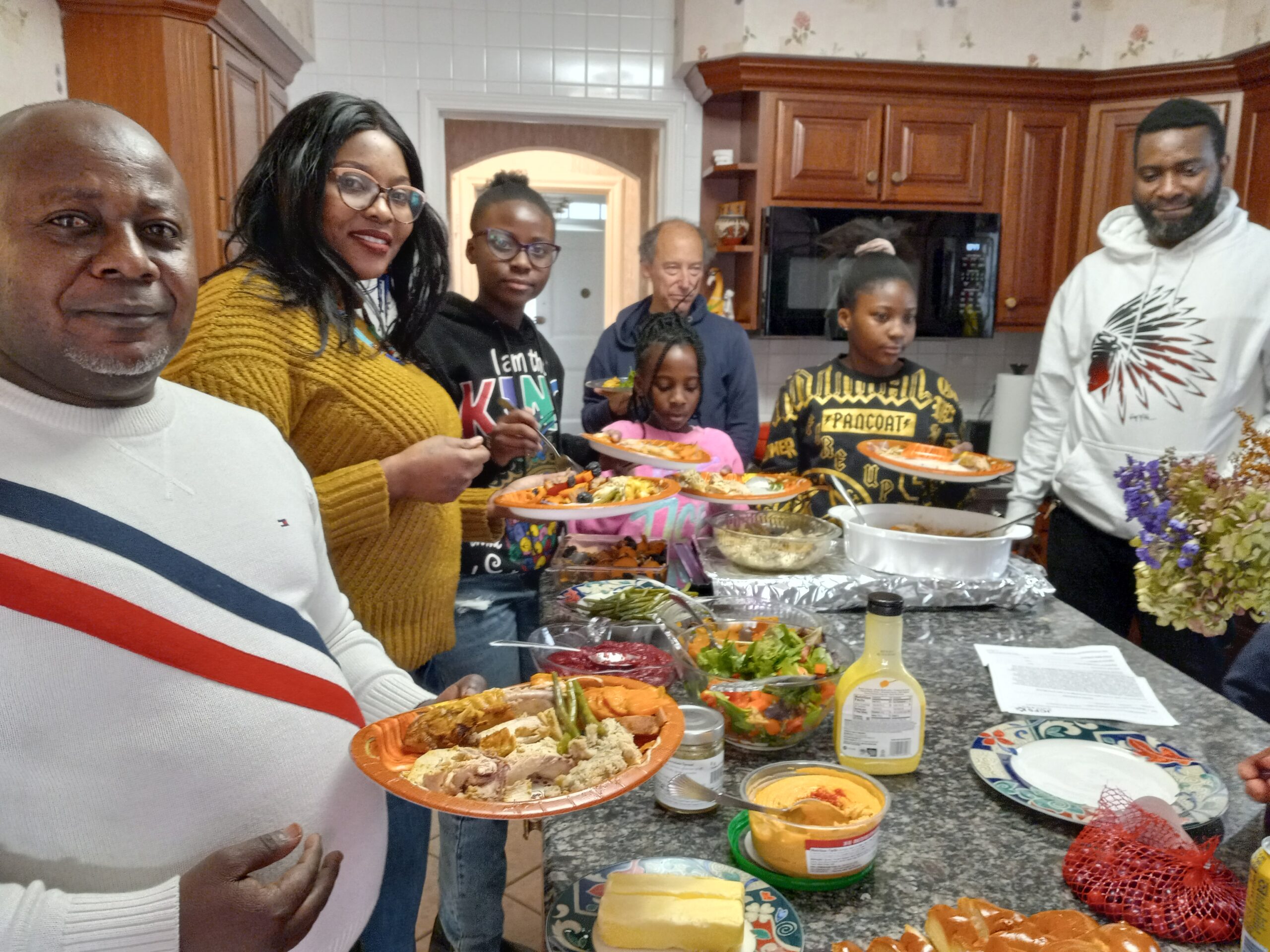
Feeding immigrants and refugees is a value all Chicagoans share
Alison Bell & Heidi Kon
For many refugees rebuilding their lives with support from JCFS Chicago’s HIAS Immigration & Citizenship, food assistance provides stability, dignity, and a sense of security during an uncertain time.
The recent federal government shutdown was a harrowing experience for people facing food insecurity. In November, the Supplemental Nutrition Assistance Program (SNAP)—formerly known as food stamps—lapsed for the first time in American history. For some of the 42 million SNAP recipients, benefits did not resume until the week before Thanksgiving. Many assume that, with the government reopened, life has largely returned to normal for SNAP recipients.
Unfortunately, a potentially more devastating crisis looms. On December 1, new rules governing SNAP took effect, including the outright elimination of benefits for refugees, asylees, and many other legal immigrants on the path to citizenship.
Under these changes, the only non-citizens who remain eligible for SNAP are green card holders, along with certain migrants from Cuba, Haiti, the Marshall Islands, Micronesia, and Palau.
Stemming from the “One Big Beautiful Bill Act (OBBBA)” signed into law earlier this year, the Congressional Budget Office estimates that 90,000 legal immigrants and refugees nationwide will lose the food assistance they depend on each month.
JUF stands at the intersection of the two issues at the heart of this crisis: helping Chicagoans avoid hunger and caring for refugees and other humanitarian migrants. For nearly 50 years, JUF has administered the State of Illinois’ Refugee Support Services Program, supporting the local agencies that carry out the day-to-day work of serving refugees currently, nearly 11,000 refugees annually.
Setting aside the political debates around SNAP, we want to underscore the real-world implications of this policy change: the people affected by these new rules are legal immigrants and individuals fleeing war, political persecution, and other hardships. They have sought safety here, under the long-held values and laws of our country. They include thousands of Ukrainians in Illinois who escaped Russia’s assault on their homeland. Furthermore, despite misinformation circulating in public discourse, undocumented immigrants have never been eligible for SNAP in the first place.
Thousands of legal immigrants and refugees may lose nearly $200 a month in food assistance. Many already face language, cultural, and bureaucratic barriers that make navigating government programs difficult under the best circumstances. Conflicting guidance from the USDA has added to the confusion and chaos, as newly affected households try to understand what these changes mean for them.
To its credit, the state of Illinois has joined a lawsuit that would ensure that all immigrants lawfully eligible for benefits are able to attain them. Further, the Illinois Department of Human Services indicated recently that the state will not, at this time, implement the eligibility changes impacting noncitizens. While this is a welcome development, these vulnerable people nonetheless remain in a highly precarious situation; the state’s decision represents a temporary fix at best, and it remains unclear how the state will pay for those benefits. It also does not resolve the confusion and fear that immigrants and refugees are experiencing.
What can be done?
In this moment of spiraling need, JUF reaffirms our commitment to caring for refugees and immigrants in Illinois with essential services, as do our partner agencies.
The Dina and Eli Field EZRA Multi-Service Center is one example. EZRA operates a client-choice food pantry and the Uptown Café, serving people of all faiths, including immigrants and refugees. EZRA—which has already provided grocery cards and enhanced food bags to help people who lost SNAP benefits due to the shutdown—will conduct workshops to help those impacted by the new eligibility rules navigate the transition.
HIAS Immigration & Citizenship, part of JCFS Chicago, has pledged to match any SNAP benefits stripped from refugees under the new eligibility rules. This commitment extends to every refugee resettled by the agency for one year following the suspension of their benefits, until they either secure permanent resident status, or have their benefits reinstated.
JUF’s commitment reflects not only Jewish value of welcoming the stranger, but also the values we share as Chicagoans and Americans: compassion, opportunity, and the belief that members of our communities should not struggle to feed their families.
This is a moment to remember that many of us are descended from people who once arrived in this country seeking safety and opportunity. But remembering is not enough. Now is the time for each of us to act.
Alison Bell, Ph.D., is the Assistant Vice President for Refugee Services at JUF.
Heidi Kon, LCSW, is the Director of the Dina and Eli Field EZRA Multi-Service Center.
A longer version of this article originally ran in the Chicago Tribune on Dec. 4, 2025.
In this issue
-

This Passover, four more questions
The youngest guests at our seders will likely ask the four traditional questions, but here are four other questions to chew on over matzah this holiday.
Read more -

New Stephen Sondheim biography details the towering figure
‘Walking encyclopedia of musical theater’: New Stephen Sondheim biography details the towering figure
Read more -

Celebrating spring and a crop of new productions
A celebration of Passover, warmer weather, and a crop of new productions
Read more