Finding room for the Fifth Child
PAUL WIEDER
The Seder serves up a few famous “fours:” Four Cups, Four Questions, and Four Children. Today, however, many Seders mention a “Fifth” Child-the one who is not at the table. Why are they missing? The answers, as befitting a Jewish question, are many.
As early as 1957, Rabbi Menachem Schneerson, founder of the modern Chabad movement, listed the Four Children. He then identified “another child: The child conspicuous by his absence from the Seder service, who has no interest in Torah and mitzvot, laws, and customs, who is not even aware of the Seder, of the Exodus… We must make every effort to save that ‘lost’ child, to bring the absentee to the Seder table.”
Recently, blogger Yeruchem Eilfort revisited this letter, suggesting two more potential reasons for the Fifth Child’s absence: “1) They have no place to attend. 2) They do not care to.”
One reason they may be boycotting the Seder? Estrangement from the family hosting it. Author Michael Levin posited in 2021 that the Fifth Child “is the relative who, for whatever reason, we don’t speak to.”
The problem is, he continues, “that everyone’s waiting for everyone else to take the all-important first step.” To break the estrangement, Levin says we should emulate not Moses, but another Passover hero-Nachshon, the first one to wade into the yet-unparted Red Sea: “Nachshon didn’t wait for others to take the first step. He took it, and everyone benefitted.”
Others explain that the Fifth Child is missing from the Seder because they are one of the 1.5 million children who perished during the Shoah. As Eytan Kenter wrote in The Times of Israel in 2020, “…This is a child who is unable to be present, but whose presence is very keenly felt.”
While Kenter refers to the child who is missing because they died, Hasidah, an organization that addresses Jewish infertility, suggests the Fifth Child may be the one who was never born at all.
Reproductive psychologist Julie Bindeman wrote on Hasidah’s website in 2019 that the Fifth Child is: “the child those struggling with infertility are working to create-or the child that almost was, but the pregnancy ended before its completion.”
Writer and artist Gregory Uzelac, however, says that the Fifth Child’s absence may not necessarily be literal. The Fifth Child may be physically present at the Seder, yet not be able to participate on a mental or emotional level. They are there, but they, unfortunately, may feel distant.
The traditional Fourth Child is the one Who Does Not Know How to Ask-Uzelac’s Fifth Child, is “The Child Who Is Not Able to Ask, forbidden from questioning the world around them. A child whose circumstances are totally debilitating.”
Uzelac, arguing for inclusion, offers many reasons for this Fifth Child’s wanting to ask questions, but being blocked from doing so by some external force. He includes those who may have difficulty communicating due to a disability, those made to feel that their input is unwanted due to abuse, and those who are members of marginalized and ostracized groups.
“The Fifth Child was a slave in Egypt and is a slave today,” Uzelac says, “be it to society, their home, or their very bodies. We must ask questions on their behalf and work to free them.”
And then there is attorney Donald B. Susswein who says that one question or comment is not enough for the Fifth Child he envisions. This one needs a whole Seder, he felt-so he wrote one, titled Haggadah for the Fifth Child, published in 2010.
To Susswein, the Fifth Child may call the Seder itself into question, asking: “Did the Exodus really happen? Did God actually talk to Moses?” While the Wicked Child excludes themselves from the Seder, Susswein’s Fifth Child seeks to exclude the whole Passover story from history, and so must be addressed with carefully chosen words.
With the Fifth Child, we have Seder participants who are, respectively: wise, wicked, simple, quiet-and gone. When we repeat the Haggadah’s immortal words, “Let all who are hungry come at eat,” we should also ask what this absent child may be hungry for.
In this issue
-
An ‘awesome’ new fellowship for teens
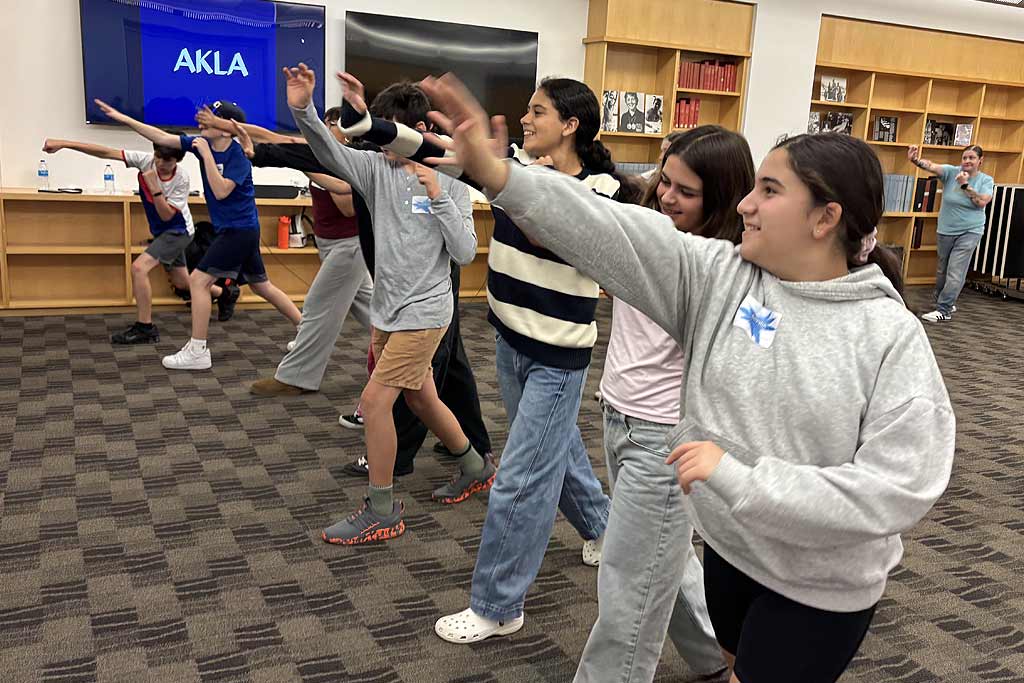
AKLA Chicago will be a free, five-week experiential experience for ages 12–14
Read more -
-