Giving kids a healthy start
JULIE MANGURTEN WEINBERG
How do you get your children off to a healthy start in life? We turned to some experts in our community for guidance. Here are the key areas that require attention, patience, and some creativity!
Sleep
A good night’s sleep can positively impact everyone’s day, but it takes time to get there.
“About 85% of children sleep through the night at age four months,” said Dr. Laurie Hochberg, founding partner of Pediatric Partners, which serves the Chicago suburbs. “But ‘through the night’ is 11 p.m. to 6 a.m.” Some parents think that all kids should sleep from 7 p.m. to 7 a.m. That doesn’t start right away.”
Beyond setting realistic expectations, Hochberg, who has 30 years of experience as a pediatrician, adds that healthy sleep hygiene starts with a routine like “bath, book, bed.”
As kids get older, she recommends offering a transitional object as early as nine months of age. “A ‘lovey’ or a stuffed animal helps them feel secure if parents aren’t in the room,” she explained. Just make sure it’s safe-nothing too big, or having small parts-like plastic eyes or buttons-that could become a choking hazard.
During the toddler years, parents often ask: “What do we do about crying and whining at bedtime?” “Some kids are super scared, and then you do have to sometimes go back in and say, ‘I love you, but it’s not time to get up.’ Avipicking them up out of their beds,” Hochberg advised.
Food & nutrition
When it comes to feeding your child healthy food, don’t stress-and keep trying, advises Robin Goldberg Simon, a certified nutrition and wellness consultant based in Chicago. “A kid may see broccoli and throw it on the floor five times, but the eighth time, maybe he’ll try it. This is natural childhood, and it’s part of the process,” said Goldberg Simon who published her kid-friendly recipes in a cookbook series called
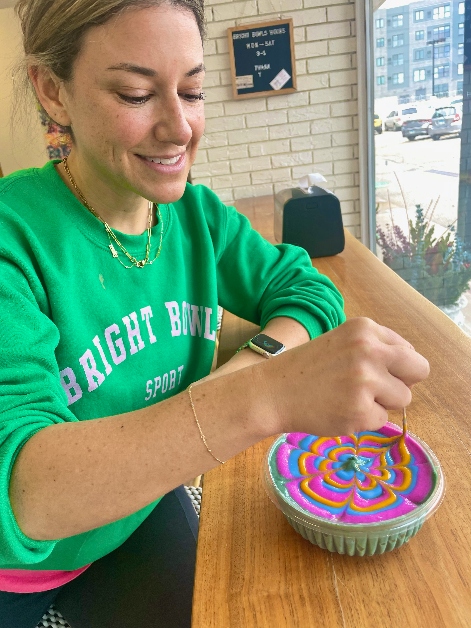
Hidden Veggies .Lindsay Meltzer, owner of Bright Bowls in Highland Park, said a parent’s approach plays a critical role in how a child responds to new foods. “You need to introduce healthy foods the way you would introduce any food. Make it fun,” she said.
This strategy works for her youngest customers, who come in to lap up bowls blended with acai berries, spinach, and cauliflower. If you don’t have time to mix it all up at home, Meltzer suggests getting kids involved in making “rainbow plates” with foods representing various colors.
“Each color has a different benefit. So, it’s not just pretty, it’s actually good for them, and you can explain that to them, too,” she said.
When you speak to your child about food, Simon advises staying away from talking about how food affects weight or labeling different items as good or bad. “It makes broccoli look negative and puts the cupcake on a pedestal,” she said.
As for our traditional Jewish foods, some of which deliver, shall we say, fewer health benefits, Simon acknowledges food provides more than nourishment.
”A lot of Jewish foods are not chock full of vegetables, but there’s a level of enjoyment, tradition, and bonding that comes with holiday foods,” she said. “That, to me, is equally as important as nutrition.”
Movement
“You don’t have to sign up your kid for every sport,” Hochberg said. However, she advocates for getting kids moving at least one hour a day.
Karen Achtman, a certified kids yoga teacher and founder of Pandaste Yoga, offers classes for babies before they even start crawling. While parents get the majority of the workout at that stage by, for example, doing pushups over the baby and kissing with each repetition, everyone benefits from the bonding.
Once kids start to walk, they can actually participate in a yoga class, albeit a class geared for their age.
“There are a lot of props and movements. It’s high energy, and the kids are all over the place,” Achtman said, explaining she also incorporates breathing exercises to help kids calm down. “I teach snippets of emotional regulation in a fun way at a young age, that the kids are going to use throughout their lives.”
Achtman teaches a jBaby yoga class at Congregation Beth Shalom in Northbrook, where she incorporates Jewish music, themes, and holidays. “In December, we spin like dreidels and pose like menorahs,” she said. And for Shabbat, she teaches the little ones to imagine they are baking challah: They twist side to side as if braiding challah and then exhale a deep breath to cool it off as it comes out of the oven.
Screen time
Managing time spent with electronic devices impacts other aspects of healthy living.
“Decreasing screen time increases exercise, improves sleep, and decreases mental illness,” Hochberg said.
She supports the American Academy of Pediatrics’ recommendation of no screen time for kids under two years old. After two, she tells families to limit a child’s screen usage to two hours a day, although less than one hour is preferable for the preschoolers.
Hochberg urges parents to look at their own screen time, as well.
“Parents need to decrease screen time as a model for their children,” she said. She points out that setting aside screens allows for more time for reading and playing games, and fosters better connections at family dinners, which Hochberg notes encourage healthy eating.
If all of this feels overwhelming to a new parent, experts say perfection is not the goal.
“If you’re making a change, you don’t go from zero to 100. Start cooking a little bit more. Start playing games once a week,” Hochberg said, adding, “Turning off the screens makes a big difference.”
Julie Mangurten Weinberg is a Northbrook-based freelance journalist with more than 25 years of experience in broadcast, print, and digital media.