Holiness and Wholeness
REBECCA MINKUS-LIEBERMAN
“What do you want for your children in 10, 15, and 20 years?”
That is the question with which we begin the first class of our Peaceful Parent Project, a mindful Jewish parenting course that we offer at Orot: Center for New Jewish Learning.
We begin with this question to allow parents to step back, recall what this whole parenting journey is about, and to anchor them back to their hopes and dreams. The answers are wide-ranging but often evoke tears: They want their children to be compassionate, kind, loving, tolerant, and generous people.
After reflecting on their dreams for their children, we ask parents to respond to the same questions for themselves: Who do they want to be, as parents and as individuals-today, in one year, in 10 years?
The body of Jewish wisdom-the deep well of texts, teachings, and values that comprise our rich tradition-has no shortage of road signs to point us towards a good life. And yet one central teaching may hold the heart of the answer. Right now in the Torah reading cycle, we find ourselves in the book of Leviticus, a manual of sorts for the priests on the now-obsolete sacrificial system. In between the rites and rituals, we find Parshat Kedoshim, which begins with the following verse:
דַּבֵּ֞ר אֶל־כׇּל־עֲדַ֧ת בְּנֵי־יִשְׂרָאֵ֛ל וְאָמַרְתָּ֥ אֲלֵהֶ֖ם קְדֹשִׁ֣ים תִּהְי֑וּ כִּ֣י קָד֔וֹשׁ אֲנִ֖י יְהֹוָ֥ה אֱלֹהֵיכֶֽם׃
Speak to the whole Israelite community and say to them: You shall be holy, for I, your God יהוה, am holy (Leviticus 19:2).
Kedoshim tihiyu. You should be holy.
Live a life of holiness.
But what does this mean? As expected, there are a myriad of understandings of this verse. But we can turn to Rabbi Yehudah Leib Alter of Ger-also known as the Sefat Emet-a Hasidic rabbi from the 19th century, for one heart-opening commentary.
The Sefat Emet teaches that when this verse is said to the “whole Israelite community,” this does not only mean that it was proclaimed in front of all of the members of the nation. He tells us that this instruction to seek holiness in life is addressed to the whole of a human being-to all of the limbs of her body, to every sinew, every breath, every thought, every pulse of spiritual energy that moves through a person.
In other words, holiness = wholeness. Shlemut. We move closer to holiness when we become aware of the ways in which our minds, bodies, hearts, and spirits are all part of one unified whole. Physical health, mental health, spiritual health, emotional health-these are not distinct, disconnected aspects of our lives. They are one integrated unit, and when we are able to recognize the threads that bind them to one another, we will be stepping towards an understanding of holiness.
So how do we construct a life that is whole and holy?
We begin to see differently, practicing histaklut-deep looking. We notice, with gentle compassion, the parts of ourselves that need more attention. Is it our sense of emotional fulfillment? Our spiritual nourishment? Our mental patterns? Our physical needs? Which parts of our lives are letting us know that they need more care? Are we awake enough to see the pieces that are out of place?
Once we see clearly, we can begin to care for those broken pieces. When we work on our own wholeness, we build our internal storehouses of wellness, patience, lovingkindness, and peace. And when our own storehouses are full, we have what to share with those around us-family members, friends, and colleagues. We are able to show up and give with deeper abundance and presence.
Think of a pebble dropped in a clear pond. The one pebble’s ripples spread outwards in circle upon circle. Our individual wholeness leads to familial wholeness, communal wholeness, social wholeness. And by integrating the disparate pieces of our lives, we elevate all to a place of holiness, reconnecting to the Divine that resides within every part of each one of us.
For more information on Orot: Center for New Jewish Learning, visit OrotCenter.org.
Rebecca Minkus-Lieberman is Co-Founder and Executive Director of Orot: Center for New Jewish Learning, a JUF Breakthrough Fund grant recipient.
In this issue
-
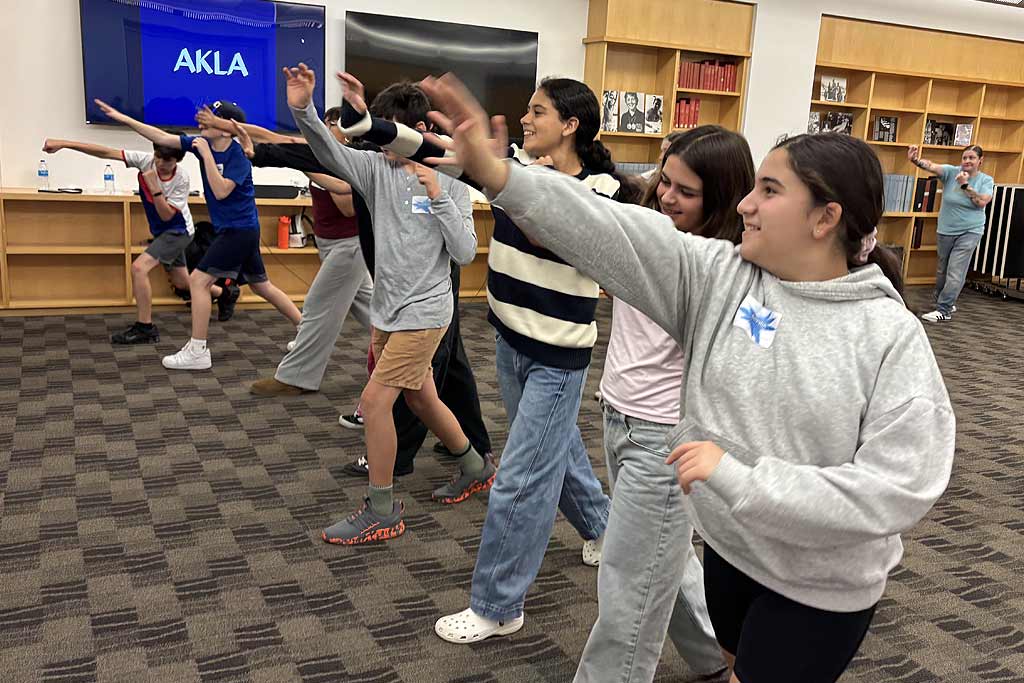
An ‘awesome’ new fellowship for teens
AKLA Chicago will be a free, five-week experiential experience for ages 12–14
Read more -
-