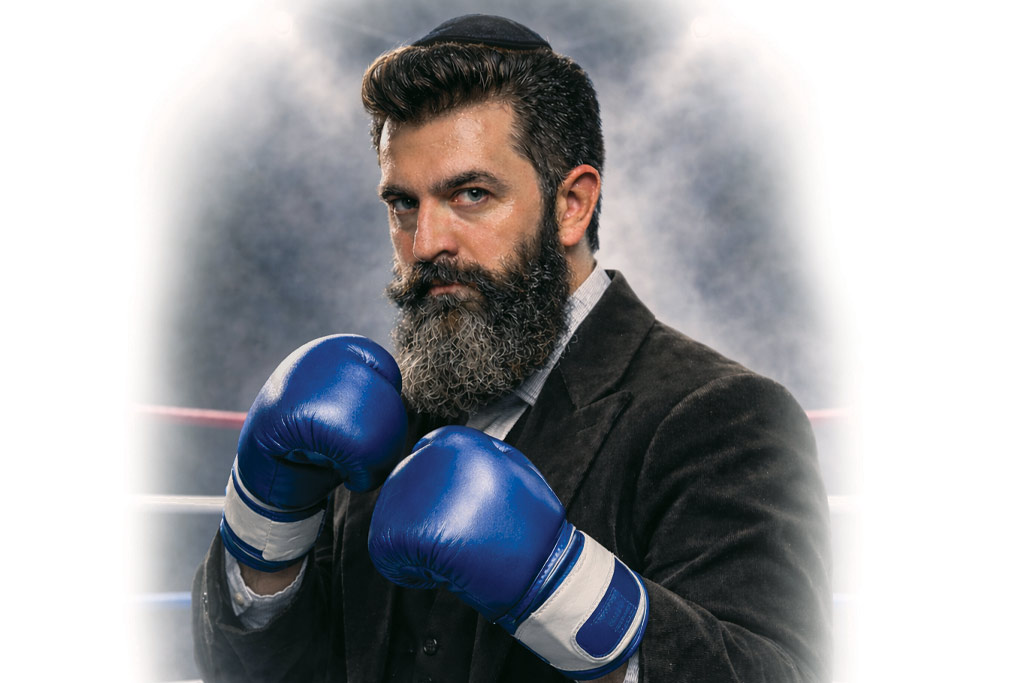
An illustration of Rav Ezra Balser created by his wife, Laura Elkayam, from a real photograph and styled to evoke Theodor Herzl. The blue‑and‑white gloves are a nod to Israel. (Photo courtesy of Laura Elkayam)
While waiting for an early‑morning CTA Blue Line train last summer, Rav Ezra Balser witnessed a violent assault unfold on the platform. After a station attendant was punched in the face, the attendant fell onto the train tracks as a train approached.
Drawing upon situational awareness and physical confidence that he developed over several years of boxing instruction, Balser, who currently serves as the Rabbi of Luba and Bernard Friedman Base Loop in Chicago’s West Loop, immediately intervened, positioning himself between the attacker and the injured attendant to prevent further violence.
Thankfully, the incoming train screeched to a halt just feet from the man. With the help of several bystanders, Balser lifted the victim to safety and remained with him until paramedics arrived. The attendant later recovered from his injuries. “I did the best I could in the moment,” Balser reflected. “One of the reasons why you train [in boxing] is so you can help and protect people.”
Balser’s training recently culminated in his first amateur boxing match in March. Jewish Chicago spoke with him about how he got started in boxing, how Judaism influences his boxing, and his advice for beginners.
Q: Why did you start boxing?
A: Initially, it was a way to get back in shape. I was recovering from hip surgery after a rough injury, which had caused me to sort of let myself go. Then, my younger daughter was born, and I felt like I needed to take my health more seriously.
I got more and more into my training and gym culture. There tends to be a stigma that these gyms can be crazy violent places, but I found it to be quite the opposite. They are incredibly supportive and encouraging places to figure out how to be healthy and take care of yourself. Similarly, there’s an assumption that fighting is a very aggressive, angry thing, but it can be an incredibly intimate experience. I didn’t expect my relationships with the people I was sparring with would become so deep.
As a Jew, I also continuously stive to be more confident in my abilities and protect my family especially in a post-October 7 world.
How does your work as a rabbi influence your fighting?
When you’re fighting another person, you’re helping each other grow and get better. After each round, you give each other compliments on what each other did well and suggest what can be done better.
I’m also in the process of developing a curriculum that is built around Jewish spirituality and religiosity, connecting it to training and fitness. Training is very ritualistic. Putting on the hand wraps before a fight is very reminiscent of putting on tefillin (phylacteries). When you’re warming up, like jumping rope or shadow boxing, it resembles the preliminary prayers. When you’re sparring with somebody, it reminds me of being in the beit midrash (place for Jewish learning) where we are sharpening one another. Iron sharpens iron.
How has your improved fitness impacted your everyday life?
I recently saw a video of myself from several years ago where I was in a swimming pool with my daughter. Obviously, I was a lot bigger, but my eyes looked very tired. It was so much harder for me to do things with my kids. I want to be around for as long as possible and be a good, active parent to my kids. That has been incredibly motivating.
What advice do you have for a first timer who feels intimidated walking into the boxing gym?
Number one, just show up. Everyone was in the same position on their first day. Everyone is fist-bumping each other at the end of class no matter if that was their first class or 100th class. It’s similar to the end of services when everyone shakes hands and says, “Shabbat shalom.” Consistency is important, as well. We’re all supportive of each other, and of each other’s goals.