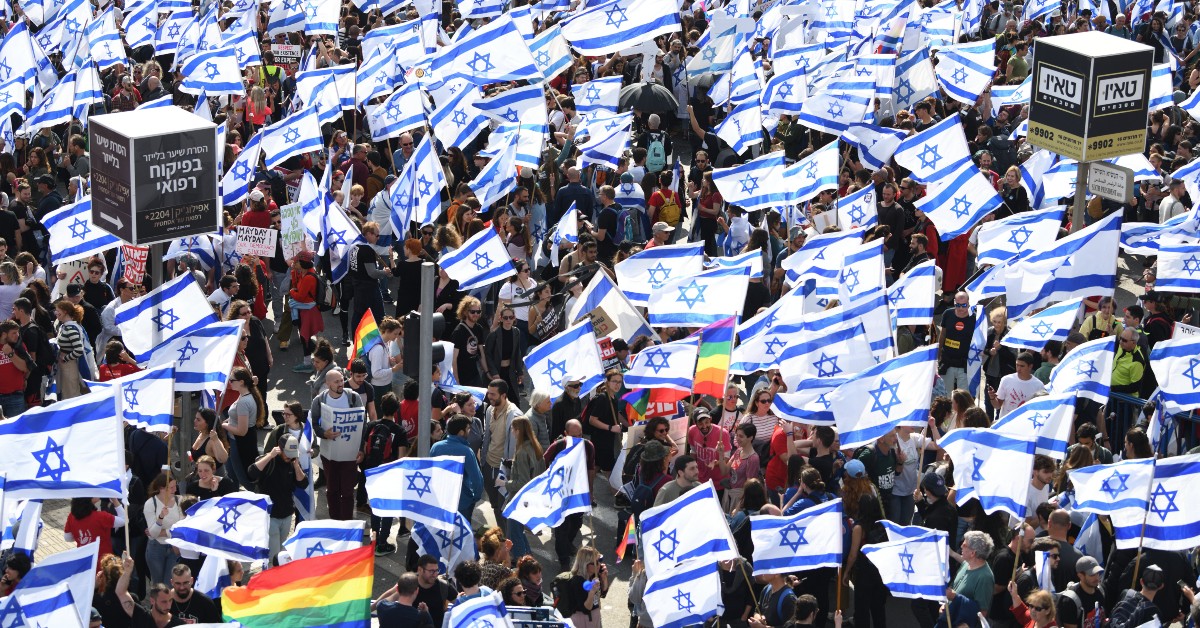
Is Israel’s ‘game’ of Capture the Flag ending?
Ofer Bavly
Daniel Webster famously said, “Let it be borne on the flag under which we rally in every exigency, that we have one country, one constitution, one destiny.” Israelis have one country and one destiny–and no constitution. But the flag under which its citizens rally has had tremendous–and changing–significance over the years.
The modern flag of Israel has in its center the Star of David, a symbol of our people’s Biblical past–though only used as such in the last century and a half. The horizontal stripes at the top and bottom are designed to represent the tallit , as do the blue and white colors, connecting the flag to the Jewish religious garb.
Tiny, clandestine flags were kept by Jews in the ghettoes and concentration camps of the Holocaust, and the same flag flew over the Exodus immigrant ship (now on display at the U.S. Holocaust Memorial Museum, thanks to Chicagoans Bill and Tom Silverstein). Israeli flags were smuggled by my late father into Soviet-era Russia. Others were painted over the transport planes that carried Ethiopian Jews to their homeland in the 1990s.
Since 1897 and after being officially adopted in 1948, the Israeli flag has come to represent many things to many people. For Israelis, it is above all a sacred source of pride in the resurrection and independence of our people after 2,000 years of Diaspora, and a celebration of the achievements of the young state. It unites us in the way described by Daniel Webster.
But it is also used to cover the coffins of our fallen soldiers, a last rite of honor for those who have given their lives for the nation. It is on the uniforms of our soldiers and police, and a red version of the Magen David adorns our life-saving ambulances.
In the ’80s and ’90s, and well into the 2000’s, the flag has been used in political ads, usually by the Likud party and other parties on the right side of the political rainbow.
For many Israelis, the flag came to represent not only the state, but more specifically a certain political side of our society. But the recent protest movement sweeping the country, standing against the proposed judicial overhaul, has triggered an interesting phenomenon.
From the start, the protest organizers– coming from many different organizations– have decided that rather than use many different flags to represent their organizations and competing for attention, all participants will rally under the Israeli flag.
Historically, on “flag day,” thousands of right-wing marchers carry flags through the streets of the Old City of Jerusalem. Now, the flag has been–for lack of a better term–appropriated (or re-appropriated) by the protest movement, which hands out thousands of flags to protesters every Saturday night. The resulting image is striking: Hundreds of thousands of Israel flags cover the streets at every weekend demonstration, reminding us of the words of James Bryce, early 20 th century British Ambassador to the US:
“Patriotism consists not in waving the flag, but in striving that our country shall be righteous as well as strong.”
The Protesters’ reclaiming of our national symbol reflects their embrace of Israel’s founding ethos, unlike in many countries where protesters seek to demolish their nation’s foundations. With both the protesters and supporters of the judicial reform proudly flying Israel’s flag–on both sides’ demonstrations–the debate can focus on the merits of ideas and not on who is or isn’t a patriot.
The flag, with its Star of David and two blue stripes, again represents all Israelis.
Ofer Bavly is a JUF Vice President and the Director General of the JUF Israel Office.
In this issue
-
This Passover, four more questions
The youngest guests at our seders will likely ask the four traditional questions, but here are four other questions to chew on over matzah this holiday.
Read more -

New Stephen Sondheim biography details the towering figure
‘Walking encyclopedia of musical theater’: New Stephen Sondheim biography details the towering figure
Read more -
Celebrating spring and a crop of new productions
A celebration of Passover, warmer weather, and a crop of new productions
Read more