‘It’s always good to stand up for the underdog’
Donald Liebenson
March 9, 1968, Vietnam. First Lieutenant Jack Jacobs and his unit were ambushed by a Viet Cong battalion. Jacobs coordinated air and artillery support before he was wounded in the face so grievously that the blood from his forehead limited his vision. But compelled by the words of Rabbi Hillel the Elder-“If I am only for myself, what am I? And if not now, when?”-he pulled 14 men to safety under intense enemy fire. By the time he ultimately left Vietnam, he was one of the most decorated soldiers of the war.
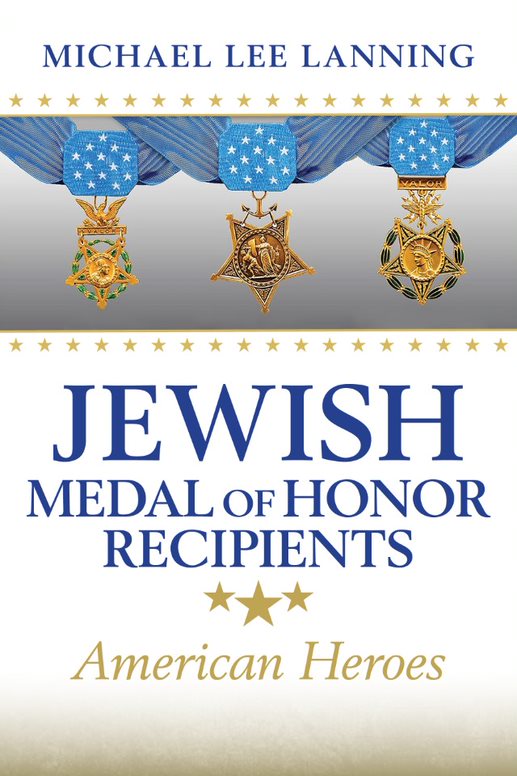
Jacobs’ is just one of the inspiring stories featured in Michael Lee Lanning’s new book Jewish Medal of Honor Recipients: American Heroes (Texas A&M University Press), a celebration of Jewish service members whose extraordinary actions and self-sacrifice in combat earned them this country’s greatest military honor.
Lanning, himself a 20-year military veteran and recipient of the Bronze Star Medal for Valor, is a prodigious author of non-fiction books about the military, including his own memoir, The Only War We Had: A Platoon Leader’s Journal of Vietnam .
His latest book– which hits shelves March 28– contains the official citations and biographical profiles of 17 Jewish Medal of Honor recipients, along with three recipients who are likely Jewish, but not confirmed, nine who are possibly Jewish, and four who were Medal of Honor recipients, but incorrectly identified as Jewish.
It is his hope, he told Jewish Chicago in a phone interview, that young people in high school or college and who are thinking about the military, can gain an understanding of Jewish veterans’ contributions. “There’s a quote in the book: ‘The Medal of Honor is an award that nobody seeks.’ What that means is that these soldiers were doing what they felt they should do,” he said.
Lanning is not Jewish. He was born and raised a Protestant, but Vietnam caused him to question his faith. He was drawn to write about Jewish soldiers, he said, because Jews, throughout history, have been underdogs, “and it’s always good to stand up for the underdog.”
The soldiers he writes about represent diverse backgrounds, but have in common “an uncommon valor that typifies service. And they fought for freedoms they weren’t always allowed to enjoy,” he says.
Jewish Medal of Honor Recipients spans primarily the Civil War, the Indian Wars, World Wars I and II, the Korean War, and Vietnam. Jews, Lanning writes, “have been an integral part of the American military since before the United States won its independence… Since colonial times, Jews have served in the U.S. military in numbers that represent a higher percentage than their percentage of the overall population.”
To gather their stories, Lanning consulted the National Museum of American Jewish Military History in Washington, D.C. and the Congressional Medal of Honor Society.
Benjamin Levy was the first and, at age 20, the youngest Jewish American to receive the Medal of Honor. His citation reads: “This soldier, a drummer boy, took the gun of a sick comrade, went into the fight, and when the color bearers were shot down, carried the colors and saved them from capture.”
During World War II, military dog tags officially recognized three religions: C for Catholic, P for Protestant, and H for Hebrew. More than 550,000 Jewish men and women enlisted to fight in World War II. Roughly 1,100 were killed and 40,000 wounded. In addition to the Medal of Honor, 157 received the Distinguished Service Cross, and 1,600 earned the Silver Star.
Lanning quotes Gen. Mark W. Clark, commander of the United States Fifth Army in Italy, who said, “To American soldiers of the Jewish faith goes my most sincere thanks for their faithfulness, diligence, and bravery in battle. To those who have passed on must go a nation’s gratitude.”
Donald Liebenson is a Chicago writer who writes for VanityFair.com, LA Times , Chicago Tribune , and other outlets.
In this issue
-
An ‘awesome’ new fellowship for teens
AKLA Chicago will be a free, five-week experiential experience for ages 12–14
Read more -
-