Jewish? Off to college?
Robert Nagler Miller
“Are you a Zionist?”
“Do you equate Zionism with colonialism and apartheid?”
“Are you part of the privileged Jewish class?”
Even before October 7, these questions, and others like them, have been bandied about American college campuses, leading many Jewish students to report a dramatic uptick in antisemitic and anti-Israel activities at their schools.
How can students–and their parents–address this problem?
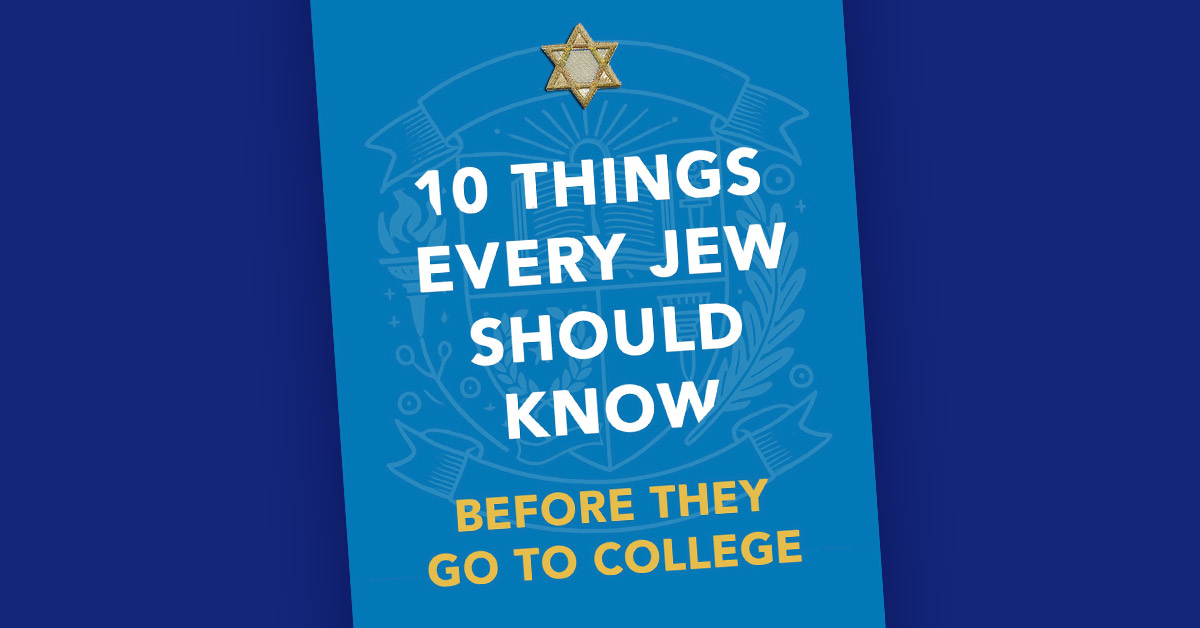
Noted Los Angeles-based artist Kimberly Brooks quickly sought to respond in the most thoughtful way possible. She called in the troops–two young Jewish journalists, Emily Schrader and Blake Flayton–and collaborated with them on the just-released 10 Things Every Jew Should Know Before They Go to College (Griffith Moon), a highly accessible primer of sorts that serves as an equivalent to the Everything-You-Wanted-to-Know-About books of the 1960s and 70s.
Through illustrations, by Brooks, and annotated, encyclopedia-like entries written by Schrader and Flayton, readers are armed with facts so that they can respond calmly and clearly when they hear distortions and misinformation or have up-close-and-personal encounters with antisemitism.
The book is organized into chapters that cover, among other topics, the history of the formation of Israel, the geopolitics of the Middle East, easily identifiable antisemitic tropes, and the ways students can safely navigate political minefields. It was the brainchild of Brooks, who said that she began detecting anti-Israel and anti-Jewish rhetoric during the COVID lockdown. She would be in online portals, where, she said, “verbal fistfights” about Israel broke out during forums that were supposed to be about art and culture.
“I had not been aware of the kind of antisemitism in the arts community,” she said. “I was floored.”
She approached Schrader and Flayton, whose work she had followed, and the three put their heads together to produce a book that, while intended for young adults headed off to higher education, could be dipped into by anyone seeking to respond to inflammatory statements about Jews and Israel.
“The book took several years to complete,” said Schrader, based in Tel Aviv, where she works for Jewish News Syndicate and Ynet news services, and it had to be “significantly revised given the rapidly changing events” following October 7.
Schrader, who made aliyah a decade ago to attend graduate school, said she only became involved in Israeli issues at her undergraduate alma mater, the University of Southern California, “after the Students for Justice in Palestine held their ‘apartheid week'” during which they targeted “Jewish organizations and students…at one pointing even kick[ing] out Jewish leaders from a publicly advertised meeting on BDS (boycott, divestment, sanction) due to their ‘views’ before anyone spoke.”
Flayton, who also moved to Israel, in 2022, said he did so “after witnessing the antisemitism on my college campus and in left-wing progressive spaces, spaces in which I had always felt comfortable.”
A graduate of George Washington University, Flayton penned, when he was a sophomore, a major New York Times
opinion essay “On the Frontlines of Progressive Anti-Semitism” in which he said, “I am a young, gay, left-wing Jew. Yet I am called an ‘apartheid-enabler,’ a ‘baby killer,’ and a ‘colonial apologist.'”
The 2019 op-ed received much play, but it left Flayton despairing.
“After its publication, I felt alienated from my peers and classmates and from the spaces where my opinion was once valued and celebrated.”
It made him realize, he said, how urgently the book he co-authored was needed.
He, Schrader, and Brooks all agreed that they should eschew taking sides in political conflicts and adhere to the verifiable information. They strove, said Schrader, to “offer multiple perspectives on complex issues…because Zionism and a love for Israel aren’t left-wing or right-wing concepts. There is room for a variety of viewpoints.”
Robert Nagler Miller is a journalist and editor who writes frequently about arts- and Jewish-related topics from his home in New York.
In this issue
-
An ‘awesome’ new fellowship for teens
AKLA Chicago will be a free, five-week experiential experience for ages 12–14
Read more -
-