Light, glass, and memory
Alanna E. Cooper
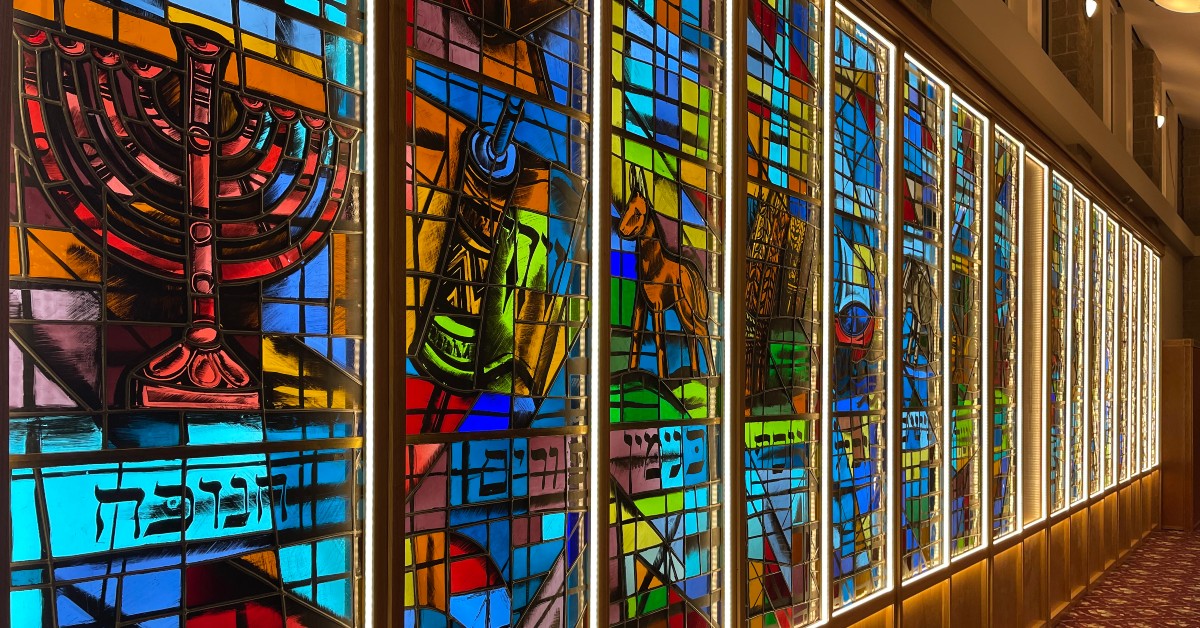
Northbrook Community Synagogue’s cavernous sanctuary seats 1,200. Blank and non-descript, the hall feels sterile. “Like a hospital,” reported synagogue member Jerry Orbach. Yet, the building’s vast stretches of empty walls also provide a benefit; they accommodate Orbach’s obsessive habit of collecting stained glass windows.
Over the past decade, he has filled the space with the self-proclaimed, “only repository of synagogue stained glass in the world,” personally covering all expenses in addition to spending hundreds of hours on research, coordination, and physical labor.
On Sunday, Nov. 20, there will be a dedication and open house–called “The Jewish Experience: A Perspective in Stained Glass Over the Last 100 Years”–at the synagogue. The permanent and growing collection of Jewish-themed stained glass has been gathered from various local and national synagogues that were no longer Jewish facilities.
I connected with Orbach through research for my forthcoming book, Disposing of the Sacred: America’s Jewish Congregations (Pennsylvania State University Press). He is a storyteller who regales with tales of acquisition: How he identified the windows, procured them, transported them, and had them reinstalled in his own synagogue.
The first set came from Kehillat Jeshurun, the Albany Park synagogue Orbach’s family attended while he was growing up. When Jews moved out of the area after World War II, the building was bought by a church. Orbach kept his eye on it and decades later returned to tour the building.
He was struck by the stained glass, which had remained intact. “I had my bar mitzvah under these windows. I got married under them,” he told me, explaining his emotional connection and how he came to arrange a trade with the church congregation. He had the stained glass removed, and replaced them with new panes, decorated with Christian iconography more suited for the church.
Unlike Kehillat Jeshurun which sold their building, Mikro Kodesh Anshe Tiktin in Peterson Park was razed after the congregation dissolved in 2004. When Orbach received news of the building’s impending demolition, he rushed to hire a crew to remove the windows. “We put up scaffolding,” and within no time, “we were pulling out the windows from the front while the building was being torn down in the back. I was terrified. The wall was crumbling as the windows were coming out.”
While Orbach once focused on windows in Chicago’s bygone Jewish neighborhoods, he’s now broadened his attention to synagogues across the country. In 2020, he acquired a set from B’nai Israel in Saginaw, Mich., and this year he procured another set from Ahavath Israel in Kingston, N.Y.
What motivates his collecting? “They are beautiful,” Orbach offered simply. But what exactly is beauty? In his famous essay “Unpacking my Library,” German Jewish cultural critic Walter Benjamin describes what it is like to watch a collector handle his objects. “He seems to be seeing through them into the distant past as though inspired.”
Indeed, Orbach looks far beyond the surface of the glass, to see what it holds: “The history of the shul that’s gone,” he explained. “If you remember the shul , you are remembering all the people who were there.”
Once Orbach has the windows removed from the original spot for which they were designed, he has them encased in wood cabinets and electrically wired to be lit from behind. In their new form, they are sculptures of light, glass, and memory. Plaques installed beside each set tell the history of the congregation whose building they once adorned.
“You’ve created a genizah for stained glass,” I suggest, referring to repositories of documents that are no longer useful but that cannot be thrown away because of their sacred status. Found later, such items have served as important primary sources for historians writing the stories of communities that are gone. “It’s a living genizah,” Orbach corrects me; it holds the past while mingling with prayers of the living.
For more information on the dedication and open house on Nov. 20 from 3 to 5 p.m. at Northbrook Community Synagogue, visit ncshul.com or call 847-509-9204. The exhibition is free and open to the public.
A longer version of this story originally ran in AJS Perspectives: The Magazine of the Association for Jewish Studies .
Alanna E. Cooper, Ph.D., is the Abba Hillel Silver Chair in Jewish Studies at Case Western Reserve University. Her forthcoming book is titled Disposing of the Sacred: America’s Jewish Congregations (Pennsylvania State University Press).
In this issue
-
An ‘awesome’ new fellowship for teens
AKLA Chicago will be a free, five-week experiential experience for ages 12–14
Read more -
-