Lily Kanter: A household name in home furnishings
Robert Nagler Miller
Entrepreneur and philanthropist Lily Kanter is known in giving circles for her support of Jewish and Israeli organizations, particularly those that support on-the-ground, grassroots efforts to provide direct aid to individuals and countries in dire need. For her charitable and civic contributions, Kanter has been recognized by Time and Town & Country magazines and received many honors, including the bestowal of a Wexner Heritage Fellowship.
Kanter also became a household name almost 20 years ago with her home furnishing design shops Serena & Lily, which she co-founded with designer Serena Dugan. Since then, Kanter, who early in her career held high-level positions at Microsoft and Deloitte, has ventured into an innovative enterprise, Boon Market, that combines the sale of eco-conscious consumer products with online charitable giving. For the past 10 years, she has also served as a guest lecturer at the Stanford Graduate School of Executive Education.
Jewish Chicago: The JUF Magazine recently chatted with Kanter, who headlined JUF’s Women’s Philanthropy Grand event this past February, about her manifold interests–including design, business, technology, and Jewish philanthropy–and their origins, which date back to her Jewish childhood in the Midwest.
Jewish Chicago : Serena & Lily is known for its stylish, beachy, California vibe, combining casual and classic lines and styles. Did you always want to get into the design world?
Lily Kanter: When I was a kid, I loved drafting. I thought I might be an artist or architect. I have always had an interest in design and aesthetics. But a certain level of financial success allowed me to pursue this as an adult. When I had my first child, I struggled to find things for my baby’s nursery. I saw a void in the market.
So, you opened your first store, Baby & Kids Company, in Marin County, where your family lived for many years?
Yes, and that led, after I met Serena Dugan, to the establishment of Serena & Lily. Serena has had a huge influence on my life. We traveled the world together–Morocco, India, and Zanzibar, among other places–and she trained my eye. She has a beautiful sense of unique color combinations.
In 2018, you started up Boon Market. What prompted you to do so?
I am interested in the notion of reimaging capitalism, leveraging the power of commerce [to promote the greater good]. I was inspired by Bono [who partnered with companies] to raise funds for AIDS. So far, we have given back $102 million to charities through Boon Supply. Forty to 50 percent of our revenue goes directly to these organizations.
The idea of giving back is nothing new to you, of course. You started a charitable foundation with your husband, Marc Sarosi, years ago, but you credit your family for your interests in tzedakah and tikkun olam. Would you elaborate?
I grew up in Kansas City, Mo., where my family has serious Midwest roots. My late father, Arnold, also grew up there. My late mother, Lee, was originally from Omaha. Both of my parents devoted their lives to helping other people. My father was a physician and ran the Kansas City public health department, and my mother taught public school in a very disadvantaged area of the city. They were very much about opening the doors to others, including Soviet Jews.
My father instilled in me a very serious dedication to the continuity of the Jewish community. I went to Kansas City’s Hebrew Academy for many years [in Overland Park, Kan.]. As a family, starting in 1973, we would travel every summer to Israel. My father would say, “The civilization is tiny, but the flame has never gone out.” So, the preservation of our peoplehood has always been important.
Immediately following the 2022 Grand Event formal presentation featuring Lily Kanter, employees of Boon Market led breakout discussions about several of the company’s initiatives. Participants had the opportunity to shop-with purpose-at Boon, with 40% of each sale donated to JUF.
Robert Nagler Miller is a journalist and editor who writes frequently about arts- and Jewish-related topics from his home in Chicago.
In this issue
-
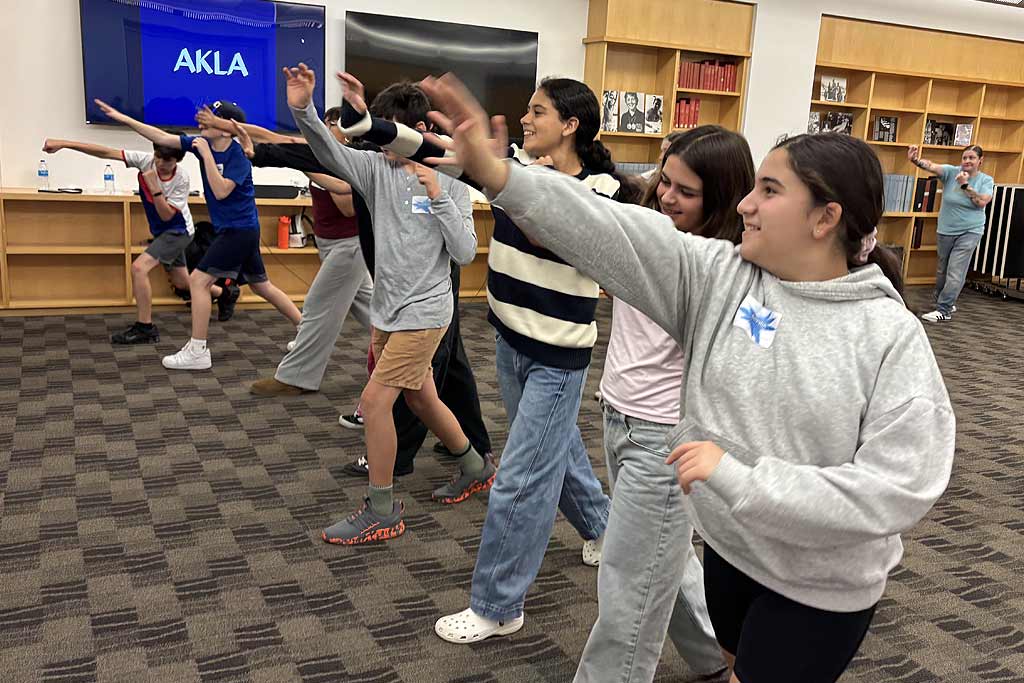
An ‘awesome’ new fellowship for teens
AKLA Chicago will be a free, five-week experiential experience for ages 12–14
Read more -
-