Mediation program eases divorce settlement
Aaron B. Cohen
Couples seeking divorce may embark on a long road, which can be paved with bitterness and lead to financial ruin. While a divorce is unavoidably painful, the suffering can be mitigated. To that end, the Beth Din (rabbinical court) of the Chicago Rabbinical Council (cRc) initiated a dedicated divorce mediation service.
The goal of the service, now in its third year, is to guide couples to mutual agreement without expending enormous resources of time, money, and emotional well-being–especially that of their children.
“The human and communal cost of protracted dispute, the financial and emotional toll, and the long-term damage to children can be traumatizing,” said Rabbi Levi Mostofsky, cRc’s Executive Director. “We’re not a social service agency and don’t plan to become one, but we saw an opportunity to do good, and to leverage our legacy services to better improve peoples’ lives.”
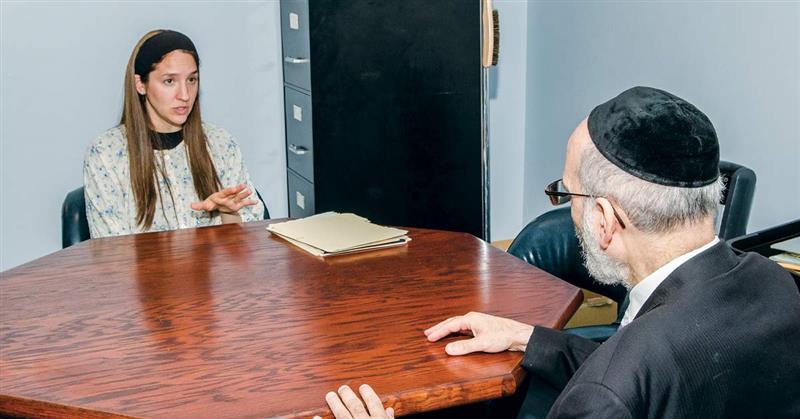
For a modest fee, the cRc employs a neutral staff mediator to facilitate negotiations. The process guides the couple to a consensus, which can be filed in Civil Court, according to Elana Lipman, Esq, Director of Divorce Mediation.
The Beth Din can also facilitate a Get , a Jewish legal document that formally dissolves a marriage. (A civil divorce under state law also is required to complete a divorce.)
“Divorce mediation is designed to be far less costly and time-consuming than court proceedings, and less contentious than going to trial, resulting in a healthier resolution for the parties and the entire family moving forward,” said Lipman, who received her law degree from Cardozo School of Law at New York’s Yeshiva University, and is licensed in Illinois.
“Mediation is voluntary, and not required in order to receive a Get or for legal divorce in Civil Court,” she explained. “If the parties can’t come to an agreement voluntarily, resolution of differences shifts to arbitration of the Beth Din . The arbiter, or arbitration panel, would then be tasked with making a binding decision to resolve differences.”
Rabbi Yona Reiss, Esq., the Av (Head of) Beth Din
, received his law degree from Yale Law School, where he was a senior editor of the Law Journal. Reiss, a Torah scholar and jurist, has worked with numerous communities to assure that the work of their Beth Din will be respected by the American court system.
The cRc’s Divorce Mediation active case load has grown 500% in the past two years. The cRc is working to find funding support to expand its capacity to serve more families.
While cRc is prominent within the Orthodox community, Mostofsky wishes to change the perception that cRc’s services are exclusive. “We’d like to bring all elements of the Jewish community closer; to that end, the cRc has developed a few programs–such as divorce mediation–that have generated interest in the larger community,” he said.
This approach is consonant with the desire of many non-Orthodox Jews to follow Jewish law in areas such as lifecycle events for both personal and pragmatic reasons. For example, a divorced person who moves to Israel and wishes to remarry there will need a recognized Get
.
Overcoming stereotypes is part of the work of engaging Jews of varying observance in a program that can benefit them, according to Mostofsky. “Sometimes Jewish law is mistakenly seen as restrictive, coercive, and regressive. Many Americans want to move past the tradition. But tradition represents something that can be highly supportive of people, especially at a time of stress,” he said.
Ultimately, cRc staff strive to support community members at a stressful time. “Sensitivity, collaboration, transparency, and respect among all parties results in a healthier resolution for the couple, the family, and the entire community moving forward,” Mostofsky said. “That’s our goal.”
To learn about divorce mediation at the cRc, email Elana Lipman at [email protected].
Aaron B. Cohen, a freelance writer living in Evanston, is the former Vice President of Communications at JUF.
In this issue
-
An ‘awesome’ new fellowship for teens
AKLA Chicago will be a free, five-week experiential experience for ages 12–14
Read more -
-