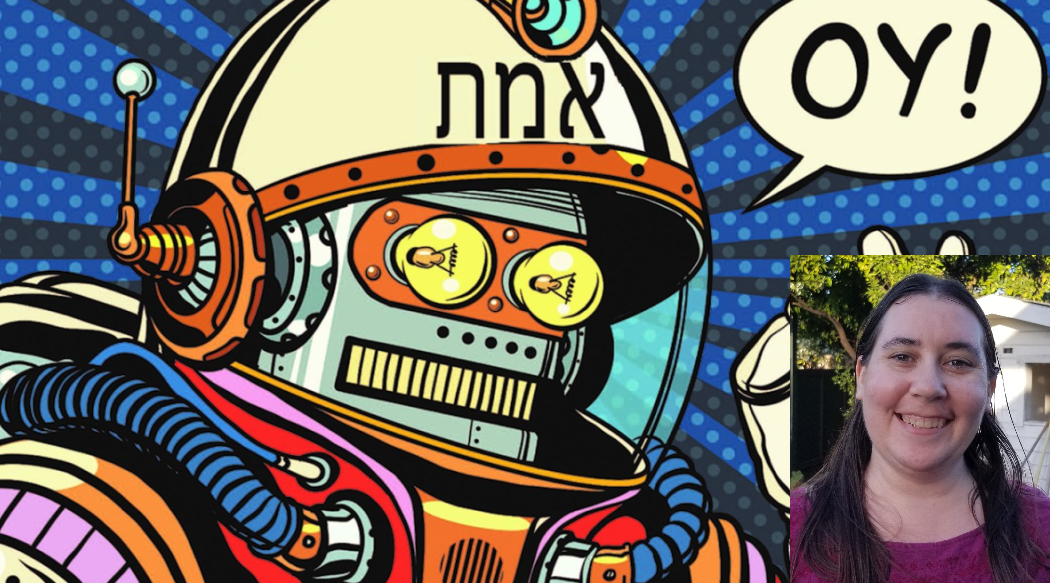
New book explores Jewish influence on science fiction and fantasy
DONALD LIEBENSON
This we do not know, but according to a new book on Jewish science fiction and fantasy by Valerie Estelle Frankel, Mary Shelley’s iconic 1818 mash-up of science fiction and horror is believed to have been influenced by Jewish folklore of the golem.
Frankel’s meticulously-researched and — wait for it — out of this world book, titled Jewish Science Fiction and Fantasy Through 1945: Immigrants in the Golden Age (Lexington Books), takes sci-fi and fantasy scholarship boldly where it has seldom gone before. The book explores Jewish influences and hidden Jewish messages, not only in popular books and films, but also lesser-known works waiting to be re-discovered. Mel Brooks never delivered on his History of the World Part II teaser of “Jews in Space” (although he did give us Spaceballs ), but this is the next best thing.
It is widely known, for example, that Superman ‘s creators were Jewish, and that Leonard Nimoy’s iconic Vulcan hand salute on Star Trek was based on the Kohanim priestly blessing. But as Frankel pointed out in a phone interview, the first modern novel written in Hebrew, Revealer of Secrets , published in 1819, has science fiction elements, including descriptions of a device that records what people say and plays it back.
In 1926, Hugo Gernsback, a Jewish Belgian immigrant, created the first science fiction magazine, Amazing Stories . Along with Jules Verne and H. G. Wells, he is referred to as the “Father of Science Fiction.” The Hugo Awards, the annual prizes presented at the World Science Fiction Convention, are named after him.
“There’s cool stuff out there that people haven’t been aware of,” Frankel said.
Frankel is a prolific author (and reader; she reads a novel a day, she says) who writes voluminously about popular culture. She is perhaps best known for her books about the “Heroine’s Journey,” exploring symbols and themes in such blockbusters as Hamilton , Dr. Who , The Hunger Games , and Game of Thrones .
How did Jewish science fiction and fantasy get on her radar? She is a lifelong reader of mythology and fairytales, she said. Star Trek: The Next Generation was her gateway to science fiction. “I’ve always known there were some cool Jewish fantasy authors,” she said. “I’d always enjoyed Jane Yolin. As everybody says about representation, ‘I enjoyed seeing myself in this.'”
Frankel sees a link between science and Judaism. “Judaism has always been pro-questioning and pro-understanding,” she said, “trying to figure out how the world worked as a path to become closer to god.”
Science fiction offered fertile opportunity to metaphorically explore themes of antisemitism. Like aliens from other worlds, Jews were treated with fear, suspicion, and hostility. “Some Jews,” she writes in her book, “battled the stereotypes through satire and dystopia… Russian fiction was largely realistic, but Jews there protested their treatment using imagery from the Bible, the supernatural realm, and Greek myth.”
Frankel writes of Lazar Borodulin, who is said to have written the first Yiddish science fiction novel, Af yener zayt Sambatyon (On the Other Side of Sambatyon River), which presents the lost world genre from a Jewish perspective.
Science-fiction and fantasy, Frankel said, “work well for criticizing the system.”
As Frankel writes in her book, one reason why Jewish writers of science fiction and fantasy flourished in such entertainment mediums as films and comic books is because many other professions did not hire Jews. “The doors to these relatively new industries weren’t closed,” she said.
Frankel plans to follow up her book with a sequel that would end in 2000. She hopes readers of this initial volume “see how big an influence Jews had on forming this genre, and also the cool stuff they can read. It’s a celebration of all the books and shows that are out there.”
Donald Liebenson is a Chicago writer who writes for VanityFair.com , LA Times, Chicago Tribune , and other outlets.
In this issue
-

This Passover, four more questions
The youngest guests at our seders will likely ask the four traditional questions, but here are four other questions to chew on over matzah this holiday.
Read more -
New Stephen Sondheim biography details the towering figure
‘Walking encyclopedia of musical theater’: New Stephen Sondheim biography details the towering figure
Read more -

Celebrating spring and a crop of new productions
A celebration of Passover, warmer weather, and a crop of new productions
Read more