Performances for the Age of Uncertainty
Hedy Weiss
For a while this past fall it seemed as if live performance was finally making a wonderfully exuberant but extremely cautious return. Then came “the variant,” along with endless testing, many cancellations and postponements of openings, and a return to uncertainty.
Although some performing arts companies-and their actors, dancers, and musicians-have managed to forge ahead, many have had to reschedule their plans. And box office staffs have been receiving record numbers of phone calls from ticket holders who must rejigger their calendars. Along the way, some arts enthusiasts have even opted to temporarily return to virtual alternatives. But hope springs eternal. So here is a sampling of events for those who are fully vaccinated, willing to wear masks, and determined to support “live” arts and entertainment.
The initials RBG hardly need explanation. And if you preface them with the word “Notorious”- the moniker that was playfully appended to her name in 2013 to suggest she was a legal “rap star” for her dissenting opinion in a case that voided crucial elements of a Voting Rights Act dating from 1965-you will have no doubt that the woman in question is Ruth Bader Ginsburg, only the second woman to be appointed as a U.S. Supreme Court Justice, and the first female Jewish justice in its history.
Ginsburg, who sat on the bench from 1993 until her death, at the age of 87, in 2020, is now the focus of When There Are Nine, a play by Sally Deering receiving its world premiere production at the Pride Arts Center, 4139 N. Broadway, where it will run through March 13.
“At the suggestion of PrideArts’ David Zak, I began writing about RBG very shortly after her death, but originally thought it might be a screenplay for a short film about this woman who was such an icon, such a supporter of gender equality, and a great deal more,” said Deering during a recent chat. “But it turned into a play-what I call ‘a dream play’-in which she goes in and out of her life story during the last days before her death from cancer, and she thinks about her successes and failures, her 56-year marriage to Martin Ginsburg, her personal and professional relationships, and the death of her own mother when she was just 17 and about to graduate from high school in Brooklyn before heading off to Cornell University. Her mother never got to see her many successes.”
“I’m not Jewish, but I learned that RGB died on Rosh Hashanah, and that one of the themes of that holy day is that very righteous people die at the end of the year because they are needed until the very end,” Deering noted. “Such people were called ‘tzadik,’ a title given to the righteous and the saintly.”
“RBG grew up through hard times-the Depression and World War II, and the many years when opportunities for women were very limited. And she had a compassion for others-a true belief in ‘justice for all’.”
Deering’s play stars Talia Langman as RBG, Gabriel Estrada as her husband, Marty Ginsburg (who Deering describes as “the great nurturer in her life”), Nicholia Q. Aguirre as Gabby (RGB’s substitute caretaker for the day), and an ensemble of seven other actors who play multiple roles.
“Of course these actors, directed by Sam Hess, are of a much younger generation,” said Deering. “But what was looked for in the actress playing RGB was mostly an innate sense of empathy-someone who could move in and out of dreams, switching both physically and emotionally from young to old.”
Aside from her legal work, Ginsburg was a lifelong fan of opera-a passion she shared with her decidedly conservative colleague on the bench, Antonin Scalia, who also happened to be her very good friend. In fact, in 2009 she even appeared in a speaking role in a production of Donizetti’s La Fille du Regiment at the Washington National Opera, and in 2015 she attended Scalia/Ginsburg, Derrick Wang’s comic opera about their unlikely friendship.
Deering regrets that she never met Ginsburg, but when asked if there was one question she might have asked her it was this: “How can we save our country?”
“It makes me cry that we don’t have her wisdom and guidance now,” said the playwright.
For tickets, visit pridearts.org or call 773-857-0222.
Reminders of the Jewish legacy of Broadway musicals and Hollywood films
Beginning in the late 1920s, and on through the 20th century (and beyond), the scores of Broadway musicals and Hollywood movie soundtracks were overwhelmingly the work of Jewish composers and lyricists. Consider this list: Jerome Kern, Irving Berlin, George and Ira Gershwin, Lorenz Hart, Richard Rodgers and Oscar Hammerstein II, Kurt Weill, Leonard Bernstein, Alan Jay Lerner, Sheldon Harnick and Jerry Bock, Jule Styne, Stephen Sondheim, Stephen Schwartz, Lynn Ahrens, Jonathan Larson. And that is just for starters.
This month you will be able to see several shows that prove the point. They include:
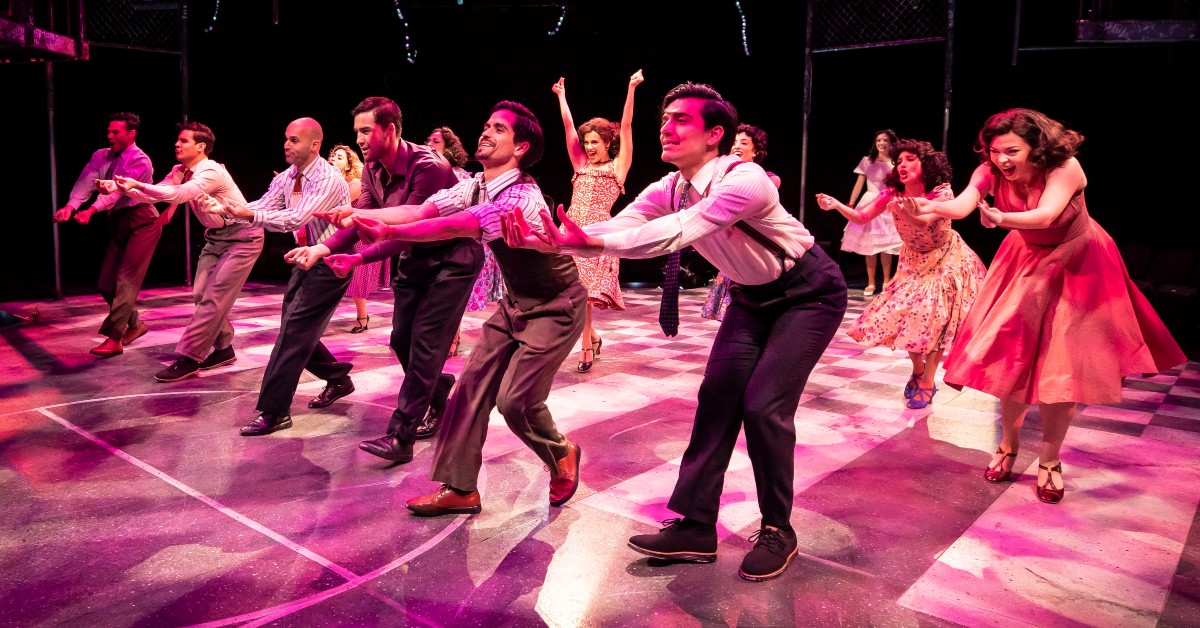
West Side Story , the Bernstein-Sondheim classic that needs no introduction, will run through March 27 at the Marriott Theatre in Lincolnshire. Visit MarriottTheatre.com or call 847-634-0200.
Once Upon a Mattress , the 1959 show that puts a comic (“mildly adult”) twist on The Princess and the Pea , the Hans Christian Andersen fairy tale, with music by Mary Rodgers (Richard Rodgers’ daughter). It runs March 11-May 1 at Theo Ubique’s Howard Street Theatre in Evanston. Visit theo-u.com or call 773-939-4101.
Disney’s Winnie the Pooh , a new stage adaptation of the 1977 animated film classic that is laced with many of the original classic songs by the Sherman Brothers (and retrofitted into a new score by Nate Edmondson). It will run March 15-June 12 at Chicago’s Mercury Theater, 3745 N. Southport. Visit WinnieThePoohShow.com .
Hedy Weiss, a longtime Chicago arts critic, was the Theater and Dance Critic for the Chicago Sun-Times from 1984 to 2018, and currently writes for WTTW-TV’s website and contributes to the Chicago Tonight program.
In this issue
-
An ‘awesome’ new fellowship for teens
AKLA Chicago will be a free, five-week experiential experience for ages 12–14
Read more -
-