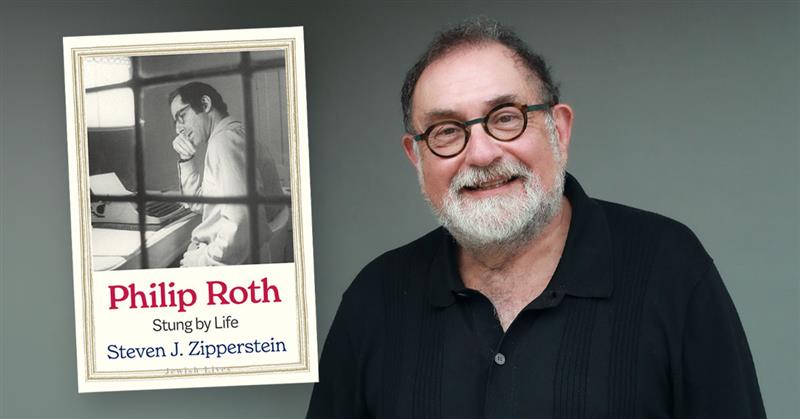
Philip Roth: Stung by Life
DONALD LIEBENSON
In 1996, actress Claire Bloom wrote an unsparing memoir which bitterly portrayed author Philip Roth, her husband of 17 years, as an egomaniacal misogynist.
In response, Roth reached out to a trusted friend, Ross Miller, a University of Connecticut English professor, to write his authorized biography. That fell through in part because of the whole misogynist thing, which Miller could not ignore, and also Miller wrote critically of Roth’s mother, Bess.
In 2021, Blake Bailey’s nearly 900-page Philip Roth: The Biography was pulled by its publisher because of allegations of sexual predation against the author. Upon this turn of events, The New Yorker observed with great understatement, “Philip Roth has not had much luck with biographers.”
Until now. Steven J. Zipperstein’s incisive biography Philip Roth: Stung by Life , the latest volume in Yale Press’ Jewish Lives series, approaches Roth primarily through his work minus salacious sensationalism.
From Roth’s much-bandied-about misogyny to criticism by some Jewish readers of his use of perceived Jewish stereotypes (as in an early story, “Defender of the Faith” in which a willful Jewish Army recruit manipulates his sergeant, a fellow Jew), Roth is a problematic subject. But Zipperstein does an admirable job of separating the man from the artist. He had access to some of the same research materials as did Bailey and while he acknowledges that Bailey’s bio of Roth is “vigorously researched,” he considers it “curiously tone-deaf to the writing at the epicenter of Roth’s life…I came to see how Bailey’s all-too-fixed interest in Roth’s sexual life not infrequently obscured Roth’s far keener preoccupation with literature.”
Portnoy’s Complaint , Roth’s controversial fourth novel published in 1969, established him as a serious writer who wrote bestsellers. The book sold 400,000 in hardcover and by 1971, three million copies were in print. As Zipperstein writes, it was “suddenly a fixture of contemporary culture,” which at once elated and overwhelmed its author.
Released the same year as Portnoy’s Complaint , the screen adaptation of Roth’s debut novella, Goodbye, Columbus , starring Richard Benjamin and Ali MacGraw, was a box office hit, “and also managed to upend still-regimented censorship restrictions.” Roth’s celebrity status was confirmed. Overall, he wrote 31 books, and won an unprecedented three PEN/Faulkner Awards and the Pulitzer Prize. But he was denied the Nobel Prize for literature, Zipperstein observes, “widely-viewed as an intentional slight even by those who didn’t greatly appreciate him.”
Zipperstein explores Roth’s prodigious output-the good ( The Plot Against America ) and the bad ( When She Was Good ). Stung By Life is most revelatory when probing the autobiographical aspects of Roth’s books and his explorations of nearly every aspect of contemporary Jewish life despite having sparse knowledge of the Jewish religion and only a passing interest in Judaism.
He writes: “the passions of Jewish children, the pleasures and anguish of postwar Jewish suburbia, Israel, diaspora, the Holocaust, circumcision, the interplay between the nice Jewish boy and the turbulent one deep inside.” Among the most urgent of such interests was what it meant for a Jew to go “wild in public,” as he wrote a few years after Portnoy’s Complaint . “[It] is the last thing in the world that a good Jew is expected to do.”
Roth, when he was in his early 20s with only some short stories to his credit, presciently advised his girlfriend-Maxine Groffsky, the model for Brenda in Goodbye, Columbus -to save his letters as there might be interest in them one day. He would later call the literary biography “the lowest of literary rackets…a lightweight approach to human character.”
But Stung by Life breaks the Roth biography curse. Zipperstein interviewed more than 100 of his friends, lovers (including Groffsky) critics, relatives, and acquaintances to take full measure of Roth as an artist chronicling Jewish-American (or just American) identity. The reader gains an appreciation for why, he writes, “No writer at the time of his death in the English-speaking world commanded comparable attention.”
Donald Liebenson is a Chicago writer who writes for VanityFair.com , LA Times, Chicago Tribune, and other outlets.
In this issue
-
An ‘awesome’ new fellowship for teens
AKLA Chicago will be a free, five-week experiential experience for ages 12–14
Read more -
-