Professional development addresses what’s next in Israel education
Julie Sugar
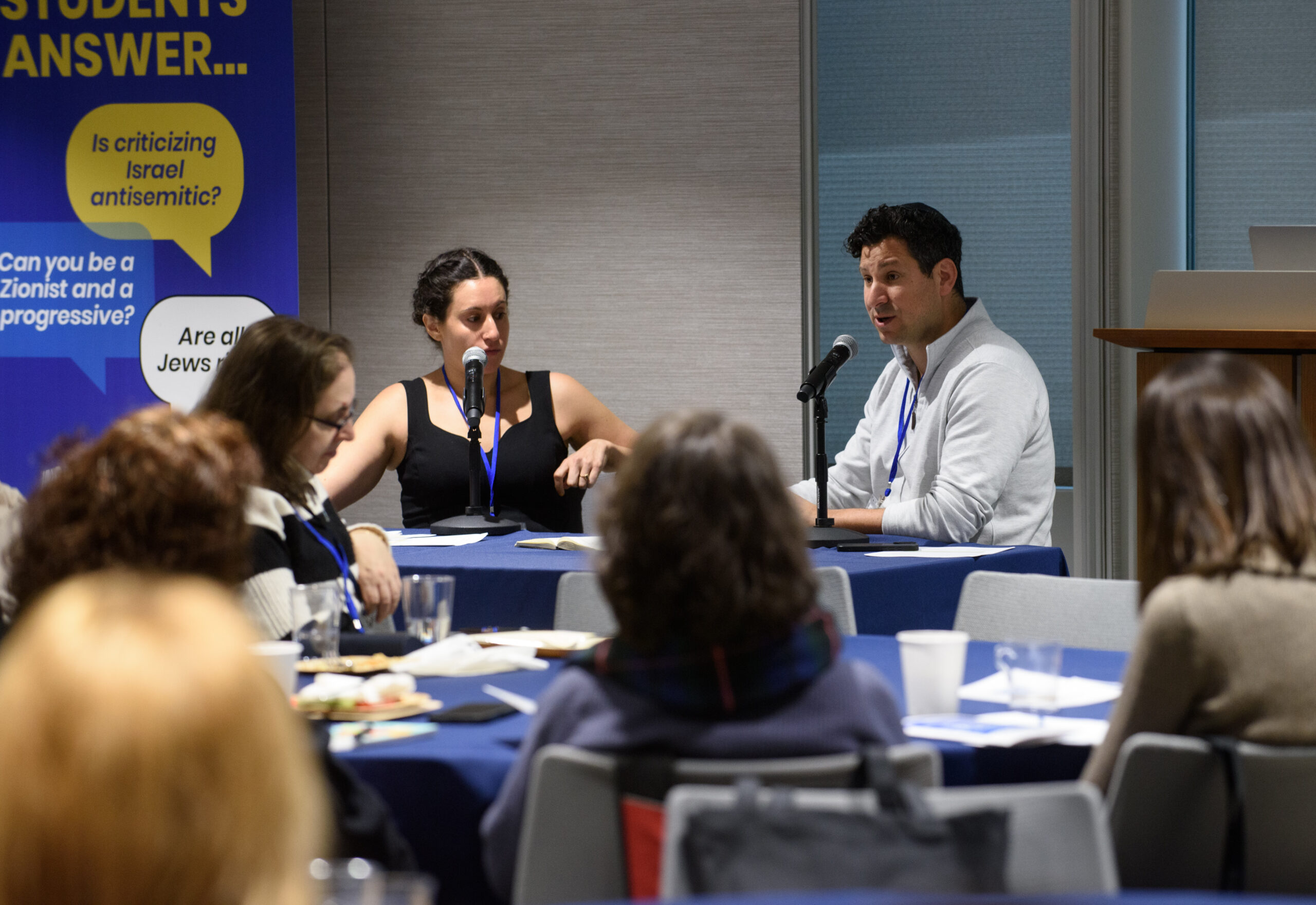
Author and Strategic Advisor Toba Hellerstein and Dr. Noam Weissman, Executive Vice President of OpenDor Media at the opening plenary. (Photo credit: Robert Kusel)
After 20 remaining living hostages returned to Israel last October, Robin Arbetman discussed the momentous time with her religious school students at Oak Park Temple B’nai Abraham Zion. The Temple Educator shared of-the-moment illustrations and political cartoons from Israeli artists and, together, they engaged in an open conversation.
“Since then, we’re going deep,” said Arbetman, while speaking to attendees at the Unpacked for Educators (UED) Midwest Regional Conference in December.
Educators from 11 day schools and 31 congregational and religious schools convened at the Chicago conference entitled “Navigating Israel Education in a Changing Landscape.” While the majority of the participants were from the Chicago area, some came from as far as Texas, California, Tennessee, and Florida.
The conference was supported by an Enhancing Israel Education & Addressing Antisemitism grant from JUF’s Community Building & Jewish Continuity Commission, with additional support from the Maimonides Fund and the Natan Fund, and in partnership with Prizmah: Center for Jewish Day Schools, M², and the Jewish Education Project.
The conference was a reflection of JUF’s deep commitment to strengthening Israel education and investing in educators who can facilitate meaningful, relevant Israel education.
“JUF’s investment includes direct support to professionals through professional development, coaching, programming grants, and convenings,” said Michelle Lawner, Senior Associate Vice President of Planning and Allocations at JUF.
According to Lawner, while many educators have access to Israel education resources, they often face barriers putting them into practice, including hesitation about when and how to teach complex topics. Yet the need for nuanced, thoughtful, and innovative strategies teaching Israel in times of crisis and addressing antisemitism has only intensified since October 7.
In the lead-up to the conference, Steve Greenbaum, FY25 Co-Chair of JUF’s Israel Education & Addressing Antisemitism grants process, expected 80, maybe 90 participants. Instead, 125 came. “To surpass our best guess estimate by such large numbers shows that we funded something that there was demand and need for,” he said.
Educators attended a wide range of thought-provoking sessions geared to provide them with both intellectual and hands-on resources and tools, from The iCenter’s “Navigating Complexity: Replacing Exclamation Points with Question Marks” to hearing local Chicago-area educators share their most impactful lessons to “Exploring Teacher Reticence for Engaging with the Israeli-Palestinian Conflict” led by Dr. Keren Fraiman, Vice President, Chief Academic Officer, and Professor of Israel Studies at Spertus Institute.
Participants also explored Israel education through Israeli TV and music, and heard from local ShinShinim, Israeli high school graduates who work as youth ambassadors abroad, about their experiences with relational Israel education in a diversity of settings.
JUF’s Community Outreach & Engagement team played a pivotal role in shaping the conference experience—helping to define session topics, coordinate logistics with the national and local partners, and provide oversight to ensure the event addressed the most relevant and timely needs of Chicago educators.
Sarah Gordon, Vice President at UED, oversaw design and implementation of the conference and taught several of the sessions. “We want teachers to leave, not just with their thinking changed, like the lightbulb moment,” Gordon said, “but also with practical, helpful lessons that you can walk into your classroom with tomorrow.”
Alissa Zeffren, who teaches Jewish History and Hebrew Bible at Ida Crown Jewish Academy, believes Israel education will be “vitally important” for the rest of her students’ lives. “We’re preparing them to go off to college campuses,” she said. “Our goals for Israel education are academic, experiential, and effective.”
Nanci Caplan, Associate Head of School at Solomon Schechter Day School of Metropolitan Chicago, said that her takeaway from the conference was that they are all in this together.
“We are all working to better this next generation of Jewish children, and to help fill them with the knowledge and context of the universe around them,” Caplan said. “And more importantly, to not hand them the answers, but to help them develop the critical thinking skills and the ability to approach situations and people with curiosity and questions.”
Following the conference, the iCenter as well as JUF’s Community Outreach & Engagement department are providing ongoing coaching and support to deepen the lessons and connections made. “With this added layer of post-conference support, the iCenter helps educational institutions move from inspiration to implementation, fostering more vibrant, meaningful, and impactful Israel education,” said Doug Winkelstein, JUF’s Assistant Vice President of Jewish Education Initiatives.
In this issue
-
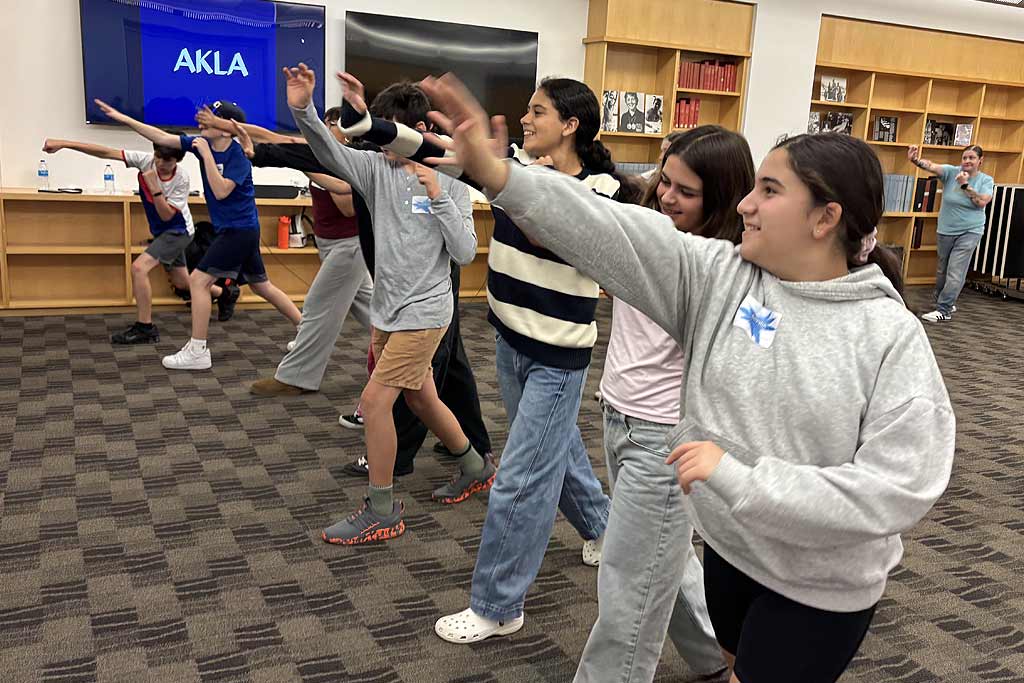
An ‘awesome’ new fellowship for teens
AKLA Chicago will be a free, five-week experiential experience for ages 12–14
Read more -

-