Putting Education to Good Use
ROBERT NAGLER MILLER
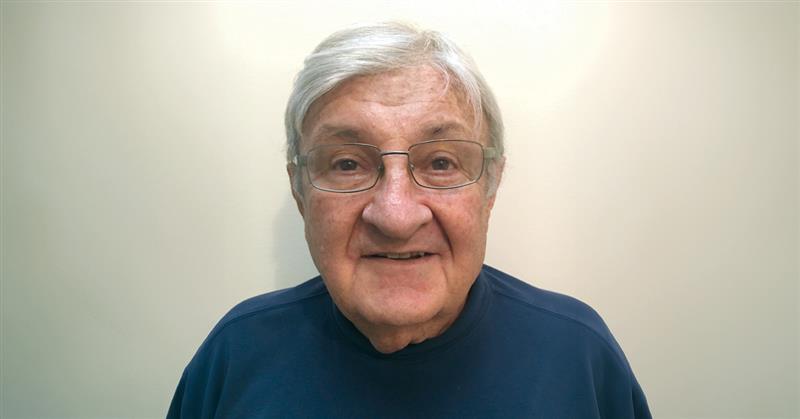
“All my life,” said Dr. Chaim Rosenberg, “I’ve been interested in what came before.”
That interest has served Rosenberg, on the cusp of his 90th birthday, particularly well for many years. A psychiatrist for four decades, he helped countless patients unravel the mysteries of earlier, formative periods of their lives. He did so mainly from Boston, where, affiliated with the medical schools of Harvard and Boston Universities, he specialized in the treatment of alcohol and drug addiction.
But his curiosity extended beyond people’s personal histories. Traveling around New England, he would look inquisitively at old mills, office structures, and stately homes, wondering about the people who had lived and worked in them.
To satisfy his curiosity about the past, Rosenberg retired from his medical practice almost 25 years ago and embarked on a second career-as a history writer. His early books focused on America’s Industrial Revolution and New England’s first families.
Since moving to Chicago with his wife, Dawn, a dozen years ago, he has gravitated toward Jewish subjects. One of his most recent books tells the stories of American Jews in the armed forces. His just-released Children of the American Jewish Ghetto: Stories of Struggle and Achievement from 1881 through World War I is, he said, “an ode to Jewish … stick-to-itiveness [and] gumption.
“I loathe descriptions of superiority,” added Rosenberg, in discussing American Jews’ outsize contributions in a broad range of fields-from science, medicine, and business to higher education, literature, and fine and performing arts, all of which he lovingly details in Jewish Ghetto.
What, in huge measure, led Jewish immigrants and their children toward success in their early years in America, he contends, was access to public education.
In the book, he writes, “Most Russian-Jewish immigrants who settled in the Lower East Side of New York, or the ghettoes in Boston, Philadelphia, and Chicago, sent their children-boys and girls-to the local free public elementary schools. …In New York, many went on to grammar school and then the tuition-free City College or Hunter College, to find work as teachers in the New York City public school system, and were assigned to Jewish neighborhoods. These teachers greatly fostered the rapid Americanization of the children of Jewish immigrants.”
Rosenberg’s life followed a similar trajectory of success, although he was born and grew up far from the Jewish enclaves of New York’s Lower East Side, Chicago’s Old West Side, and Boston’s Dorchester and Roxbury.
A native of Johannesburg, South Africa-to which his parents immigrated from the same Lithuanian shtetl in the late 1920s-he was raised in a Yiddish-speaking household. His father worked as a baker; his customers were Black laborers working under the country’s Apartheid regime.
Young Chaim had an early interest in the world beyond the segregated society into which he was born. He wrote, in a history for his medical school class at the University of Witwatersrand, “I frequently rode my bike to the Local Central News Agency (bookshop) to page through the travel magazines and learn about the fascinating places” in which he might one day find himself.
His dream came to fruition. Following medical school, Rosenberg, accompanied by his wife, left South Africa. They lived in Israel; Sydney, Australia; and London before settling in Boston, where they raised three children. Since moving to Chicago-where his son, a rabbi, lives with his family-Rosenberg has taken an interest in Chicago history and written a number of articles for Chicago Jewish History, the quarterly publication of the Chicago Jewish Historical Society.
Rosenberg said that he is duly impressed with the local Jewish community and its history. “The Jews have played a more significant role in Chicago than in Boston,” he said.
Rosenberg’s Children of the American Jewish Ghetto is published by McFarland & Company, Inc. His 2022 work, Shield of David, was published by Post Hill Press.
Robert Nagler Miller is a journalist and editor who writes frequently about arts- and Jewish-related topics from his home in New York.