Rabbi Victor Weissberg
PAUL WIEDER
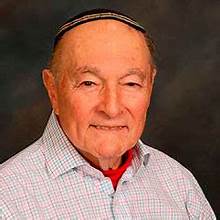
Long commitments were second nature to Rabbi Victor Weissberg. He served as rabbi of Temple Beth-El Chicago for 40 years, he was married to his late wife, Tamar, for 70 years, and he attended classes into his late 70s. Weissberg died on October 13, at 97.
Weissberg served on the JUF board from 1982 to 1988; he and Tamar were also Golden Givers to the JUF Annual Campaign.
Weissberg was born near Detroit to Ruth and Isadore, Polish and Russian Jewish immigrants. He grew up in Cleveland, attending Jewish schools, camps, and youth groups.
His leadership abilities emerged at a young age. In fourth grade, he led his fellow students on a strike to play baseball during recess. In junior high, he started a club called the Brotherhood of Betterment. After high school, Weissberg served in the Navy in World War II.
Weissberg graduated from the University of Chicago in 1948. He went on to attend Hebrew University in Jerusalem, where he earned a second bachelor’s degree as well as master’s, and doctorate degrees. He was ordained at Hebrew Union College.
While in Israel in 1952, he met and-six weeks later-married Tamar. They fostered a warm family and traveled the world, enjoying theater and collecting Jewish artwork.
In 1953, Weissberg became assistant rabbi at Temple Isaiah Israel in Hyde Park.
One year later, he accepted the pulpit of Temple Beth-El in Chicago, moving it from Logan Square to West Rogers Park and then to Northbrook. In 1995, he retired, becoming Rabbi Emeritus.
“Rabbi Weissberg was a man who dedicated his life to Temple Beth-El, and we will forever cherish the gifts of his heart, mind, and spirit,” said Rabbi Sidney M. Helbraun D.D., Beth-El’s Senior Rabbi. “More than a lifelong teacher and scholar who seemed to have married or buried half of Chicago, he was a brilliant man who never forgot a person’s name. He was a builder of our people, [whose] dozen disciples made careers in the rabbinate. While he stood six feet tall, his aura reached even higher, for he was looked up to with a presence felt far beyond Chicagoland.”
Weissberg integrated his interest in mental health with both his clerical and educational work. In fact, he earned a master’s in education with a double concentration in administration and counseling from the University of Cincinnati, and earned certificates in psychotherapy and pastoral counseling from the Alfred Adler Institute and the University of Health Sciences-Chicago Medical School.
Weissberg served as a chaplain everywhere from the Rosewood Rehabilitation Center to Cook County Jail, and was Chairman of the Chicago Board of Rabbis Chaplaincy Commission from 1999-2002. Active in the American Foundation of Psychiatry and Religion, he founded the Rabbinical Counseling Service; he wrote books on topics ranging from Jewish history to the mysticism of the Hebrew alphabet.
A staunch advocate for Israel, Weissberg co-founded and led the PAC To Protect Our Heritage, which supports the American-Israeli alliance, founded the Young Leadership arm of Bonds for Israel Chicago, and served on the Illinois and national boards of AIPAC in the 1990s.
Many other groups benefited from Weissberg’s efforts. He was the founder and director of the Hebrew Association of the Deaf and director of the National Convention of Jewish Deaf. He led the Inter-Congregational Journey of Support for Soviet Jewry and founded a Senior Social Service Center at Temple Beth-El.
As an educator, Weissberg taught Jewish studies to high schools and Intro to Judaism at Oakton Community College. As a student, he studied Judaism at the University of Chicago, the Shalom Hartman Institute, and the Hebrew Theological College.
While he was a coin collector, Weissberg certainly would have agreed with Benjamin Franklin’s advice: “If a man empties his purse into his head, no man can take it from him; an investment in knowledge always pays the best interest.”
Rabbi Weissberg was the husband of the late Tamar (nee Libovsky) and the father of Amyra (Kenneth) Henry, Ariel (Hava) Weissberg, and Alona Anspach. He had eight grandchildren and 10 great-grandchildren. Memorials may be made to Magen David Adom. Funeral arrangements were made by Mitzvah Memorial Funerals.