“Brothers shot, my sisters lost, I am bereft as the night;
The Gestapo has taken father away,
Already, three pogroms they’ve made.”
Ayzik Flaysher wrote those lyrics for a song, “The Third Pogrom.” At the time, he was a 13-year-old orphan whose family had been exterminated during the Holocaust. He survived by hiding in the forest in a self-dug pit, living off scraps farmers tossed to their pigs.
During one of history’s darkest chapters, music—like humor—offered solace, fostered commiseration and community, and gave voice to grief, hope, and defiance.
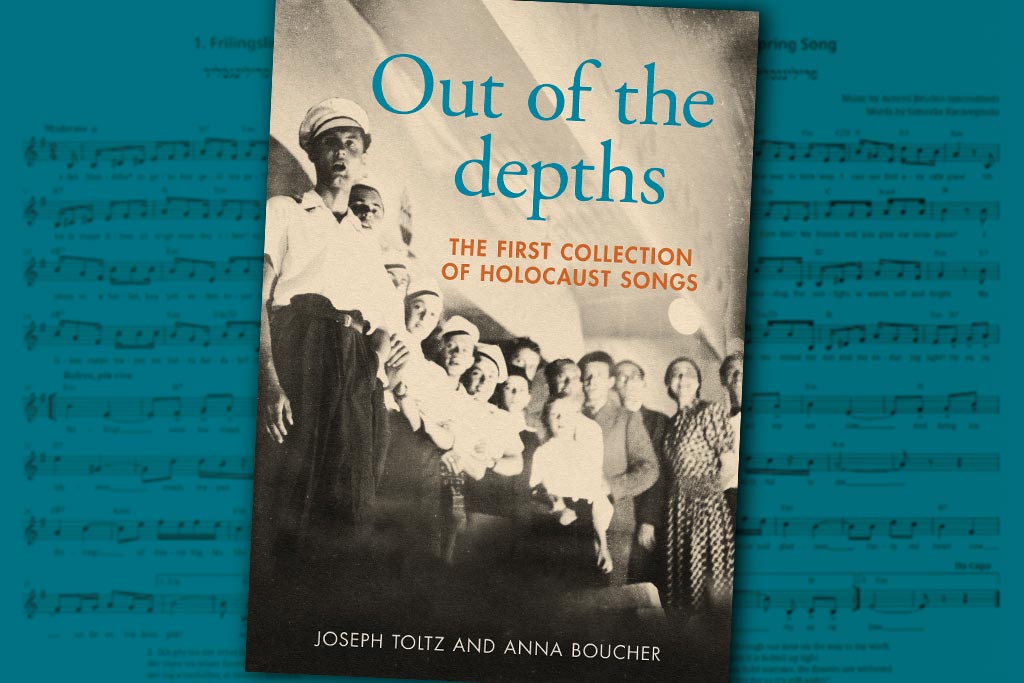
“The Third Pogrom” is one of 20 Yiddish songs preserved in an extraordinary archival discovery, Out of the Depths, the first collection of Holocaust songs discovered to date. These are not songs about the Holocaust; they are of the Holocaust, written between 1939 and 1944 by ghetto inhabitants, concentration camp prisoners, people in hiding like Ayzik, and resistance fighters.
Together, these songs of despair, hope, identity, and resilience serve as a heretofore unsung historical record and a unique perspective of Jewish life during the Holocaust.
This remarkable songbook surfaced in the belongings of Olga R., a Jewish woman who passed away in Sydney in 2013 at 98. She had grown up in the Polish city of Stary Sacz, and had survived the Holocaust by living under a false identity before emigrating to Australia in 1956. The songbook was found between the pages of a musical score. It was in pristine condition.
Joseph Toltz, an ethnomusicologist approached by the family, translated the title, Mima’amakim: folkslider fun lagers un getos in poyln (Out of the Depths: Folk Songs from the Camps and Ghettos of Poland). Further research revealed it to be a rare 1945 first edition of a songbook created after the Holocaust by Jewish survivors. The title refers to Psalm 130, whose first verse reads: “Out of the depths have I called You, O Lord.”
Anna Boucher, a renowned migration scholar and political scientist, collaborated with Toltz to publish the songbook in English for the first time. They researched the stories of the contributors and their songs, tracking down their descendants. In the book’s introduction, they write, “This book has taken us on a journey through the experiences of survivors and the ways in which music is created, adapted, and used for survival and the maintenance of its historical record.”
Out of the Depths is a crucial addition to Holocaust scholarship at a time when new methods are needed to teach young people about the Holocaust. The authors cite a 2020 study of young Americans, in which 63% of respondents did not know that six million Jews were murdered during the Holocaust. Thirty-six percent thought that ‘two million or fewer Jews’ were murdered, while roughly 11% believed Jews themselves caused the Holocaust.
Several of the songs in Out of the Depth rise above desperation and despair. “Es Brent” (It Burns) is a call to fight, to resist the enemy:
“Don’t stand, brothers, and look on it while our town burns!
If this town is dear to you, take the vessels, extinguish the fire, Extinguish it with your own blood!
Prove that you can.”
Others are profoundly moving expressions of hope, as in the song “The Yellow Patch”:
“The sorrowful present I loudly proclaim
will sound forth in tones of freedom one day.”
Ayzik Flaysher witnessed the murder of his parents and all 10 of his siblings in Ukraine. In 1945, he stowed away on a boat to pre-Israel Palestine, where he built a successful life, despite severe physical deformities caused by his prolonged confinement while hiding.
Music, his son told Boucher, remained an important part of his postwar life, including “The Third Pogrom,” his composition. “He would sing his song every single morning,” Flaysher said.
When asked why, his son shared a story of Ayzik telling a neighbor in Israel why he sang all time: “He told him that he has two options: sing all the time, or cry and die. He preferred to sing all the time.”
Donald Liebenson is a Chicago writer who writes for VanityFair.com, The Washington Post, and other outlets.