Revamped tashlich rituals add profound meaning to High Holidays
Michelle Cohen
On the surface, tashlich seems like a simple ceremony. But traditions new and old can reveal the deeper meaning of a time set aside for reflection and moving forward.
” Tashlich is a uniquely important moment in Rosh Hashanah and the High Holiday period,” said Rabbi Michael Siegel of Anshe Emet Synagogue in Lakeview. “The High Holidays are all about turning inward and at the same time turning outward. What would it take to let go of some of the issues that hold us back in order to go forward?”
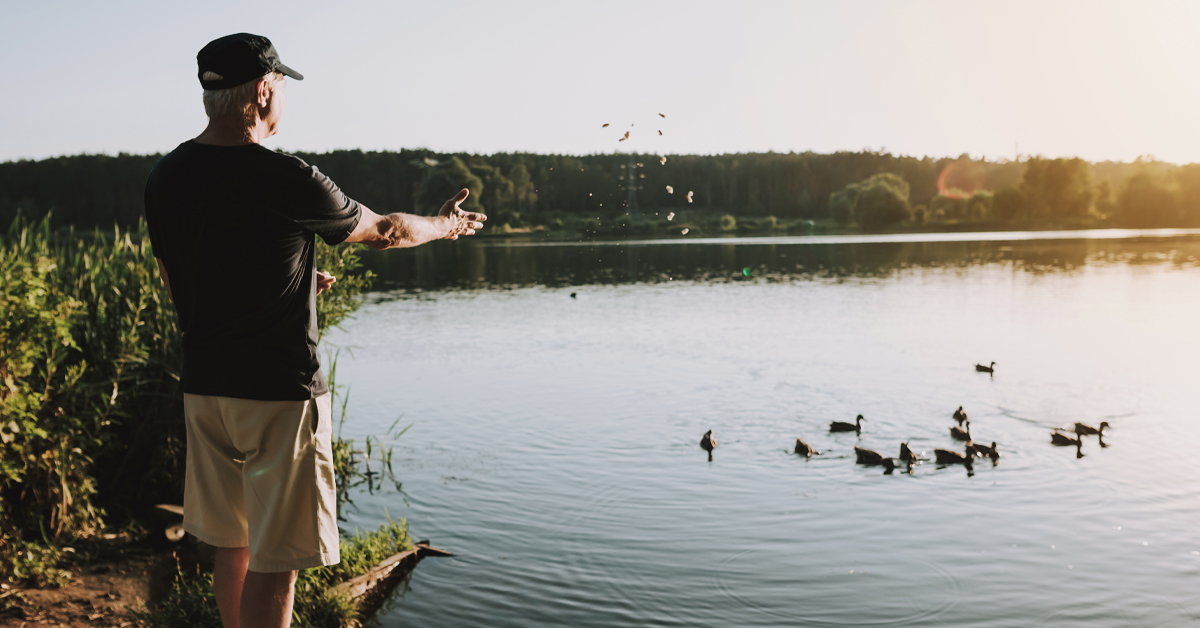
The idea of letting go is key to tashlich –a ritual translated as “casting off,” where it is traditional to scatter breadcrumbs representing sins into a body of water.
Last year, when in-person tashlich was hampered by the pandemic, synagogues got creative with bringing the ritual to people’s homes. Rabbi Wendi Geffen of North Shore Congregation Israel in Glencoe worked with a committee to construct a mini-website with traditional liturgy and alternative service guides for congregants to perform the ritual on their own. These guides ranged from family-friendly to meditative, were portable, and provided information about necessary supplies and the right blessings to say.
Even though NSCI did not offer in-person services last year, the guides on their website provided a powerful thought exercise in the personal versus communal observance Geffen finds key to the High Holidays. “We’re repenting as individuals, but in a community” in most years. But during the pandemic, when these individual accommodations were necessary, it was important to remember that ” tashlich is meaningful whether done individually or collectively.”
Rabbi Shoshana Conover of Temple Sholom in Chicago also offered resources for tashlich , in a kit that congregants could pick up to guide their High Holiday experience. She also brought something new to the mix–in the face of environmental concerns, she offered biodegradable paper for participants to write their sins down and cast them into the water.
After using pebbles two years ago to avoid making ducks sick, last year’s dissolvable paper proved an even more meaningful way to engage with the ritual. “The paper is really powerful,” Conover said. “Writing sins on the paper made it even more tangible than throwing bread. The words literally dissolve in front of your eyes and it takes a while, so you are really contemplating it.”
The paper made tashlich “one of the more spiritual experiences that I’ve had–and I’ve always found it to be extraordinarily meaningful,” said Conover. She also appreciated the way the ritual takes place outdoors–which made it possible to do a socially-distanced communal observance last year. “It can’t be that we have a beautiful spiritual moment in the synagogue and then just go back to our ordinary lives. This is a way of elevating our regular lives and saying this is holy, too, and this is where the real work happens.”
This year, Siegel hopes tashlich will provide a similar spiritual experience for a country coming out of the pandemic. “One of the things that tashlich reminds us of is that it is possible to change. We can discard some of the things that hold us back and hold us down, those issues that feel like we repeat. For a country and a community coming out of this period of COVID-19, that is precisely what we should be thinking about.”
Whatever this year’s observance looks like, Siegel hopes people will think of tashlich’s main question: “How have we changed?”
This year, ” tashlich can serve as a symbolic opportunity to say we can let go of pre-COVID things,” he said. “The experience of throwing something and watching it hit the water and disappear–all of this is a very powerful statement about the possibility of change. Can we go forward on a new path? I think we all can agree that it’s vital, but can we imagine it to be true? Tashlich opens that opportunity.”
In this issue
-
An ‘awesome’ new fellowship for teens
AKLA Chicago will be a free, five-week experiential experience for ages 12–14
Read more -
-