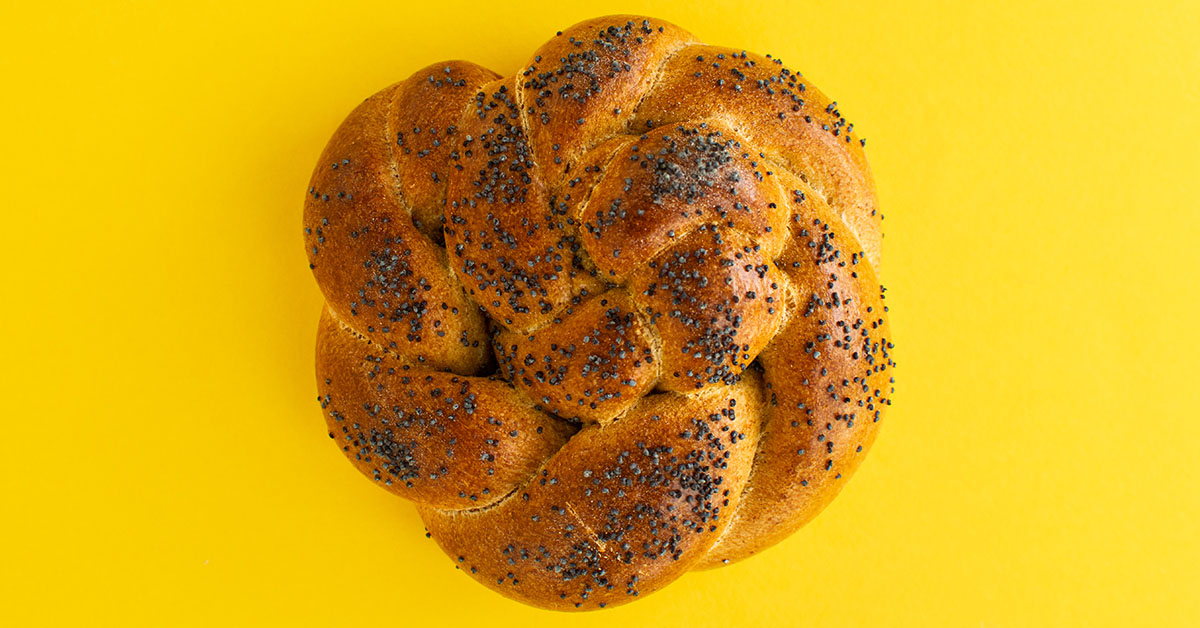
The international way to your lightest, fluffiest challah ever!
Laura Frankel
At Rosh Hashanah, we eat foods symbolic of our hopes for the New Year– including a round challah, to symbolize life and a year of blessings without end, and apples and honey for a sweet year.
But what if I told you that your beloved family heirloom challah recipe could be better? Well, it can!
This challah dough is everything . Rich and complexly flavored, light, and airy-textured. I love old family recipes… but as a chef, I also know that food changes, and new and better techniques can be discovered.
Whether you are a newbie of maven baker, pretend this recipe is a great novel (in a way, it’s better than one, because you can eat it when you’re done), and sit down and read it all the way through. There are a couple of twists and turns you should know going in, and I find a recipe yields a better result if I can picture the steps.
My challah recipe is a modern version of the classic. I use honey instead of sugar, and extra virgin olive oil instead of vegetable oil. Plus, to achieve a rich dough, I use more egg yolks than whole eggs.
Modern commercial yeast does not need to be “proofed.” Instead, I start the fermentation process with a “sponge.” A sponge adds more flavor to the finished bread– and the longer the ferment, the better the flavor.
My new technique is borrowed from a Japanese bread making method and is called “tangzhong.” Tangzhong, or water roux, is a method of adding hydration to bread dough. Why does your challah need more hydration? Well, the standard challah recipe is about 40-45% hydrated. The optimum level of hydration for pillowy, soft, meltingly tender bread dough, though, is 70%-75%.
Using the tangzhong method only changes the recipe by adding more water–but it changes the bread-making method a bit more. A simple roux is made by simmering additional water and adding flour, to make a loose paste. The paste is the “vehicle” to add water to the dough. Cool the paste completely (or it will kill the yeast), and then add the roux to the dough during mixing. The result will be a fluffier, taller, and much more tender dough. Bonus: the finished challah will not go stale as quickly.
Why can’t you just add more water and skip the whole roux process? Adding more water to the early steps will result in the need for more flour, which will decrease the hydration– the opposite of what we want.
Note: To calculate bread hydration, divide the weight of the liquid by the weight of the flour.
Making the Dough
Yield: 1 large challah or 2 medium loaves
To make a sponge:
1 cup bread flour
2½ teaspoons yeast
1 cup warm water (not hot)
Mix the ingredients together and cover, while you gather and measure the remaining ingredients. The sponge can sit and ferment for up to 2 hours.
Tangzhong (optional):
¾ cup water
¼ cup flour
Bring water to a simmer and immediately add the flour. Turn off heat and stir together to make a paste. Cool completely.
2 whole eggs
3 egg yolks at room temperature
2½ teaspoons sea salt
1 / 3 cup of honey
½ cup extra virgin olive oil
4-4½ cups bread flour
Egg wash
1 whole egg, whisked
2 teaspoons water
Optional toppings: poppy seeds, sesame seeds, oats, pumpkin seeds, everything bagel seasoning, streusel
*Optional fillings: chocolate, jam, pesto, olives, lox, cinnamon-sugar, chopped corned beef, and mustard.
1. Add the eggs, yolks, salt, sugar or honey, and extra virgin olive oil to the sponge. Add cooled tangzhong if using.
2. Slowly mix in the flour. You may not need all the flour depending upon the humidity and water content of the flour.
3. When the dough starts to pull together, and off the floor of the mixer, stop adding flour. The dough should be tacky but not stick to your fingers (the flour needs to rehydrate, which doesn’t happen all at once, so keep dough a bit “damp”).
4. Allow the dough to rise at least 1 hour at room temperature, until doubled in volume, or cover and refrigerate overnight. If you refrigerate dough, allow it to come to room temp before braiding.
*To fill your challah: Flatten ropes before braiding and schmear or dollop filling onto each rope. Roll ropes and pinch to seal. Braid challah and bake. Or, for Rosh Hashanah, make a round challah.
5. Braid or pan dough, cover with a clean towel, and allow to rise for 2 hours. Preheat oven to 350 F.
6. Whisk egg and water together. Egg-wash the braided dough, and allow the wash to dry for 10 minutes. Then brush the challah again. If you are using any toppings, sprinkle on challah.
7. Bake for 15 minutes. Rotate pan and continue baking for another 12-15 minutes or until medium brown.
Apple-Honey Schmear
Yield: about 2 cups
This schmear is a must with your round holiday challah… and a great toast topper.
1 pound apples, peeled, cored and diced
1½ cups apple cider (not sweetened juice)
Zest of 1 lemon and 2 tablespoons lemon juice
¼ cup honey
2 tablespoons dark brown sugar
1 teaspoon sea salt
1. Simmer apples, cider, lemon zest and juice, honey, sugar, and salt for 1 hour, stirring frequently.
2. Puree mixture with an immersion blender or food processor until smooth.
3. Return the mixture to pan and reduce, stirring constantly, until very thick.
4. Store covered, in the refrigerator for 5 days, or freeze for up to 3 months.
Laura Frankel is a noted kosher chef, a cookbook author, and Culinary Director for a media company. Currently, she serves as Director of Catering at Circle of Life catering at North Suburban Synagogue Beth El.
In this issue
-
This Passover, four more questions
The youngest guests at our seders will likely ask the four traditional questions, but here are four other questions to chew on over matzah this holiday.
Read more -

New Stephen Sondheim biography details the towering figure
‘Walking encyclopedia of musical theater’: New Stephen Sondheim biography details the towering figure
Read more -
Celebrating spring and a crop of new productions
A celebration of Passover, warmer weather, and a crop of new productions
Read more