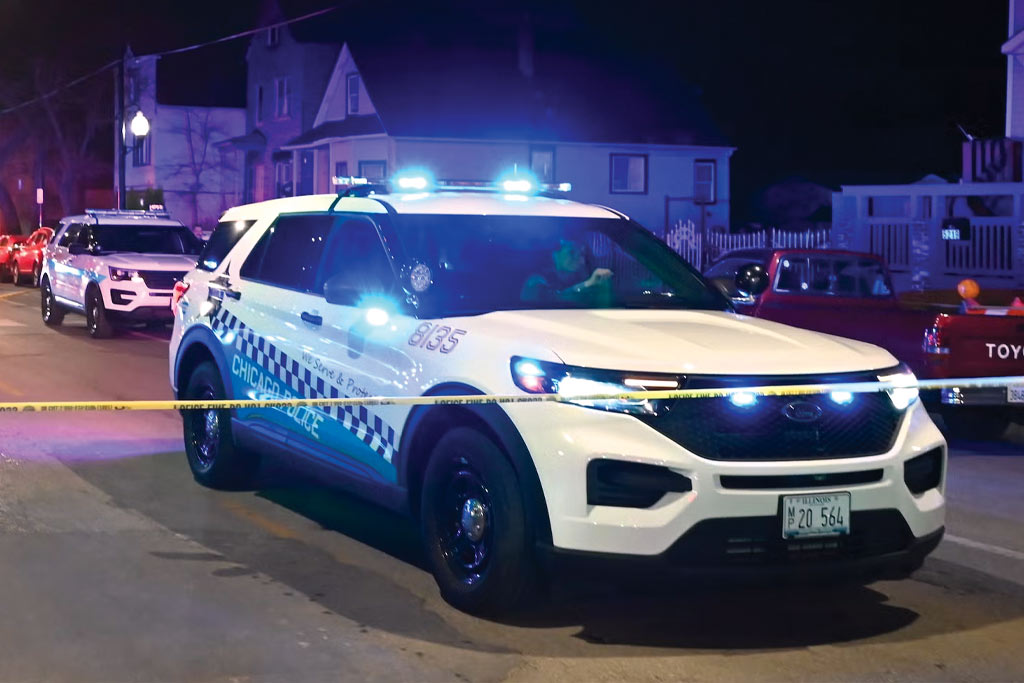
A police car pictured in Chicago on April 13, 2024. (Photo credit: Kyle Mazza/Anadolu via Getty Images)
JUF educates law enforcement about our community and educates our community about law enforcement.
As the most frequent victims of religious hate crimes, and as the lead advocates for creating such a criminal category, Jews expect that the laws be applied to any underlying crime (vandalism, assault, battery, etc.) apparently motivated by antisemitism. Yet that expectation should be balanced by appreciating the overwhelming evidence needed to convince a judge or jury of the motivation, and the time it takes to gather such information. Unfortunately, some in our community have demonstrated unreasonable impatience with supposedly delayed application of hate crime charges, sometimes even demonizing law enforcement officials.
The following guest op-ed by longtime trusted Assistant State’s Attorney David Williams details the process and sets reasonable expectations.
By DAVID WILLIAMS
On October 25, 2024, Chicago witnessed a horrifying series of attacks that sent shockwaves through the Jewish community. A man wearing a kippah walking to synagogue in West Ridge was followed and shot in the back. Sidi Abdallahi, the offender, remained in the area. When first responders arrived, he emerged from the shadows and fired again— this time at the ambulance crew and Chicago Police officers who had come to save the victim’s life. Abdallahi was arrested and charged with Attempted Murder of both the Jewish victim and the responding police officers and emergency personnel.
However, many in the community immediately asked: Why wasn’t he also immediately charged with a hate crime? It is a reasonable question— one that seems obvious to almost any outside observer.
However, properly building a hate-crime case takes time. It requires more than collecting video footage, firearms evidence, and witness statements. Investigators also must look deeply into the offender himself.
Under Illinois criminal statutes, prosecutors must prove every element of every charge. For a hate crime, this includes proving motive—not just that the offender committed the violent act, but why. That burden is intentionally high.
My mother used to express the frustration many people feel: “How can they just stand there and say they’re innocent when everyone knows they did it?” The answer lies in the justice system: It is the prosecution’s responsibility to prove guilt beyond a reasonable doubt, using evidence that has been properly gathered, preserved, and ruled legally admissible. If those procedures are not followed, a skilled defense attorney may succeed in excluding key evidence, jeopardizing the entire case.
Following the October 25 attack, investigators pursued an extensive, methodical process. They issued subpoenas, executed search warrants, interviewed additional witnesses, and analyzed voluminous digital and electronic data. As that evidence developed, a clearer picture emerged:
- October 19: Abdallahi searched for and mapped multiple Jewish institutions.
- October 22: He researched where he could purchase a firearm.
- October 23: He altered his social media profile to express an intention toward martyrdom.
- Morning of October 25: He sent a message that he intended to die as a martyr.
- His phone and social media accounts contained hundreds of antisemitic statements, and expressions of extremist ideology.
Only after this evidence was secured—and secured properly—were the charges expanded to include Domestic Terrorism and Hate Crimes.
The path to securing hate crime charges can take an extended amount of time. I have seen it in prior cases I’ve litigated, including Stuart Wright’s attack on the Loop Synagogue in 2017 and Shahid Hussain’s 2022 spree of vandalism against Jewish institutions on Devon Avenue. In each instance, investigations had to uncover the motive before we could label the crime for what it truly was—an act of hate. Each offender in these two cases was convicted and sentenced to prison.
Yes, it is difficult to wait. Yes, it feels agonizing when the damage is fresh, and the community is shaken. But patience is often the difference between a conviction and a case’s collapse.
We cannot fight antisemitic violence—or any hate-fueled violence—without the community acting on the guiding principle of “If you see something, say something.” Some of our most significant breakthroughs come when community members speak up. The community’s vigilance remains vital. If a case is not being investigated, it is critical to shine a light on it.
The Cook County State’s Attorney’s Office continues to strengthen communication with community organizations and law-enforcement partners. We currently lead a coalition with JUF and the Decalogue Society of Lawyers that includes the Simon Wiesenthal Center, AJC, ADL, Hillel, the Illinois Holocaust Museum, and the Shomrim Society—as well as state and local law enforcement agencies, and campus police. Together, we train, share information, and build strategies for prevention and response.
Not every act of hate is a prosecutable hate crime, but all such acts should be documented. They may later become critical evidence in proving motive when a hate crime does occur.
To protect our community, we must continue to work together, build trust, understand the process, and remain vigilant in the pursuit of justice and safety for all.
The Cook County State’s Attorney’s Office is committed to securing justice for everyone in Cook County. If you have information about a possible hate crime, please contact your local police department. If you have questions, feel free to reach out to me directly at [email protected].
David Williams is the Deputy Bureau Chief of the Multi-Jurisdiction Bureau in the Cook County Assistant State’s Attorney’s Office. David founded and leads the Cook County State’s Attorney’s Office Regional Organized Crime Task Force (CCROC) and the Cook County State’s Attorney’s Response to Antisemitic Hate Crimes (CRASH).
In this issue
-
New Jewish high school to open its doors in Chicago in 2027
‘The Davis Difference’ : New Jewish high school to open its doors in Chicago in 2027
Read more -
An ‘awesome’ new fellowship for teens
AKLA Chicago will be a free, five-week experiential experience for ages 12–14
Read more -