The transformative power of a colored thread
RABBI MICHAEL S. SIEGEL
Whoever puts on a tallis when he was young, he will never forget;
Taking it out of the soft velvet bag, opening the folded shawl,
Spreading it out, kissing the length of the neckband (embroidered
or trimmed in gold). Then swinging it in a great swoop overhead
like a sky, a wedding canopy, a parachute. And then winding it
around his head as in hide-and-seek, wrapping his whole body in it,
close and slow, snuggling into it like the cocoon of a butterfly,
then opening would-be wings to fly.
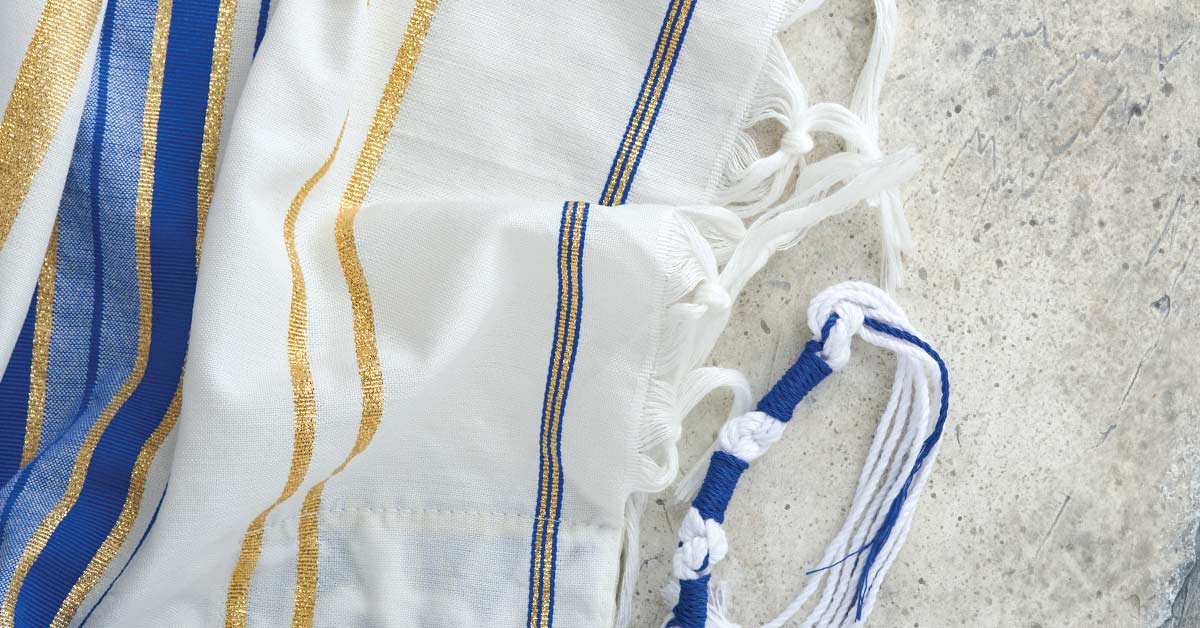
Anyone who has ever worn a tallit will be able to relate to the words of the above poem by Yehuda Amichai’s.. While the experience of wrapping oneself in the tallit is moving, the true power of the garment lies in what is missing from most of them: the petil techelet, the thread of blue.
The commandment in the Torah reads: Tell them to make for themselves fringes on the corners of their garments throughout their generations; and they will place with the fringes of each corner a thread of blue (Numbers 15:35).
In the ancient world, it was not unusual for people to put fringes on the hems of their robes as a symbol of status. What makes the tallit unique is that Israelites, no matter their strata, were commanded to put a thread of blue in each corner of their garment.
As its particular color of purplish blue was also the color of royalty, the thread was a statement that every Israelite was part of a mamlechet kohanim, a kingdom of priests. In this way, the thread elevated each wearer, creating a societal revolution. A colored thread served as a powerful reminder that we all possess a bit of the tzelem Elohim, the image of God. In short, the Petil Techelet announced that every person had inherent worth, and was deserving of dignity no matter their economic situation. This simple ritual was one of the earliest statements of societal equality ever recorded, and its message resonates today.
Consider the dehumanizing rhetoric that we so often hear in public discourse, in America and in Israel. Debate and protest serve as the lifeblood of every viable democracy. If you believe in a cause, then it is natural to engage with passion. But there are limits to any debate. As committed as you might be, it does not give you the right to turn your opponent into an enemy, or a personal threat.
There was a long period when the crustacean traditionally used to create that particular shade of blue could not be found, but it was recently rediscovered. Imagine all of us wearing a blue thread, or a button, or a picture, to remind everyone that we come into contact with that there is a baseline for engagement in debate. It begins with the idea that all of us are created in the image of God. All of us are people with loved ones, who all want what is best for our country. The Petil Techelet can also serve as a reminder to the wearer to comport themselves in ways that reflect our shared humanity.
Toward the end of his poem “Symbols.” Amichai writes:
And why is the tallis striped and not checkered black-and-white
like a chessboard? Because squares are finite and hopeless.
Stripes come from infinity and to infinity they go
like airport runways where angels land and take off.
Yehuda Amichai makes great use of his poetic imagination by comparing the stripes of the tallit to lines on a runway, bidding us to ascend. In so doing, he encourages us to dream of what it would take to create a better day for all of us, and those who will follow. In a time when our ability to have thoughtful conversations and debate has reached a low ebb, an ancient symbol points the way forward… and upward.
Rabbi Michael S. Siegel is Senior Rabbi and The Norman Asher Rabbinic Chair of Anshe Emet Synagogue.