The virtual road to progress
Amy Zimmerman, Jonathan Schrag, and Ellie Prober
Over 60 JUF and agency professionals and volunteer leaders gathered virtually in March for the 2022 Springfield Advocacy Mission and in April for the 2022 Washington D.C. Advocacy Mission. Although the pandemic has required some structural changes to JUF advocacy and our missions–from 2020 cancellations, to a combined Springfield and D.C. virtual mission in 2021, to this year’s separate, virtual missions–the energy of participants and impact of their advocacy has not wavered. The advocacy of our community on both the state and federal levels make a difference.
Springfield
While State legislators were eager to finish the abbreviated session (three months instead of five) and get back to their districts to start campaigning for the June primaries, they were entirely dialed in for our meetings and they managed to pass significant legislation and an impactful budget. The 63 state mission participants championed bills and subjects of great importance to JUF, our network of affiliated agencies, and the Chicago Jewish community, by focusing on four key priorities:
Funding The Illinois Nonprofit Security Grant Program (IL NSGP)
With the rise of antisemitic and other hate crimes, the IL NSGP allows nonprofit organizations at risk of attack to apply for grant funds to purchase safety equipment, obtain specialized security training or contract with security professionals. The program signed into law in 2017, had never received a budget appropriation. JUF spearheaded this campaign and created the 52-member Safeguard IL Communities Coalition to advocate for funding in this year’s fiscal year 2023 budget. The final budget passed by the Illinois General Assembly included the $20 million for NSGP that Gov. Pritzker sought.
Fully Funding the Guidehouse Rate Study
Fully funding the rate study would best support agencies, workers, and individuals eligible for and/or receiving home and community based services. The current staffing shortage caused by inadequate state funding to support wage increases means that thousands of families sit on waitlists for these important services provided by JUF partner agencies. Last year this was a priority for JUF as well, and it resulted in a final budget increase. The final $94.8 million increase in the FY 23 budget is important, but it was not what the study called for. JUF will continue to advocate for fully funding the rate study.
Safe Gun Storage Campaign
JUF supported common-sense gun legislation again this year. The bills we advocated for proposed a public awareness campaign to prevent accidental gun-related deaths and injuries caused by unsafe storage and an implementation appropriation. Both bills passed, including the full sought-after $3.5 million appropriation.
Early Intervention Timeline
Conceived and drafted by JUF and other early childhood advocates at Start Early, the bill codifies a 30-day timeline for implementation of services that benefit children from birth to 3 years old with developmental delay and/or disabilities and their families. Children should not languish on waitlists for these critical services and supports.
Mission participants were briefed by issue experts from Start Early, the Illinois Association of Rehabilitation Facilities, the Gun Violence Prevention Action Committee, and JUF Government Affairs intern Jared Hoffman.
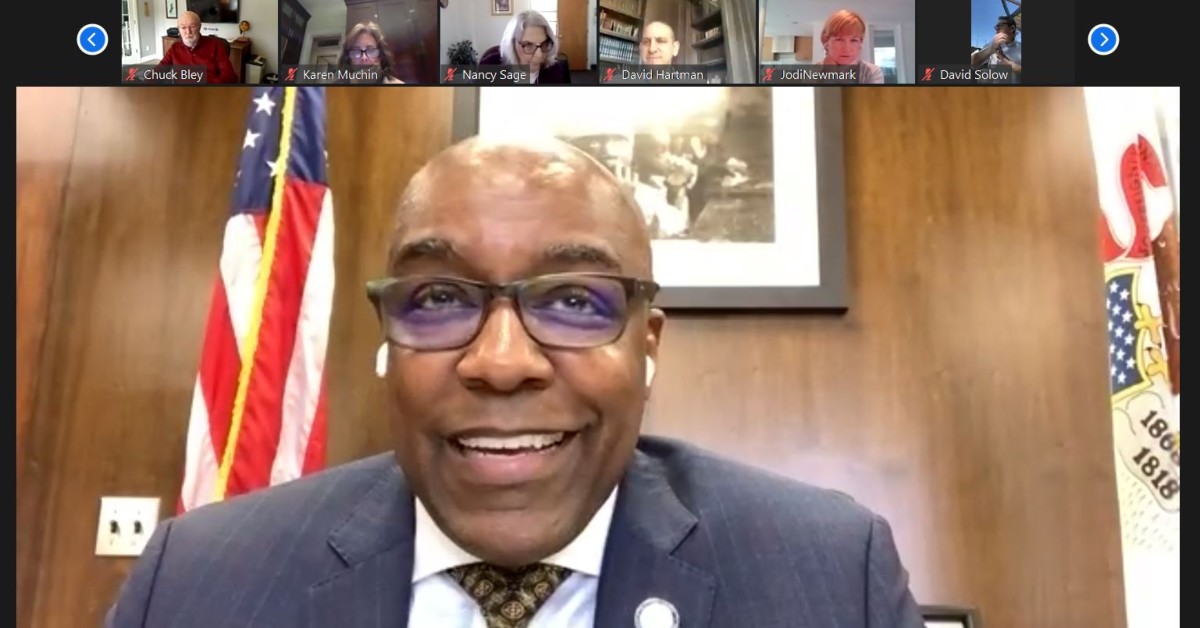
Attorney General Kwame Raoul was our keynote speaker. His remarks were both personal and heartfelt and he expressed appreciation for the work of JUF and our affiliated partners.
***
Our advocacy day included meetings with Illinois Legislative Jewish Caucus members as well as individuals with important committee assignments. JUF lay leaders led meetings with Sens. Sara Feigenholtz, Julie Morrison, Robert Peters, and Karina Villa, and Reps. Robyn Gabel, Jackie Haas, Anna Moeller, and Kathleen Willis.
By the time the spring legislative session closed, JUF had many reasons to celebrate. “The mission was a fantastic success this year,” said Amy Zimmerman, JUF Assistant Vice President, State Government Affairs. “The legislators were very receptive to our asks and some not already championing our bills added their support after the legislator meetings.”
Washington, D.C.
With the federal budget season for FY 23 kicking off just a few weeks ago and midterm elections coming up in November, our virtual mission provided an ideal opportunity to discuss key funding and legislative priorities with members of the Illinois congressional delegation. The 65 federal mission participants advocated for five key priorities:
Nonprofit Security Grant Program (NSGP) Improvement Act of 2022
This act would authorize $500 million for NSGP, and would also make adjustments to the program’s administrative structure to strengthen it moving forward. This would include the establishment of an office within the Federal Emergency Management Agency (FEMA) to expand outreach to underserved communities that could benefit from this grant. In the FY 21 grant cycle, 73 Illinois sites received federal security grants totaling $8.5 million. Delegates also advocated for $360 million for the federal NSGP in the FY 23 cycle.
Holocaust Survivor Assistance Program
This program has provided crucial care and services to Holocaust survivors since its establishment nearly 10 years ago. Currently funded at $6 million, it ensures that survivors receive person-centered trauma-informed care, meaning that their history as survivors is central to the care they receive. Delegates advocated for this program to receive $10 million in FY 23.
Emergency Food and Shelter Program
This program provides funds to charitable organizations like JUF and our partner agencies to combat homelessness and food insecurity in our communities. This is especially important now with increased rates of food insecurity and homelessness throughout the pandemic, leading delegates to request steady funding for the program.
Supplemental Security Income (SSI) Restoration Act
This act would update the benefit levels and program requirements used by SSI, a program meant to support people who cannot work enough to support themselves, either due to a disability or old age. However, the outdated benefit levels and asset limits have not been adjusted in decades, with some not increasing since the program’s founding in 1972. Delegates requested that members of the Illinois congressional delegation support the bill by joining as co-sponsors in support of it.
Mental Health Professionals Workforce Shortage Loan Repayment Act
This act would work to address the concerning shortage of mental health services and programs across the country by offering student loan forgiveness to professionals who serve in shortage areas. Delegates requested that members of the Illinois congressional delegation back the bill by joining as co-sponsors in support of it.
***
Mission delegates met with members or staff representing 11 of the Illinois congressional offices, including full group meetings with Sen. Tammy Duckworth, and Reps. Jan Schakowsky and Brad Schneider. These meetings followed briefings from issue experts, including the Chicago Sun-Times’ D.C. Bureau Chief Lynn Sweet, as well as presentations from several agency executives.
To close out the mission, delegates met with: Emily Voorde, the White House’s Assistant Director of the Office of Public Engagement and the Administration’s Liaison to Disabled Americans; and Mark Levin, the CEO of the National Coalition Supporting Eurasian Jewry, who following his recent visit to Warsaw shared insight into the ongoing Russian invasion of Ukraine and the antisemitic language coming out of the conflict.
“This year’s Washington D.C. Advocacy Mission presented an important opportunity for the community’s collective voices to be heard on a range of our core domestic federal policy issues,” said Lisa Shuger Hublitz, JUF Assistant Vice President, Federal Government Affairs and Director, Washington D.C. Office. “In follow-up conversations with Congressional offices, it is clear that our advocacy has already had an impact and laid the groundwork for the advancement of these important policy priorities.”
Amy Zimmerman is JUF Assistant Vice President, State Government Affairs; Jonathan Schrag is JUF Legislative Director for Federal Government Affairs; and Ellie Prober is a JUF Intern.
In this issue
-
An ‘awesome’ new fellowship for teens
AKLA Chicago will be a free, five-week experiential experience for ages 12–14
Read more -
-