Truck driver delivers personal message about hostages
JULIE MANGURTEN WEINBERG
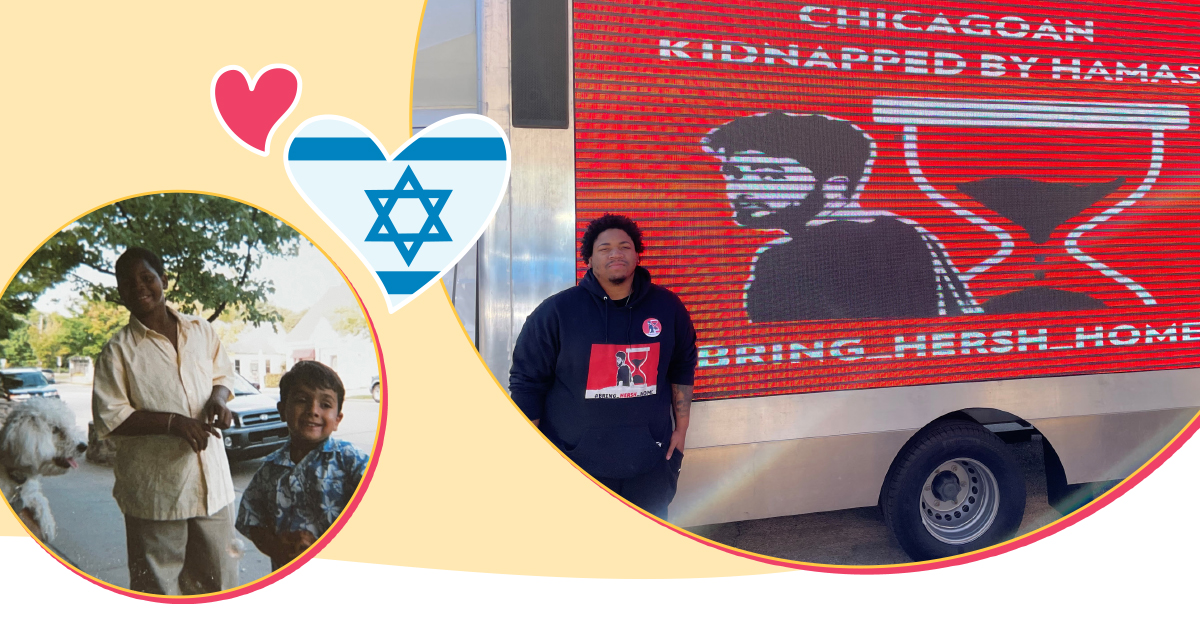
Six days a week, 12 hours a day, Jeremiah Smith drives a truck sided with digital billboards throughout Chicagoland to raise awareness about the hostages held by Hamas since October 7.
But this is no regular gig. For him, it’s personal.
“I wouldn’t want anybody else to do it. I’m out here, and I got Hersh’s back,” Smith said. He is referring to Hersh Goldberg-Polin, the Israeli-American whose Chicago-native parents created the Bring Hersh Home campaign.
Goldberg-Polin–seen in captivity in a video released in April–was attending the Nova music festival in Israel when he was wounded and captured by Hamas.
The two grew up together after Goldberg-Polin’s grandmother took in Smith, introducing him to a new world and a new family.
Smith, now 27, and his own family were living in Cabrini Green, one of Chicago’s public housing projects.
“I used to think ‘I won’t ever accomplish [anything], know how to drive, [or] take a plane,'” he said.
But everything changed when, at age six, he met Marcy Goldberg. She was a tutor at his school, George Manierre Elementary, on the city’s Near North Side.
“I saw people selling drugs. I saw people getting killed. But Marcy came, and she showed me other things,” he said. “She basically saved my life.”
Goldberg guided Smith on his schoolwork and introduced him to Shabbat, challah, brisket, and matzah ball soup. “I used to love the food,” he said.
He called her Bub be, and she called him her grandson. By the time Smith was 12 years old, he moved in with her, got to know her entire family, and bonded with her grandchild, Goldberg-Polin, around age 8 at the time.
“Hersh called me his brother/uncle/cousin,” Smith recalled. “It was nice having a little brother running around.”
When Goldberg-Polin and his family visited from Israel, the boys stayed up late at night and played basketball during the day. Holidays and special occasions brought them together, including Goldberg-Polin’s bar mitzvah in Israel.
“He was the big brother there, because I didn’t know the language,” said Smith.
When Smith received the news of Goldberg-Polin’s capture, he said his “heart dropped” and he “sped over to check on Marcy.”
Earlier this year, community activist Jeff Aeder, the force behind buying the truck, hired Smith to serve as its driver. It was a natural fit, as Smith has his own trucking company, now on hold.
“I’ll do anything to help get the message out there: These hostages have families that want them home,” he said.
With an app on his phone, Smith controls the digital display on three of the truck’s sides, showing images of those in captivity along with messages like: “Hamas is your problem, too.”
The majority of people respond positively, with requests to take pictures and compliments for his effort. However, Smith does encounter critics–and retorts with one question: “Do you think the hostages shouldn’t be free?”
Smith noted that his own childhood uniquely prepared him for this moment. “Growing up in the projects, you have to watch your back everywhere you go. Driving this truck, I have to watch my back everywhere I drive, and I realized, driving the truck, that there’s a lot of hate about what’s happening in Israel and Chicago,” he said. “I’m just glad I was the man for the job.”
Smith has talked to Goldberg-Polin’s mother, Rachel, who shared her love and appreciation. She encouraged him to include pictures of all of the hostages on the truck–not just Hersh.
When asked what Goldberg-Polin would say to his brother/uncle/cousin right now, Smith didn’t hesitate: “I know that Jeremiah will always have my back. He’s family.”
Julie Mangurten Weinberg is a Northbrook-based freelance journalist with 25+ years of experience in broadcast, print, and digital media.