Virtually building a better reality
Michelle Cohen
Chicago’s Jewish Federation held its 121st annual meeting on Sept. 14, and while the format was virtual, the sense of community was very real as presenters highlighted the ways Federation and its family of agencies brought support and connection to people separated by a global pandemic.
“It’s often been said that JUF does more than feed the hungry–we also nourish those who hunger for community. This year, we were reminded of just how much that sense of community means,” said Lisa Rosenkranz, chair of the annual meeting. “Throughout this past year, while much of everyday life was put on pause for the pandemic, our commitment to Jewish life–and to one another– only grew.”
In the spirit of growth, new board members were elected, and retiring members given a fond farewell. Rosenkranz offered special thanks to representatives of local, state, and federal branches of government and agencies, and welcomed Israel’s new Consul General to the Midwest, Yinam Cohen.
More awards than ever before were presented to young leaders and community activists. These included the Davis, Gidwitz, and Glasser Award, for outstanding lay leadership, to Hannah Bloom-Hirschberg and Emily Pevnick; and the Samuel A. Goldsmith Award, for outstanding professional leadership, to Nora Bergman, Letícia Cardoso, Kyle Kolling, and Tejal Patel.
Kim Shwachman, the chair of JUF’s Annual Campaign in 2021, who “[rose] to the challenge” of fundraising during a pandemic with “intense determination and focus” according to JUF/Federation Board Chair Pam Friend Szokol, was honored with the Shofar Award. She passed the torch to Steve Miller, who will hold the role in 2022.
Andy Hochberg received the 58th annual Julius Rosenwald Memorial Award, the Federation’s highest honor. The award, presented each year at the Federation’s Annual Meeting, goes to an individual who has demonstrated a lifetime of outstanding dedication and service to the Federation and the entire Jewish community.
Described by Szokol as someone who “lends new meaning to the tenet of L’dor V’dor , from generation to generation,” Hochberg has continued his family’s proud tradition of chairing JUF’s Annual Campaign. He has also served as the immediate past JUF Board Chair and in a variety of other leadership roles at JUF and beyond.
In his acceptance speech, Hochberg likened the work of building the Jewish community to an athlete training to win a gold medal, and cited four values–unity, training, persistence, and passion–that will help the Jewish community reach its future goals.
Finally, attendees heard from JUF President Lonnie Nasatir, whose “adept oversight of Federation’s response to the pandemic is emblematic of the energy and vision Lonnie brings to the organization,” said Szokol. “Communicating core values to guide Federation’s work, he has led a strategic process with his senior staff to articulate a clear vision and priorities for Federation’s role in the community, from engaging the next generation and securing Jewish continuity to fostering diversity, equity, and inclusion, and fighting antisemitism.”
“Any discussion of this past year must begin with the pandemic,” Nasatir began. “Right now, it feels like we have been running an 18-month marathon. But JUF was built to respond in times of crisis, and–together–we and our family of agencies have kept up a steady pace, meeting challenges unlike any most of us have ever experienced.”
He spoke about efforts like the 2020-2021 Chicago Jewish Population Study to get a better picture of the community as it is, and a goal of cultivating the diversity of opinions while maintaining ” derech eretz “–common decency. This extends to JUF’s fight against antisemitism and anti-Israel sentiment.
Nasatir invited attendees to participate in a future where “JUF continues to be the place where Jews of all backgrounds can find a home; where individual politics are left at the door, and we all focus on our core mission of helping the most vulnerable and engaging the Jewish community in new and exciting ways.”
In this issue
-
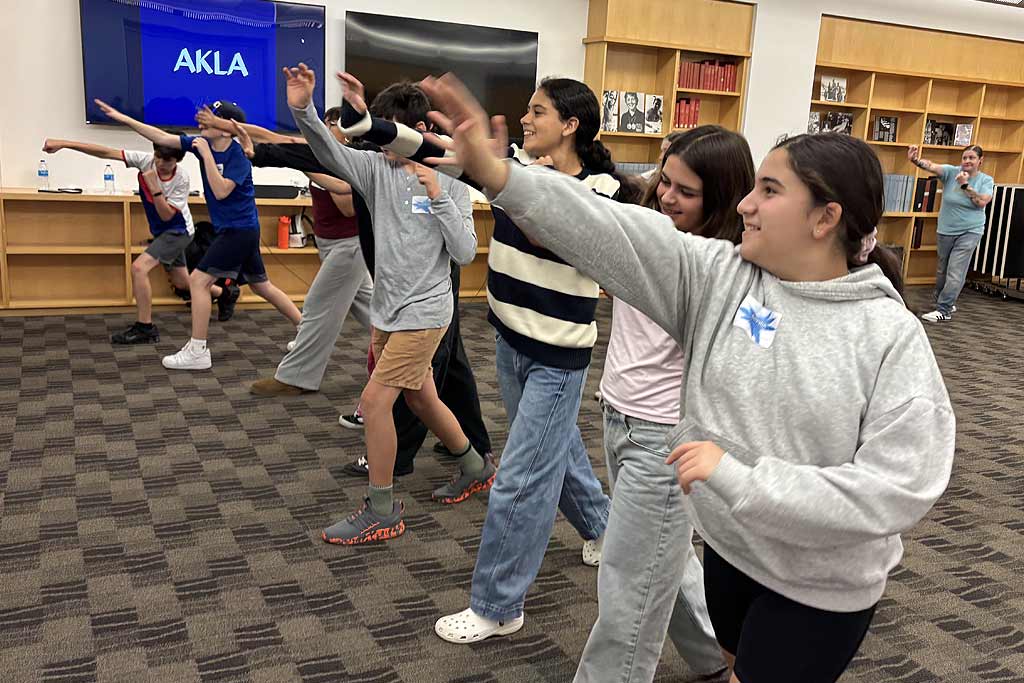
An ‘awesome’ new fellowship for teens
AKLA Chicago will be a free, five-week experiential experience for ages 12–14
Read more -
-