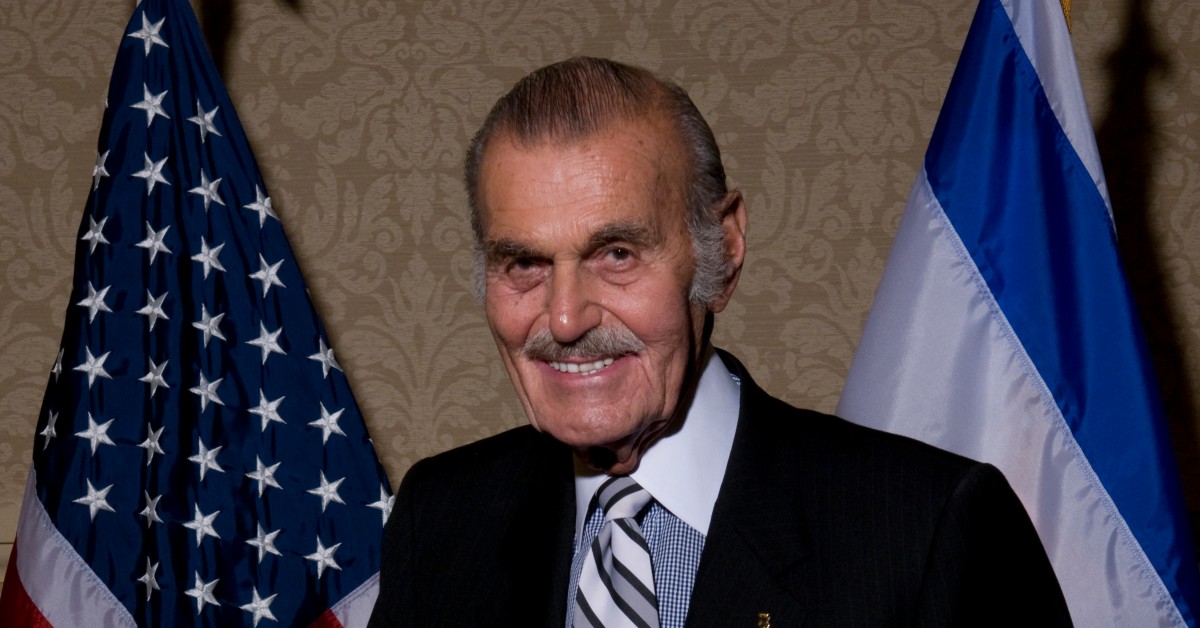
War Hero Leonard Sherman
Joel Schatz
Banged up and bandaged from the serious wounds he suffered in Israel’s War of Independence, Leonard Sherman came home to Chicago in 1948 with nothing in his pocket but the $25 his father had given him.
In short order, he headed downtown and handed $22 of it to the Jewish Federation.
“That was my first gift,” he recalled more than six decades later. The first of countless contributions, not only of cash but of time, passion and unending commitment to the Jewish people and the State of Israel.
Sherman, who died Nov. 17, just two weeks shy of his 99th birthday, not only supported Jewish life and Israel in myriad ways. He was an indelible part of their history.
“In the lobby of the JUF headquarters, Leonard Sherman is one of the names carved into the stone on the wall to mark those who have made significant contributions to this community,” JUF President Lonnie Nasatir said. “It is so appropriate, because Leonard was one of the true builders of our community and the State of Israel for nearly three-quarters of a century.”
In Chicago, he was deeply engaged in the work of the Jewish United Fund. He spoke at events, made countless personal appeals for contributions to support those most in need, and was actively involved as a leader. He led or joined dozens of missions for JUF and the national United Jewish Appeal, as well as serving as a UJA vice chairman and on its General Assembly.
In 1975, just over a quarter century after giving his $22 gift, Sherman was named to chair JUF’s Annual Campaign–and took a 14-month leave of absence from his business to run the fundraising effort.
For all of his many contributions, in 2008 Sherman received the Julius Rosenwald Memorial Award, the Federation’s highest honor, marking a lifetime of service to the Jewish community.
A few weeks before his passing, Sherman asked Dr Steven B. Nasatir, his friend of 51 years, to give his eulogy, which was delivered in November.
“Len was willing to solicit anyone anytime, anywhere–in an office, in an elevator, at the beach, or Shabbat at this synagogue,” Nasatir said in his eulogy. “When it came to supporting Israel and our Jewish community, Leonard knew few, if any, boundaries. That was Leonard–hard driving, creative, inspiring, but also stubborn like a mule. He was a force of nature, and that force resulted in many blessings.”
He also was a major supporter of the Council for Jewish Elderly, now CJE SeniorLife, in no small part due to his wife Diane’s strong commitment.
“She wanted to always extend a helping hand,” he said. “She worked for CJE, ran Shabbat luncheons at Temple Emanuel, offered cooking classes for seniors in Rogers Park, and volunteered at Passover seders for Russian Jews.”
“She was the motivation of my life,” Sherman said of the woman he was married to for 64 years. Many of the endowments and awards he made over the years are named in her memory.
Together for a lifetime, Sherman and his wife carried on what they called “the business of the Jews.” It was, in many ways, a family business. His sister, Suzy Braun, was active in JUF’s Women’s Division and the Federation Board. And it was passed on to Leonard and Diane’s children, David and Miriam, and grandchildren. On the day in 2008 that Sherman received the Rosenwald Award, his son David was installed as chair of the JUF/Federation Board.
“My father’s commitment to the survival of the Jewish people was the most important aspect of his life, and I am ever-thankful that he got me started on my philanthropic journey,” David Sherman said. “I am forever committed to honoring his legacy.”
As committed as Sherman was to Chicago’s Jewish community and American Jewry, his love of Israel was just as steadfast.
After slogging through the South Pacific with the U.S. Army during much of World War II, he said the only skill he learned was how to use mortars. “And when I got out, I couldn’t find a job as a mortar sergeant,” he joked.
“So I went to Palestine to see what I could do to help my fellow Jews.” He worked his way there aboard an export ship out of New York. When he arrived, he quickly joined a military unit and trained others to make and use mortars.
It wasn’t a surprising move. He had grown up in a household deeply committed to the creation of a Jewish State in what then was Palestine. His grandmother was with Theodor Herzl at the first World Zionist Congress in Basel, Switzerland, in 1897.
Fifty years after that congress, on Nov. 29, 1947, Sherman was one of the thousands who stood all night outside the Jewish Agency building in Jerusalem, awaiting word that the United Nations had approved the partition of Palestine.
“The sun came up,” he recalled, and “(David) Ben-Gurion came out on the balcony and announced that we’re a state.” Decades later, the memory still brought tears of joy to Sherman’s eyes. “We waited 2,000 years for this.”
Less than six months later, on May 14, 1948, Israel formally declared independence, and immediately was attacked on all sides by Arab armies. During the siege, Sherman was on a Jerusalem street with his unit, battling to hold back the invasion.
“There were a lot of shots, and the Jordanians were lobbing mortars from behind the walls in the Old City,” he said. “We had no helmets, and I was laying on the street and I got hit in the head.” Those were the wounds that sent him back to Chicago.
David Sherman recounts going on a JUF Mission at age 27 or 28 and visiting Mount Herzl, Israel’s national cemetery.
“The tour guide gestured to the rows upon rows of graves and said,’ Anyone who thinks this land was handed to us on a silver platter? This was our silver platter,'” David Sherman said. “It was at that moment when it first truly hit me–the enormity of what my father did, and how he could have been one of them.”
Over the years that followed his return to Chicago, Sherman became a highly successful real estate entrepreneur, heading Benj. E. Sherman & Sons, the business his father began. But he returned to Israel constantly–more than 90 times–and was deeply enmeshed in the life of the young nation.
He was on a first-name basis with many of the country’s leaders: Golda Meir (“A chain smoker. I used to bring her cartons of Kent cigarettes.”), Yitzhak Rabin, Moshe Dayan, Levi Eshkol, Menachem Begin, all the prime ministers.
During the Six-Day War in 1967, Sherman hopped on a plane from Chicago with fellow real estate developer and philanthropist Philip Klutznick and flew to the battle zone. He was armed only with a suitcase full of transistor radios, which he distributed to wounded soldiers in the hospitals. “That was my total contribution to the Six-Day War,” he said.
Much like his relationship with Israel itself, Sherman’s involvement with its premier science and technology university, The Technion, predated the birth of the state. In 1947, when he was sent to Haifa to train others to use mortars, he slept on a cot at the school.
“I didn’t pay anything for that cot,” he said, “and I’ve been repaying the debt ever since.” He did that by funding endowments for fellowship grants, underwriting three buildings, and spearheading countless fundraising efforts, some of them as president of the American Technion Society. In the decades since Sherman first slept there, the school, which he came to refer to as “my university,” has nurtured much of the scientific leadership that built the state and trained the innovators behind more than 100 NASDAQ-listed firms.
For his efforts, he was awarded the Technion Medal in 2004, just the seventh person to receive the honor in 80 years. And the State of Israel awarded him honorary citizenship for his roles in building the nation and in the War of Independence.
Sherman also was a major supporter of Birthright Israel, the program that offers Jewish young adults free 10-day trips to discover the Jewish State.
“Once we get them to Israel,” he said, “they come back and get involved in Jewish organizations and federations and synagogues and everything under the sun. There is a chance, not a guarantee, but a big chance that Birthright will help save the Jewish people in America and maybe elsewhere in the world.”
Decades after his own first trip to Palestine, under very different circumstances, Sherman would look in awe at what Israel has become.
“We built this,” he said. “The American Jews and Jews elsewhere in the free world and the Israelis have built this. It’s been a partnership. I believe in partnership.”
“My one talent,” Sherman said, “is I’m a great fundraiser. The satisfaction of getting your fellow Jew to contribute to helping another Jew that he may never see or know, to me is the greatest satisfaction one can have.
“That’s my legacy. To extend a helping hand to my fellow Jews.
The beloved husband of the late Diane (nee Natovich), Sherman was the loving father of Mimi and David (Dr. Susie), and the grandfather of Jason, Adam and Josh Kaplan, Ned, Gordie and Adeline Rohrbach, and Jacob and Eli Sherman. Memorials may be made to JUF, or to the American Technion Society. The interment was at Memorial Park Cemetery; arrangements were made by Chicago Jewish Funerals.
Joel Schatz is a writer based in Chicago’s northern suburbs.
In this issue
-
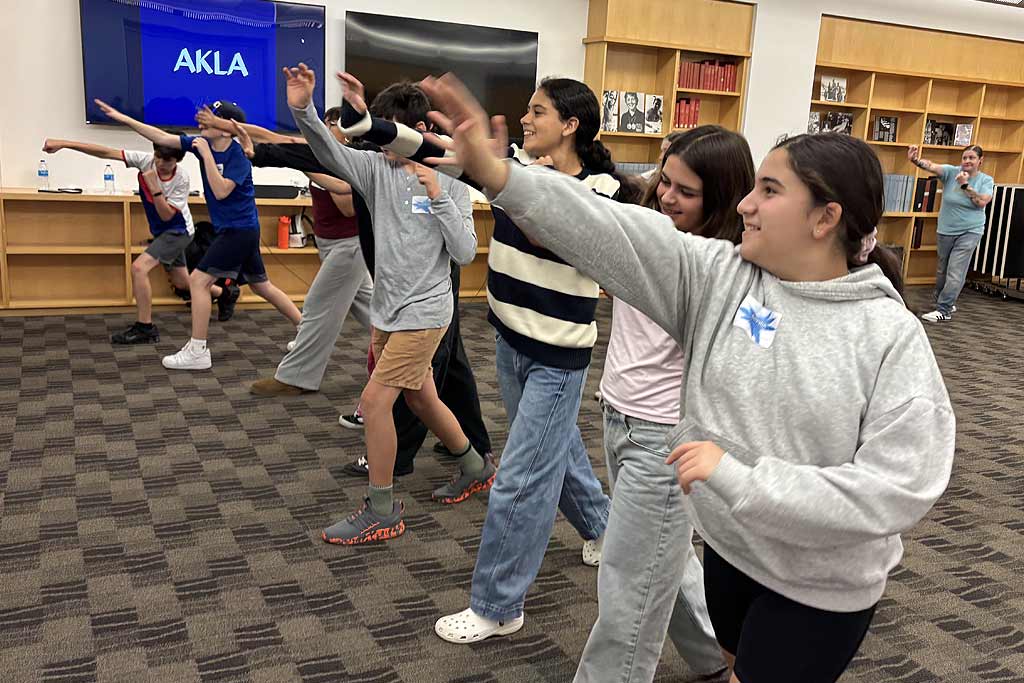
An ‘awesome’ new fellowship for teens
AKLA Chicago will be a free, five-week experiential experience for ages 12–14
Read more -
-