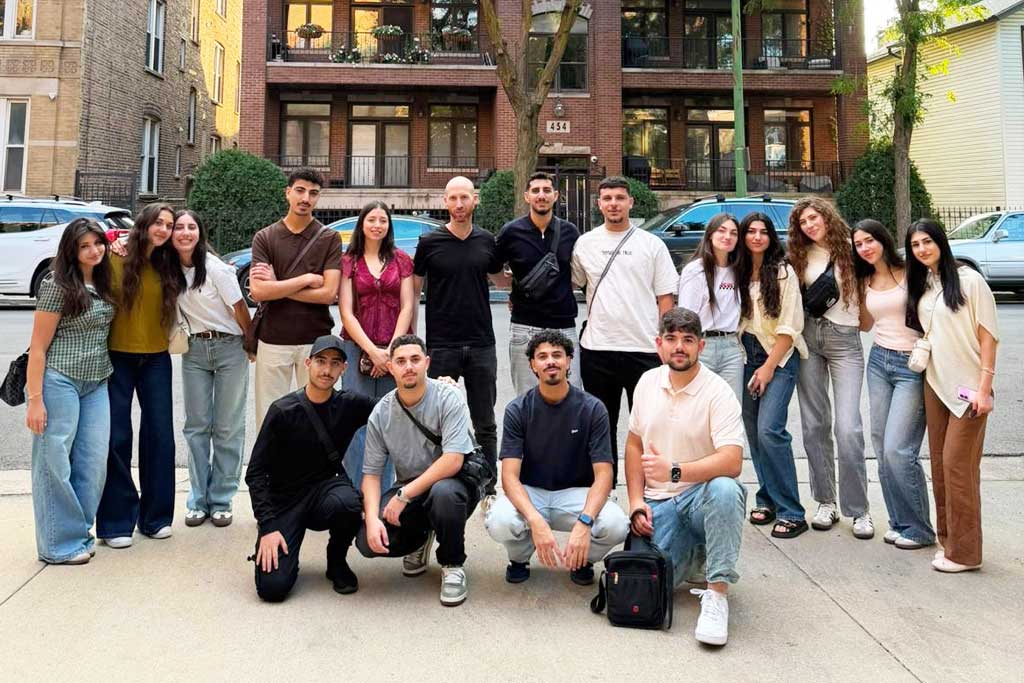
Sanabel teens enjoy Chicago just before going to their first Shabbat dinner.
Many know that a significant percentage of Israel’s citizens are not Jewish. What is less recognized is that this population is as diverse as Israel’s Jewish population itself.
The Druze religion, for example, has traditionally been extremely supportive of the state of Israel. However, as a small minority—numbering 150,000—they have lacked both leadership and a collective voice, and they face many other challenges in Israeli society.
In response, JUF launched a novel, signature project in Israel in 2023.
The Sanabel Druze leadership program is a competitive ten-year course for young members of the Israel Druze minority, starting at age 15. Over the course of ten annual cohorts—each with approximately 25 participants a year—the program aims to create a cadre of 250 leaders for the Druze, and Israel, to help address those challenges.
Over a week in the summer, I had the chance to accompany 15 participants of Sanabel’s first cohort—now 18 years old— to Chicago. The visit introduced these impressive Druze ambassadors to our Chicago community, and showed them what a Diaspora Jewish community looks like. As one minority to another, there is much to be shared and learned about the challenges of living as a distinct religious community.
The Sanabel participants, all first-time visitors to the U.S., had an opportunity to celebrate, for the first time in their lives, Shabbat dinner, which they did with Rav Ezra Balser and his family at the Silverstein Base Chicago. At JUF they heard about the rising antisemitism in Chicago and beyond. They met with Chicago alderpersons representing districts with large minorities, and they followed Jewish students on a tour of the Northwestern campus and Hillel.
The participants also had an opportunity to volunteer at The Ark and at the JUF Uptown Cafe, learning about how our community helps all those in need, Jewish or not. For the Druze, the concept of mutual support, “the Alliance of Brothers,” is a basic tenet of their religion. They were impressed at how our Chicago community implements that value locally and internationally.
In meetings with existing and potential Sanabel donors, the teens had an opportunity to discuss the Druze community, sharing their challenges and dreams. In panel discussions, they related their experience in Sanabel over the past three years, and expressed their future plans as recent high school graduates. They told audiences about their personal growth and the leadership tools they acquired.
One participant has been accepted to an army program which will send him to medical school— at the expense of the IDF—after which he will commit to serving as a combat surgeon. Another was accepted into flight school and will become a fighter pilot. A third participant was accepted into a highly exclusive and competitive military technological program for gifted teens. Some will enroll in national service, working at hospitals and educational institutions, and others will join the IDF in combat and support roles. All will continue to contribute to the state of Israel and to its defense.
The group got a chance to tour Chicago, too. While in town, the teens and I enjoyed going up to the top of Willis Tower, taking the architectural boat tour, and watching a White Sox game, their first baseball game ever.
On the final day, we asked the teens about their impressions of Chicago’s Jewish community. All of them were struck by the mutual responsibility of our community, by the strength that comes from our unity, and by our far-reaching support of needs across the world and especially of the Druze community.
Sanabel is the most massive program ever built for the Druze people by any Jewish community, and the teens certainly appreciated that fact. They gained a deep understanding of the challenges of being Diaspora Jews and the need for us— Diaspora and Israel— to stand together.
Sanabel is an ambitious pilot program, building the future leadership of a very deserving, but overlooked, Israeli minority.
The first cohort’s visit to Chicago exposed our community to these incredible young adults who, thanks to us, are gaining the tools to be future leaders. At the same time, the visit enabled them to gain a firsthand understanding of what a Jewish community in America looks like. Both sides gained important new insights into what makes Israel – and the Jewish world – so strong.
Ofer Bavly is a JUF Vice President and the Director General of the JUF Israel Office.