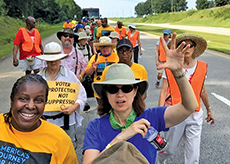
I sat in a bit of a daze in a small, packed church in Cheraw, S.C. on the evening of Aug. 27, 2015. I struggled to keep my eyes open for this NAACP Mass Meeting.
I had woken up that morning in army barracks in Columbia, S.C. where I arrived late the night before to join America’s Journey for Justice with the NAACP. The NAACP has organized this 860-mile, 40-day trek from Selma, Ala. to Washington, D.C. under the banner: “Our Lives, Our Votes, Our Jobs and Our Schools Matter.”
When Rabbi Seth Limmer heard about plans for this journey, he put out a call to see if any rabbis would like to march. To date, over 180 rabbis have walked in this journey coordinated largely by the heroic efforts of Allison Porten and Claire Shimberg, of the Religious Action Center of Reform Judaism.
The march that day commenced with an Elul (12 th month of Hebrew calendar) shofar blast. We marched two-by-two, kept in order by a former marine drill sergeant and kept safe by several plain-clothes policemen. In front, NAACP President and CEO Cornell Brooks led the way with a man holding the American flag. Behind them, people alternated walking with the Torah. Twenty pairs of marchers walked that day-from teenagers to elders-hydrating every mile and taking quick bathroom breaks every three.
After our third three-mile marker, we gathered together to hear some unsettling information: we were approaching an area notorious for its Ku Klux Klan activity. We began this leg of the journey in silence. I held the Torah and watched cautiously as I noticed a Rottweiler off its leash in a nearby open yard. A small crowd of about 10 people gathered across the street at a gas station. One shouted “boo” as others laughed derisively.
Soon, I found myself walking alongside Ivan. This Mississippi-born, 70-year-old man walked with a cane, yet was determined to walk every inch of the 860 mile-journey. We walked the rest of the day’s journey together.
That night at the church, important figures surrounded us and spoke from the pulpit. When Cornell Brooks arrived on the pulpit, he did not look like he had just marched 16 miles-and he certainly didn’t sound like it. He challenged us to see beyond pictures and, in reference to the mass incarceration of people of color, to see beyond prison records. Repeating the numbers listed under the mug shots of Dr. Martin Luther King Jr. and Rosa Parks, he declared:
“You are not defined by your criminal ID record or number, but by your God-given dignity.” He continued: “People counter the notion of ‘black lives matter’ by saying that ‘all lives matter.’ If that be the case, then why is it that a black man is 22 times more likely to lose his life at the hands of a police officer than his white counterpart? We believe that if black lives matter, we have to act like they matter.”
Mr. Brooks’ energy surged as the speech wore on, so that by the end, he nearly shouted the verses that open “Lift Every Voice:”
Lift every voice and sing
Till earth and heaven ring,
Ring with the harmonies of Liberty…
Facing the rising sun of our new day begun,
Let us march on till victory is won.
Fist in the air, he repeated over and over:
“Let us march on! Let us march on!
Let us march on! Let us march on!”
These words continue to echo in my ears as I ready myself to read the words of Parashat Nitzavim (Section of the Hebrew Bible) that begin:
“You stand this day all of you before the Lord your God; your captains of your tribes, your elders, and your officers, with all the men of Israel; Your little ones, your wives, and your stranger who is in your camp, from the hewer of your wood to the drawer of your water; That you should enter into covenant with the Lord your God, and into his oath, which the Lord your God makes with you this day.”
The word for “stand,” nitzavim , is often associated with going into battle. Here, it means “to stand at attention.” Get ready to march.
As I return to Chicago, I stand at attention, ready to continue this march with all of you. There is real work to do in Chicago and we must stand together with others: our school-grade captains, our elders, our elected officials, with all the people in the Chicago community; our teenagers and young ones, our neighbors, and many strangers from the Bronzeville school teacher to the caregiver in Englewood; we have entered into a covenant with the Lord our God who holds us accountable to uphold our part in this brit tzedek -this sacred covenant of justice.
This is how we perform the command in our parasha to choose life: by lifting every voice and giving it the dignity it deserves. We must do this not only in personal interactions, but in the laws we pass and the way we enforce them: ending wage discrimination and racial profiling, restoring and strengthening schools in every neighborhood, and granting everyone the right to vote.
As we begin the new year of 5776, let us march on. Let us choose life!
Rabbi Shoshanah Conover is the Associate Rabbi of Temple Sholom of Chicago.
Other stories
-
Chicago to Israel to Kenya
A family’s story of living Jewishly on three continents Michelle Cohen World May 28, 2021 Avital, Tzofia, and Netanel Kaszovitz outside their home in Nairobi on Yom HaAtzmaut. When Avital Kaszovitz prepared to be a Modern Orthodox shlicha (emissary) to the Jewish community in Ke
Read more -
New exhibit spotlights the experience of ‘Shanghai Jews’
Explore a new Illinois Holocaust Museum and Education Center exhibit
Read more -

Europe’s brave new teachers of the Holocaust
Teaching the Holocaust in the modern era has its difficulties and rewards.
Read more