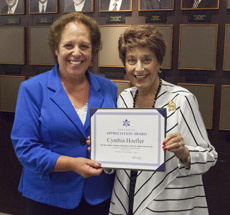
Cynthia Hoefler, a kindergarten teacher at the Bernard Weinger JCC in Northbrook, has been chosen as the first recipient of the Sue Pinsky Award for Excellence in Jewish Education, administered by JUF’s Community Foundation for Jewish Education (CFJE).
Starting this year, The Pinsky Award will be given annually by CFJE to a Chicago area congregational or JCC teacher of children ages 3-12.
“Mrs. Hoefler is the type of Early Childhood teacher that children remember for the rest of their lives,” said Rachel Weber, director of Early Childhood at Weinger. “You can hear her singing out in the hallways, you can see her modeling values for the children in all of her lessons and you can see her listening attentively to every child’s unique wants and needs. Her support is unwavering and her engagement with the children is constant and active.”
Hoefler, a Deerfield resident who originally hails from Skokie and attended Niles West High School, has been teaching for 35 years. She joined the Weinger team in 2004.
“To my son, and our family, Mrs. Hoefler is larger than life,” said Melissa Berman, a Weinger parent. “She has led by example in teaching our children that it is their responsibility to take care of the world around us and each other. She has changed their mindset, from that of someone who is taken care of, to that of someone who is in a position to help take care of others.”
At the award presentation on June 11, Hoefler thanked JUF and the Pinsky family for the acknowledgement.
“It is such an honor to receive this award,” she said. “Teaching has always been my passion and my joy.”
The Pinsky Award was established in honor of Sue Pinsky, a long-time Jewish educator who was instrumental in the founding of the North Suburban JCC. In her 50 years of being a Jewish educator, it is estimated that Sue worked with over 5,000 children in the community.
Sue’s son, Mark Pinsky, and his wife, Lisa, generously established an endowment fund in Sue’s honor to ensure the award in perpetuity through JUF’s Agency Endowment Program
“My mother devoted her career to Jewish education, with a focus on young children,” said Mark. “She taught countless children how to braid a challah, sing ‘Shabbat Shalom’ or make their first menorah. Generations of children in the Chicago area benefited from her enthusiasm, creativity and profound gift for building joy in Jewish identity. We are hoping to inspire future generations of teachers to passionately pursue a career in Jewish education.”
For more information, please contact Rabbi Scott Aaron, PhD, Executive Director of JUF’s Community Foundation for Jewish Education, at[email protected].
Other stories
-
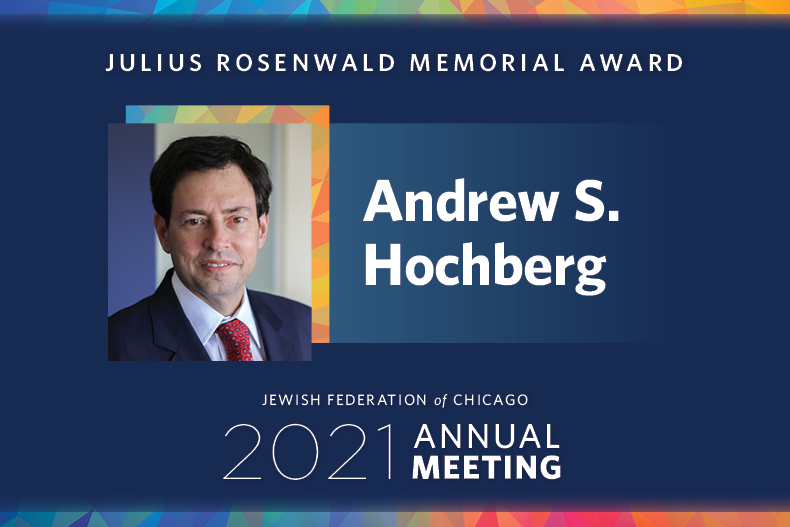
Meet Andrew S. Hochberg, 2021 Julius Rosenwald Memorial Award recipient
Celebrate Andy Hochberg at the virtual Annual Meeting on Sept. 14
Read more -
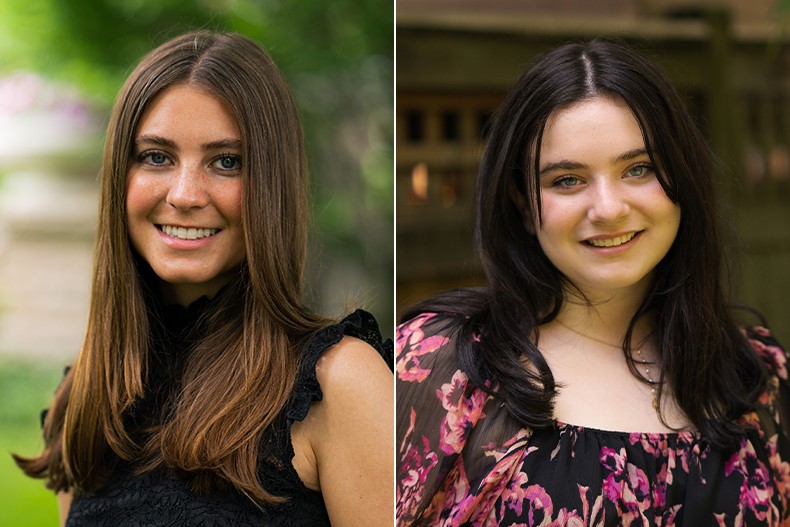
Two local teens win national recognition
Recipients of the annual Diller Teen Tikkun Olam Awards
Read more -
Celebrating six young award winners cultivating the community
Introducing young adult award winners
Read more
Breaking new ground and laying bare old myths, 1913: Seeds of Conflict explores the little-known history of Palestine during the latter part of the Ottoman Empire, a time of relative harmony between Arabs and Jews. Living side by side in the multi-lingual, cosmopolitan city of Jerusalem, Jews, Christians, and Muslims intermingled with a cultural fluidity enjoyed by all. How did this land of milk and honey, so diverse and rich in culture, become the site of today’s bitter and seemingly intractable struggle? Was there a turning point when things could have been different? Weaving the raveled threads of Arab and Jewish narratives back together, 1913: Seeds of Conflict provides new and fascinating insights into events that took place in Palestine which presaged a century of unrest.
1913: Seeds of Conflict premieres Tuesday, June 30, at 9 p.m. on PBS.
See a film preview here: http://1913seedsofconflict.com/trailer/ .
Other stories
-
Meet Andrew S. Hochberg, 2021 Julius Rosenwald Memorial Award recipient
Celebrate Andy Hochberg at the virtual Annual Meeting on Sept. 14
Read more -
Two local teens win national recognition
Recipients of the annual Diller Teen Tikkun Olam Awards
Read more -
Celebrating six young award winners cultivating the community
Introducing young adult award winners
Read more
On Tuesday, June 16, following six months of intense training and mentorship by some of Chicago’s top Jewish business leaders, 13 JCC PresenTense Chicago entrepreneurs, or Fellows, will present to the public how their innovative ideas will impact the Chicago community and the world at JCC PresenTense Chicago’s Launch Night.
From a life-changing bicycle to youth language development, Fellows have developed a wide range of social ventures to meet both niche and global needs. At Launch Night, which is free (for those who register online in advance) and open to the public, Fellows will have one minute to pitch their ventures to generate interest from potential funders, and will then host a business booth expo to present their mission in more detail. Amid the buzz at 1871 Chicago, audience members will network with fellow start-up enthusiasts and help determine who gets funded by doling out valuable “PresenTense Dollars.” The event includes complimentary drinks, appetizers and opening remarks by 1871 CEO and serial entrepreneur, Howard Tullman.
Launch Night takes place from 6:15-9 p.m. Tuesday, June 16, at 1871 (Merchandise Mart, 12th floor), 222 W. Merchandise Mart Plaza. More info about the JCC PresenTense Chicago Fellows and their projects can be found at www.gojcc.org/ptlaunch .
Becky Adelberg, JCC PresenTense Chicago Manager, describes Launch Night as “making it happen…it’s all about launching these ideas and helping them soar.”
Be part of PresenTense’s largest event of the year and engage first-hand with Chicago’s next generation of Jewish change-makers.
The event is free for everyone who registers in advance online at http://bit.ly/ptlaunchtix . $10 at the door. (Space is limited)
Sponsor partners for the JCC Chicago PresenTense Launch Night include: JVS Chicago: Illinois SBDC/Duman Entrepreneurship Center; Spertus Institute for Jewish Learning and Leadership; Jewish United Fund: Trades, Industries & Professions; and, UpStart Chicago.
Other stories
-
Meet Andrew S. Hochberg, 2021 Julius Rosenwald Memorial Award recipient
Celebrate Andy Hochberg at the virtual Annual Meeting on Sept. 14
Read more -
Two local teens win national recognition
Recipients of the annual Diller Teen Tikkun Olam Awards
Read more -
Celebrating six young award winners cultivating the community
Introducing young adult award winners
Read more
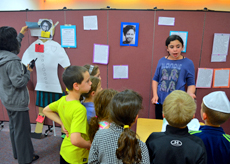
Sixth-grade students at Bernard Zell Anshe Emet Day School (BZAEDS) created a Civil Rights Museum with exhibits on Civil Rights figures like Martin Luther King Jr., Malcolm X, Emmett Till, and Claudette Colvin. They served as docents for parents and fellow students as young as first graders. Among themselves, they discussed themes of tikun olam (repairing the world), the difference between “bystanders” and “upstanders,” and the similarities between the Civil Rights movement and Jewish history. The experience was an outgrowth of BZAEDS’s partnership with Facing History and Ourselves; professionals from that organization visited the student-made museum and reported back to the Crown Family Foundation, which has underwritten Facing History and Ourselves’ school partnerships.
Other stories
-
Meet Andrew S. Hochberg, 2021 Julius Rosenwald Memorial Award recipient
Celebrate Andy Hochberg at the virtual Annual Meeting on Sept. 14
Read more -
Two local teens win national recognition
Recipients of the annual Diller Teen Tikkun Olam Awards
Read more -
Celebrating six young award winners cultivating the community
Introducing young adult award winners
Read more

The second annual Chicago Kosher BBQ Competition and Festival (cRc supervision) will take place from 11:30 a.m. to 4 p.m. Sunday, June 14, at Anshe Emet Synagogue, 3751 N. Broadway, Chicago.
With an anticipated 15 teams competing, trophies will be awarded in the following categories: Best Brisket, Best Ribs, Best Chicken, Best Beans, Most Original Team Name, Best Booth Decoration and Grand Champion.
Competing teams include: 5 Dudes and A Vegetarian, Bris-Cut BBQ Team, Burnt Offering, Caught Smokin, Dukes of Chazzer, Farbreng It, Holy Smoke, Meat The Press, RaBBI-Q, Reggie’s Smoked Meats, Rib Roastin’ Rabbis, The Urban Jew and Uncle Mordy, John and the MEATzva Girls
In addition to the BBQ competition, events will include pickle and hot dog-eating contests, live entertainment featuring the Chicago Boyz Acrobatic Team, a DJ, and Hi-Five Hoops Basketball and NFL Flag Football clinics. The kids zone will feature face painting, a balloon artist, inflatables, a dunk tank, a mechanical bull and more.
Delicious food will be offered from Milt’s Food Truck.
This event is open to the general public. A $5 donation for entry is suggested with the proceeds going to this year’s designated charity, Maot Chitim.
For additional information, please visit: http://chikosherbbq.org
Other stories
-
Meet Andrew S. Hochberg, 2021 Julius Rosenwald Memorial Award recipient
Celebrate Andy Hochberg at the virtual Annual Meeting on Sept. 14
Read more -
Two local teens win national recognition
Recipients of the annual Diller Teen Tikkun Olam Awards
Read more -
Celebrating six young award winners cultivating the community
Introducing young adult award winners
Read more
In a recent article for Huffington Post , Barbara Ernst Prey, an artist and member of the National Council on the Arts, said this about the importance of support for art and artists: “What artists do is tell stories. They help us make sense of our world, and they broaden our experience and understanding. The arts enable us to imagine the unimaginable, and to connect us to the past, the present, and the future, sometimes simultaneously.”
This realization is not lost on the Jewish community. The Midwest Jewish Artists Lab addresses the need to broaden the impact of the arts in Jewish life, helping foster meaning, community, identity, and spirituality. Beginning this fall, a cohort of ten to twelve Chicago-area artists will have the opportunity to participate in this innovative four-year-old initiative, as the lab comes to Spertus Institute for Jewish Learning and Leadership, generously supported by a grant from the Covenant Foundation.
For the participating artists, the project will provide a community of creativity, support, and enrichment. Monthly meetings – facilitated by Spertus Institute faculty and outside experts – will include opportunities for Jewish text study, discussions of topics and themes relating to Jewish art, and occasions for critical evaluation of participants’ work. Art and artifacts from Spertus Institute’s world-class collection will provide examples for discussion and inspiration. An exhibit of participants’ work will be mounted at Spertus Institute in late spring 2016.
Initially piloted at three locations, the Harry & Rose Samson Family Jewish Community Center in Milwaukee, the University of Wisconsin Hillel in Madison, and the Sabes Jewish Community Center in Minneapolis, Spertus Institute in Chicago is part of an expansion of the Midwest Jewish Artist Lab that will also include the Jewish Community Center of Greater Kansas City.
A central theme for 2016 will be selected by representatives of the five participating communities at a conference in Milwaukee in August 2015. Past themes have included Wandering , Light , Text/Context/Subtext , and Water .
Of the program, Spertus Curator of Collections Ilana Segal says, “Spertus Institute has a long and established tradition of supporting local Jewish artists. Past efforts have included juried competitions for contemporary Jewish ceremonial art, as well as solo and group exhibits of both emerging and established local artists. The Midwest Jewish Artists Lab represents an exciting development in this tradition, one we hope will help serve as the next step in our work to foster a flourishing community of Jewish artists in Chicago.”
Applications for the newest cohort of the Midwest Jewish Artists Lab are being accepted through Aug. 3 for Jewish artists in the Greater Chicago area. Artists may work in any medium.
To enter, artists must submit a personal statement and several samples of their work. If selected, artists will be expected to pay a $180 participation fee and attend monthly sessions, which will be held at Spertus Institute, October 2015 through June 2016. These sessions will be scheduled in consultation with participants.
Participating artists will create a work or series of works that reflect the theme selected for 2016, and then these works will be shown at Spertus Institute in the concluding exhibit. More information can be found at spertus.edu .
Other stories
-
Meet Andrew S. Hochberg, 2021 Julius Rosenwald Memorial Award recipient
Celebrate Andy Hochberg at the virtual Annual Meeting on Sept. 14
Read more -
Two local teens win national recognition
Recipients of the annual Diller Teen Tikkun Olam Awards
Read more -
Celebrating six young award winners cultivating the community
Introducing young adult award winners
Read more
Chicago law firm Much Shelist filed a complaint in the US District Court for the Northern District of Illinois on behalf of the victims of French deportations during World War II and their families. The suit is against Société Nationale des Chemins de Fer Français (SNCF)-the French national railway.
The suit, which includes a plaintiff, Karen Scalin of Lincolnshire, seeks to hold SNCF accountable for the expropriation of cash, securities, silver, gold, jewelry, works of art, and other belongings confiscated from their families. The items were taken during the deportations of more than 75,000 Jews and others from France to Nazi camps from 1942-44. SNCF, one of the 250 largest corporations in the world, does business in Illinois through its subsidiary, which maintains a Rosemont-based facility.
“My grandparents were transported in SNCF cattle cars to their deaths at Auschwitz in 1942, and their belongings were seized by railroad officials,” said Scalin. “No compensation has ever been made to my family and the thousands of other victims of these coercive acts.” The suit was filed on April 16, International Holocaust Remembrance Day.
“These seizures were a violation of international law and a crime against humanity, and restitution is long overdue,” said Much Shelist attorney Steven P. Blonder, who represents the plaintiffs.
Other stories
-
Meet Andrew S. Hochberg, 2021 Julius Rosenwald Memorial Award recipient
Celebrate Andy Hochberg at the virtual Annual Meeting on Sept. 14
Read more -
Two local teens win national recognition
Recipients of the annual Diller Teen Tikkun Olam Awards
Read more -
Celebrating six young award winners cultivating the community
Introducing young adult award winners
Read more
A recent Chicago Tribune editorial correctly applauds the Illinois legislature for having divested pension funds from companies doing business with Sudan (for its genocide in Darfur) or with Iran (for its illicit nuclear program). That divestment approach was also justified with apartheid South Africa.
Thus, it is only natural that the General Assembly-with leadership provided by Sen. Ira Silverstein, D-Chicago, and Rep. Sara Feigenholtz, D-Chicago-has passed a bill to synchronize our state’s investment policies with our values: divesting from foreign companies boycotting Israel.
Despite the partisan rancor often paralyzing Springfield, the bill passed the Senate and the House without a single dissenting vote. As JUF News went to press, Gov. Bruce Rauner, who has championed the effort, said he would sign the bill. Illinois will be the first state to compel foreign boycotters to make a choice: You are free to profit from our investment dollars. You are also free to boycott Israel. But in this state you will no longer be free to do both. If you choose the boycott avenue, we are free to cash in our investment. You-the foreign company -do not have U.S. or Illinois constitutional rights to our discretionary investment dollars.
Why should foreign companies have the right to politicize, in a blatantly discriminatory manner, their business choices while Illinois must sit passively on its hands, powerless to do anything other than continue to fund that foreign company?
The bill doesn’t “boycott the boycotters.” Foreign companies boycotting Israel remain free to not only conduct business in Illinois but even to secure contracts with the state itself.
The status quo actually puts U.S. companies at a competitive disadvantage. For 40 years, federal law has criminalized participation by American firms in the Arab economic boycott of Israel. In fact, the first to plead guilty for violating that law was an Illinois company that paid the maximum $500,000 fine.
Why should U.S. firms be fined while foreign companies would not only be held harmless, but could even get a continuous stream of capital investments from Illinois taxpayers?
Beyond fixing that anomaly, the bill supports our nation’s closest, most stable, and only democratic ally-Israel -in the volatile Middle East. Illinois has strong economic, scientific, academic and cultural ties with Israel, ties that bring jobs, commerce and other benefits to our citizens.
The bill also adds a clause that actually reduces costs Illinois incurs to enforce the Sudan and Iran divestment laws. By creating the Illinois Investment Policy Board, compliance with all divestment directives will now be administered from one consolidated list.
The boycotters of Israel have two priorities.
• First, stop all direct trade with Israeli companies.
• Second, boycott and divest from companies, typically American ones, doing business in Israel. Often at the very top of that roster are Illinois companies where tens of thousands of our neighbors, families and friends are employed: Caterpillar, Motorola Solutions, Baxter, Abbott, McDonald’s, Boeing, ADM and John Deere, to name just a few.
Illinois is doing the right thing by requiring the state’s pension system to shun companies that refuse to do business with Israel. Many other states will likely follow suit.
In politically polarized Springfield, this bill enjoys uncommon common ground. Its sponsors represent both political parties, urban and rural districts and include Latino, African-American and Arab-American legislators. It allows Illinois to stand with our ally, align our values with our investments and level the playing field for American companies competing with foreign counterparts.
Who wants to boycott that?
Jay Tcath is JUF executive vice president. This article first appeared in the May 18, 2015 Chicago Tribune and is reprinted with permission .
Other stories
-
Meet Andrew S. Hochberg, 2021 Julius Rosenwald Memorial Award recipient
Celebrate Andy Hochberg at the virtual Annual Meeting on Sept. 14
Read more -
Two local teens win national recognition
Recipients of the annual Diller Teen Tikkun Olam Awards
Read more -
Celebrating six young award winners cultivating the community
Introducing young adult award winners
Read more
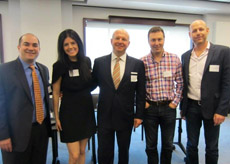
The third Annual JUF’s Ben-Gurion Society (BGS) Luncheon, on May 7 at Winston & Strawn, celebrated Jewish honorees of Crain’s Chicago Business 2014 40 Under 40. Crain’s 40 Under 40 honors dealmakers, innovators, risk-takers, and job creators, all who have reached the top of their fields before their 40 th birthdays. The event was chaired by Steven Levine, with a host committee of 21.
Highlighting the sold-out program was an interactive panel, featuring three 40 Under 40 honorees-Lindsay Avner, Founder & CEO of Bright Pink, Zach Kaplan, Founder and CEO at Inventables, and Matt Spiegel, Senior Vice President and General Manager of MediaLink. The panelists told the audience about ventures past and present, challenges they’ve overcome, and words of wisdom.
BGS is a national donor recognition society for young adults, ages 25-45, who make a contribution of $1,000 or more to JUF’s Annual Campaign. BGS embodies David Ben-Gurion’s legacy that men and women use their passion and resources to build a strong and responsible Jewish community at home, in Israel, and around the world.
Thanks to the generosity of a group of former JUF Young Leadership Division Campaign chairs and board presidents, any new 2015 JUF Annual Campaign gifts of-or increases to–$1,000 will be matched, doubling the impact of the gift. Sixty new BGS members have already been secured through this match fund.
Other stories
-
Meet Andrew S. Hochberg, 2021 Julius Rosenwald Memorial Award recipient
Celebrate Andy Hochberg at the virtual Annual Meeting on Sept. 14
Read more -
Two local teens win national recognition
Recipients of the annual Diller Teen Tikkun Olam Awards
Read more -
Celebrating six young award winners cultivating the community
Introducing young adult award winners
Read more
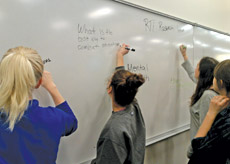
Do you think about “big things”- like gender, sexuality, and class? Do you have complicated feelings about what it means to be a Jew? Do you wish the adults in your life would just listen to you for once?
Well, Teens@JUF is listening! Right now! If you are a Jewish girl between 13 and 18 living in the Chicago area, take a quick 15-minute survey about your experiences. You can find it online at surveymonkey.com/s/VW9H397.
The results will directly impact the kinds and qualities of services JUF has available to you. For example, the Research Training Insititute (RTI)-whose 2015 class created this survey!
RTI is for U!
Interested in becoming a Research Training Intern next year? JUF’s RTI program is an internship for Jewish high school-aged girls interested in exploring issues of race, class, power, gender, sexuality, and privilege, through the lenses of Judaism and academic research. By seeking to better understand their own communities, RTI interns hope to affect real changes in the kinds and qualities of programs, supports, and services available to their peers.
This year, 16 RTI interns representing a diversity of experiences are creating a survey to explore how privilege and oppression inform the identities of young Jewish women in the Chicagoland area.
As a part of our team, you will have the opportunity to join our research team and work with us to address critical questions, like:
• Who is the “perfect girl” and what does a girl have to do to be like her?
• What are the secrets to her success?
• What happens when girls try to live up to these expectations?
These questions help us dive into this important topic. Where we go from there will be up to you!
When you become an RTI intern, you will receive training by DePaul University researchers to design a study of the messages teen girls have to navigate, collect data from your peers, and analyze the results. You will learn how to use these findings to educate others and pursue social justice.
And you will enhance your résumés and college application materials-not only by pioneering the first-ever Jewish teen research internship in Chicago- but also by engaging in college-level discussion and research methodology.
Plus, you will make new friends
among a diverse group of young Jewish women in the Chicago community with a broad range of backgrounds, experiences, interests, ideas, and skills!
For more information about how to get involved in next years’ Research Training Internship, visit
juf.org/teens/RTI_About.aspx .
Other stories
-
Meet Andrew S. Hochberg, 2021 Julius Rosenwald Memorial Award recipient
Celebrate Andy Hochberg at the virtual Annual Meeting on Sept. 14
Read more -
Two local teens win national recognition
Recipients of the annual Diller Teen Tikkun Olam Awards
Read more -
Celebrating six young award winners cultivating the community
Introducing young adult award winners
Read more