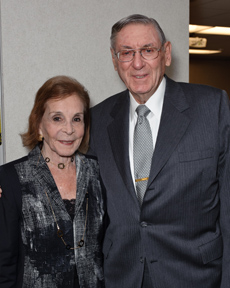
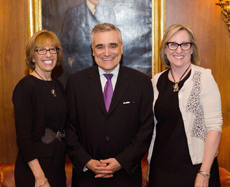
Longtime Chicago Jewish leader, JUF supporter, lover of Israel, and humanitarian Lester Crown was honored in advance of his 90th birthday at the JUF Board of Directors Meeting on May 21. The community paid tribute to Crown, as well as his wife and partner, Renee, “as a perpetual source of strength and support during the most difficult and most joyous times in modern Jewish history.”
At the meeting, Crown sat down for a conversation about his remarkable life to date with Dr. Steven B. Nasatir, JUF President, and Bill Silverstein, Chairman of the JUF Board.
Crown spoke about his family’s origins in Eastern Europe, who journeyed to this country to achieve the “American Dream” like so many other Jews. “They were as patriotic as anyone could be,” he said. “I always felt that if you pricked dad’s arm, the blood would come out red, white, and blue.”
He spoke with adoration about his father, the late Henry Crown, a great philanthropist and industrialist. When the state of Israel was established, Henry’s building materials business was booming. “If Israel is every threatened to the point of…extinction,” Henry said, “you send them everything we have. Everything! We can start over; they can’t.”
When asked what advice Crown has for the next generation, he quipped, “make more money and contribute more…You give back to those who are less fortunate because that’s what you owe, because you have the good fortune to be here.”
Other stories
-
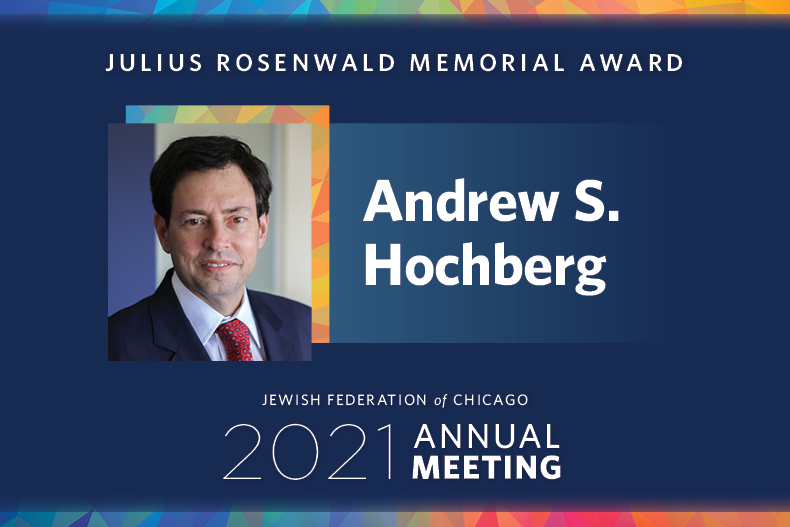
Meet Andrew S. Hochberg, 2021 Julius Rosenwald Memorial Award recipient
Celebrate Andy Hochberg at the virtual Annual Meeting on Sept. 14
Read more -
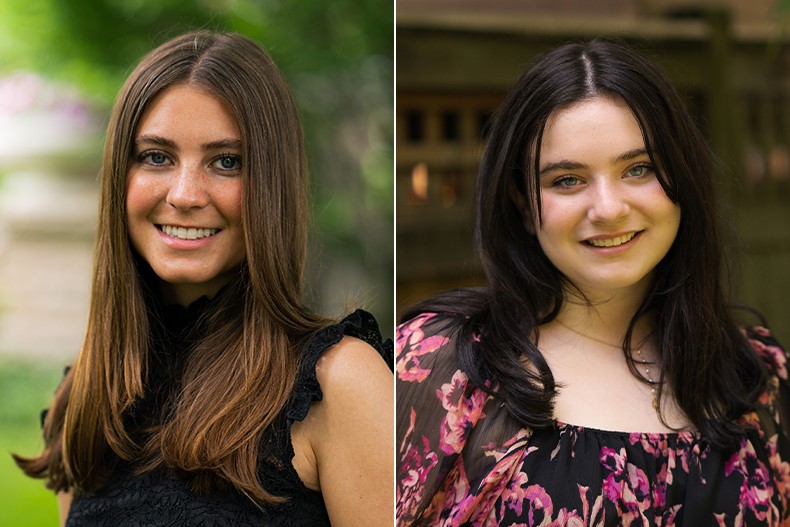
Two local teens win national recognition
Recipients of the annual Diller Teen Tikkun Olam Awards
Read more -
Celebrating six young award winners cultivating the community
Introducing young adult award winners
Read more
In the first year of operation, the Create a Jewish Legacy program has raised 323 endowment gifts totaling $8.8 million for Chicago area Jewish agencies, synagogues, and day schools.
Create a Jewish Legacy , a national program operating in 23 cities, is designed to train and support communal organizations in the areas of legacy giving, planned giving, and endowments. Supported by the Harold Grinspoon Foundation and an anonymous donor, Create a Jewish Legacy is being led in Chicago by the Jewish United Fund/Jewish Federation of Metropolitan Chicago.
The 15 local partner agencies, synagogues, and day schools that participated in year one of Create a Jewish Legacy attended group seminars on how to secure bequests from donors, received marketing tools, and had individualized coaching sessions. In the first year of the program, all of the Create a Jewish Legacy partners met their goals in securing declarations of intent from donors who pledged to leave them bequests in their wills. In addition, $817,797 in cash gifts was realized. All of the organizations will receive a $10,000 incentive grant for their unrestricted use.
“We are proud of the accomplishments of the participants and are extremely pleased that JUF/JFMC has been able to provide resources to help them be successful,” said Jane Cadden Lederman, Create a Jewish Legacy Chair.
Create a Jewish Legacy Chicago partners include: Am Yisrael Conservative Congregation; The ARK; Chicago Jewish Day School; Chicago Sinai Congregation; CJE SeniorLife; Hebrew Theological College; Hillel Torah North Suburban Day School; Illinois Holocaust Museum & Education Center; Jewish Child & Family Services; Keshet; North Shore Congregation Israel; North Suburban Synagogue Beth El; Oak Park Temple B’nai Abraham Zion; Solomon Schechter Day School of Metropolitan Chicago; and Temple Jeremiah.
“The program has done an excellent job in providing the impetus for us to tackle planned giving,” Sheryl Cohen Solomon, Development Director at North Shore Congregation Israel. “Our congregants have been excited to participate in order to help us receive the incentive grant, and it has provided a perfect opportunity for us to begin what can sometimes be a difficult conversation.”
Ed Plotkin, Director of Development at Hillel Torah said, “Discussions about endowments and legacies have been going on for some time at Hillel Torah, but this program put everything together and provided the incentive that helped us start to act. Next year, legacy giving will be part of our Society of Patrons and Grandparents Club Campaigns.”
To learn more about the program, contact Naomi Shapiro at (312) 357-4853 or [email protected].
Ron Krit is manager of endowment development, Legacies and Endowments, for the Jewish United Fund of Metropolitan Chicago.
Other stories
-
Meet Andrew S. Hochberg, 2021 Julius Rosenwald Memorial Award recipient
Celebrate Andy Hochberg at the virtual Annual Meeting on Sept. 14
Read more -
Two local teens win national recognition
Recipients of the annual Diller Teen Tikkun Olam Awards
Read more -
Celebrating six young award winners cultivating the community
Introducing young adult award winners
Read more
Jewish United Fund increases allocations by nearly $4 million
CHRISTINE SIEROCKI LUPELLA
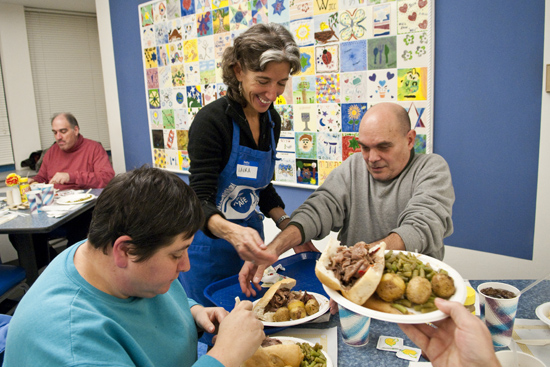
Providing meals at the JUF Uptown Cafe is one of the numerous ways JUF meets local basic needs.
Meeting basic human needs. Advocating for and supporting Israel and endangered Jews around the world. Ensuring a vibrant Jewish future.
With these primary goals in mind, hundreds of community leaders spent thousands of hours crafting the plan for how the Jewish United Fund/Jewish Federation of Metropolitan Chicago will allocate $154.4 million in Fiscal Year 2016-a nearly $4 million increase from last year.
The largest share of funding comes from the JUF Annual Campaign, which raised $82.1 million last year. In addition, JUF/Federation distributes funds received from government agencies, foundations, endowments, donor advised funds, the United Way, and other sources.
“Each year, JUF reaches 300,000 Chicagoans of all faiths who are in need through a comprehensive network of social service agencies, and provides relief for 2 million Jews around the world,” said Bill Silverstein, JUF/Federation Chairman.
Meeting basic human needs
With its commitment to meeting basic human needs, JUF/Federation furnishes support to approximately 70 agencies and programs. Under the FY ’16 budget, $24.71 million will go to Chicago area social service agencies and programs, including Jewish Child & Family Services, CJE SeniorLife, Jewish Vocational Service, Sinai Health System, and The Ark.
Increased resources have been made available to enhance services to Holocaust survivors, reinforce existing emergency safety net programs, and provide legal services for domestic violence survivors.
Supporting Israel and overseas programs
Nearly $34.4 million will go to Israel and overseas to provide significant support for world Jewry in crisis through JUF/Federation partner agencies and programs, including Jewish Federations of North America, American Jewish Joint Distribution Committee, Jewish Agency for Israel, and World ORT.
During the past year, Jews around the world have been under siege, with wars in Israel and Ukraine and increased anti-Semitic activities across Europe. JUF/Federation’s support enables these partners to provide emergency and long-term assistance that helps individuals and communities recover.
The allocation also reinforces JUF overseas initiatives and programs. These include Partnership Together, which provides services to the most vulnerable in Israel’s Kiryat Gat-Lachish-Shafir region, and the Kyiv Kehilla Project, which addresses hunger and supports formal and informal Jewish education programs in Ukraine. In addition, the funds will enhance educational programs operated by the streams of Judaism in Israel: Progressive (Reform), Masorti (Conservative), and Modern Orthodox.
Fostering a vibrant community
JUF/Federation allocations reflect a strong commitment to building community and promoting Jewish continuity. In FY ’16, $17.1 million will go to the Jewish Community Center of Chicago, Associated Talmud Torahs, Community Foundation for Jewish Education, 16 Chicago area Jewish day schools, Spertus Institute for Learning and Leadership, Hebrew Theological College, and other programs.
A total of $245,000 within these allocations has been designated to encourage adult participation in Chicago Jewish communal life, create professional development opportunities for day school educators, and extend partnerships with local congregations.
Engaging Jewish teens
An additional $120,000 allocation will be the first part of a multi-year commitment to a broad new teen initiative that will significantly increase opportunities for youth engagement and expand partnerships with youth groups (See story on p. 23).
Creating connections to Israel
Another $5.75 million will go to efforts to promote Israel outreach, advocacy, and cultural connections at the local and national levels, including combating anti-Israel campaigns; maintaining Israel studies programs on campuses; and sponsoring Birthright trips. This allocation also includes support for agencies such as the Illinois Holocaust Museum and Education Center.
Advancing innovative programs and initiatives
In addition, a $1.17 million allocation to the Breakthrough Fund-nearly $180,000 more than FY 2014-15-will support innovative programs and initiatives in the Chicago Jewish community.
This pilot program-in its second year-awards grants to a broad array of efforts, including programs focusing on inclusion and individuals with disabilities, the creation of online resources for seniors, programs that strengthen students and engage community members, programs for Jewish grandparents and an incubator for Jewish social entrepreneurs (See story on p. 17).
Most of the remaining JUF/Federation FY ’16 allocations cover distributions from donor-advised funds, community programs and services provided directly by JUF/Federation, support services to affiliated agencies, and operational expenses.
Effectively distributing JUF/Federation funds is a collaborative effort involving community leaders, and JUF/Federation and agency professionals. Members of the Health and Human Services, Israel and Overseas, and Community Building and Jewish Continuity Commissions of JUF’s Overall Planning and Allocations Committee identify needs, assess impact, and recommend future allocations.
“An engaged and impassioned group of lay leaders worked on these allocations for an entire year,” said OPAC Chair Andrea Yablon. “They carefully considered each request and made their recommendations based on site visits, interviews and strategic planning.”
“Through this process we ensure that critical assistance will be available in the future, and that agencies are equipped to provide effective responses to rapidly changing needs,” Silverstein said.
Other stories
-
Meet Andrew S. Hochberg, 2021 Julius Rosenwald Memorial Award recipient
Celebrate Andy Hochberg at the virtual Annual Meeting on Sept. 14
Read more -
Two local teens win national recognition
Recipients of the annual Diller Teen Tikkun Olam Awards
Read more -
Celebrating six young award winners cultivating the community
Introducing young adult award winners
Read more
Don’t forget to build your bones! Aside from not wanting to look frail, it’s important to have strong bones to prevent injuries. Everyone lists a different age, but the consensus is, in our 30’s bone growth slows down, and if you are not exercising, it’s time to start. The silver lining; weight bearing exercises can help increase bone density! Weak bones might affect the elderly the most, but exercising in your youth and proper nutrition can help lower your risk as you age.
In regard to bone health, not all exercises are created equal. The best movements to increase bone density are strength training and body weight exercises. Even walking can help! Swimming and biking are great exercises, but when it comes to bone growth there needs to be some sort of impact for the exercise to spur the growth. Here is a list of bone building movements:
• Walking, jogging, hiking
• Stair climbing
• Basketball
• Tennis
• Dancing
• Elliptical training
Since the hips are an area where many adults develop thinning of the bone (osteoporosis), the best exercise for that region is squats. The easiest way to practice this move is by sitting in a chair, standing up, and then sitting down again several times. If you experience pain while squatting, consult your doctor for alternatives. I also recommend meeting with a personal trainer to learn correct form. Improper exercise can also lead to bone, joint, and muscle pain.
Another crucial factor that ties into skeletal health is nutrition. According to Dr. Alpert, sports medicine orthopedic surgeon at Midwest Bone and Joint, “The strength of our bones is dependent on an appropriate amount of calcium and vitamin D. Although most of this intake can occur on a daily basis from diet and sunlight, the general recommendations are for 1000-1200 mg of calcium and at least 1000 units of vitamin D per day.”
Certain foods that are rich in calcium are great for our bones, like dairy (like yogurt, milk, and cheese), almonds, leafy greens, and broccoli. Several studies have shown excessive tobacco, alcohol, and caffeine consumption has negative effects on bone health. Vitamin D is added to many foods these days like milk and certain juices. The sun is the best source of vitamin D, but you need to be careful to avoid skin cancer-but getting some sun is healthy. Since we obviously live in a cooler climate, in the wintertime, talk to your doctor about supplementation.
Dr. Alpert also suggested, “For patients who are at high risk to develop osteoporosis, (especially post-menopausal women) ask your doctor about obtaining a dexa scan, a simple quick painless test which can measure bone density and level of osteopenia and osteoporosis.”
It’s not surprising that a healthy lifestyle combined with weight-bearing exercise will strengthen your bones. Before starting a new training regimen, always check with your doctor first. Now go out for a nice walk and follow it up with a kale smoothie. For more information, email me at [email protected] .
Ron Krit is the Manager of Endowment Development for the Jewish United Fund of Metropolitan Chicago. He is also the owner of Fit With Krit, a health and wellness company specializing in seminars and personal training.
Other stories
-
Meet Andrew S. Hochberg, 2021 Julius Rosenwald Memorial Award recipient
Celebrate Andy Hochberg at the virtual Annual Meeting on Sept. 14
Read more -
Two local teens win national recognition
Recipients of the annual Diller Teen Tikkun Olam Awards
Read more -
Celebrating six young award winners cultivating the community
Introducing young adult award winners
Read more
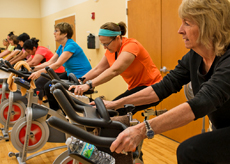
Does working out with other Jews keep you Jewish? The role of JCC fitness centers
MAAYAN JAFFE
For Daphna Krupp, her daily workout (excluding Shabbat) at the Jewish Community Center of Greater Baltimore has become somewhat of a ritual. She not only attends fitness classes but also engages with the instructors and plugs the J’s social programs on her personal Facebook page.
“It’s the gym and the environment,” says Krupp. “It’s a great social network.”
Krupp, who lives in Maryland, is one of an estimated 1 million American Jewish members of more than 300 Js around the country. Each J-in line with the bylaws of their umbrella organization, the JCC Association of North America (JCCA)-has a fitness center that serves as one of its core businesses. Often, the fitness center can be perceived as a for-profit enterprise of the J, with thousands of dollars invested annually in facility maintenance and gym advertising.
But Steve Becker, vice president of health and wellness at the JCCA, says that is a myth. “JCCs are not fitness centers, we are engagement centers,” he tells JNS.org . “All fitness-related programs are structured to be relationship-building activities.”
The institution of the J was founded in 1854 as the Young Men’s Hebrew Association (YMHA), to provide help for Jewish immigrants. A Young Women’s Hebrew Association was first established as an annex to the YMHA in New York in 1888. The first independent YWHA was set up in 1902. In 1917, these organizations were combined into a Jewish Welfare Board, and were later renamed Jewish Community Centers.
“After World War I, the Jewish Welfare Board morphed into an organization to meet the cultural, intellectual, physical and spiritual needs of the Jewish community,” says JCCA Communications Manager Marla Cohen, noting that physical needs were always part of the equation.
The much-debated 2013 Pew Research Center study of the American Jewish community found that a strong majority of Jews (62 percent) say being Jewish is mainly a matter of ancestry and culture, rather than religion. The study showed a decline in non-Orthodox individuals involved with the organized Jewish community. As such, Jewish communal leaders-from award-winning author and lecturer Dr. Erica Brown to Jewish Agency for Israel President and CEO of International Development Misha Galperin-have been calling for increased “low-barrier, high-content” programming to meet Jews where they are. This, says Cohen, is a niche the J can fill.
“For some people, aside from High Holiday attendance, working out at the J is probably the only flavor of Judaism they have. The J could be a very big part of these people’s Jewish identity,” Krupp says of some of the members she has met in the gym.
“These individuals are not choosing between the JCC and synagogue. They are choosing between everything else-the mall, soccer, snowboarding, you name it-and the J,” says Cohen.
Statistics support Cohen’s assertion. According to a 2013 JCCA benchmarking survey of JCC members across the country, 62 percent say JCCs have helped them develop a broader perspective of the Jewish community, 54 percent say the JCC has helped them develop a greater appreciation for Jewish values, and 60 percent say JCC membership has led to them to feel a deeper connection to their Jewish identity.
Krupp sees the J as a community-building tool. “I think when you work out together, you realize you are more alike than different. We are all dealing with the same struggles-to get there on time, to deal with snow days, with our eating, our weight, our children. It brings the community together,” she says.
Working out is a Jewish principle, Becker says, referencing the Jewish value of shmirat ha’guf , sustaining one’s body.
The representatives of JCC Chicago concur. “There’s no question that taking care of one’s body is a core Jewish principle, and that is one of the most important reasons that fitness and wellness are central to JCCs,” said Todd Braman, assistant general director and Chief Operating Officer of JCC Chicago. “But we can’t overlook the potential a fitness center has to bring large numbers of new people through the doors of a JCC who will then attend a JCC holiday celebration, a cultural arts event, or send their children to our preschools and camps. There are very few places where Jews of all ages and denominations come together several times a week. Fitness is a key piece of why this happens at a JCC.”
Other stories
-
Meet Andrew S. Hochberg, 2021 Julius Rosenwald Memorial Award recipient
Celebrate Andy Hochberg at the virtual Annual Meeting on Sept. 14
Read more -
Two local teens win national recognition
Recipients of the annual Diller Teen Tikkun Olam Awards
Read more -
Celebrating six young award winners cultivating the community
Introducing young adult award winners
Read more

New studies in the last year have shone an even greater light on the risks in the Jewish community related to mutations in the BRCA1 and BRCA2 genes.
The BRCA genes (commonly pronounced BRAH-CAH) are named for BReast CAncer, because it is mutations in those genes that cause hereditary forms of breast cancer. In the general population, BRCA mutations occur in about 1 in 400 persons. Among people of Ashkenazi descent, that number rises to 1 in 40-a tenfold increase.
Women with BRCA mutations face a 56-67 percent lifetime risk for breast cancer, and a 27-44 percent lifetime risk for ovarian cancer, significantly higher than for persons without these mutations. But those figures alone don’t tell the whole story about BRCA, because of two facts not widely known outside of the medical community.
The first is that BRCA mutations increase individual risk for several kinds of cancer in addition to breast cancer. Genetic research links BRCA mutations to certain hereditary forms of prostate and pancreatic cancer as well.
The second is that while breast cancer is more common in women, men get breast cancer too. Among men with BRCA mutations, the lifetime risk can be up to 7 percent, many times higher than for men without the BRCA mutations.
Men in general seek much less medical care, particularly preventative care, than women. Combined with the general lack of awareness about male breast cancer, we find a serious awareness gap within our community around these issues.
Fortunately, new partners have recently emerged to help bring more attention to this rarely articulated and poorly understood problem with two forthcoming documentaries.
Inspired by her own family’s story, Lori M. Berlin is the producer and director of Men Have Breasts Too. Berlin, who shared her own story recently on the Center for Jewish Genetic’s blog, describes the project as “a labor of love” to honor her cousin, her family, and the many people she met along the way when dealing with her own positive test for a BRCA mutation. The film features the stories of men and their families dealing with male breast cancer.
Another friend of the Center, Alan Blassberg, is making Pink & Blue. Besides exploring BRCA risks in general, Blassberg’s film sheds light on needed cultural and medical changes necessary to help men get the help they need without shame or embarrassment. The name of the film alludes to these issues, with the color pink dominating the discussion of breast cancer in the U.S.
Both of these films originate with the lived experiences of Jewish families. We view them as important contributions to awareness of BRCA mutations in general and male breast cancer specifically in the Jewish community. At the Center, we plan to do our part too.
As part of our expanded education and programming related to hereditary cancer, the Center will present a large-scale community education event this fall, on Oct. 14. The program, designed for individuals with questions and concerns about BRCA, will feature a panel of local experts and a keynote presentation by Dr. Susan Domchek of the Basser Center for BRCA. The event will be held in the northern suburbs on Oct. 14 at a to-be-determined venue.
For anyone of Ashkenazi origin, learning more about BRCA may prompt more questions than answers. One we hear frequently is: “Should I get screened?”
The decision to seek screening is a personal one. For those with a personal or family history of cancer, screening may be the right approach. For persons without any such history, the answer may be more complicated. Some researchers advocate that all women of Ashkenazi descent receive screening, but this recommendation remains controversial.
For anyone considering screening, we at the Center advocate taking an approach that starts with a conversation with a genetic counselor who can take a family history, describe in detail what a screening test can and cannot tell you, and help you think through what you will do with the information depending on your results.
Our Center does not perform BRCA screening, but we can help get you started by connecting you to the right resources.
For more information about our upcoming BRCA event and other issues related to Jewish Genetic Health, visit the Center’s website at www.jewishgenetics.com .
Jason Rothstein, MPH, is Director of the Center for Jewish Genetics. The Center for Jewish Genetics is a cooperative effort of the Jewish United
Fund/Jewish Federation of Metropolitan Chicago and the Ann & Robert H. Lurie Children’s Hospital of Chicago.
Other stories
-
Meet Andrew S. Hochberg, 2021 Julius Rosenwald Memorial Award recipient
Celebrate Andy Hochberg at the virtual Annual Meeting on Sept. 14
Read more -
Two local teens win national recognition
Recipients of the annual Diller Teen Tikkun Olam Awards
Read more -
Celebrating six young award winners cultivating the community
Introducing young adult award winners
Read more
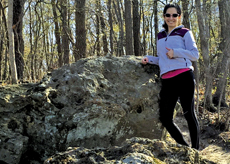
Why does walking get such a bad rap? I often hear children making fun of their parents for walking instead of running. They tell their parents that walking is not a workout because they don’t sweat when they are walking.
If people are walking for the calorie burn, walking a mile and running a mile burn roughly the same number of calories. The difference is about 10 to 20 calories. Also, if you are walking for cardiovascular health, walking is great for your heart. According to meta-analysis study by Harvard University, walking for 30 minutes a day can lower the risk of heart disease by 18 percent. Therefore, the argument that walking isn’t as effective of an exercise just doesn’t hold up.
Deuteronomy 13:5 says, “Walk after the Lord, your God,” meaning strive to be closer to God. We are supposed to walk instead of running to be closer to God because we should take our time and not rush our growing process. The same applies for our health. Being healthy is something we should strive for every day.
I understand the appeal of running-it’s fun! Blood pumps through our bodies and we get a wonderful runners’ high. It is good for you to run once in a while; however, if done every day our bodies start to fall apart. I often hear people say, “I was running on the treadmill for 60 minutes.” They say it with such excitement and pride. I just don’t understand why that is a good thing. Why is pounding the pavement for an hour beneficial? People will also say I work out seven days a week. Usually those workouts consist of running five miles a day. Again I don’t understand how this is healthy. Our bodies aren’t made to keep running. People develop plantar fasciitis, bone spurs, torn ligaments, or broken bones from too much activity. A healthy active lifestyle has variation.
Switching up your routine and incorporating walking or hiking as well other physical activities will help preserve your body. Being gentle on your body while exercising is important to ensuring we can be active for the rest of our lives.
I always tell people to walk to the grocery store, to a friend’s house, or even to the gym. The more miles of walking you add to your week the better.
Remember don’t be so negative about walking. It allows us to see more nature, have better conversations with loved ones, and be kinder to our bodies. Sometimes, we should test our bodies and workout harder, but we shouldn’t feel like lighter workouts aren’t healthy for us. It is just as healthy and in the long run might even be healthier.
Dana Fine is owner of Dana Fine Acupuncture, LLC in Northbrook.
Other stories
-
Meet Andrew S. Hochberg, 2021 Julius Rosenwald Memorial Award recipient
Celebrate Andy Hochberg at the virtual Annual Meeting on Sept. 14
Read more -
Two local teens win national recognition
Recipients of the annual Diller Teen Tikkun Olam Awards
Read more -
Celebrating six young award winners cultivating the community
Introducing young adult award winners
Read more
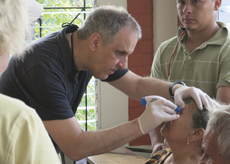
Dr. Stuart Sondheimer has three offices in the Chicago suburbs–in Skokie, Park Ridge, and Deerfield. But in a way, the whole world is his office. This ophthalmologist has practiced everywhere from Central America to the Far East, bringing sight to those in desperate need.
For the past four years, Sondheimer, who is Jewish, has performed cataract and other eye surgeries from Vietnam to Honduras. His most recent trip, in February, was a return to El Salvador.
Volunteering for the less fortunate is something he has wanted to do for a long time, he says, but admits he waited until “after the kids were grown.” After that, “I recruited myself,” he laughs.
He works through Eye Care International. This organization is like Doctors Without Borders, but it focuses on eye health and restoring vision. The doctors are all volunteers who pay their own way, for travel, food, and lodging.
But much of the medical equipment is donated by American manufacturers. Even if some of this equipment is considered slightly outdated in the US, “our garbage is their gold,” Sondheimer says. Eye Care International also raises some of the necessary funds.
Blindness is rampant in the developing world, he explains, because so many of the medical realities we take for granted-prevention, sanitation, checkups, early intervention, and the latest eye-care technology, as well as insurance to help pay for all of that–simply do not exist in poorer countries.
If such resources do exist, they are found only in their major cities. And even then, they may be rare. One city in Honduras, he notes, has three eye surgeons for one million people. Meanwhile, “My Skokie practice has some 80 patients,” he says.
As a result of the scarcity of care, what would be healed in an outpatient visit here can lead to total blindness elsewhere. “There is a tremendous need,” Sondheimer says. “There is an epidemic of blindness in the world.”
In El Salvador, the Eye Care International team saw 6,000 patients at 10 stations, which offered everything from reading glasses to invasive surgeries. The teams worked from 8:00 a.m. to 9:00 p.m. Patients’ conditions were caused by many factors: illness, genetics, accidents, malnutrition, or even side effects of other medical interventions. But mostly, they were degenerative, due to overexposure to the Sun or industrial pollution.
Part of what Eye Care International doctors donate is their own fee. Cataract surgery in the US costs $2,000-$6,000, even after insurance, due to safety and legal concerns. But he charges only $2.00 to his Central American patients. And some can’t even afford that, paying him in homemade food or handicrafts. But all are appreciative. “One even said, ‘I have nothing to give, but I will pray for you.'” he recalled.
Sondheimer spends time training with the outmoded equipment and techniques he uses in disadvantaged countries. In the US, he would use lasers, ultrasound, and topical anesthetics. There, he uses infusion bottles and syringes.
Sondheimer does not foray into foreign lands alone. On every trip, he is one of many doctors from, possibly, the US, Canada, Europe, Australia, or Israel. There were 80 people on his February trip. Sometimes his wife, who has learned how to dispense reading glasses, joins him.
Communication barriers are overcome several ways. Some of the doctors are bilingual, some volunteer translators travel with them, and sometimes local residents or Peace Corps volunteers assist.
Local and national governments, he said, were sometimes helpful, but sometimes a hindrance. He credits Eye Care International for handling much of the bureaucracies and paperwork involved. “Officials, even if they are on our side, have procedures they must follow.” He likened one attempt get all of their unusual-looking equipment and medicines past various customs offices to “a scavenger hunt.”
But it is all worth it for his patients, Sondheimer says. “Their lives are not all that different from ours. They just have less.” Now they have him, too.
Other stories
-
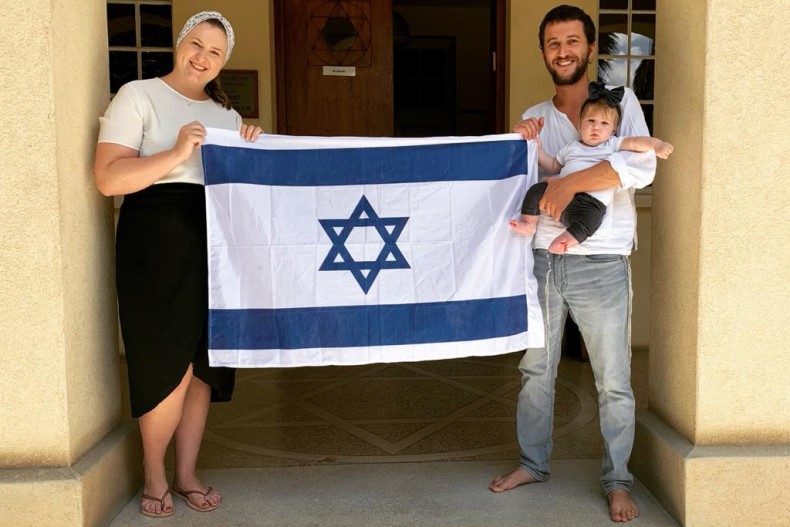
Chicago to Israel to Kenya
A family’s story of living Jewishly on three continents Michelle Cohen World May 28, 2021 Avital, Tzofia, and Netanel Kaszovitz outside their home in Nairobi on Yom HaAtzmaut. When Avital Kaszovitz prepared to be a Modern Orthodox shlicha (emissary) to the Jewish community in Ke
Read more -
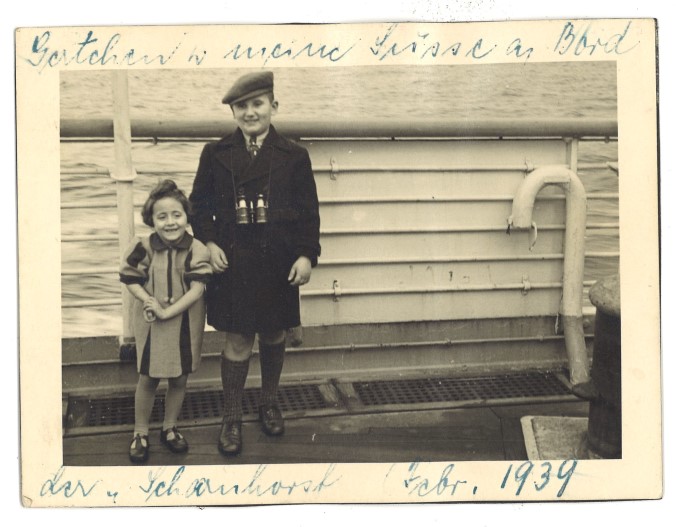
New exhibit spotlights the experience of ‘Shanghai Jews’
Explore a new Illinois Holocaust Museum and Education Center exhibit
Read more -
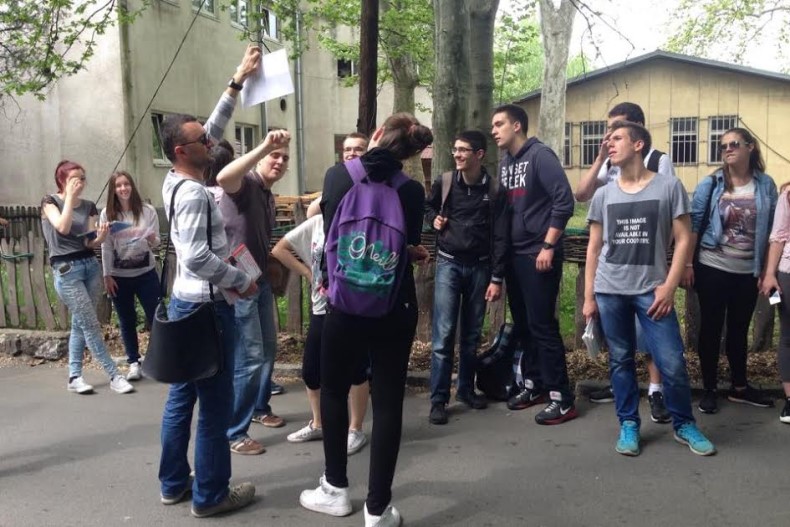
Europe’s brave new teachers of the Holocaust
Teaching the Holocaust in the modern era has its difficulties and rewards.
Read more
I look around in sadness and bewilderment at the bleak predicament that faces world Jewry today. In Europe, in particular, Jews haven’t seen darker times since World War II. The April 2015 issue of The Atlantic promptly asked, “Is It Time for the Jews to Leave Europe?” The Atlantic article observed that, “In 2014, Jews in Europe were murdered, raped, beaten, stalked, chased, harassed, spat on, and insulted for being Jewish. Sale Juif -‘dirty Jew’-rang in the streets, as did ‘Death to the Jews,’ and ‘Jews to the gas.'” French emigration to Israel doubled in 2014 and one study reported that 75 percent of French Jews reported that they were considering leaving.
A ‘missing generation’
To show solidarity with European Jews, I recently joined 85 members of Jewish Federations of North America (JFNA)’s National Young Leadership Cabinet in a mission to Hungary and Romania. JFNA distributes overseas funds through JUF’s main global partners-the American Jewish Joint Distribution Committee (JDC) and the Jewish Agency for Israel (Jewish Agency).
Approximately 75 percent of Hungary’s 742,000 Jews, and approximately 50 percent of Romania’s 757,000 Jews were murdered during the Holocaust. Nearly half the Jews killed in Auschwitz were Hungarian Jews. During approximately 10 weeks starting on May 14, 1944, approximately 440,000 Hungarian Jews were deported, mostly to Auschwitz-Birkenau, and 320,000 of them were sent directly to the gas chambers (that’s approximately 1.1 times the number of Jews in metropolitan Chicago). Romanian Jews ended up in mass graves, died during deportation, or perished in ghettos and death camps of Transnistria in Western Ukraine.
My great-great-grandfather, Baruch Teplitsky, was born in Bessarabia (Russia) in 1889 and perished in the Holocaust with his son, Shimon, and his daughter, Krein (Romania controlled Bessarabia in 1917-1940). After the war, approximately 70 percent of Hungary’s survivors and approximately 98 percent of Romania’s survivors emigrated.
Only 100,000 Jews remain in Hungary and only 7,000 remain in Romania. The Jews who remained in these communist countries were denied the right to practice their religion, forced to assimilate, and forbidden to practice any form of Zionism. Hence, those Jews who grew up in Central and Eastern Europe in the 1950s through the 1980s are considered by some European Jewish studies experts as a “missing generation.”
A renaissance among young Jews
While today’s Hungary suffers from political anti-Semitism, a renaissance is taking place among young Jews-the children of the “missing generation.” The Jewish Agency is actively working to support aliyah (immigration to Israel), provide social welfare, and increase engagement through the Taglit-Birthright heritage trip to Israel. JDC’s Camp Szarvas provides many of its 1,500 campers from 25 countries with their first Jewish experience. Budapest’s old Jewish neighborhood recently welcomed the opening of the Mazel Tov pub where patrons can enjoy hummus, kebabs, and modern Israeli music.
In Romania, the highlight of our trip was the opportunity to visit Holocaust survivors in Bucharest. I met with Francisc Rosenberg who was born in 1928, suffered during the war, and was liberated by the U.S. Army. He then worked as a cartographer, but continued to face pressure at the workplace due to his last name. Rosenberg is 87 and suffers from Parkinson’s disease. Due to JDC’s support, Rosenberg receives cash assistance, medicine, winter relief, Pesach relief, and weekly home care. Our trip also included a solemn stop to Romania’s Holocaust memorial. There, I saw remnants of tombstones from the cemetery in Odessa, a Ukranian city close to where my grandfather, Boris Teplitsky, was born.
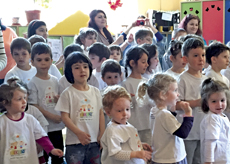
Today, Romania maintains good relations with Israel and the Jewish kindergarten which we attended in Bucharest serves as a memorial to the once-great Jewish community there.
Our brother’s keeper
JDC’s Camp Szarvas in Hungary is one example of JUF’s mission to make a positive impact in support of the Jewish renaissance in Central and Eastern Europe. Theodor Herzl, the Hungarian-born founder of modern political Zionism, said that “If you will it, it is no dream.” By giving to JUF, we help make it possible for Jews of Europe to sing ” Shalom Aleichem ” and dance the ” hora ” in Chicago, in Israel, and in Hungary and Romania. This is a global fight for what is most fundamental, and we must all be our brother’s keeper to remain vigilant in the face of ever increasing threats and provocations.
Michael Teplitsky is a member of JFNA’s National Young Leadership Cabinet and is the current Campaign Chair of the JUF Trades, Industries, and Professions Financial Services division and a former Campaign Chair and board member of the Young Leadership Division.
Other stories
-
Chicago to Israel to Kenya
A family’s story of living Jewishly on three continents Michelle Cohen World May 28, 2021 Avital, Tzofia, and Netanel Kaszovitz outside their home in Nairobi on Yom HaAtzmaut. When Avital Kaszovitz prepared to be a Modern Orthodox shlicha (emissary) to the Jewish community in Ke
Read more -
New exhibit spotlights the experience of ‘Shanghai Jews’
Explore a new Illinois Holocaust Museum and Education Center exhibit
Read more -
Europe’s brave new teachers of the Holocaust
Teaching the Holocaust in the modern era has its difficulties and rewards.
Read more
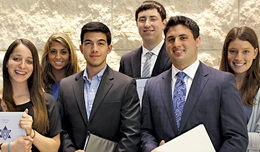
In its record-breaking 28th year, the Hillel of Illinois Harriet and Maurice Lewis Summer Intern Program (LSIP) welcomed 38 interns to JUF, the largest cohort that LSIP has ever hosted.
Each year, LSIP places top-performing college students at non-profit organizations across the Chicago area. LSIP Interns learn, hands-on, about the Chicago Jewish community and the non-profits that serve it while gaining work experience and professional skills. Many interns even become Jewish professionals after they graduate.
Now, for the first time in its history, LSIP has placed interns in for-profit companies, which will help interns develop a larger set of skills to take into their professional lives. This year, seven interns have been placed with for-profit concerns, including Associated Agencies, VNA Healthtrends, ICM Properties, Next Realty, Much Shelist, and Yastrow and Company.
These for-profit placements were identified by Jewish lay leaders, and many of their supervisors serve on Hillel boards and are involved in campus affairs. The supervisors are excited to help shape the professional development skills and Jewish identity of the college students they are employing.
Adam Winick, co-owner of ICM Properties, shared his thoughts on the recent addition of for-profits to the program. “We were excited when approached to join the Lewis Summer Intern Program this summer. I think LSIP offers very dedicated, hardworking, and ethical interns who want to succeed in the business world and give back to their community at the same time,” he said. “I look at this as a win-win situation for both the for-profit companies and JUF. I would have loved to be a part of an experience like this when I was in school!”
Evan Frank, a rising senior at the University of Illinois Urbana-Champaign, interning at VNA Healthtrends, is eager to work at a for-profit to gain valuable work experience. He said, “Learning that LSIP now offers for-profit internship opportunities was definitely a selling point when finalizing internship plans this summer. I am looking most forward to applying what I learn to my studies at school. I will also be able to gain experience in my field of interest.”
In addition to their specific placement, the 38 interns will come together for weekly seminars at JUF. The interns will have the opportunity to learn professional development skills from Jewish Vocational Services, Spertus Institute for Jewish Learning and Leadership, and Jewish professionals from an array of professional fields. Interns will participate in discussions with their peers about their Jewish generation, identity, and Jewish pluralism. Each week, different board members, lay leaders, and Jewish community members from the Chicago area will speak to the interns, helping to build each one’s Jewish professional future.
Eliana Block, a rising junior at the University of Maryland, College Park, will intern with the Illinois Holocaust Museum and Education Center. “The seminars, social aspect, and professional fieldwork are what really drew me to the LSIP this summer,” she said. “Working alongside students from for-profit companies is also a plus!”
Tori Weinstein is the Assistant Director of the Lewis Summer Internship Program.
The Hillels of Illinois is a department of JUF/Federation, and a branch of Hillel: The Foundation for Jewish Campus Life.
Other stories
-
Local campus administrators convene on hate speech, bias
JUF and ADL brought together 17 student safety, diversity and inclusion and student affairs administrators and Hillel representatives from various Illinois campuses to discusses issues of hate speech and bias.
Read more -
Engaging students about Israel on campus
Too often we hear about difficulties facing Jewish college students on Illinois campus, but to focus solely on the politics gives only one piece of the complex narrative that is Jewish life on campus.
Read more -
Hillel International launches fellowship initiative to train young Jewish professionals
The Springboard Fellowship will train cohorts of young Jewish professionals in highly-valued skillsets and place them at local Hillel campuses for two years.
Read more