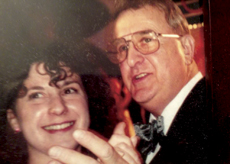
The discussion of young women and breast and ovarian health always reminds me of my senior year at Indiana University. It’s my first week back at school and I sit in the waiting room at Indiana’s health center to see a doctor in the women’s clinic. I missed the chance to see my gynecologist at home and, judging by the hour I’ve spent waiting, I’m not the only one. I sit there itching to get back out into the sun while mindlessly filling out the paper work. Asthma? No. Allergies? Only to these awful gray walls. Family history of cancer? Yup. That check is nice and bold.
Finally, my name is called and I endure a quick exam. After briefly glancing at my paperwork and ignoring the giant check mark I made, the doctor gives me a generic speech reminding me about safe sex, eating my vegetables, and that spending four years of college drinking like a fish can in fact damage my health. Thanks-who knew?
I’m lucky-I didn’t need this doctor to discuss my cancer risk with me. My aunt was diagnosed with breast cancer while my grandfather was well into a cancer battle of his own. These things don’t tend to be coincidental in families. The genes that make us share the same eyes and gave me weirdly tiny ears also unite us in having a high risk for cancer. Genetic testing revealed that my grandfather and all three of his daughters carried the BRCA2 mutation, increasing their lifetime risk for breast and ovarian cancer to more than 50 percent. My grandfather passed away in September of 2012 after an impressive four-year fight. Remarkably, my aunt entered remission after several rounds of chemotherapy and a double mastectomy, only to be killed in an automobile accident several months later in July of 2013.
I didn’t need the Indiana University women’s health clinic doctor to tell me I was high risk-but I am in the minority. Many young women do not receive enough education about their risk for breast and ovarian cancer. When my grandfather passed away he left behind a legacy of love, laughter, and learning. He also left us genetic health information that provides a vital clue to our family health history. Knowing your family history is the first and most important step in becoming self-aware about one’s risk for hereditary cancer. Understanding your risk-and, when appropriate, undergoing genetic testing-gives you resources to live a proactive life and an edge in the fight to remain cancer-free. In our family, we use this knowledge to stay on top of every preventative measure that exists.
Many things in this world you won’t see coming and can’t control. But knowing your risk of hereditary cancer and other genetic illnesses can empower you to take steps to protect yourself and your family. Genetic information can be frightening, so avoid being overwhelmed by taking advantage of educational, counseling, and screening programs offered by the Center for Jewish Genetics. You can also reach out to their amazing partner organizations like Bright Pink, a non-profit focused on educating young women on breast and ovarian health; or Sharsheret, an education and outreach organization focused on breast cancer in the Jewish community. All these organizations work from a common theme: knowledge is power.
As illustrated by my experience at Indiana, doctors are busy and won’t always know exactly what issues to discuss with you. I encourage you to use the Center, its partner organizations, and other resources to prepare for your next doctor appointment. Arrive ready to ask your questions and speak up about your wellness priorities.
And if you don’t know where to start in terms of finding these educational resources, you are in luck! The Associate Board of the Center for Jewish Genetics is bringing back our very popular young leadership event, Jean Therapy; and this year’s Jean Therapy will highlight resources and information related to hereditary cancer awareness.
Jean Therapy is a night to shop for jeans, jewelry and other specialty items, socialize, network and learn more about the hereditary cancer resources in our back pocket here in Chicago. You’ll hear from the Center for Jewish Genetics, as well as have a chance to learn life-saving information while enjoying a beautiful night out in Downtown Chicago.
Register now at www.juf.org/JeanTherapy for this event taking place on Thursday, May 7, from 6:30-9 p.m. at the Conrad Hilton Hotel, and join other young adults in Chicago who believe that knowledge is power.
Eden Faye is the Community Engagement Coordinator at the non-profit organization Bright Pink and serves on the Associate Board for the Center for Jewish Genetics. She hopes to become a genetic counselor one day.
Other stories
-
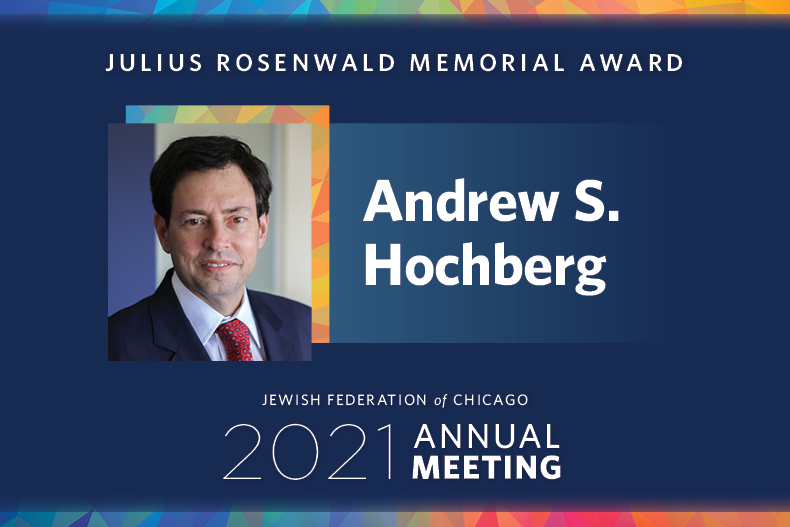
Meet Andrew S. Hochberg, 2021 Julius Rosenwald Memorial Award recipient
Celebrate Andy Hochberg at the virtual Annual Meeting on Sept. 14
Read more -
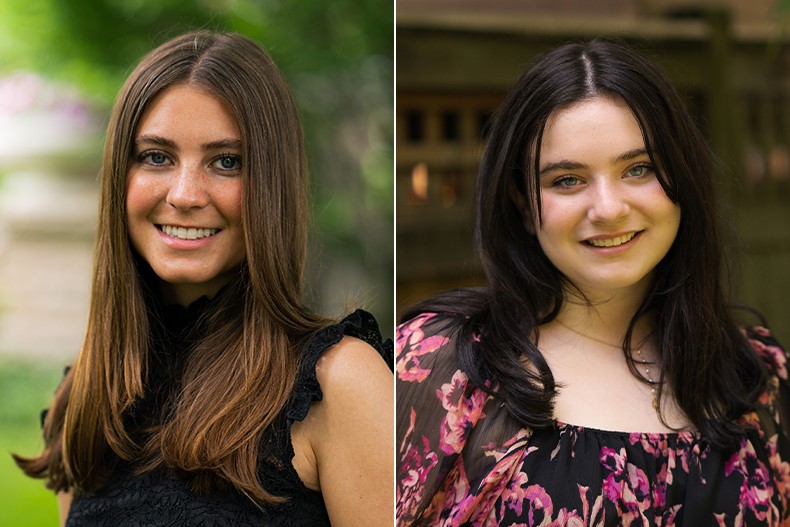
Two local teens win national recognition
Recipients of the annual Diller Teen Tikkun Olam Awards
Read more -
Celebrating six young award winners cultivating the community
Introducing young adult award winners
Read more
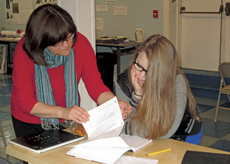
From a young age, I watched my late mother’s commitment to the Jewish United Fund of Metropolitan Chicago
in action.
My mom, Peggy Norton, who passed away in 2002, was JUF’s Jewish Community Relations Council director from 1978 to 1988. Among her many accomplishments during her tenure, she spearheaded a Soviet Jewry rally in Lincoln Park, led an interfaith leaders group, and spoke with media and government officials about critical Jewish issues. Mom was a master of extemporaneous speaking. She made close friends among her peer group of JCRC directors nationwide and was a role model for younger women in Jewish communal circles.
My mother loved having the opportunity to use her skills to benefit the Jewish community, to which she felt deeply connected.
Growing up in the 1970s, I had a second home at the Horwich JCC. I did teen leadership training there, planting seeds towards my future career of psychology.
In college, I participated in what is now JUF’s Lewis Summer Intern Program. In the intern seminar, I studied Jewish texts and took part in my first traditional Shabbat at JCC’s Camp Chi.
Interns received a small stipend and were surprised when we were solicited for a gift through JUF. This sparked a discussion about being part of the worldwide Jewish community. We learned that even a small contribution demonstrates acceptance of our responsibility for other Jews.
While attending graduate school in psychology at Boston University, I was awarded a JUF grant for students from Chicago entering helping professions.
After earning my doctorate I worked as a psychologist in community mental health and private practice. Then I was drawn to work coordinating services for day school students with learning challenges.
Three years ago I joined a new innovative day school for girls, as both a parent and as a staff member. My husband and I were excited to choose The Binah School for our daughter.
The heart of the Binah curriculum is its project based learning (PBL) approach. Students investigate a complex problem and present solutions to challenges. Gaining problem solving, critical thinking, collaboration, and communication skills are as essential to the learning as the content.
Binah created a one-of-a-kind approach to PBL, with Torah values and social justice central to students’ yearlong inquiry. In addition to an Avi Chai Foundation grant, the school has the support of an arts and social justice grant from the Covenant Foundation. Last year this gave students an opportunity to learn from a professional muralist. The students’ mural design grew out of their Judaic and secular studies during the year’s PBL theme of areyvut, responsibility for the other, and spreads the message that inclusion of people with all abilities is essential for the growth of a community and of the Jewish people.
In my professional role at Binah I teach students to develop self-awareness and executive function skills to participate effectively in collaborative learning groups. I also assist teachers in developing differentiated learning strategies for our multi-age classrooms.
My involvement during adolescent and young adult years in Federation-supported programs, and in my adult years as a psychologist and Jewish educator, are rooted in receiving and giving back as a member of the Jewish community.
I benefited immensely from growing up surrounded by the people and programs at the JCC. I received financial support from JUF for my graduate education as a psychologist, and that goal was shaped by my JCC and JUF intern opportunities, where I also received an introduction to my path towards increased Jewish observance.
Now I have the opportunity to give back by using my skills and experiences to support members of the next generation of Jewish young women.
I am thrilled to use all I’ve been privileged to receive in service of the Jewish community. It’s what I watched my mother do while I was growing up. I hope my daughter is watching me.
Nancy Norton, Ed.D. is a psychologist and educator who grew up in Rogers Park and currently lives in Sharon, Mass., outside of Boston. She can be reached at [email protected].
The Binah School, located in Sharon, Mass., is a local and boarding high school with students from locations throughout the United States and Canada. For more information, visit www.thebinahschool.org.
Other stories
-
Meet Andrew S. Hochberg, 2021 Julius Rosenwald Memorial Award recipient
Celebrate Andy Hochberg at the virtual Annual Meeting on Sept. 14
Read more -
Two local teens win national recognition
Recipients of the annual Diller Teen Tikkun Olam Awards
Read more -
Celebrating six young award winners cultivating the community
Introducing young adult award winners
Read more
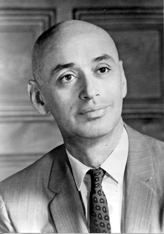
Abe Vinik, former General Director of the Jewish Community Center of Chicago, has passed away. He was 94.
Vinik’s career with JCC began in 1948, and he served as General Director from 1966 to 1980. Even after retiring, he continued to serve as a volunteer for many years.
“The JCCs in Chicago saw great growth and development under his direction,” said JUF President Dr. Steven B. Nasatir. “He was a man of great commitment and passion for Jewish communal work.”
A World War II Army veteran, Vinik studied social group work at Cleveland’s Case Western Reserve University in the 1940s. He wrote papers for the Journal of Jewish Communal Service on Jewish community centers, and co-authored the 1992 book Social Action in Group Work. He also taught group process at the University of Chicago and other schools of social work.
Vinik held board leadership positions at the National Association of Social Workers and other professional organizations and institutions, and was honored by the Association for the Advancement of Social Work with Groups at their 1988 symposium. Additionally, Vinik served as consultant for the State Department in Europe and Israel.
His areas of specialty included group work theory, board and staff development, agency planning and administration, and he consulted on issues of executive development, evaluation of agency structures and programs, and continuing education for professional staff.
Vinik is survived by his wife Maiga, his children Karen (Anthony), Martin (Nancy), and Nina (Ross Bricker), and five grandchildren.
A memorial service was held; the funeral and burial were private. In lieu of flowers, the family asks that contributions may be made to the Lake Forest Place Scholarship Fund or the Jewish Community Centers of Chicago.
Other stories
-
Meet Andrew S. Hochberg, 2021 Julius Rosenwald Memorial Award recipient
Celebrate Andy Hochberg at the virtual Annual Meeting on Sept. 14
Read more -
Two local teens win national recognition
Recipients of the annual Diller Teen Tikkun Olam Awards
Read more -
Celebrating six young award winners cultivating the community
Introducing young adult award winners
Read more
On May 3, members of the Cantors Assembly will convene for their 68th annual convention for inspiration, education, and relaxation. The annual event has been held across the United States, in Israel, Poland, and Germany, and is scheduled for Spain in summer 2016. This is the second time that Chicago has played host to this exhilarating event.
“The impact of the annual convention has been most keenly felt by our members and their community synagogues, as they return refreshed and infused with new ideas, music and approaches to celebrating our faith,” said Cantor Steven Stoehr of Congregation Beth Shalom in Northbrook, one of this year’s co-chairs. “However, such as when we have traveled internationally to Poland and Germany, we have come to learn that the local communities have benefitted as well. Each time we share music with a local Jewish or non-Jewish choir, visit historic sites, share in dialogue with religious and governmental leaders, we believe that our voices are intricately blended with those of the citizens in that locale. When we can dialogue and truly get to know the other, then we have a non-fighting chance to find solutions to common needs, desires, dreams, and visions.”
During this year’s convention, each day will climax with an evening concert. The week will kick off with local Maxwell Street Klezmer Band. The Wednesday night gala will be held at the Anshe Emet Synagogue in Chicago and will feature local jazz talents such as master harmonica player Howard Levy, and an array of national Cantorial talent. Combined with Anshe Emet’s annual Dr. Arnold H. Kaplan Concert, the Anshe Emet congregation will honor Hazzan Alberto Mizrahi as he assumes the office of International President of the Cantors Assembly.
The Cantors Assembly has been in dialogue with Chicago Pastor, Chris Harris Sr., leader of Bright Star Church in the Bronzeville community. They are planning to hold a joint concert to benefit the Bronzeville Dream Center, a vision which Pastor Harris has set for his community based on NATAL, a shelter center which he visited on a previous trip to Israel. The Center is dedicated to serving the community with counseling and other social services aimed at minimizing negative factors that cause violence, and increasing protective influences that yield positive outcomes.
During the conference, the cantors will be holding educational classes, listening to local Jewish communal educators and leaders such as Rabbi Benay Lappe, Rabbi Lizzi Heydemann, Ben Sidran, Dr. Robert Bastian, and Dr. Steven B. Nasatir, JUF president. Evenings will culminate with a late night presentation of everything from Chicago jazz and blues to comedy, and allow everyone to relax and enjoy some social time. Day passes and concert tickets are also available to the public.
Anyone is welcome to register for the convention. Contact the Cantors Assembly national offices at (330) 864-8533 or visit www.cantors.org for more information.
Other stories
-
Meet Andrew S. Hochberg, 2021 Julius Rosenwald Memorial Award recipient
Celebrate Andy Hochberg at the virtual Annual Meeting on Sept. 14
Read more -
Two local teens win national recognition
Recipients of the annual Diller Teen Tikkun Olam Awards
Read more -
Celebrating six young award winners cultivating the community
Introducing young adult award winners
Read more
Other stories
-
Meet Andrew S. Hochberg, 2021 Julius Rosenwald Memorial Award recipient
Celebrate Andy Hochberg at the virtual Annual Meeting on Sept. 14
Read more -
Two local teens win national recognition
Recipients of the annual Diller Teen Tikkun Olam Awards
Read more -
Celebrating six young award winners cultivating the community
Introducing young adult award winners
Read more
Dorothy Brown, clerk of the Circuit Court of Cook County, Michelle T. Boone, City of Chicago’s DCASE commissioner and Paulina Kapuscinska, Consul General of Poland in Chicago will open an exhibit on Monday, March 23, in Chicago’s Richard J. Daley Center to honor the Polish Righteous Among the Nations, a group of men and women who rescued Jewish people from the Nazis during World War II.
The exhibit is titled “They Risked Their Lives – Poles Who Saved Jews during the Holocaust.” It has been sponsored by Poland’s Consulate General in Chicago and it is being co-presented at the Richard J. Daley Center thanks to cooperation between the Polish Consul General Paulina Kapuscinska, Cook County Clerk Dorothy Brown and City of Chicago’s DCASE Commissioner Michelle T. Boone.
“This exhibit’s mission is to teach about the virtues of selflessness and courage. It shows how one’s life choices can change history for generations of people” said Kapuscinska.
This exhibit commemorates the Polish Righteous Among the Nations, who demonstrated extraordinary courage and risked their own lives – and the lives of their families – to rescue Jewish men, women and children from extermination by the Nazis. The exhibit is a tribute to the rescuers who by saving a single life saved entire generations.
Clerk Brown said: “This exhibition is so thought-provoking, causing us to recognize the extreme bravery of these men and women who, under the threat of severe punishment and death, stood up for what is moral and just and saved the lives of others.”
Polish citizens were the only people in the entire Nazi-occupied territory who were punished by death for helping Jewish people. Over 20,000 people worldwide have been honored by the State of Israel as the Righteous Among the Nations for saving Jewish lives from the Holocaust, and nearly than 6,500 were Polish citizens, the highest number from any country.
The exhibit will be displayed for the week of March 23-27 and is located in the East Lobby of the Richard J. Daley Center, 50. W. Washington Street, Chicago.
Other stories
-
Meet Andrew S. Hochberg, 2021 Julius Rosenwald Memorial Award recipient
Celebrate Andy Hochberg at the virtual Annual Meeting on Sept. 14
Read more -
Two local teens win national recognition
Recipients of the annual Diller Teen Tikkun Olam Awards
Read more -
Celebrating six young award winners cultivating the community
Introducing young adult award winners
Read more
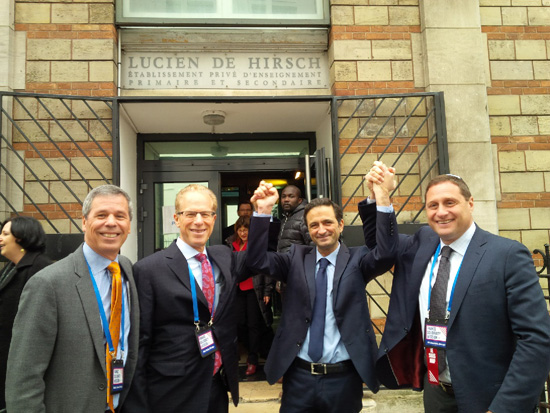
Chicago leaders David T. Brown, Marc Sacks and JUF Chairman Bill Silverstein with Paul Fitousi (second from right), principal of Lucien Hirsch Day School, on the national solidarity mission to France in February 2015.
Paris was experiencing one of its darkest winters in February, when eight Chicago lay and professional Jewish community leaders made a solidarity and fact-finding visit in the aftermath of the terrorist murders at the Charlie Hebdo publication and the Hyper Cacher supermarket.
In addition to exploring the somber situation of French Jewry generally, the Chicagoans made personal connections with their French counterparts. Prominent among them is David Revcolevschi, a partner in an international law firm and board member of both the Consistoire Central, one of France’s primary Jewish communal organizations, and of the FSJU, which is the French equivalent of the Jewish Federations.
This week Revcolevschi made his first visit to Chicago to reunite with his new American colleagues and friends, to update them concerning the situation in France, and to continue building a relationship between the Paris and Chicago communities.
“We are thrilled to have David with us again, to learn from him, and to deepen our relationship with the Jews of France. There is no substitute for face-to-face connection,” noted JUF Board member Caryn Rosen Adelman, who introduced a working lunch between Revcolevschi and the Chicagoans he first had met last month.
Revcolevschi underscored the deeper implications of solidarity with the American Jewish community, which he said profoundly moved the Jews of France at a time of need.
“Solidarity is not just an emotional response, which was very intense when we met in France. The next step is for the communities really to know each other,” he said. “The challenge is to know and to share best practices, and to provide opportunities to learn and to meet, so that people can help one another as effectively as possible when needed.”
The terrible events in Paris in January created a tipping point in terms of needs: growing radicalism in Europe, Islamist violence, and a toxic stew of anti-Semitism and hatred of Western values came together in a ‘perfect storm’ of events.
JUF responded by creating its French Terror Relief Fund, part of a Jewish Federations of North America effort to help the French community.
Former JUF Chairman David Brown, who chairs Global Operations: Israel and Overseas of JFNA and led February’s solidarity mission, invited Revcolevschi to Chicago after participating, along with Adelman and JUF staff, in the national allocation process for French emergency and security assistance. To date the national system has allocated $1.1 million.
For its part, JUF raised some $250,000 to assist the French Jewish community; that sum, in addition to helping cover vastly increased security costs, also provides some direct support for the families of the Hyper Cacher victims.
Revcolevschi expressed deep appreciation for the assistance, as well as the need for increased partnership in addressing a common threat and a common Jewish agenda.
“Now things are clear. There is a violent threat from radical Islam. We as Jews want to fight for our rights, but also for what we think society should do and how we can contribute to its cherished values. We share the same values, and I don’t think those threats stop at one border… I think we are facing the same issues that the whole world is facing.”
Andrea Yablon, chair of JUF’s Overall Planning and Allocations Committee, reiterated Revcolevschi’s call to continue to strengthen ties between French and American Jewry, and beyond. “We need to explore a whole host of possibilities for engagement, from youth trips to rabbinic exchanges, and to do this with all Jewish communities.”
“In a globalized world,” Revcolevschi concluded, “strong local communities need to be less isolated and more integrated in worldwide Jewry, for our own sakes and also to serve Israel best.”
Other stories
-
Chicago to Israel to Kenya
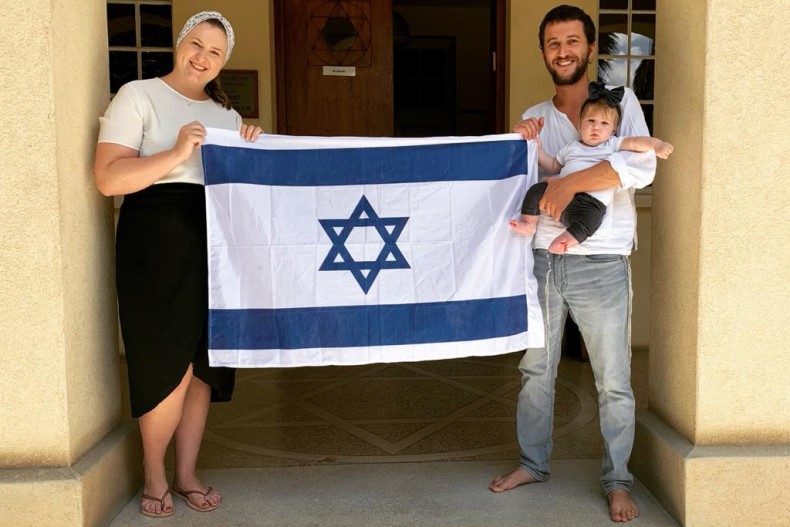
A family’s story of living Jewishly on three continents Michelle Cohen World May 28, 2021 Avital, Tzofia, and Netanel Kaszovitz outside their home in Nairobi on Yom HaAtzmaut. When Avital Kaszovitz prepared to be a Modern Orthodox shlicha (emissary) to the Jewish community in Ke
Read more -
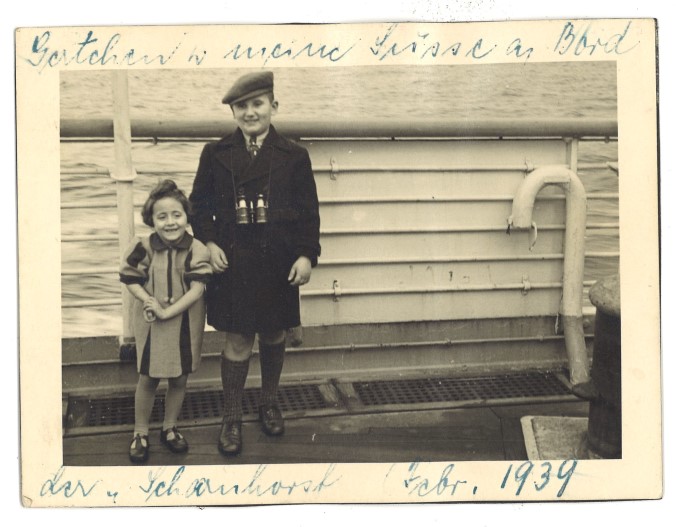
New exhibit spotlights the experience of ‘Shanghai Jews’
Explore a new Illinois Holocaust Museum and Education Center exhibit
Read more -
Europe’s brave new teachers of the Holocaust
Teaching the Holocaust in the modern era has its difficulties and rewards.
Read more
This Passover, 4,000 boxes of matzah will be on the shelves of local food pantries thanks to an exciting new partnership between The ARK, Greater Chicago Food Depository and Jewel-Osco.
“We [The ARK] are fulfilling our mission to help members of our Jewish community who are in need—wherever they live in the Chicago area.” said Caroline Musin Berkowitz, Director of Volunteers and Outreach at The ARK.
Affixed to boxes are stickers with information about The ARK. “We want every Jew in need [in Chicago] to know that The ARK can help them—not just with food, but with medical care, counseling, housing, and other vital services.”
Jewel-Osco donated 1,500 boxes of matzah, and The ARK purchased the rest. The cases were delivered to the GCFD for distribution to local food pantries. The ARK will deliver matzah to food pantries in suburban locations not served by the GCFD.
“This matzah will help thousands of local Jews in need have matzah at their Passover seders,” Musin Berkowitz said. “We are very grateful to Jewel-Osco and the GCFD, and to our generous donors who make everything we do possible.”
For more information about The ARK, visit www.arkchicago.org.
JUF’s Community Foundation for Jewish Education has announced nominations for the inaugural Sue Pinsky Award for Excellence in Jewish Education.
The award will recognize outstanding teachers of students between the ages of 3-12 in Jewish Community Center or synagogue early childhood and congregational education classrooms that go above and beyond to positively impact the Jewish life and identity of their students, the students’ families and the school itself.
Pinksy encapsulated the vision of what a recipient of this award – established and endowed in her honor by her children Mark and Lisa – embodies:
“My hope is that this award will be a way to recognize dynamic Jewish teachers who serve as an inspiration for the next generation (of teachers),” Mark said. “It’s those small tastes of Judaism in preschools … (or) in congregational programs – those little sparks that come out of an innovative teacher saying something to a child – these are the things that can turn into a lifelong love of learning and Judaism.”
Basic eligibility criteria are:
- Currently employed as a lead teacher in JCC or independent congregational early childhood classroom or congregational school classroom
- Minimum of five years working in the nominating institution in a lead teacher capacity
- Nomination must be made jointly by both a professional and lay leader of the school
Nomination forms must be completed by Friday, April 17. Finalists will be notified by May 1. To make your nomination, fill out this form.
Other stories
-
Meet Andrew S. Hochberg, 2021 Julius Rosenwald Memorial Award recipient
Celebrate Andy Hochberg at the virtual Annual Meeting on Sept. 14
Read more -
Two local teens win national recognition
Recipients of the annual Diller Teen Tikkun Olam Awards
Read more -
Celebrating six young award winners cultivating the community
Introducing young adult award winners
Read more
The Chicago area’s 70th annual collective Holocaust memorial observance will be held at 1:30 p.m. Sunday, April 19, at the Skokie Valley Agudath Jacob Synagogue, 8825 East Prairie Road, Skokie. The event, which draws hundreds of participants, traditionally is the largest gathering of Holocaust survivors in the Midwest and one of the largest in the United States.
“Seventy years after the liberation of the concentration camps, we face a world of hatred and injustice against the Jewish people,” said Charles Lipshitz, president of Sheérit HaPleitah of Metropolitan Chicago, the umbrella organization for the area’s Holocaust survivor groups and sponsor of the memorial service.
“Less than two generations after the Holocaust, we see a rapid escalation of anti-Semitism around the globe and, of particular note, throughout much of Europe.”
Some countries actually believe they will be “protected” by selling out the Jews and Israel, Lipshitz said. Unfortunately, they will learn, the hard way, that letting tyrants loose without constraint will cause millions of people to pay the price of appeasement.
“This annual memorial honors our 6 million martyrs, including 1½ million innocent children who perished only because they were Jews,” he said. “We cannot let the world forget that a modern society, Nazi Germany, was capable of committing such atrocities. Many reactionary forces are hard at work to change history and deny that the Holocaust ever happened. We must be vigilant to not allow this to occur.”
“The number of Holocaust survivors is dwindling to a precious few as we approach the 70th anniversary of the end of World War II,” said Larry Schwartz, president of the Association of Descendants of the Shoah – Illinois, Inc. “We, as children and grandchildren of Holocaust survivors, are taking an active role in reminding the world that the crimes of Nazi Germany can happen again if we do not maintain vigilance. The legacy of the Holocaust survivors will be sustained and enhanced through our education and outreach efforts, for we shall never forget the sacrifices of the Six Million Jews who did not live to see the Nazi war machine defeated.
I M Hubscher, representing the Sheérit HaPleitah memorial committee, said “We will not remain silent in the face of the Iranian, Arab, ISIS or any other wish to destroy Israel. This circle of violence must stop, and we, as children, grandchildren and great-grandchildren of survivors will continue to lead the effort to eradicate hate, death and destruction.”
Speakers at the 2015 service, which is cosponsored by Chicago’s Jewish United Fund, will include the Honorable Roey Gilad, Consul General of Israel; Mayor George Van Dusen of Skokie; and Prof. Shlomo H. Resnikoff of the DePaul College of Law. Officials of the Jewish War Veterans – Skokie Post 328 and Jewish Boy Scout Troops #69 and #243 will present colors. As part of the ceremony, the winners of the 2nd annual Yom HaShoah (Holocaust Memorial Day) essay contest will be announced by David Levine, chairman of the event. A grandchild of survivors will pay tribute to the tremendous contributions Holocaust survivors have made to the Chicago community in passing their legacy of courage to future generations.
A high point of the service each year is the candle lighting ceremony honoring the six million Jewish victims who perished. The ceremony will be conducted by Sherry Rubinstein Warso of Dor L’Dor, the Young Leadership Division of Sheérit HaPleitah, with participation by children and grandchildren of local-area Holocaust survivors. Proclamations from Gov. Bruce Rauner, Mayor Rahm Emmanuel of Chicago and Mayor George Van Dusen of Skokie will be published in our memorial journal.
The Village of Skokie is supportive of Sheérit HaPleitah’s efforts to sustain the memory of the Holocaust. When the American Nazi Party chose Skokie in 1978 for its infamous demonstration, Sheérit HaPleitah helped lead the opposition, with the assistance of former Mayor Albert J. Smith and the village trustees. The struggle was portrayed in a made-for-television movie starring Danny Kaye. Sheérit HaPleitah later led the movement to construct a monument in memory of the Holocaust victims on the Skokie village green, on land donated by the village, using funds collected from area individuals and synagogues and the Jewish United Fund.
The monument’s sculpture by Edward Chesney, depicting three generations, torn prayer books, a menorah, and other items symbolizing the destruction of European Jewry, was unveiled on May 31, 1987. That night, the memorial received worldwide attention after it was desecrated with spray paint, including the epithet “Jew liars” and other messages of hate.
“This insidious act made the message on the dedication plaque even more meaningful,” said Lipshitz. It reads, “This monument will remain in perpetuity as a reminder of what hate can do to mankind if decent people are not vigilant to forestall such a calamity in the future.”
A documentary by Todd Whitman, about the days leading up to the infamous 1978 demonstration, aired on PBS in January 2013. The film featured many Jewish survivors of the Holocaust, as well as activists from the next generation who stood ready to protect the survivor community.
Sheérit HaPleitah includes the following groups: Association of Descendents of the Shoah – Illinois, Inc.; Hofesh Chapter – Na’amat USA; the Illinois Holocaust Museum and Education Center; Jewish Lithuanian Club of Chicago; Laor Organization; Midwest Chestochover Society; New Citizens Club; Workman’s Circle; the United Chicago Jews of Hungarian Descent, Inc.; Association of Child Survivors; Dr. Janusz Korczak B’nai Brith Lodge; and Dor L’Dor – a group of children and grandchildren of Holocaust survivors who will play an important role of carrying on our legacy.
Other stories
-
Meet Andrew S. Hochberg, 2021 Julius Rosenwald Memorial Award recipient
Celebrate Andy Hochberg at the virtual Annual Meeting on Sept. 14
Read more -
Two local teens win national recognition
Recipients of the annual Diller Teen Tikkun Olam Awards
Read more -
Celebrating six young award winners cultivating the community
Introducing young adult award winners
Read more