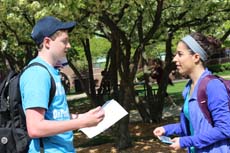
DePaul non-binding divestment resolution passes with narrow majority; JUF condemns its language and tactics used to promote it.
As announced by DePaul University officials at 3 p.m., a student referendum at DePaul aimed at calling on the university to divest funds from U.S. companies that do business in Israel passed by a vote of 1,575 to 1,333.
“While the results are unfortunate, the very strong showing against the referendum, in part a direct result of the hard work by Jewish and non-Jewish students who waged a valorous ‘Vote No’ campaign, is notable,” said Emily Briskman, Director of the Jewish United Fund’s Israel Education Center.
“Given the effort which went into passing this referendum, the numbers hardly reflect a sweeping mandate,” Briskman said. “The goals of those who created this referendum, and the larger Boycott Divestment and Sanctions Movement, are to falsely accuse and demonize Israel rather than create a civil dialogue based in fact. That approach was clearly reflected in the incendiary language of this referendum. The result was disappointing but the many students who voted ‘no’ saw through the misleading language in the referendum in favor of finding real solutions to peace in the region.”
At the beginning of April, Students for Justice in Palestine (SJP) at DePaul successfully submitted a petition with over 1,000 student signatures to the Office of Student Involvement requesting that a referendum be placed on this week’s Student Government Association (SGA) election ballot. Citing DePaul mutual fund investments in four U.S. companies, the student referendum, which is not binding in any way, asked:
“Do you think that DePaul should follow socially responsible investment practices and divest its funds from companies that profit from Israel’s discriminatory practices and human rights violations?“
Elections opened May 19 and concluded today.

“This action is different from resolutions that have appeared on campuses around the country to date, which have been debated in front of elected student senators,” said Briskman. “Nearly all of those resolution attempts have failed and the referendum is an easier path to the end goal. It allows activists to boil down the Israeli-Palestinian conflict into slogans and sound bites in order to promote an anti-Israel agenda on campus and vilify the Jewish state.
“While these actions are not binding on any campus administration, the negative PR effect is divisive to the campus community, allows student groups such as SJP the platform to advance their hostility toward Israel and to attempt to intimidate supporters of Israel on campus, is corrosive to the university as a whole and creates a hostile atmosphere that is demoralizing to Jewish students and the greater Jewish community,” Briskman said.
JUF’s Israel Education Center (IEC) and community partners were on the forefront of combatting the divestment referendum by supporting students, faculty and staff at DePaul on a large-scale “VOTE NO” campaign that was launched at the beginning of April. A core group of student activists took charge of running the campaign with the IEC’s guidance and full support.
One of the leaders of the “VOTE NO” effort and IEC’s Israel Intern Jessi Barnes said “My family was forced to flee Libya in 1967 because of the Arab-Israeli War. Some family members came to Chicago through HIAS and others went to Israel. I am deeply committed to the survival of the Jewish state. When the DePaul Divest referendum was introduced I knew I had to stand up for what I believe in. BDS divided my campus and made me, my friends and Jewish community feel isolated and attacked for our beliefs. But witnessing our community stand together has been beautiful.”
“Throughout this week, SJP members and other supporters of the referendum engaged in harassment tactics by shadowing, interrupting and yelling at volunteers throughout campus, protested every event the students held during the week, violated campaign rules, along with a few unconfirmed incidents that directly targeted Jewish students- these reports have been brought to the administration’s attention,” said Briskman. “Jewish students held their ground and the worse the intimidation tactics by SJP supporters, the more galvanized the Jewish students became.”
“Although the DePaul Divest Referendum has passed, the efforts, dedication and passion of the students who worked tirelessly throughout the campaign deserve much praise,” said Briskman. “As we move forward in the wake of the referendum, there are a few topics that we still will want to pursue, including the unsubstantiated inflammatory language of the referendum and concern about SJP’s behavior. “
“At this point, I couldn’t be prouder of the strong statement that students, staff and the community made in opposition to the referendum and the BDS Movement,” Briskman said. “Tactics like this referendum, while largely symbolic, create a divisive and hostile environment for Jewish students and Israel supporters on campus. JUF’s Israel Education Center will continue to support all efforts to combat BDS and delegitimization on Illinois campuses and provide opportunities for students to connect with Israel in a positive way.”
The IEC’s activities regarding the referendum were coordinated with Alpha Epsilon Pi, Stand With Us and the Consulate General of Israel to the Midwest.
Other stories
-
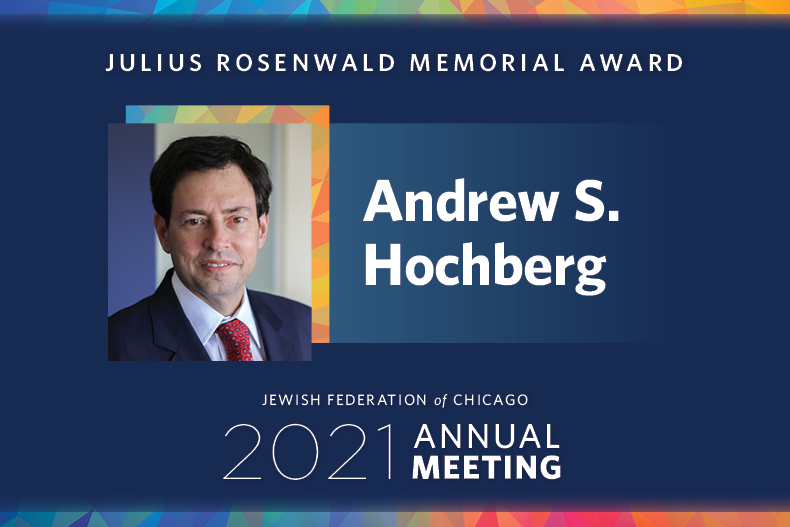
Meet Andrew S. Hochberg, 2021 Julius Rosenwald Memorial Award recipient
Celebrate Andy Hochberg at the virtual Annual Meeting on Sept. 14
Read more -

Two local teens win national recognition
Recipients of the annual Diller Teen Tikkun Olam Awards
Read more -

Celebrating six young award winners cultivating the community
Introducing young adult award winners
Read more
Capitol Hill received 23 members of the Jewish Federation of Metropolitan Chicago’s Government Affairs Committee this week as agency executives and board members advocated for their programs.
The two-day mission to Washington D.C. began with a private night tour of the Capitol by Congressman Brad Schneider, who led the participants through the halls, highlighting both the House and Senate chambers where legislators spend their time debating. The trip included meetings with Senators Richard Durbin and Mark Kirk, the Illinois House delegation, U.S. Department Officials, Subcommittee chairman Ileana Ros-Lehtinen of Florida, Rep. Schneider, and civil rights legend Rep. John Lewis of Georgia. A reception included friends and supporters of the Jewish Federation.
During the trip, the delegation witnessed the passage of five anti-human trafficking bills in the House of Representatives, marking a step forward in combatting trafficking. In addition, there was vocal support for other Federation priorities: the IRA Charitable Rollover, increases in access to healthcare and the reauthorization of the Older American’s Act with additional services for Holocaust survivors. The group was also able to thank Senator Kirk for sponsoring a resolution honoring Holocaust survivors and their contributions to the United States. The resolution passed on Thursday night.
“It’s very exciting to see the success of our work while we are still in D.C.,” said trip leader David Golder, Federal vice-chair of the Government Affairs Committee.
The final meeting of the trip with Rep. Lewis was especially powerful for the participants, many of who grew up listening to stories of the civil rights leader. The congressman, who has served in Congress for 27 years, shared stories of his past and his work with the Jewish community as well as efforts to continue working toward human dignity and rights.
Other stories
-
Meet Andrew S. Hochberg, 2021 Julius Rosenwald Memorial Award recipient
Celebrate Andy Hochberg at the virtual Annual Meeting on Sept. 14
Read more -
Two local teens win national recognition
Recipients of the annual Diller Teen Tikkun Olam Awards
Read more -
Celebrating six young award winners cultivating the community
Introducing young adult award winners
Read more
Chicago Jewish activists urge Congress to pass International Violence Against Women Act
In the wake of the kidnapping of more than 250 schoolgirls in Nigeria and following the introduction last Thursday of the International Violence Against Women Act (IVAWA) in the U.S. Senate, four Greater Chicago Area residents met with their Members of Congress to implore them to strengthen policies aimed at ending the global wave of violence against women and girls and pass IVAWA. The Chicago delegation included:
- Rabbi Alison Abrams, Highland Park
- Rabbi Sam Feinsmith, Evanston
- Etty Hasak, Chicago
- Yael Reynolds, Highland Park
The Chicago delegation was among 150 supporters of American Jewish World Service on Capitol Hill. AJWS is the leading Jewish international development and human rights organization.
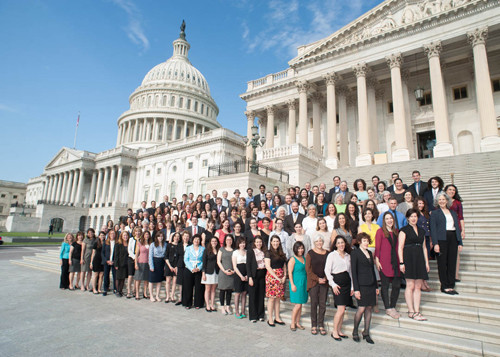
The delegation of 150 on Capitol Hill.
The Chicago delegation met with staff from the offices of Senator Dick Durbin (D-IL), Senator Mark Kirk (R-IL), Congresswoman Jan Schakowsky (D-IL-9), Congressman Brad Schneider (D-IL-10) and Congressman Michael Quigley (D-IL-5) to discuss how IVAWA, if passed, would improve the lives of the millions of women and girls who suffer from violence and abuse worldwide at no cost to U.S. taxpayers.
“The time to pass the International Violence Against Women Act is now,” said Ruth Messinger, president of AJWS. “How many more devastating stories must we hear before we act? As Jews, we understand the horrible consequences of people remaining silent in the face of violence and injustice. We cannot and will not stand idly by as women and girls are attacked by extremists aiming to strip them of their rights and dignity.
“Our government has made great strides in protecting women and girls in this country, as evidenced by the recently released guidelines for colleges in the U.S. to address sexual assaults on campus and last year’s passage of the domestic Violence Against Women Act. But we must do more to tackle the epidemic of violence against women and girls on a global scale. The Obama Administration took the first step by launching the U.S. Strategy to Prevent and Respond to Gender-Based Violence Globally in 2012. Now, it is time for Congress to act.
“We thank Senators Boxer, Menendez, Kirk, Collins and Shaheen for introducing the bill in the Senate, and Congresswomen Schakowsky, Lowey, Wasserman Schultz and Congressmen Engel, Gibson and Hanna for introducing it in the House last year. Now, we need Congress to make the passage of the International Violence Against Women Act a top priority. Taking steps to ensure that women and girls live free of violence and fear is not only right but is strong foreign policy,” Messinger said.
Today’s Lobby Day marks the culmination of AJWS’s Policy Summit, which is a part of We Believe, AJWS’s national advocacy campaign. We Believe, which launched last year, aims to help end violence against women and girls, stop hate crimes against LGBT people and empower girls to end child marriage. The first initiative of We Believe is to advocate for the passage of IVAWA. IVAWA would, for the first time, put the full power of the U.S. government behind the fight to end violence against women and girls internationally.
If passed, IVAWA would:
- Direct the U.S. government to implement its strategy to reduce violence against women and girls in at least five countries
- Make ending violence against women and girls a top diplomatic priority, and make the Office of Global Women’s Issues in the State Department permanent
- Promote legal protection for women and girls who survive violence
- Increase the capacity of the health care sector worldwide to address violence against women and girls by integrating such care into existing health programs
- Promote public awareness campaigns to change the attitudes that perpetuate violence against women and girls
- Support programs to reduce women and girls’ vulnerability to violence by improving their economic status and educational opportunities
Other stories
-
Meet Andrew S. Hochberg, 2021 Julius Rosenwald Memorial Award recipient
Celebrate Andy Hochberg at the virtual Annual Meeting on Sept. 14
Read more -
Two local teens win national recognition
Recipients of the annual Diller Teen Tikkun Olam Awards
Read more -
Celebrating six young award winners cultivating the community
Introducing young adult award winners
Read more
The everyday lives of Jews in the State of Israel and throughout the Middle East are at constant risk – a risk that is political, cultural, spiritual, and existential. Thankfully, the Jewish United Fund/Jewish Federation of Metropolitan Chicago and its affiliated agencies such as the American Jewish Joint Distribution Committee (JDC) and the Jewish Agency for Israel are there to help.
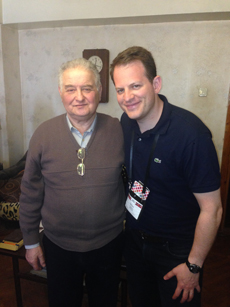
I recently took part in the Jewish Federations of North American National Young Leadership Cabinet study mission to Baku, Azerbaijan and Istanbul, Turkey. Jewish communities in the United States should care about these countries because they neighbor Iran, they are important allies of the U.S., and they are home to Jewish minority populations of approximately 20,000 within almost entirely Muslim populations.
Since Azerbaijan obtained independence from the Soviet Union in 1991, this oil-rich country on the Caspian Sea has successfully developed the massive Baku-Tbilisi-Ceyhan pipeline to the West. As a result, Azerbaijan’s GDP has exploded from $8 billion to over $67 billion in the last decade. Although the political leadership has been accused of authoritarianism, Azerbaijan has progressively directed oil and gas revenues toward poverty reduction and infrastructure investment. Azerbaijan bears many similarities to Dubai and its coastline, Neftchilar Avenue, is lined with five-star hotels, designer boutiques, and luxury cars. The skyline is dramatized by the 600-foot Flame Towers, three skyscrapers outfitted with 10,000 LED lights.
Azerbaijan President Ilham Aliyev is a friend to Israel and to the local Jewish population. In fact, over 40 percent of Israel’s oil is supplied by Azerbaijan, and Israel recently agreed to sell $1.6 billion worth of weapons to Azerbaijan. Furthermore, the Azerbaijan constitution provides for religious freedom, and the Synagogue of Baku recently received its first Torah scroll, which was funded in part by a special grant from President Aliyev.
Our group of 75 North American young Jewish leaders visited Azerbaijan’s Kuba Mountain Jewish community (population of 3,000), which includes a secondary school and a synagogue. We then visited the Hesed Gershon welfare center and took part in a visit to the home of a retired Jewish engineer with respiratory problems and a dismal monthly income of $232. JDC, a JUF-affiliated humanitarian assistance organization, supports this retiree with a bank card for food purchases and with winter relief.
We also met with young Jewish leaders who previously took part in summer camps sponsored by the Jewish Agency and saw the flourishing Chabad Day School where we were welcomed with a student choir. Our meetings with senior U.S. and Azerbaijan officials supported this country’s warm relations with Israel and its local Jewish community.
With a population of 74 million and a GDP of $789 billion, Turkey is a power player in the Middle East. The vibrant ethos of Istanbul’s Grand Bazaar (3,000 shops with over 250,000 visitors) reflects the country’s influences of the west and the east.
Unfortunately, Prime Minister Erdogan’s authoritarian moves have triggered a series of mass protests within this split society searching for a modern identity. Discontent is based on rumors of corruption within the ruling ranks, demands for improved health and housing services, disagreements about separation of religion and state (Turkey has 82,693 mosques), and restrictions on freedom of the press (with bans on Twitter and YouTube). Nonetheless, Turkey is an important U.S. ally based on shared interests in regional security and economic cooperation. The relationship with Israel, however, is still recovering from the 2010 “Gaza Freedom Flotilla” raid.
In Istanbul, we visited the Jewish Day School, toured the JDC Assisted Old Age Home, and attended Shabbat Services at the Sisli Synagogue. A particularly gloomy stop on our trip was the Neve Shalom Synagogue (the largest Sephardic synagogue in Istanbul), which was attacked by terrorists in 1986 and 2003. We engaged in active discourse with numerous members of the local Jewish community and met with the Israeli Consul General. We also saw firsthand the massive demonstrations on Taksim Square on May 1, the Labor and Solidarity Day in Turkey.
With the recent overthrow of the Muslim Brotherhood government in Egypt, the ongoing civil war in Syria, and with Russia’s annexation of parts of Ukraine, the daily conditions of the local Jewish communities in the Middle East, Central Asia, and Eastern Europe should be of primary importance to all of us. The intimate bond of the Jewish people transcends all borders – Jews will always respond to human suffering because it is our responsibility to do so. Fortunately, JUF and its affiliated agencies in Baku and Istanbul are serving in the spirit of tzedakah,tikkun olam and klal yisrael to build bridges to Judaism and Israel through education and to preserve the value of every single Jewish life.
Other stories
-
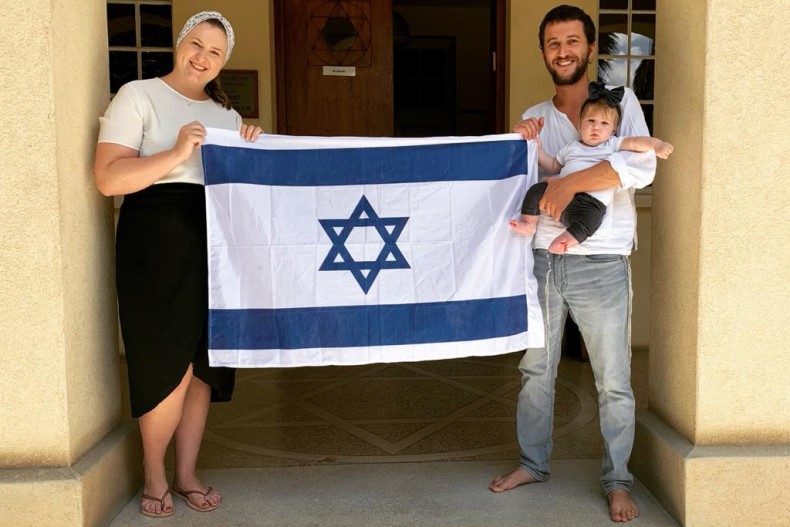
Chicago to Israel to Kenya
A family’s story of living Jewishly on three continents Michelle Cohen World May 28, 2021 Avital, Tzofia, and Netanel Kaszovitz outside their home in Nairobi on Yom HaAtzmaut. When Avital Kaszovitz prepared to be a Modern Orthodox shlicha (emissary) to the Jewish community in Ke
Read more -
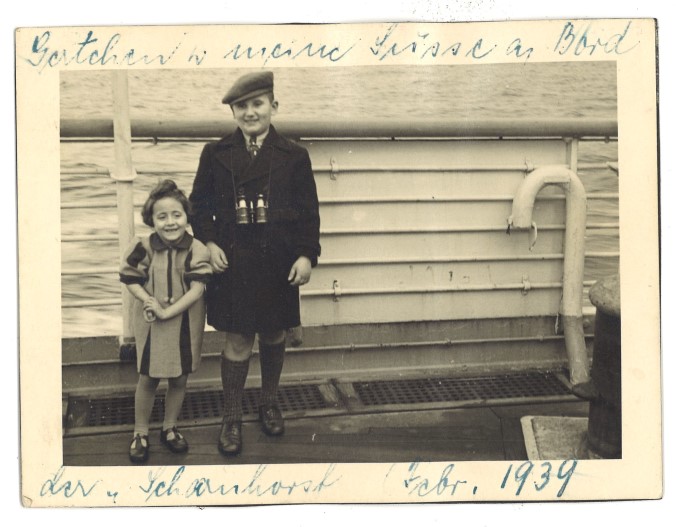
New exhibit spotlights the experience of ‘Shanghai Jews’
Explore a new Illinois Holocaust Museum and Education Center exhibit
Read more -
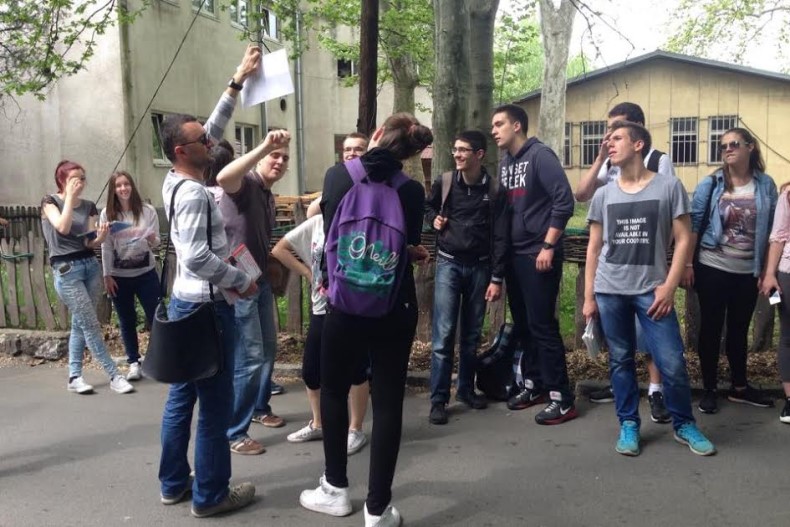
Europe’s brave new teachers of the Holocaust
Teaching the Holocaust in the modern era has its difficulties and rewards.
Read more
Starting a family changes everything, including the parents’ priorities, needs and perspectives. One big part of that often is an examination of the values and identity they want to convey to their young child, and how they want to do that.
The next episode of the public-affairs program “Sanctuary” – which airs at 11 a.m. Sunday, May 11, on ABC7-Channel 7 – looks at the many ways the Jewish community reaches out to the parents of young children, offering them a wide range of opportunities to connect with other parents and families, as well as with Jewish life and traditions.
Featured programs include jBaby Chicago, for parents of newborns; PJ Library, which sends young children free Jewish books and music each month; PJ Events, a variety of fun get-togethers for young families; and JUF Right Start, which provides up to $2,000 to families sending their first child to a Jewish preschool.
This episode is hosted by Cindy Sher.
Starting the week of May 12, the program will be available for viewing on the Jewish United Fund website.
“Sanctuary” is a joint production of the Jewish Federation of Metropolitan Chicago and the Chicago Board of Rabbis, in cooperation with ABC7-Channel 7.
Other stories
-
Meet Andrew S. Hochberg, 2021 Julius Rosenwald Memorial Award recipient
Celebrate Andy Hochberg at the virtual Annual Meeting on Sept. 14
Read more -
Two local teens win national recognition
Recipients of the annual Diller Teen Tikkun Olam Awards
Read more -
Celebrating six young award winners cultivating the community
Introducing young adult award winners
Read more
On May 8, close to 700 members of the Women’s Division came together for the Jewish United Fund’s 2014 Spring Event at the Fairmont Hotel, featuring renowned violin virtuoso Itzhak Perlman.
The theme of the luncheon, “A Seat at the Table,” emphasized the importance of taking action to help those in need – especially those must vulnerable members of our community, who are often voiceless.
Acclaimed violinist David Lisker, who studied with Perlman, also spoke at the event. Lisker’s family received help from JUF agencies when they emigrated to the U.S., and he testified that his success would not have been possible without that critical assistance.
“I’m standing in front of you as an example that real people are being helped by JUF every day. Lives are being completely changed,” he said. “JUF found us, and didn’t leave our side. They invested in us. To be here today, having studied with Itzhak Perlman… it’s beyond a dream, and JUF made it possible.”
Chaired by Dana Gordon, Overall Chair; Lynne Shapiro, Young Women’s Board Chair; and Michelle Friedman, Young Women’s City Council Chair; the event also included moving remarks by Women’s Division leaders Charlene Sales, Jennifer Worth, and Robyn Tavel, who shared their individual reasons for supporting JUF’s important work.
Alison Cuddy, newly-appointed program director for the Chicago Humanities Festival, moderated a conversation with Perlman, after which he performed for the crowd.
“I feel so lucky to be able to make a living at what I love to do,” said Perlman, who is known for his passionate emotional connection to his music. “Right now, I’m just yearning to continue to be connected to what I do. To not be bored. I think I’m doing a good job, because I’m still going on stage and not saying to myself, ‘Ugh, again?’ As long as I can continue to do that, I’m in good shape.”
Women’s Board members Marcey Barichello, Debra Green, Sharon Koltin, Debra Marcus and Sheryl Perlman co-chaired the event.
Each attendee received the gift of an award-winning cookbook, One Egg Is A Fortune, which served as a major sponsor for Spring Event.
Gordon thanked the crowd of JUF contributors, noting: “Everyone in this room is an important advocate for the needs of the Jewish community. We ensure that the community here, in Israel, and around the world is fed, educated, and protected in every stage of life.”
Other stories
-
Meet Andrew S. Hochberg, 2021 Julius Rosenwald Memorial Award recipient
Celebrate Andy Hochberg at the virtual Annual Meeting on Sept. 14
Read more -
Two local teens win national recognition
Recipients of the annual Diller Teen Tikkun Olam Awards
Read more -
Celebrating six young award winners cultivating the community
Introducing young adult award winners
Read more
Other stories
-
Chicago to Israel to Kenya
A family’s story of living Jewishly on three continents Michelle Cohen World May 28, 2021 Avital, Tzofia, and Netanel Kaszovitz outside their home in Nairobi on Yom HaAtzmaut. When Avital Kaszovitz prepared to be a Modern Orthodox shlicha (emissary) to the Jewish community in Ke
Read more -
New exhibit spotlights the experience of ‘Shanghai Jews’
Explore a new Illinois Holocaust Museum and Education Center exhibit
Read more -
Europe’s brave new teachers of the Holocaust
Teaching the Holocaust in the modern era has its difficulties and rewards.
Read more
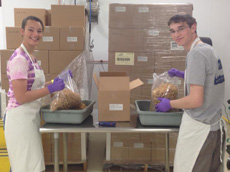
They came, they learned, and they made a difference.
On May 4, close to 250 Chicago-area Jewish teens joined peers from around the world for a meaningful day of volunteering as part of J-Serve 2014, the ninth annual International Day of Jewish Youth Service.
The event was hosted under the auspices of the Jewish United Fund’s Hunger Awareness Project.
This year’s project brought 7th-12th grade students from across Chicago together at the Northern Illinois Food Bank in Geneva, where they spent the day fighting hunger through hands-on service and advocacy.
“Working with teens from all over Chicago to make an impact was one of the most fulfilling things I have done,” said Mallory Sherwood, a junior at Stevenson High School and one of the teen leaders who helped plan the event. “I think we inspired other teens to make a difference, and confirmed our commitment to being instrumental voices in changing our community.”
In addition to sorting through nearly 20,000 pounds of food – the equivalent of 15,718 meals that the food bank will provide to Chicago families in need – the teen volunteers received a crash course on food insecurity in the Chicago area. Educational workshops focused on Judaism and hunger, root causes of hunger and how to be an effective advocate, and how to use social media to make a difference.
The programming was presented by Anshe Emet Rabbi Heather Altman, Rebecca Katz of the Jewish Council on Urban Affairs, teen leaders from the Jewish Teen Alliance of Chicago, and staff of the Northern Illinois Food Bank.
“As a teenager, a lot of times you don’t realize there’s hunger in the community,” said Donna Lake, Communications Director at the Northern Illinois Food Bank. “This was a great event to help teenagers understand the challenges that their peers in the community face.”
Internationally, the larger J-Serve program aims to educate teens about the Jewish values of gemilut chasidim, acts of loving kindness; tzedakah, just and charitable giving; and tikkum olam, the responsibility to repair the world, as well as build community and connections across religious and societal lines. The program is the Jewish service component of Youth Service America’s annual Global Youth Service Day and a collaboration of BBYO and Repair the World. J-Serve is underwritten by the Charles and Lynn Schusterman Family Foundation, along with support from partner agencies: The Foundation for Jewish Camp, JCCA, Jewish Federations, Jewish Student Unions, Jewish Teen Funders Network, NCSY, NFTY, Rock the Vote, USY and Young Judea.
In Chicago, the local J-Serve program is officially cosponsored by the Jewish Teen Alliance of Chicago, which is composed of JUF/Federation, BBYO, Bnei Akiva, the Community Foundation for Jewish Education (CFJE), JCC/Chi-Town Connection, the Jewish Council on Urban Affairs, Jewish Student Connection, Jewish Student Union, Moving Traditions, NCSY, NFTY, Or Tzedek, Shorashim, Response, USY, Yachad, and Young Judea.
Other stories
-
Meet Andrew S. Hochberg, 2021 Julius Rosenwald Memorial Award recipient
Celebrate Andy Hochberg at the virtual Annual Meeting on Sept. 14
Read more -
Two local teens win national recognition
Recipients of the annual Diller Teen Tikkun Olam Awards
Read more -
Celebrating six young award winners cultivating the community
Introducing young adult award winners
Read more
For more than 30 years, Keshet has provided educational, recreational, vocational, and social programs for individuals with developmental/intellectual disabilities operating according to traditional Jewish values.
For individuals with developmental/intellectual disabilities, questions of Jewish identity and involvement can be challanging as they figure out their place in the Jewish community. The Sidney and Lisa Glenner Keshet GADOL Program, for individuals over the age of 21, provides young adults with special needs the chance to live a full Jewish life alongside their peers within their community.
What is your Jewish identity? What is your place within the Jewish community? We asked three particpants of the Sidney and Lisa Glenner Keshet GADOL program these very questions and this is what they had to say:

“I like going to shul and davening. I enjoy learning and helping people. I have a lot of cousins and family and friends in the community. I feel that I’m respected because I’m part of the community. There are a lot of kosher restaurants, which make it easy for me. It’s important for me to live a Jewish lifestyle so I can keep Shabbos. I mostly like to relax on Shabbos.”
-Jonathan Weissbrot, age 33

“I like being involved and working in the Jewish community. I like being part of GADOL because I like being around my friends and that’s where they are. I like keeping kosher because it’s important. I like to celebrate all of the holidays and my favorite is Passover.”
-Avi Lesser (middle), age 26

“I feel that being part of the Jewish community helps me fit in and interact with people. I get a chance to make new friends and be a part of something. Also, keeping kosher and going to kosher restaurants lets me see what people like about keeping kosher and kosher foods.
Being Jewish and being part of the community helps me decide to choose certain clothes and learn rules about keeping kosher and how to live in a Jewish home.
There are certain lifestyle rules to follow: no electronics during Shabbos and no showers during Shabbos.”
-Becky Shuman (right), age 23
Everyone has a different upbringing and wants different things out of life, and Keshet gives individuals with special needs the opportunity to experience everything life has to offer, including a place within the Jewish community.
Deb Weiner is the manager of Marketing and Community Outreach for Keshet.
Keshet is a partner in serving our community, supported by the JUF/Jewish Federation of Metropolitan Chicago.
Photography included in this article was taken by Michael Lee Photography.
Other stories
-
Meet Andrew S. Hochberg, 2021 Julius Rosenwald Memorial Award recipient
Celebrate Andy Hochberg at the virtual Annual Meeting on Sept. 14
Read more -
Two local teens win national recognition
Recipients of the annual Diller Teen Tikkun Olam Awards
Read more -
Celebrating six young award winners cultivating the community
Introducing young adult award winners
Read more
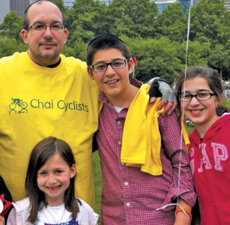
If you ask my wife and three kids (a boy, 14 and two girls, 11 and 7) if I am a good father, I’m not sure what they would answer. If you ask them if they think I’m a cool abba, they’ll tell you that I used to be cool. Being cool is a choice. I spent, what seems like months, saying to my own children. “Kids, I really am cool.”
I tried explaining to them about the glory of the 80s and how music was much better back then, especially the stuff that fell into the categories of college radio and punk. I tried showing them how a bunch of my friends all dressed differently than everyone else (we all mostly wore black…very original). I told my daughters that I had crazy hairspray and hair dryer skills that they couldn’t even dream about. It was never a conscious choice, but during high school and the beginning of college I was seen as being “cool.”
I know plenty of parents that go out of their way to appear cool to their kids. They might try to friend their kids and their kids’ friends on Facebook, be up on the latest music, novels, and texting abbreviations. If that works for you and the relationship you want to have with our kids, more power to you. I eventually gave up and just accepted the fact that I was no longer cool. I stopped trying to be cool in their eyes.
It was much easier than I thought it would be. However, I found that the choice of not being cool opened up a whole new avenue of going out of my way to be uncool. I had thoughts of calling my kids’ friends by nicknames that only I would understand. I had visions of interrupting play dates my kids had by doing the robot dance. To my family’s delight, I rarely acted upon these examples.
What I did implement was a conscious choice to show my kids that I was cool. Again, I am far from a model parent, but this mindset has fostered a more positive relationship with my kids. This was much easier than I thought in some aspects. My wife and I have always stressed to our children that there are things our family does and it might be a little different than other what other families do. There are TV shows, music, and movies that we feel are appropriate and others that are not. These decisions do me uncool, at times, but my kids have learned that my wife and I are willing to listen to their points of view and if we are swayed to their side it is solely because they have valid reasons and not because we are looking to be “those parents,” the ones that propel the parent/child relationship with the fuel of coolness.
Rabbi Joseph Hurwitz (1847-1919), known as the Elder of Novardok (a city in Belarus) taught that, “When the world means nothing, life means everything.” I have always looked at this quote as a message that we have to stand our ground sometimes. We shouldn’t always do things that the masses are doing, especially if it goes against our value system. When we stop worrying about what others think is when we can have opportunities to do what we know is the right thing in life. This is something that we can’t lecture our kids about; it is something that we have to show by example. I am no poster child for leading by example all the time. I am, however, blessed with three great kids who are learning the importance of doing the right thing, which is a foundation of Judaism.
Neil Harris and his family live in West Rogers Park and, aside from being uncool, he works in commercial finance and writes monthly for Oy! Chicago.
Other stories
-
Meet Andrew S. Hochberg, 2021 Julius Rosenwald Memorial Award recipient
Celebrate Andy Hochberg at the virtual Annual Meeting on Sept. 14
Read more -
Two local teens win national recognition
Recipients of the annual Diller Teen Tikkun Olam Awards
Read more -
Celebrating six young award winners cultivating the community
Introducing young adult award winners
Read more