African-American, Jewish communities come together at JUF Hunger Seder
Stephanie Sklar
Nearly 150 members of the African-American and Jewish communities celebrated an early Passover Seder together April 2, focusing on the issue of hunger.
The JUF Hunger Seder was part of the year-long JUF Hunger Awareness Project and was hosted by the Jewish United Fund of Metropolitan Chicago, in partnership with Rabbi Michael Siegel of Anshe Emet Synagogue in Lakeview and Pastor Chris Harris of Bright Star Church in Bronzeville.
The Seder, adapted from the Jewish Council for Public Affairs/MAZON Hunger Seder Haggadah (the prayer book used at a Seder), reframed the historical tale of redemption from slavery as the modern struggle faced by hungry people across our country. Attendees experienced all of the traditional Passover Seder rituals and symbols, including the meal.
The program provided an opportunity for meaningful dialogue between the African-American and Jewish communities. It included inspirational singing by the Bright Star Church Choir, including “Lean on Me,” “Let My People Go,” and “Glory, Glory Hallelujah.”
Skip Schrayer, chair of JUF’s Jewish Community Relations Council, remarked that the Seder was meant “to promote awareness about important issues, such as hunger, and to bring communities together to engage in dialogue and build relationships that can lift all of us up and bridge divides. This is what I hope will be just another meaningful moment that our communities can share in together.”
He also extended special thanks to representatives from the Greater Chicago Food Depository, Lakeview Pantry, Northern Illinois Food Bank, Bread for the World, and the JUF Uptown Café, which all do critical work on hunger issues.
“Tonight, we are one family,” Rabbi Siegel said. “Tonight, our focus is on the oppression of hunger, the slavery that so many are enjoined to. We will tell that story and we will pledge to make a difference – because I know we can.” Pastor Harris remarked, “Tonight, I’m grateful to be here with all of you – to make wonderful harmony together – because we are all better together.”
The Seder was supported by generous grants from the JCPA and the Crown Discretionary Fund.
For more information about similar programs, call 312-357-4770 or email [email protected]. For more frequent updates, follow @ChicagoJCRC on Twitter.
Stephanie Sklar is Director of Domestic Affairs for the Jewish Community Relations Council of the Jewish United Fund/Jewish Federation of Metropolitan Chicago.
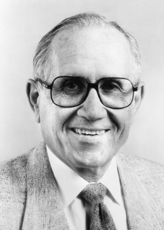
Abe Matthew was the 1995 JUF General Campaign Chairman; he led the campaign to raise a then-record $55 million. He had previously served on the JUF-Federation Board from 1979-85, including a time as the Board’s Vice President. He was actively involved in JUF’s Major Gifts Committee and served as JUF Chair of Bryn Mawr Country Club. He passed away on Saturday, Feb. 22; he was 87.
Matthew began his efforts as General Chairman with a fact-finding mission to Morocco, Israel, and-only a year after peace had been declared-Jordan. “We were welcomed warmly everywhere,” Matthew recalled. “Witnessing firsthand the good our generosity accomplishes is, for me, a great personal joy.”
“Abe was a wonderful man who cared passionately about our Jewish community,” said JUF/JF President Steven B. Nasatir.
“Abe was kind, and always smiling,” said Jeffrey Cohen, JUF Senior Development Advisor. “He was always concerned about others and had a high regard for communal professionals. He had great leadership skills across the board.”
Professionally, Matthew was Chairman of Custom Accessories, Inc., an importer for the auto-parts aftermarket. Aptly, he chaired JUF’s Auto Parts Division, which named him an Honoree.
Matthew was also very involved in synagogue life. He served in the boards of four synagogues, including two in the Chicago area, Lincolnwood Jewish Congregation and Congregation Yehuda Moshe. For JUF, he chaired the Synagogue-Federation Relations Committee and served as Vice Chairman of the Congregations Division campaign.
Additionally, Matthew was also passionate about Jewish education, serving as a member of JUF’s Jewish Education Committee and donating to JUF’s Jewish Day School Guaranty Trust Fund. He also served on the boards of the Hebrew Theological College and the Associate Talmud Torahs and was active in the Hillel system.
As he showed with his travels for the Jewish community, Matthew’s compassion for his fellow Jews crossed all borders. He served on the board of Israel Bonds and was active in Friends of Refugees of Eastern Europe.
Matthew was the husband of Nettie (nee Putterman), and the father of Ken (Myrna), Dr. Edward (Adrienne) and the late Norman (Linda). He was the Zayde of Brett (Steven) Schwartz, Jennifer (Adam) Schreier, Harrison (fiancée Alana Gale) and Samuel Matthew, Blair (Brian) Wolf, and Keith and Jared Matthew, and the proud great-grandfather of Alec, Josh, Phoebe and Darcy. The brother of the late Jack (Esther) Matthew and the late Belle (late Joseph) Putterman, Matthew also was “Uncle Abe” to many.
The funeral was held on Feb. 24 at Memorial Park Cemetery in Skokie, with arrangements by The Goldman Funeral Group. In lieu of flowers, the family asks that memorials be made to JUF, to Congregation Yehuda Moshe, or to Lincolnwood Jewish Congregation.
Other stories
-
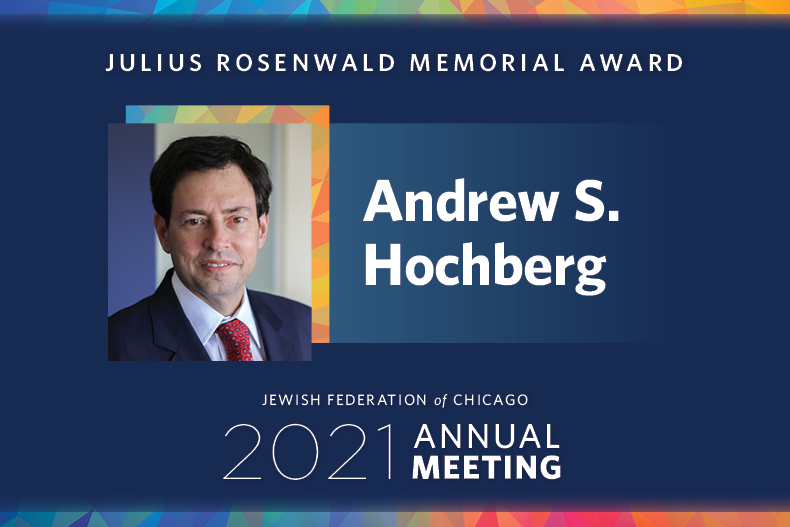
Meet Andrew S. Hochberg, 2021 Julius Rosenwald Memorial Award recipient
Celebrate Andy Hochberg at the virtual Annual Meeting on Sept. 14
Read more -
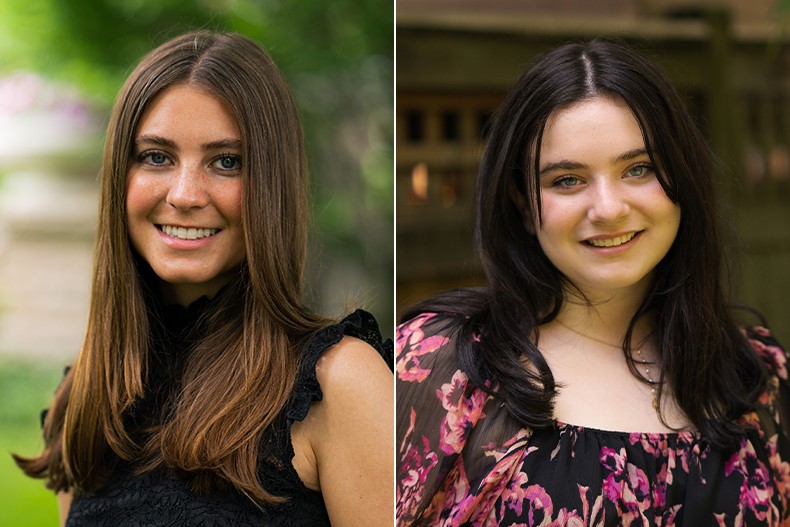
Two local teens win national recognition
Recipients of the annual Diller Teen Tikkun Olam Awards
Read more -

Celebrating six young award winners cultivating the community
Introducing young adult award winners
Read more
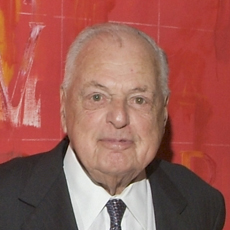
Herschel Seder was the Chairman of the Board of the Milwaukee Valve Company, Inc., which be bought in 1959, with his late partner, Max Koenigsberg. The two would run Milwaukee Valve together for 40 years, expanding its offerings to more than 5,000 items for home and industrial use. He died on March 1, at age 95.
A member of JUF’s Prime Minister’s Associates, Seder was a long time significant annual donor to JUF, and a Golden Giver, meaning that he had donated to JUF for 50 consecutive years or more.
“I remember his kind and gentle smile,” said Jeffrey Cohen, JUF Senior Development Advisor. “He was a mentor to following generations; like him, his children are involved in the Campaign.” Cohen also recalled that Seder’s commitment to JUF travelled with him to Boca Raton, where he was active in JUF’s Snowbird events.
Born in Webster, Mass. in 1918, Seder graduated with a degree in economics from Johns Hopkins University in 1939. The Army then brought him to Chicago, where he would stay and raise his family after meeting his wife, Ruth Altschuler, in 1944.
“He was stationed in Chicago, and the Jewish community fixed up young, single Jewish men and young Jewish women,” said his daughter, Diane Seder. “[Ruth’s] father said, ‘I like this man. This is the man you should marry.'”
“My father, I consider kind of the legacy of the greatest generation,” Robert Seder said. “He was one of those people who grew up a self-made guy… You worked hard, but you had to give it away. Even when business was tough, he still gave.”
In 1983, Hershel and Ruth Seder were honored by the Chicago chapter of the Anti-Defamation League for their humanitarian work. He also raised money through a telethon for United Cerebral Palsy for about 20 years, in the summers welcoming children with cerebral palsy to his house for swimming and ice cream.
Seder also was grateful to his alma mater, serving as a trustee at Johns Hopkins for 20 years. He also served on the advisory committees of the university’s Whiting School of Engineering-where he established its first endowed professorship in in the department of biomedical engineering-and its School of Advanced International Studies and Applied Physics Laboratory. In 1979, the university honored him with its Distinguished Alumni Award, and in 2000, with its Heritage Award.
In addition, the family has awarded 47 scholarship awards at Johns Hopkins, plus others at the University of Vermont, Brandeis University and Champlain College.
Seder was the beloved husband of the late Ruth Altschuler Seder. He was the dear father of John D. (Cheryl) Seder, James A. (Marie) Seder, Diane (Bruce Rosen) Seder, and Robert A. (Deborah L. Harmon) Seder and the devoted grandfather of Brea, Tal and Zoe Seder, Ilana, Sophie and Eli Rosen, Daniel and Mia Seder, and Jane Seder. The fond brother of Edith Seder (Dr. Bernard Kaye) Kaye, Evelyn Heller, and the late Ada Greenbaum, Betty Fishman and Dorothy Seder, he will also be missed by Lorraine Becker.
Services were held at North Shore Cong. Israel, followed by a private interment. Arrangements were made by Piser Funeral Services. In lieu of flowers, memorials may be made to The Ark, 6450 N. California Ave., Chicago, IL 60645.
Some of the information in this obituary came from a Chicago Tribune article, written by Meredith Rodriguez.
Other stories
-
Meet Andrew S. Hochberg, 2021 Julius Rosenwald Memorial Award recipient
Celebrate Andy Hochberg at the virtual Annual Meeting on Sept. 14
Read more -
Two local teens win national recognition
Recipients of the annual Diller Teen Tikkun Olam Awards
Read more -
Celebrating six young award winners cultivating the community
Introducing young adult award winners
Read more
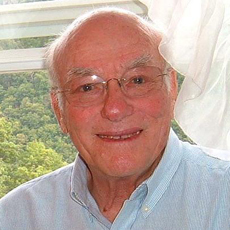
Alan Crane was born on July 16, 1924 and died peacefully in the early morning of Feb. 23, 2014; he was 89.
An energetic and creative salesman in the folding carton industry, Crane started his own business in 1962 and built his fledgling company into a thriving factory employing more than 200 people he cherished. Crane ran it for 40 years and by 2000, it was posting $43 million a year in sales. PPIMagazine, a trade magazine covering his industry, called Crane Carton Co., “a premier independent folding carton facility.” Crane was a strong force in the folding carton industry, mentoring and helping others whenever he could; he was proud of his employee’s loyalty, telling the trade magazine, “We have practically no employee turnover.”
In 1992, Crane- along with fellow Chicago business leaders Joan & Stan Golder and Howard Roseblum and Rabbi Dr. Douglas Goldhamer- established the Hebrew Seminary, A Rabbinical School for Deaf & Hearing. It was the first seminary to specifically train deaf and hearing people to become rabbis and teachers serving not only hearing people, but the numerous Jewish deaf communities in United States.
Crane served on JUF’s Task Force for Services for the Disabled in the 1990s and its Campaign Policy Committee in the 1980s. He chaired JUF’s Paper Division, and participated in many JUF Snowbird events in Palm Beach, even hosting one. Additionally, he was a Golden Giver to JUF’s Annual Campaign.
“Alan was a good friend. Once you became his friend, you stayed his friend,” said Jeffrey Cohen, JUF Senior Development Advisor, who knew Crane for nearly 35 years. “He was always good at giving advice.”
Crane was also a member of the executive board of JVS Chicago in the 2000s, and its board of directors. “He brought his vision and commitment to JVS Chicago, ensuring that those most at-risk in our community were cared for. He was a thought leader, a passionate advocate and a gentle spirit,” said Janice A. Kaufman, director of JVS Institutional Advancement.
The Duman Entrepeneurship Center is a program of JVS, and Crane served on its Loan Approval Committee as well as chairing its Loan Oversight Committee. “He was incredibly generous of spirit and worked with small business owners to ensure their success,” recalled Donna Rockin, director, IL SBDC/Duman Entrepreneurship Center at JVS Chicago.
After three years in the army during WWII, Crane received his undergraduate degree from Northwestern University. He loved the outdoors and was a dedicated golfer and an outstanding, powerful skier.
Crane was the son of the late Sigmund and Bertha “Buddy” Crane. He was married to Lori (Meyerovitz) for 41 years. He was the father of Beth, Jennifer (Burt Weinstein), and Bruce (Laura Cooper) Crane, and the stepfather of Karen, David (Mary Kenney), and John (Lynn) Manilow. The brother of the late Doty Weil (late Bert), he was the uncle of Laura (Ed) Cohn and the brother-in-law of Marilyn Paul (Bob Holstein) and Robert (Ellie) Meyers. And he was the Papa of Carrie (Adam) Scott, Lindsay (Patrick) Fagan, Jeffrey, Brian, and Eric Smolensky, Sarah and Benjamin Crane, Alex and Amy Cole, and Aaron, Jackson, Maya, Noah, Oliver, and Nate Manilow, and the great-grandfather of Sheanan and Lennon Scott.
Funeral services were held at Temple Beth Israel in Skokie on Feb. 26, with internment at Shalom Memorial Park. Arrangements were made by Chicago Jewish Funerals.
In lieu of flowers, memorials may be made to Hebrew Seminary or Congregation Bene Shalom, both at 4435 W. Oakton St., Skokie, IL 60076.
Other stories
-
Meet Andrew S. Hochberg, 2021 Julius Rosenwald Memorial Award recipient
Celebrate Andy Hochberg at the virtual Annual Meeting on Sept. 14
Read more -
Two local teens win national recognition
Recipients of the annual Diller Teen Tikkun Olam Awards
Read more -
Celebrating six young award winners cultivating the community
Introducing young adult award winners
Read more
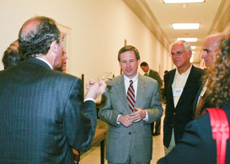
Arnold Levy, former Plan Commission Chairman for Glencoe, died on February 25, while spending the winter in Ft. Myers, Fla. A prominent real estate developer and philanthropist, he was a former staffer for Mayor Richard J. Daley’s anti-poverty programs in the late 1960s. Levy was 72.
A leader in Chicago’s Jewish community as well, Levy served as the president of JUF’s Young People’s Division (today’s Young Leadership Division). He was involved in the establishment of The ARK and served as its founding President. Levy also was involved with the Center of Jewish Studies at his alma mater, the University of Wisconsin.
He was very involved with the Spertus Institute, serving as chair the board of directors in 1995 to 96, and as a trustee since 1989. Of his work with and for Spertus Institute, he wrote, “together we worked to strengthen and expand the organization’s unique role in the Chicago Jewish community.”
“I grew up on the same block as Arnold Levy,” said Steven B. Nasatir, JUF/JF President. “We attended the same elementary and high school. Arnold was a leader who always cared, spoke out, and took action on behalf of those in his community in need.”
Born in 1941 to Roy and Esther Levy (nee Scheff), Levy grew up in the Peterson Park neighborhood. He attended Von Steuben High School, then University of Wisconsin-Madison, where he majored in political science. Upon his graduation in 1963, he taught that subject at DePaul and Loyola, and at Roosevelt University, where he received a master’s degree in public administration.
Levy began his community-planning career in the late 1960s, as one of the original staff members of Chicago’s Anti-Poverty Agency, under Mayor Richard J. Daley. Levy served on the Chicago Committee on Urban Opportunity, and worked with the Neighborhood Youth Corps, the Model Cities Program, and the Mayor’s Office of Employment and Training. He then joined the Urban Investment and Development Company.
After an unsuccessful state-senate bid in 1974, Levy switched careers, becoming an international real estate developer. He became president of JMB/Urban Hotels, presiding over luxury properties worldwide, including Chicago’s Four Seasons and Ritz-Carlton hotels.
Levy married Eva Cichosz in 1976, ultimately moving to Glencoe. From 1997-2005, he served on the village’s planning commission, including as chairman.
Other stories
-
Meet Andrew S. Hochberg, 2021 Julius Rosenwald Memorial Award recipient
Celebrate Andy Hochberg at the virtual Annual Meeting on Sept. 14
Read more -
Two local teens win national recognition
Recipients of the annual Diller Teen Tikkun Olam Awards
Read more -
Celebrating six young award winners cultivating the community
Introducing young adult award winners
Read more
Howard Geller served as the executive director of Garden View Home, and on the board of directors of the Illinois Council on Long Term Care. He passed away on March 10 at the age of 84.
“Howard was deeply involved and committed to the Jewish community,” said Steven B. Nasatir, JUF/JF President. “He was a thoughtful, kind and compassionate man who will be missed.”
Geller was very active in JUF. He served as vice chairman of the Board, chaired its Contributor Account Relations and Social Welfare committees, and served on its Executive Committee. Over the years, Geller served on many other committees, ranging from Care for the Aged and Health & Human Services to Philanthropic Funds, Overall Planning & Allocations, and Legacies & Endowments, as well as the Task Force on Resettlement. Geller served on some committees for decades, serving on as many as 10 at once.
Midge Perlman Shafton, then JUF Board Chair, wrote him a personal note in 2005 regarding his dedicated service to JUF: “Your input and slant on things is always so valuable. You’ve made a very special contribution in your years of service.”
Joel A. Stone, when he chaired JUF’s Board a decade earlier, wrote Geller in 1996: “I am so happy to have gotten to know you so much better… you have demonstrated your willingness to commit your time and energy whenever asked.”
Geller was also committed to Jewish education, and was a significant donor to JUF’s Jewish Day School Guaranty Trust Fund. He was chairman of the Board of Arie Crown Hebrew Day School and president of Associated Talmud Torahs. He served as president of Hebrew Theological College, and was a board member and multiple honoree of that institution. Hillel Torah voted Geller and his wife, Rita “Grandparents of the Year.”
Geller was deeply dedicated to the success of Chicago’s congregations, and helping them integrate into the larger community. He chaired JUF’s Congregations Division and its Synagogue-Federation Committee. He also served as president of Kehilath Jacob Beth Samuel, and was very active in Congregation Or Torah.
Geller was also a staunch advocate of Israel. He co-chaired the Jerusalem 3000 Mission in 1996 and also joined the Israel@50, Centennial, and Israel Solidarity missions to the Jewish homeland, traveling there again as an official JUF delegate to the 1998 General Assembly in Jerusalem. Back in Chicago, Geller served on JUF’s Missions and Partnership 2000 committees. He chaired the Aliyah Council, served as chapter president of the Religious Zionists of Chicago, and was active in Friends of the IDF and Israel Bonds.
He is remembered as the husband of Rita (nee Cohen) and the father of Marc (Debbi) Geller, Dr. Steven (Barbara) Geller and Beth (Bradley) Alter. He was the grandfather of Aviva (Mikey), Rena (Zachary), Jeremy, Ariela, Zev (Hila), Tamar (Yair), Eliana, Matan, Raanan (Andrea), Daniel, Talia, Gabriela and Bayli, and the great-grandfather of Jordyn, Mya, Gabriel, Ella, Kailey and Lucy. Geller was the dear brother of Jerold (Judy) Geller, the late Rose (the late Wilmer) Goldstein, Rabbi Eugene (Helen) Geller and Pauline (Henry) Meyers. He was also an uncle to many nieces and nephews.
A memorial service was held at Congregation Or Torah, followed by interment at Shalom Memorial Park; arrangements were made by Chicago Jewish Funerals. In lieu of flowers, memorials can be made to AMIT, 3856 W. Oakton Suite B, Skokie, IL 60076.
Other stories
-
Meet Andrew S. Hochberg, 2021 Julius Rosenwald Memorial Award recipient
Celebrate Andy Hochberg at the virtual Annual Meeting on Sept. 14
Read more -
Two local teens win national recognition
Recipients of the annual Diller Teen Tikkun Olam Awards
Read more -
Celebrating six young award winners cultivating the community
Introducing young adult award winners
Read more
Thanks to a generous gift from Nick and Alex Turik, as well as support from the Genesis Philanthropy Group, the 10th Russian Shabbaton was held in Hilton Chicago Indian Lake Resort (Bloomingdale, IL) the weekend of March 7.
It attracted close to 130 participants, among them first-time attendees, as well as alumni. Notably, distinguished alumni and co-founders of Shabbaton Misha Zilbermint and Olga Abezgauz joined the annual celebration for its anniversary. When asked to share the reason for coming to this event, most participants stated (some in Russian, some in English) that they were looking for a sense of community. They all added that they found this community at Shabbaton.
Russian Jewish Division (RJD), the organizers of this event, really did a wonderful job of creating a sense of togetherness for the participants. By reshuffling everybody into various small groups (by interest, city of origin, or randomly) they insured that all in attendance met as many fellow participants as possible. The Shabbaton began with a beautiful candle lighting ceremony followed by a big group session where Shabbat was explained and everyone was encouraged to welcome it with songs and prayers. This was followed by dinner and an intellectual game night (What? Where?When?).
Saturday was just as packed with activities starting with a discussion with Dmitriy Shimelfarb from JAFI, NY on Russian Jewish identity, cleverly expressed in a desire to create an acronymic alphabet for the community. The discussion was followed by workshops, the focus of which varied from painting led by Ramona Luka, JUF, and acting with famous Russian director Ilya Rudiak, to discussions about the media led by Jane Charney, AJC Chicago, and the psychology of Exodus with Rabbi Pinchus Zusis. Participants were encouraged to choose two workshop sessions that they found most interesting. With a plethora of options, it was hard to settle on just two, but no matter which workshops the participants selected, all were very satisfied with the knowledge and skills they gained from attending.
Bonding continued in small groups; as participants shared their experience of being a Russian American Jew. Many have found that what they thought to be a uniquely personal life-event was actually one that they share with other Russian Jews. Among such experiences were attendance of Jewish summer camps, realization of one’s Jewish identity, and facing some form of anti-Semitism throughout one’s life.
Participants also created shared experiences while at the conference: for most the Havdalah ceremony became the most cherished memory from the trip. The prayers, dancing and singing made participants feel like a part of something greater; it made them realize that they have a community which welcomes them and into which they fit with ease.
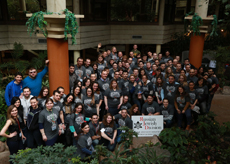
The sharing of personal experiences and the creating of shared ones did not stop with the scheduled programming. Despite days packed with ceremonies, workshops and sessions, participants were given plenty of free time in which most strove to continue to get to know each other. Some played card games, others sang songs and played guitars, still others held intellectual discussions over problems faced by the contemporary Jewish community. As the conference closed on Sunday, participants, now sporting a grey RJD t-shirts, hugged their new friends for a group picture. In the sea of grey, 130-something smiling faces confirmed that the 10th Shabbaton was a huge success. Please take a look at this short video and photos from the retreat.
To learn more about the Russian Jewish Division or Russian Shabbaton, contact Evgenia Kovelman, RJD’s director, at www.juf.org/RJD or 312-673-2351.Other stories
-
Meet Andrew S. Hochberg, 2021 Julius Rosenwald Memorial Award recipient
Celebrate Andy Hochberg at the virtual Annual Meeting on Sept. 14
Read more -
Two local teens win national recognition
Recipients of the annual Diller Teen Tikkun Olam Awards
Read more -
Celebrating six young award winners cultivating the community
Introducing young adult award winners
Read more
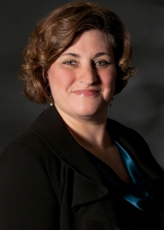
Rabbi Andrea London, of Beth Emet Synagogue in Evanston, was selected by the Forward as one of 28 of America’s Most Inspiring Rabbis of 2014.
Selected from hundreds of entries from readers everywhere, the national Jewish publication selected Rabbi London as one of 28 “Men and Women Who Moved Us” in 2014.
The nominating letter, written in part by congregant Ellen Blum Barish, recounts how a recording of Dr. Martin Luther King Jr. speaking at Beth Emet prompted Rabbi London to invite members from a nearby Baptist church to co-host Shabbat dinner and discuss race relations in the Evanston community. The evening of courageous conversation attracted several hundred people to services and a dinner which spurred interfaith, race-related book and play discussions; bibliodrama workshops, concert collaborations, and a bus trip to the civil rights sites in the South, with 38 high school students from both congregations.
Blum Barish writes, “She inspires us to find innovative ways to make a difference in our community, become a bridge between the faiths and discover our own Jewish spirituality.”
Other stories
-
Meet Andrew S. Hochberg, 2021 Julius Rosenwald Memorial Award recipient
Celebrate Andy Hochberg at the virtual Annual Meeting on Sept. 14
Read more -
Two local teens win national recognition
Recipients of the annual Diller Teen Tikkun Olam Awards
Read more -
Celebrating six young award winners cultivating the community
Introducing young adult award winners
Read more
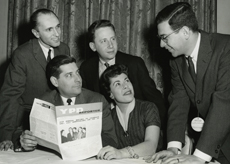
My father passed away on Dec. 13, 2013. Alan M. Rosenberg was 85 years old. He was married to my mom for 54 years, had three children, seven grandchildren, and lived a life devoted to intellectual pursuits, his vocation, the Jewish community, and, among other things, a vast array of plants he tended to in his home. He made creative birthday, anniversary, and Valentine’s Day cards for members of his family, was his own search engine on any topic, and was very precise and particular in how he lived his life.
In the months that have passed since he died, I have done what any son or daughter would probably do in that time: balancing my busy life at work and home while trying to think about my dad, process what his life and death have meant to me, and attempt to put it all in perspective. Along the way, I have said Kaddish in a variety of places, kept my beard from the Shloshim mourning period (it was, after all, the kind of winter to keep a beard), and have had moments where I came across a photo of him with my kids which made me smile.
As I look back on the weeks following his death, two thoughts kept popping into my head during those days and continue to this day.
First, I think about my own Jewish DNA. My dad was a former president of the Young People’s Division (YPD), which today is known as the Young Leadership Division (YLD). Not only did he meet my mom during their YPD days, but his involvement in Federation at the time helped define who he was, what was important to him, and provided him with lifelong friends. And while my own journey in the Jewish community played itself out over the years through various means, from summers at OSRUI camp to trips to Israel, my professional path in the Federation world is not a coincidence. My dad never pushed me in this direction and frankly, early on in my career while working at the Jewish Federations in Detroit and then Cleveland, I didn’t reflect all that much on his past Federation involvement. But I gravitated to this line of work and I have to think that I was programmed to do so, in no small part because of what he did and stood for over the years. It rubbed off on me somehow and I’m glad it did.
The second realization relates to the first. As we prepared for Shiva, we naturally pulled out old and recent photos of my dad and the family. Of the photos that we laid out on the dining room table, the ones that struck me the most and that my mom was particularly interested in having out were the photos (and speeches and event programs) from those old YPD days. There were photos from the late ’50s of my dad with other Federation volunteers, some of whom ended up being well-known leaders in our community, and all who did their part to build our community and raise the dollars necessary to help those in need. As I looked at these photos, I began to wonder what other photos and papers from our Jewish community’s history are sitting in boxes in homes throughout Chicago and the suburbs. While our Federation, its agencies, and other communal institutions showcase plenty of important documents and photos from our shared past, the bulk of the community archives can probably be found in our basements. After seeing the photos during Shiva, we all wondered why we hadn’t spent more time looking at them, particularly in my dad’s final years.
And that is, perhaps, the lesson that should be learned, and it is especially timely as we prepare to join with family and friends to observe the Passover Seders. Just as we tell the story of our Exodus from Egypt every year, we also have an obligation throughout the year to tell the story of those who came before us and what they accomplished to make our Jewish community what it is today. Those photos are not meant to collect dust or be stored in boxes. Rather, they need to come alive and be shared. And whether they are items from historic community events, newspaper clippings, or just old summer camp photos, we are who we are today because of what took place many years ago. Our Jewish community has flourished for decades and today is stronger than ever. We need to take a moment, look at what we have, and remember how we got here. By doing so, we honor the past and continue to build for the future.
Jim Rosenberg is Chief of Staff of the Jewish United Fund/Jewish Federation of Metropolitan Chicago.
Got photos?
Got an old photo that helps tell the Chicago Jewish story? Scan it and email it to JUF News at [email protected] with a caption and your email address. We may use it in a future issue of JUF News. Please do NOT send original photographs in the mail.
Other stories
-
Meet Andrew S. Hochberg, 2021 Julius Rosenwald Memorial Award recipient
Celebrate Andy Hochberg at the virtual Annual Meeting on Sept. 14
Read more -
Two local teens win national recognition
Recipients of the annual Diller Teen Tikkun Olam Awards
Read more -
Celebrating six young award winners cultivating the community
Introducing young adult award winners
Read more
The challenges that arise as one ages can be complicated. But for aging adults who have children with disabilities, their concerns are even more complex since they often have growing financial, social, emotional, and physical issues of their own. The gnawing worry about who will be around to care for their child with a disability can add even more stress. Statistics show that more than three fourths of older adults with disabilities are aging in place with their parents, a number that will only grow during the “silver tsunami.”
JUF News spoke with Rosann Corcoran, CJE SeniorLife’s Clinical Supervisor and Linkages Coordinator, to learn more about what CJE and other Federation-affiliated agencies are doing to address the rising concerns of the families and service providers in light of many recent policy changes affecting long-term supports for older adults and people with disabilities.
JUF News: What makes CJE SeniorLife’s Linkages program so unique?
Rosann Corcoran: One of only a few programs like it in the country, and the only one in Chicago, Linkages was originally formed to reduce the potential institutionalization or homelessness of adult children with disabilities and to give support to their aging parents. With a state system that is finally changing its focus from institutional services to community services, families and service providers are scrambling to understand how this will impact them. Quite often, however, there is misinformation and misunderstanding about what services are actually available.
What has been done to raise awareness about services and support systems for older adults and people with disabilities?
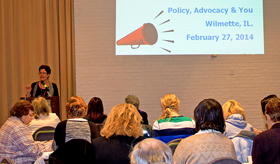
Linkages recently collaborated with a number of Federation-affiliated agencies to host an event-Policy, Advocacy and You: An Update on Disability and Aging Services-during Jewish Disability Awareness Month. This community event for seniors, people with disabilities and professionals focused on changes to long-term supports and services at the federal, state and local levels-all of which have a direct impact on the delivery of services to local families.
What were the main topics discussed at the event?
The hot topic was the sheer number of legislative changes that are happening on a national, state and local scale while the state of Illinois still lags far behind in implementing them. This “perfect storm” has been overwhelming for both families and service providers. From the Affordable Care Act to the Illinois’ SMART Act, which caused major changes to Medicaid, to the roll out of the Integrated Care Program to the Ligas, Colbert and Williams legislation and the Governor’s Rebalancing Initiative-our state’s attempt to save money while also trying to expand and improve services has been unduly stressful and challenging.
While these changes create the opportunity for improving quality of life and community living, they can also create fear of the unknown such as the possibility of limited choices and reductions in the quality of services and supports.
What are some of the emerging changes in the social service system that can provide support for older adults and people with disabilities?
To better help families navigate the emerging changes in long term supports and services, a network of referral agencies has been set up by the Federal government and the State of Illinois known as Aging and Disability Resource Network (A.D.R.N.). CJE currently participates in this referral network by serving as an A.D.R.N. for the Niles Township area. Typically, seniors and people with disabilities can meet with a CJE Resource Specialist to learn more about the new Health Insurance Marketplace, Medicare plans, retirement information, veteran’s benefits, real estate tax exemptions, financial management, and other government and community resources as well as long term supports and services for seniors and adults with disabilities.
How can readers find out more about CJE’s Linkages program or the services of the A.D.R.N.?
There are a number of ways to connect with CJE’s Linkages program. Information and referral services can be provided over the phone. We have a support group for parents of adults with disabilities, which focuses on more sensitive issues within a small group setting in an effort to reduce feelings of isolation and discuss the best ways to access community aging and disability resources in Illinois. As one parent commented, “I don’t know what I would do without CJE and the Linkages program. They have become family to me.”
We also have a monthly information meeting for larger groups where guest speakers cover relevant topics such as the Americans with Disabilities Act, housing and financial independence for people with disabilities, and services for people with mental illness. We also hold social events twice a year, providing adults with disabilities and their families with an uplifting way to connect with one another. Our quarterly newsletter features updates on current disability issues as well as information on such upcoming programs.
You can find out more about CJE SeniorLife’s Linkages program, including upcoming events, vital resources, and the latest newsletters, at www.cje.net/linkages. For more information, please contact Rosann Corcoran, Clinical Supervisor and Linkages Coordinator, at (773) 508-1694 or [email protected]. To learn more about A.D.R.N. services in Niles Township, please call Elisa Todd, Aging and Disability Resource Specialist, at (847) 656-6338 or email [email protected].
Other stories
-
Meet Andrew S. Hochberg, 2021 Julius Rosenwald Memorial Award recipient
Celebrate Andy Hochberg at the virtual Annual Meeting on Sept. 14
Read more -
Two local teens win national recognition
Recipients of the annual Diller Teen Tikkun Olam Awards
Read more -
Celebrating six young award winners cultivating the community
Introducing young adult award winners
Read more