Born at 29 weeks gestation, weighing 2 lbs. 13 oz., I was on a ventilator for 24 hours and in the neonatal intensive care unit for five weeks. Doctors told my parents I might have disabilities. My parents didn’t know what to expect. At four months of age, my mother noticed I was not rolling over or sitting up. At 11 months old, I was diagnosed with cerebral palsy. Doctors said I would have trouble walking and doing many physical tasks. Boy, were they wrong. I have since gone ice-skating, skiing, and been a participant on a birthright trip to Israel.
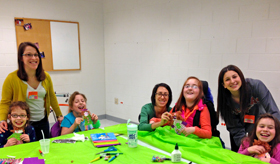
From the time I was six years old I have been determined to create an organization for kids with physical differences. In the summer of 2010, I began transforming my dream into reality. Six girls with cerebral palsy met weekly, took part in art and cooking projects, and, ultimately, created lasting friendships. The participants decided to name the group “Girls Club.’ Girls Club was the launch pad to my life’s work. The participants wanted to keep Girls Club going all year around. It was then I realized that the idea of girls club could reach more than six girls; so I set out to create a larger organization.
I began expanding my organization in December 2013. I changed the name of the organization from Girls Club to “Just Give Me A Chance.” It now incorporates boys and girls with a variety of movement differences. The mission of the organization is to create an environment where children with physical disabilities share a comfortable space and can just be a kid.
Growing up I developed strong friendships with people who did not have physical disabilities. I was thrilled to be seen as just another kid. However, I wished there was an organization for kids with physical differences to have fun and compare stories. I made a promise to myself that I would create an organization where children with physical disabilities could simply have fun and enjoy each other’s company.
Just Give Me A Chance provides a space filled with arts and crafts, cooking, games, laughter, singing and more. The organization creates a community where children feel comfortable sharing what it is like to have a movement difference.
As a little girl who participates in the group said, “My favorite part about the group is that I get to play with people just like me.”
Just Give Me A Chance started its fourth round of classes in March. Classes are held at the Bernard Wenger Jewish Community Center in Northbrook. For more information, visit www.jgmc.org, email [email protected], or call (847) 751-0073.
Aimee Halstuk is the program director of “Just Give Me A Chance.”
Other stories
-
Meet Andrew S. Hochberg, 2021 Julius Rosenwald Memorial Award recipient
Celebrate Andy Hochberg at the virtual Annual Meeting on Sept. 14
Read more -
Two local teens win national recognition
Recipients of the annual Diller Teen Tikkun Olam Awards
Read more -

Celebrating six young award winners cultivating the community
Introducing young adult award winners
Read more
The Donor Advised Funds (DAF) program at the Jewish Federation of Metropolitan Chicago continued to grow and thrive in 2013, helping thousands of donors to make meaningful contributions to both the Jewish and secular communities.
In 2013, community members opened 35 new Donor Advised Funds and distributed 5,809 charitable grants totaling $28.6 million to a wide variety of charities in Chicago, the U.S. and Israel, and around the world.
A Donor Advised Fund (DAF) is a vehicle for charitable giving that allows donors to better manage and organize their charitable giving through a single, personalized fund, while also enjoying a tax deduction each time money is deposited into the fund. As a less costly alternative to a private foundation, Donor Advised Funds are held at and managed by the Jewish Federation, financial institutions and community foundations. The Jewish Federation currently administers 818 DAFs with aggregate assets of $141.7 million-up 43 percent from last year.
“We are proud that so many members of the Jewish community have entrusted the Jewish Federation with their charitable dollars,” said Peter Kupferberg, Chair of Jewish Federation’s Philanthropic Fund Committee. “The growth of the program is a reflection of our community’s exceptional generosity, as well as the Federation’s ability to provide expert services to our donors.”
The Jewish Federation’s Donor Advised Fund Program began in 1971 and is among the oldest and most established programs of its kind in the country-and continues to seek innovative ways to improve year after year. Last summer, the organization implemented a new investment policy that under certain circumstances, allows outside financial advisers to continue to manage their clients’ assets even after those assets have been contributed to a DAF. 2013 also was the inaugural year of a strategic partnership with Israel Bonds which, according to Associate Vice President of Donor Advised Programs Rose Jagust, allowed donors to “get twice the bang for their philanthropic buck by investing a portion of their DAF assets in Israel bonds which, when redeemed, return to the Jewish Federation to be put to work all over again.”
In 2013, 74 percent of the Jewish Federation’s DAF charitable distributions went to Jewish organizations, and 26 percent were directed to secular causes.
The Jewish United Fund was the largest beneficiary of 2013 DAF distributions, receiving $5.4 million from 553 individual grants. Other Jewish organizations receiving significant funds included: The Jewish Federation of Metropolitan Chicago, The Jerusalem Foundation, American Friends of the Hebrew University, Friends of the IDF, American Friends of the Israel Museum, and Spertus Institute of Jewish Learning and Leadership.
Donors also made significant contributions to universities, cultural institutions, and health organizations, especially those based in the Chicago area. Top college recipients included the University of Chicago and Northwestern University, and major contributions were also made to the Harris Theater for Music and Dance, the Lyric Opera of Chicago, and the Art Institute of Chicago. In the health sector, significant distributions were made to Northwestern Memorial Foundation and the Usher III Initiative (seeking a cure for blindness). Additional recipients ran the gamut from the Inner-City Scholarship Fund to the Newberry Library to the Boys and Girls Club of Chicago.
Starting a Donor Advised Fund requires a minimum tax-deductible contribution of just $1,000. Then the donor recommends where Jewish Federation should invest those dollars, which can grow tax-free. The donor then will recommend how those funds should be distributed as grants to non-profits in good standing throughout the U.S. and the world.
Donors can name their fund in honor of their family, in memory of a loved one or to celebrate a special occasion, such as a bar/bat mitzvah, graduation, or wedding.
Federation offers secure online access to DAF contributors, who can make their gift recommendations online, check their balances, and track their account activity throughout the year. Donors may add funds to their DAFs as they wish, and can make additions in the form of cash, stock or other appreciated assets. Federation staff does due diligence to confirm the soundness of charities receiving grants, handles all the paperwork, and ensures that grants go out twice a month.
For more information, please contact Nicole Miller at (312) 357-4719 or [email protected].
Other stories
-
Meet Andrew S. Hochberg, 2021 Julius Rosenwald Memorial Award recipient
Celebrate Andy Hochberg at the virtual Annual Meeting on Sept. 14
Read more -
Two local teens win national recognition
Recipients of the annual Diller Teen Tikkun Olam Awards
Read more -
Celebrating six young award winners cultivating the community
Introducing young adult award winners
Read more

Navigating a child’s development can be a daunting task for parents. Each child brings unique potential and qualities into the world-and sometimes, parents need help from those in similar situations to understand how best to nurture that child, and help him or her become an integral part of the community.
Hannah*, a Jewish professional from Chicago, is the mom of a young child who is gender non-conforming. “Most little kids who are gender non-conforming are not transgender,” she said. “We’re doing the wait and see approach.”
Joan’s* daughter came out as a lesbian as a young high school student. “We kind of knew,” Joan said. “It’s not really been a hurdle that we had to overcome.”
Hannah and Joan are members of Response Center’s Parent Family Connection, a support and education group for parents and family members of Jewish Lesbian/Gay/Bisexual/Transgender/Queer (LGBTQ) individuals.
“Our monthly support meetings are for parents looking for a safe space to talk about their experiences, questions or concerns,” said Rachel Marro, Response Outreach and Prevention Specialist and PFC facilitator.
“I like that PFC is a specifically Jewish group. We can talk about all this gender stuff within Judaism,” Hannah said.
Parenting a gender non-conforming child can be challenging, she said, especially when it comes to dealing with comments from family members or people at school. “Then there is your own pain and questioning. Where is this from? How do we support our kid?”
“The Response PFC provides a safe, confidential place to voice concerns and to learn about LGBTQ youth issues,” said Debbie Dresner, Response Advisory Committee member and Parent Family Connection Co-Chair.
Now in its second year, the PFC includes parents and grandparents whose family members with gender issues range from as young as five to in their 20s. There is no fee to attend the meetings, and everyone is welcome. Group members can receive additional support through a mentoring program.
“The group gives people the opportunity to slow down, ask questions, reexamine their feelings, and maybe reframe the context from which those feelings come that causes them to have difficulty with a person they love,” said Hollis Russinoff, a Response Board member.
Although her daughter has experienced acceptance from family members, Joan worries about intolerance. While her daughter was walking in their neighborhood, someone called her a “faggot.”
“She said, ‘I’m a girl,’ and moved on,” Joan said. “But, I am always concerned about her safety.”
Hannah hopes her child will become secure and confident, that he will have friends – and that he will find a place within Judaism. “I guess that’s everyone’s concern, but maybe in my case it’s heightened or slightly different because of the high rates of LBGTQ youth who try to commit suicide. A large percentage is bullied. You see the statistics and you worry.”
“The age of someone coming out is getting younger, and there is a growing need for parents and families dealing with this reality to know where to turn,” Dresner said. “Many surf the Internet for information from organizations like PFLAG (Parents, Families, & Friends of Lesbians and Gays), but nothing was out there from a Jewish perspective.”
“I appreciate meeting other [Jewish] parents and just hearing from people in different stages of life and how they’ve approached things. I look forward to the meetings,” Hannah said.
Last fall, PFC partnered with Emanuel Congregation and Congregation Or Chadash, to sponsor a film screening and panel discussion of “Melting Away,” the first Israeli film to depict a family and their transgender teen. Response provides many other LGBTQ-focused programs that include training sessions for working with LGBTQ youth for professionals and parents; Hineini, a workshop that includes a documentary film and discussion focused on LGBTQ Jewish teens; and Summer Alliance, a weekly summer group for LBGTQ high school students and allies.
“Our staff at Response has been through multiple trainings on working with LGBTQ youth, so our counseling services, sexual healthcare clinic and leadership programs like Snowball are fully inclusive,” Marro said.
“There is growing acceptance in Jewish and secular communities. We have come a long way so all children, teens, and young adults can experience much more of their lives in the open,” Dresner said.
“I am so proud of the Jewish community, that we have this resource and support each other in this way,” Hannah said.
For information on Response or the Parent & Family Connection, call (847) 676-0078 or visit the website at www.responsecenter.org.
Response is supported in part by the Jewish United Fund/Jewish Federation of Metropolitan Chicago.
*Names have been changed.
When a teen comes out to you
“Coming Out” is when a person tells someone else that he or she is gay, lesbian or bisexual. This means that person trusts you enough to be honest. What can you do to support that teen?
- Let the teen know that you still care for him or her. The main fear for people coming out is that they will be rejected by their family and friends.
- Do not say, “Are you sure?” When someone comes out, he or she has gone over this question thousands of times in his or her own mind.
- It’s OK if you feel uncomfortable or upset – but it’s important to separate your own feelings of discomfort from what you convey to the teen.
- Respect the teen’s confidentiality. Telling others, friends or family must be done on the teen’s schedule.
- Recognize that this is not something that needs to be reported to parents, clergy or your superiors. It is neither your responsibility nor your right to tell others.
- Learn about organizations (like Response) and publications that might help provide support to the teen.
- If someone came out to you and you feel badly about how you handled it, you can go back and try again. It’s never too late.
Source: Keshet of Boston
Other stories
-
Meet Andrew S. Hochberg, 2021 Julius Rosenwald Memorial Award recipient
Celebrate Andy Hochberg at the virtual Annual Meeting on Sept. 14
Read more -
Two local teens win national recognition
Recipients of the annual Diller Teen Tikkun Olam Awards
Read more -
Celebrating six young award winners cultivating the community
Introducing young adult award winners
Read more
When you walk into the beautiful two-flat in Rogers Park, you’ll smell the food being prepared.
The three residents love to make cuisine from all around the world. They research countries and customs, cook the meal, and maybe even host a few friends. From now until the end of the year, they’ve got every dinner and its theme planned out.
The residents are young adults who are just beginning their transition into adulthood and they couldn’t be happier. This past winter, they hosted an Open House for residents of the community to see what life is like at The Heichal Home.
The Heichal Home is a program of Jewish Child & Family Services (JCFS), and participates in the Chicago Jewish community’s Supported Community Living Initiative. The person-centered community-integrated living arrangement (CILA) for people with intellectual/developmental disabilities. More than 100 individuals from prospective families and members of the community attended the Open House for a guided tour and to get more information about living in a CILA.
“The Open House was an incredible experience that enabled us to begin to see just how much the Jewish community at large supported Heichal and-perhaps more importantly-how much support Heichal could provide to the community of Jewish persons with disabilities,” said Milt Wakschlag, father of two of the residents at Heichal.
For parents coming through who have young adults with disabilities, the event sent a powerful, tangible message.
“When you walk into the house and you see the bedroom and living room and where the people living here take their boots offs and where they have their meals, you can visualize the future,” said Jodi Newmark, director of the Supported Community Living Initiative.
A typical week for the individuals who live in the Heichal Home is just that, typical. They go to work for six hours, come home and prepare a meal, do their chores, and unwind by watching some TV. Maybe they’ll have an activity planned or they’ll go to a Yad B’ Yad. On the weekends: Shabbat and a social activity with the residents at Migdal Oaz, another CILA nearby. Or, maybe they’ll just sleep in.
“They are doing what young adults do-they’re going out and they’re expressing themselves,” Newmark said. “They make choices that we may or may not agree with, but they’re given the opportunity to make those choices.”
Wakschlag believes the Heichal Home will allow his children to enjoy the kind of like that we all seek ourselves, which, until about a year ago, he never thought could happen in a Chicago Jewish context in his lifetime.
“Their life is not an afterthought,” he said. “It’s important to my wife and me as their parents because we love to see our children blossom personally into the best people they can be, largely through the attentive and loving encouragement of Heichal and Keshet staff.”
In Hebrew, Heichal means “sanctuary” or “sanctified dwelling.” As an acronym, Heichal stands for “Home for Engaged, Inclusive, Communal, Hilchati Adult Living.” To provide a person-centered approach in its truest form, the vision of the Heichal Home is supported via an Advisory Group made of up parents, siblings, community members, and JCFS representatives. This group meets to discuss goals, issues, wellbeing, community support, and ways to enrich the daily life and opportunities for the residents.
The JCFS site manager with special education expertise occupies the top floor apartment. The overarching goal is to stimulate and support self-determination, growth, and a sense of community for the residents.
While the three residents quickly became best friends, the Heichal Home will soon need to set the table for four-another resident moves in soon.
For more information on CILA’s and the Supported Community Living Initiative, call 855-ASK-JCFS (855-275-5237), or e-mail [email protected].
Jewish Child & Family Services (JCFS) is a partner in serving our community supported by the Jewish United Fund/Jewish Federation of Metropolitan Chicago.
Chris Krapek, for Jewish Child & Family Services.
Other stories
-
Meet Andrew S. Hochberg, 2021 Julius Rosenwald Memorial Award recipient
Celebrate Andy Hochberg at the virtual Annual Meeting on Sept. 14
Read more -
Two local teens win national recognition
Recipients of the annual Diller Teen Tikkun Olam Awards
Read more -
Celebrating six young award winners cultivating the community
Introducing young adult award winners
Read more

Teen girls receive myriad messages about how to define and value themselves from popular culture, parents, peers, other adults and school. The Research Training Internship will provide an opportunity for young Jewish women to discuss and explore issues that directly affect their lives, conduct research to test their ideas and report on their findings-which will help guide the future of the Chicago Jewish community.
RTI is sponsored by the Jewish Federation of Metropolitan Chicago, in partnership with Ma’yan and the Beck Research Initiative for Women, Gender and Community at DePaul University, with an additional grant from the Jewish Women’s Foundation of Metropolitan Chicago.
“This is really innovative, bringing together these community partners,” said Beth Catlett, Associate Professor and Chair of the DePaul University Department of Women’s and Gender Studies and director of the Beck Research Initiative.
DePaul University researchers will train interns to design a study, collect data from their peers and analyze the results by using participatory action research. The focus of the study will grow from the interns’ immediate concerns and interests.
Hallie Shapiro, Assistant Vice President, Israel Experience and Youth Initiatives at Federation, said, “The program will provide a safe space for young women to talk about things like race, class, gender and social issues through the lens of Judaism.”
“We’re hoping to learn what’s on the minds of young Jewish women,” said Amira Proweller, Ph.D., associate professor and chair, Department of Educational Policy Studies and Research, DePaul College of Education. “We’re also hoping to see young people learn about how to design focused inquiry that’s meaningful, that helps them learn not only about the communities around them but also about themselves.”
“We’ll guide them within a social justice framework,” said Catlett said. “It’s going to be a wonderful opportunity to bring together their Jewish and feminist identities.”
Stephanie Goldfarb, Senior Associate of Youth Initiatives at the Jewish Federation of Metropolitan Chicago, said, “We’re hoping to bring together a diverse group that includes girls from the city and neighboring communities.” She said a majority of the group’s work would be done at meetings, because many teens are already busy with homework, sports and other activities.
“This is an opportunity for them to meet other Jewish girls and produce something meaningful to them and to the community,” Goldfarb said.
“This project is an opportunity for them to cultivate purposeful relationships with other young women, and learn who they are and how to relate to and engage the world around them,” Proweller said.
After conducting their research, the interns will present their findings to the community through a written piece, multimedia project, video or other format. “They’ll think through how to disseminate this information throughout the community in a way that has the most significant impact,” Catlett said. “We really hope the interns will come to see themselves as agents of change in their own communities.”
Interns will participate in training sessions twice a month from October 2014 through January 2016, at the DePaul University Lincoln Park campus. No meetings will take place in July or August. Kosher meals will be provided at each session. There is no cost to participate. Interns will receive a $200 stipend upon completion of the project.
Jewish girls starting their freshman, sophomore or junior years of high school in the fall are eligible to apply. Applications are available on the Jewish United Fund website. Up to 12 interns will be chosen for the first cohort of the program. The application deadline for this fall is May 31.
For information, contact Stephanie Goldfarb at 312-444-2802, or at [email protected].
Visit the website at www.juf.org/teens/rti.aspx.
Other stories
-
Meet Andrew S. Hochberg, 2021 Julius Rosenwald Memorial Award recipient
Celebrate Andy Hochberg at the virtual Annual Meeting on Sept. 14
Read more -
Two local teens win national recognition
Recipients of the annual Diller Teen Tikkun Olam Awards
Read more -
Celebrating six young award winners cultivating the community
Introducing young adult award winners
Read more
Following the passage of a resolution recommending an academic boycott of Israeli universities by a small association of university professors in December, hundreds of university presidents throughout the U.S. sharply denounced the move as an attack on academic freedom, including many in Illinois, representing schools public and private, urban and rural, large and small.
Several state legislatures around the country – and Congress – began considering appropriate responses to this damaging academic development. In Springfield, a few Illinois state legislators, along with JUF, decided to advance a joint senate/house resolution that condemns academic boycotts while applauding the strong statements by Illinois university presidents. Resolution SJR 59, sponsored by Senator Ira Silverstein, is scheduled to be heard in the Senate Judiciary committee at 4 p.m. this Tuesday, April 1.
Meanwhile, a vigorous campaign has been unleashed against the resolution and its supporters by those promoting boycotts of Israel and misrepresent the resolution as itself an attack on academic freedom.
JUF urges you to call the offices of the senate president and members of the judiciary committee in support of SJR 59 (the legislative assistants keep track of the calls), or to sign an electronic witness slip in support of the resolution. Please specify if you personally know the legislator or are a constituent.
Share feedback on your communication with the legislator’s office with JUF’s state government affairs office at [email protected]
Senate President John Cullerton (Chicago) [email protected] or (217) 782-2728
Kwame Raoul (Chicago) [email protected] or (217) 782-5338
John G. Mulroe (Chicago) [email protected] or (217) 782-1035
William R. Haine (Alton) [email protected] or (217) 782-5247
Don Harmon (Oak Park) [email protected] or (217) 782-8176
Michael E. Hastings (Orland Hills) [email protected] or (217) 782-9595
Toi W. Hutchinson (Olympia Fields) [email protected] or (217) 782-7419
Michael Noland (Elgin) no email listed or (217) 782-7746
Ira I. Silverstein (Chicago) [email protected] or (217) 782-5500
Kirk W. Dillard (Hinsdale) [email protected] or (217) 782-8148
Jason A. Barickman(Bloomingdale) or [email protected] or (217) 782-6597
Darin M. LaHood (Dunlap) [email protected] or (217) 782-1942
Dale A. Righter (Matton) [email protected] or (217) 782-6674
For those with time and patience, sign an electronic witness slip in support of the resolution:
- Go to www.ilga.gov
- GA dashboard (written in red).
- Register to participate on site if you have not already done so.
- Senate
- Committee hearings
- Month (tab in the middle)
- Judiciary Committee: Go to far-right icon
- SJR 59: Go to far-right icon for the witness slip
- Sign in Support.
Other stories
-
Meet Andrew S. Hochberg, 2021 Julius Rosenwald Memorial Award recipient
Celebrate Andy Hochberg at the virtual Annual Meeting on Sept. 14
Read more -
Two local teens win national recognition
Recipients of the annual Diller Teen Tikkun Olam Awards
Read more -
Celebrating six young award winners cultivating the community
Introducing young adult award winners
Read more
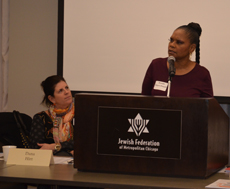
Human trafficking. In Chicago alone, 16,000 to 25,000 local women and girls are prostituted every day. This multibillion-dollar industry is the equivalent of modern-day slavery, according to Lynne Johnson, policy and Advocacy Director, Chicago Alliance Against Sexual Exploitation (CAASE), which receives a grant from the Jewish Women’s Foundation of Metropolitan Chicago.
On March 25, the Jewish Women’s Foundation, Jewish United Fund Government Affairs Committee and Jewish Community Relations Council (JCRC) co-sponsored the program, “The Realities of Sex Trafficking in Chicago and Our Community’s Response.”
The program highlighted a newly formed Jewish Coalition on Sex Trafficking in Metropolitan Chicago that will focus on multi-faceted ways to combat sex trafficking, from public awareness and education to community services for survivors, legislative policy advocacy and specialized professional education opportunities.
The Coalition is a partnership of Jewish and secular organizations, agencies and synagogues, including JUF Government Affairs; JCRC; JWF; the National Council of Jewish Women Chicago North Shore Section; J-cares (part of Jewish Child& Family Services); Na’amat USA; Greater Chicago Council; Congregation Hakafa; Congregation Judea Mitzpah; the Jewish Reconstructionist Congregation, the Dreamcatcher Foundation; Heartland Alliance and CAASE.
Johnson was among program presenters who included Anita Alvarez, Cook County State’s Attorney and Brenda Myers-Powell, survivor of human trafficking and advocate with the Dreamcatcher Foundation.
Prostitution: Not a victimless crime
The public often perceives prostitution as a victimless crime. The truth is that prostituted women experience rates of post-traumatic stress similar to that of combat war veterans, Johnson said. “Most women involved in prostitution have experienced routine physical and emotional abuse, theft and sexual assault. Most women involved in prostitution do not believe they will be treated fairly by our court system and do not report the crimes against them.”
Another persistent myth is that women and girls choose to be prostitutes. A 2008 Chicago study of 100 women up to age 25 found their average age for entering prostitution was 15. “Girls this young often exchange sex for clothes, shelter or food in order to survive,” Johnson said. Many are runaways from either dysfunctional homes or foster care. “Pimps and traffickers look for people to recruit into the sex trade who have few, if any, meaningful choices in life.”
Another myth is that prostitutes make a lot of money. According to the Chicago study, 53 percent of prostituted women said they had to give all their money to a pimp. Many said they could not leave prostitution because they feared retribution from their pimps.
“It’s an equal opportunity oppressor,” Johnson said, noting that the sex trade may look different in urban versus rural environments, yet happens just as frequently in both.
Twenty-five years working the streets
Brenda Myers-Powell was abused and raped, starting at age 4, while living with her alcoholic grandmother. By age 14, she had given birth to two children, and started working as a prostitute on Rush Street. A pimp kidnapped her, keeping her as a slave for five months. When she escaped and went home, she learned her grandmother never reported her as missing. “Nobody wanted me,” Myers-Powell said.
For 25 years, she worked the streets. She was shot five times and stabbed 13 times. She used drugs to soothe her constant physical and emotional pain.
She received a referral by social services through a county hospital emergency room. She finally received the help she needed to change her life.
Now, through the Dreamcatcher Foundation, Myers-Powell helps rescue women and girls from prostitution by offering them alternatives. “They don’t know any other way out,” she said.
So, who’s paying for sex?
A 2008 Chicago study of 113 johns—men who purchase sex—revealed that they can be anyone. “These are regular folks with very diverse backgrounds,” Johnson said. Among the subjects of the study, the average age was 39, within a range of age 20 to 71 years. The majority had attended some college or earned a college degree. Some 62 percent identified as having a wife or girlfriend.
“This is the most deter-able group of folks you’d ever want to find,” Johnson said. A majority of men in the study said they would stop buying sex if their photos or names were in printed the local paper, on a billboard or listed on the Internet; if a letter documenting their arrest for soliciting a woman for prostitution was sent to their families, they served jail time or their driver’s licenses were suspended.
“Clearly, it means (these things) are not happening now,” Johnson said. In fact, the burden of the criminal justice response falls on the people who need help the most—the victims—and not on the traffickers or buyers, she noted.
Legal changes focus on traffickers rather than victims
Anita Alvarez took office in 2008 and began evaluating the way the courts handled human trafficking cases. In the past, a young girl might be arrested for prostitution, charged and released—and then was expected to testify against her pimp. “We weren’t helping her,” Alvarez said. “And nothing happened to him.”
“We recognized that we needed to change existing law.” In one legislative session, the Illinois Safe Children Act passed. The law decriminalized juvenile prostitution and allocated money for much-needed, victim-centered social services.
“You have to look at these minors as victims,” she said.
New laws made it possible for sex trafficking victims like Myers-Powell to have their prior criminal records expunged. “It was an extensive process,” Myers-Powell said, “but it’s worth it.” Today, she has no criminal background.
Alvarez said the new laws allow prosecutors to build cases without relying on victims to testify against the “bad guys.” She has seen the changes: 93 defendants were charged with sex trafficking-related offenses since 2010. Four years earlier, that number was zero. A number of departments and agencies have worked cooperatively on this effort, she said, from the U.S. Attorney’s office to Chicago, Cook County and suburban police departments.
“We recognize that more work needs to be done,” Alvarez said.
Proposed federal, state legislation to crack down on sex traffickers
Two federal bills to end sex trafficking were recently proposed— the Stop Advertising Victims of Exploitation (SAVE) Act and the Justice for Victims of Trafficking Act (S. 1738).
Sen. Mark Kirk introduced the SAVE Act in the Senate in March. The SAVE Act would make it unlawful to sell or promote advertisements that facilitate kidnapping; trafficking or exploitation of children; sexual abuse or illegal sex; pimping, prostitution, child sex abuse and trafficking. Alvarez said the legislation would allow law enforcement to shut down advertisements on websites promoting underage sex.
The Justice for Victims of Trafficking Act creates a domestic trafficking victims’ fund within the U.S. Treasury to support programs for victims of human trafficking and child pornography.
In Illinois, Senate Bill 3558—Services for Survivors of Human Trafficking, introduced in February, would impose fines for various human trafficking offenses, to be collected and distributed through a new Specialized Services for Survivors of Human Trafficking Fund.
For information on the Jewish Coalition on Sex Trafficking in Metropolitan Chicago, call 847-853-8889 or email [email protected].
Other stories
-
Meet Andrew S. Hochberg, 2021 Julius Rosenwald Memorial Award recipient
Celebrate Andy Hochberg at the virtual Annual Meeting on Sept. 14
Read more -
Two local teens win national recognition
Recipients of the annual Diller Teen Tikkun Olam Awards
Read more -
Celebrating six young award winners cultivating the community
Introducing young adult award winners
Read more
A delegation of senior officers of Israel’s Home Front Command, led by Major General Eyal Eizenberg, visited Chicago this week as guests of the Illinois National Guard. Their series of briefings and site visits were designed to expand existing collaboration between the two partners, as well as with other participating law enforcement agencies: U.S. Department of Homeland Security, FBI, Cook County Department of Homeland Security and Emergency Management, and the Chicago Police Department.
Among other stops, the delegation visited the Northeastern Illinois Public Safety Training Academy, the Chicago Office of Emergency Management and Communication and Rush University Medical Center.
To conclude the visit, JUF hosted a dinner last night at its headquarters. The commanders of the participating agencies each offered expressions of mutual admiration and commitments to further deepen the meaningful ties between Israel and Illinois security agencies.
Commenting on behalf of the group of senior Israeli officers, Major General Eizenberg said, “The relationship with the Illinois National Guard is of strategic importance to Israel. The ILNG has expertise in specific areas which can benefit Israel’s security.”
Speaking for the Illinois National Guard, Brigadier General Richard Hayes said, “Israel has practical experience in emergency response to armed aggression which the National Guard can learn from. Israel is the United States’ most important strategic partner. This is a mutually beneficial relationship which will increase the effectiveness of both our units to provide better service to our citizens.”
Reflecting on the full schedule of the group’s activities, Michael Masters, Executive Director of the Cook County Department of Homeland Security and Emergency Management, said “The interactions between first responders in our region and our counterparts in Israel highlight not just the shared threats – both man-made and natural – that we face, they demonstrate how – by sharing best-practices, collaborating on training and developing plans together – we can enhance the safety and security of communities in both nations. For our part here at Cook County, we appreciate and welcome the role JUF plays in helping facilitate these essential partnerships.”
In closing remarks at the dinner, JUF Executive Vice President Jay Tcath applauded the “collegial spirit and the tachliss work that characterizes this special arena – security cooperation – of the U.S.-Israel relationship. Israel and America are actively sharing best practices, strategies and intelligence in several spheres, and this partnership is thriving in Illinois in particular. Tonight’s half-work, half-celebratory dinner also served as an impromptu reunion for a number of local law enforcement officers who have traveled to Israel with JUF for intensive security seminars. The dividends from those JUF investments continue pay many dividends, for the citizens of Illinois and Israel alike.”
Participants in the two day exchange included:
- Colonel Itshak Bar, Israel’s Home Front Command
- Lieutenant Colonel Ariel Blitz, Israel’s Home Front Command
- Protective Security Advisor, John Busch, U.S. Department of Homeland Security
- 1st Lieutenant Sara Carr, Illinois National Guard
- Major Michael Eiter, Illinois National Guard
- Major General Eyal Eizenberg, Commander, Israel’s Home Front Command
- Major Maxim Goldenberg, Israel’s Home Front Command
- Deputy Director Ray Hamilton, Cook County Department of Homeland Security and Emergency Management
- Colonel Duane Hayden, Illinois National Guard
- Brigadier General Richard Hayes, Deputy Adjutant General, Illinois National Guard
- Brigadier General Daniel Krumrei, Adjutant General, Illinois National Guard
- Colonel Christopher Lawson, Public Affairs Officer, Illinois National Guard
- Executive Director Michael Masters, Cook County Department of Homeland Security and Emergency Management
- Major William Powers, National Guard Bureau Israel Desk Officer
- Major Zackary Riddle, Illinois National Guard
- Colonel Robert Roth, Judge Advocate General, Illinois National Guard
- James Roussell, Chief of Staff, CPD
- Executive Director Gary Schenkel, Office of Emergency Management and Communications, City of Chicago
- Colonel Alicia Tate-Nadeau, National Guard Bureau
- Major Lenny Williams, Illinois National Guard
- 1LT Sara Carr, Illinois National Guard
- First Deputy Superintendent Al Wysinger, Chicago Police Department
- Captain Dustin Cammack, Illinois National Guard
Other stories
-
Meet Andrew S. Hochberg, 2021 Julius Rosenwald Memorial Award recipient
Celebrate Andy Hochberg at the virtual Annual Meeting on Sept. 14
Read more -
Two local teens win national recognition
Recipients of the annual Diller Teen Tikkun Olam Awards
Read more -
Celebrating six young award winners cultivating the community
Introducing young adult award winners
Read more
For the 69th year, hundreds of Holocaust survivors will come together Sunday, April 27, in what traditionally has been the largest gathering of survivors in the Midwest – the Annual Holocaust Memorial Service.
Organized by Sheérit HaPleitah of Metropolitan Chicago, the umbrella organization for area Holocaust survivor groups, the collective memorial observance will begin at 1:30 p.m. at Skokie Valley Agudath Jacob Synagogue, 8825 East Prairie Road, Skokie. The event is co-sponsored by the Jewish United Fund/Jewish Federation of Metropolitan Chicago.
“This annual memorial honors the memory of our six million martyrs, including one and a half million innocent children who perished only because they were Jews,” said Charles Lipshitz, president of Sheérit HaPleitah of Metropolitan Chicago. “We also will observe the 69th anniversary of the liberation from the concentration camps, and honor the contributions that Holocaust survivors have made to society.
“We cannot let the world forget that a modern society, Nazi Germany, was capable of committing such atrocities,” Lipshitz said. “Many reactionary forces are hard at work to change history and deny that the Holocaust ever happened. We must be vigilant not to allow this to occur.”
“The number of Holocaust survivors is dwindling to a precious few as we approach the 69th anniversary of the end of World War II,” said Larry Schwartz, president of the Association of Descendants of the Shoah – Illinois, Inc. “We, as children of survivors, are taking an active role in reminding the world that the crimes of Nazi Germany can happen again if we do not maintain vigilance. The legacy of the Holocaust survivors will be sustained and enhanced through our education and outreach efforts, for we shall never forget the sacrifices of the Six Million Jews who did not live to see the Nazi war machine defeated.”
“We will not remain silent in the face of Iranian, Arab, or any other entity’s wish to destroy Israel,” said I. M. Hubscher, co-chairman of the community commemoration. “This circle of violence must stop, and we, as children, grandchildren and great-grandchildren of survivors will continue to lead the effort to eradicate hate, death and destruction.”
At the 2014 memorial service, Regine Schlesinger, veteran anchor/reporter for WBBM Newsradio 780 and the daughter of Holocaust survivors who were on Schindler’s List, will be one of the featured speakers. Others will include the Honorable Roey Gilad, Consul General of Israel to the Midwest; Mayor George Van Dusen of Skokie; and David T. Brown, Board Chair of the Jewish United Fund/Jewish Federation of Metropolitan Chicago.
A high point of the service is the candle-lighting ceremony honoring the six million Jews who perished. The ceremony will be conducted by Sherry Rubinstein Warso of Dor L’Dor, the Young Leadership Division of Sheérit HaPleitah, with participation by children and grandchildren of local-area Holocaust survivors.
Winners of the first Yom HaShoah (Holocaust Memorial Day) essay contest will be announced by David Levine, the new chairman of the memorial service. Officials of the Jewish War Veterans-Skokie Post 328 and Jewish Boy Scout Troops #69 and #243 will present colors. Proclamations by Gov. Pat Quinn and Mayor Rahm Emanuel of Chicago and Mayor George Van Dusen of Skokie will be published in the ad journal.
The village of Skokie is supportive of Sheérit HaPleitah’s efforts to sustain the memory of the Holocaust. When the American Nazi Party chose Skokie in 1978 for its infamous demonstration, Sheérit HaPleitah helped lead the opposition, with the assistance of former Mayor Albert J. Smith and the village trustees. The struggle was portrayed in a made-for-television movie starring Danny Kaye.
A documentary by Todd Whitman about the days leading up to the infamous 1978 demonstration aired on PBS in January 2013. The film featured many Jewish survivors of the Holocaust, as well as activists from the next generation who stood ready to protect the survivor community.
Sheérit HaPleitah later led the movement to construct a monument in memory of the Holocaust victims on the Skokie Village Green, on land donated by the village and from funds collected from area individuals and synagogues and the Jewish United Fund.
The sculpture by Edward Chesney, depicting three generations, torn prayer books, a menorah, and other items symbolizing the destruction of European Jewry, was unveiled on May 31, 1987. That night, the memorial received worldwide attention after it was desecrated with spray paint, including the epithet “Jew liars” and other messages of hate.
“This insidious act made the message on the dedication plaque even more meaningful,” said Lipshitz. It reads, “This monument will remain in perpetuity as a reminder of what hate can do to mankind if decent people are not vigilant to forestall such a calamity in the future.”
Other stories
-
Meet Andrew S. Hochberg, 2021 Julius Rosenwald Memorial Award recipient
Celebrate Andy Hochberg at the virtual Annual Meeting on Sept. 14
Read more -
Two local teens win national recognition
Recipients of the annual Diller Teen Tikkun Olam Awards
Read more -
Celebrating six young award winners cultivating the community
Introducing young adult award winners
Read more
Israeli championship fencer Dan Alon will speak about his experiences at the 1972 Munich Olympics for the first time in Chicago. Alon is a highly sought after speaker and brings rave reviews from dozens of communities worldwide. The public is invited to hear Alon at 7 p.m. on Monday, March 31 at Shallots Bistro, 7016 Carpenter Road in Skokie, Chicago’s premiere kosher steakhouse and sushi bar.
Alon’s fencing career began at age 12, continued through his teen years and reached its peak at age 27 when he joined the Israeli fencing team at the Olympic Games.
“The Olympics are a symbol of freedom and peace between nations,” says Alon. He recalls marching into the Olympic stadium in Munich under the Israeli flag. “I was in heaven. It was the most beautiful day of my life.”
Alon’s world was shattered five days later on Sept. 5. Black September terrorists invaded the building where he and his 15 fellow athletes and coaches were living. Eleven were murdered in cold blood; only five managed to escape.
In honest, often emotional terms, Alon shares with audiences his journey, the security concerns prior to the Games, the harrowing attack, and the process of returning to normal life. Alon remains active in the as of yet unsuccessful struggle to honor the memories of his slain teammates at the Olympics every four years.
Alon began a career in business and became a manager-director at a plastics company. He met his wife, Adele — a native of Capetown, South Africa — while she was hitchhiking in Israel. Now 68, he lives in Tel Aviv. The couple has three children: Meir, 32; Pazit, 25; and Arik, 30, who is also a champion fencer, like his father and grandfather.
Admission is $100 per person and $180 per couple and includes dinner. Advance registration required at www.DanAlonChicago.com. There is limited space available and will be given on a first-come basis.
Other stories
-
Meet Andrew S. Hochberg, 2021 Julius Rosenwald Memorial Award recipient
Celebrate Andy Hochberg at the virtual Annual Meeting on Sept. 14
Read more -
Two local teens win national recognition
Recipients of the annual Diller Teen Tikkun Olam Awards
Read more -
Celebrating six young award winners cultivating the community
Introducing young adult award winners
Read more