Whether you’re visiting Europe or traveling across the U.S., an important way to make your trip more meaningful is to tour a synagogue or participate in Shabbat or holiday services. You may discover that exploring Jewish life and tradition in a new destination adds a new dimension to your experience.
If you traditionally attend Shabbat services, look for a congregation at that destination. Many host Friday night dinners and welcome visitors. Reach out to a synagogue, especially in popular resort destinations, and share the holidays as my husband and I did recently with Chabad of Puerto Vallarta for Shavout.
After he lost his mother, Michael Salberg of Highland Park traveled a great deal for his job. When he needed to say Kaddish, he found solace in local congregations. “ The great thing about saying Kaddish on the road is that in a time of sorrow you are welcomed as a friend by strangers. Particularly in smaller cities where the shul may have trouble getting a minyan, you can imagine how happy they were when I arrived sometimes as the 10th for a minyan . I’ve said Kaddish in wealthy mega shuls and storefront Chabads, in Orthodox, Conservative, and Reform congregations. I’ve found it moving and meaningful.”
Seth Arkin of Skokie makes a point of visiting synagogues in disparate places, which helps him better appreciate the global interconnectivity of Judaism, and the culture beyond the religion. “Sadly, some of the most unique synagogues stand in places to commemorate Jewish communities that have largely perished,” he said. His favorite synagogue was the Dohany Street Synagogue in Budapest. “It’s the most beautiful synagogue I’ve ever seen,” Arkin said.
“Whenever we travel abroad, we try and see at least one synagogue,” said Jordan Shifrin. “Sometimes we can get a guided tour. We’ve been to synagogues in India, Morocco, Athens, Rome, Cairo, and more. Many have a wonderful story to tell. My favorite was the New Synagogue in Danzig, Poland. Rebuilt from the ashes of what was once a grand synagogue, there are a couple hundred Jews left. Our guide told us her life story and we believed she was born Jewish but was adopted.”
“Since I’m Shomer Shabbat, I tend to stay near a Masorti synagogue,” said Sandy Starkman of Highland Park. “My favorite experiences have been at two Masorti synagogues I frequent in Jerusalem. I’ve made friends in each place who warmly welcome me! When we were in Sacramento for a family simcha, my husband, Larry, read the haftorah on Shemini Atzeret. The next day, on Simchat Torah, the rabbi unrolled the Torah scroll and all 100-plus attendees participated. It was really very special.”
“We had an uncle pass away in Boise, Idaho and it was our responsibility to provide him with a traditional Jewish burial,” said Matt Pestine. “I googled ‘Boise Jewish life’ and found a Chabad rabbi who promised to take care of everything. When my son and I flew to Boise the next day, the Chabad rabbi had made all of the arrangements, even had someone sit with the body all night. That evening, we spent Shabbos dinner with the rabbi’s family and about 15 other guests. Some were not even Jewish, but they told me they often stopped at a Chabad House because everyone was welcome. It was one of the warmest, sweetest Shabbat meals I’ve ever had.”
Our Own Experiences
We recently attended Shabbat morning services in Anaheim, Calif. When they announced the Mourner’s Kaddish, they suggested that if you’re standing next to someone saying Kaddish, you should stand up, too, and support them. What a beautiful tradition.
At a liberal congregation in London’s Golder’s Green, we discovered that during the reading of the Megillah, they not only “boo” Haman, they also “yeah” for Esther and Mordechai. Yes, it made the Megillah reading infinitely longer, but afterward we were treated to hamantaschen and tea!
By visiting a synagogue when you travel, you’ll learn about the local community, discover their local customs, and maybe even make a few new friends.
How to find a congregation abroad
• Reform Congregations, urj.org/congregations. For international locations, download the app at wupj.org/wupj-international .
• Conservative Congregations – uscj.org
• Orthodox Synagogues – ou.org/synagogue-finder
• Chabad – Chabad.org
Mira Temkin is a Highland Park-based travel journalist who writes about travel and theater. Follow her at miratemkintravel.com .
Other stories
-
Chicago to Israel to Kenya
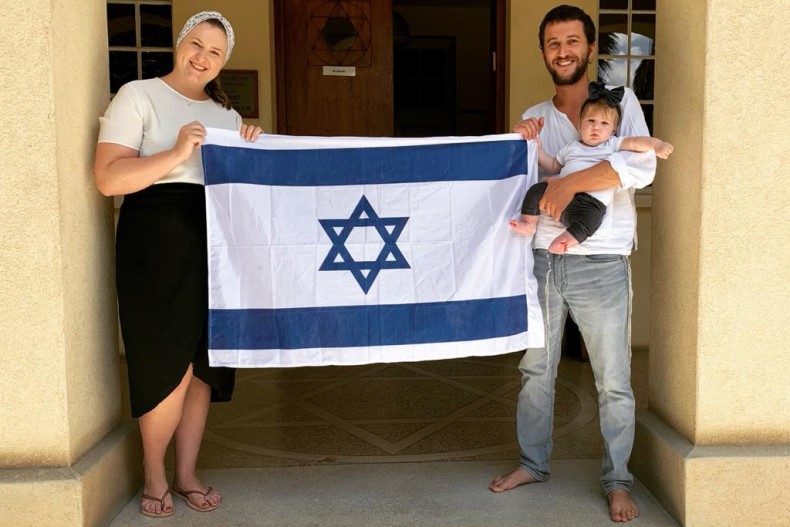
A family’s story of living Jewishly on three continents Michelle Cohen World May 28, 2021 Avital, Tzofia, and Netanel Kaszovitz outside their home in Nairobi on Yom HaAtzmaut. When Avital Kaszovitz prepared to be a Modern Orthodox shlicha (emissary) to the Jewish community in Ke
Read more -
New exhibit spotlights the experience of ‘Shanghai Jews’
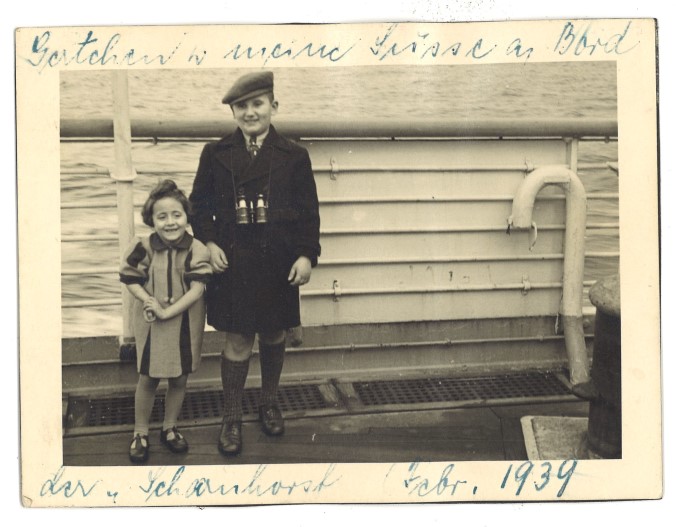
Explore a new Illinois Holocaust Museum and Education Center exhibit
Read more -
Europe’s brave new teachers of the Holocaust
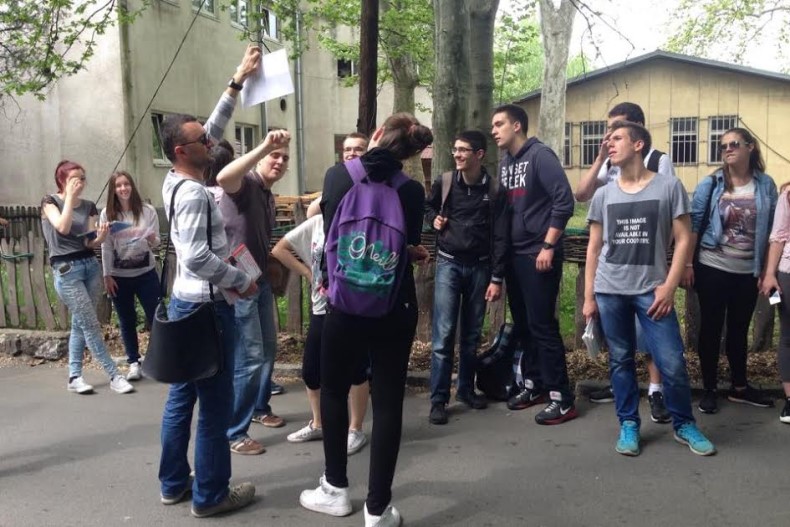
Teaching the Holocaust in the modern era has its difficulties and rewards.
Read more
Six educators stand along an imaginary line in the carpet, each position representing how much they agree or disagree with a definition of “Jewish Giving.” They are participating in hands-on training for three new Jewish Youth Philanthropy programs that will launch in the coming months, bringing together dozens of teens to explore important social justice issues in the Chicago community-hunger, homelessness, and youth at risk-and address those issues through the vehicle of Jewish philanthropy.
The programs will premiere this fall and winter at Anshe Emet Synagogue’s Tikkun Chicago high school program; Congregation B’nai Jehoshua Beth Elohim Congregation; and the Teen Midrasha Co-op, a partnership of North Suburban Synagogue Beth El, Beth Hillel Bnai Emunah, and Moriah Congregation.
Fueled by a generous $250,000 gift to the Fund for the Future from David and Susie Sherman, these congregational partnerships are part of a major expansion of JUF programming that could quadruple the number of local teens engaged in Jewish philanthropy projects.
Each of the three cohorts will get incomparable hands-on experience, learning the fundamentals of grant-making, researching critical needs-and ultimately being provided with $40,000 to allocate to local organizations. The Shermans’ gift will enable the congregations to build up and strengthen their programs in partnership with JUF while bolstering deserving local social justice organizations with more than $210,000 in new grants.
“Jewish philanthropy programs are an exciting way for teens to express their values and make an impact on the community,” said Susie Sherman. “We’re especially excited about teens helping to direct Jewish communal dollars toward organizations that the Jewish community doesn’t often support [because they aren’t Jewish organizations] but which are doing incredible work.”
Chicago is already home to one of the oldest Jewish youth philanthropy programs in the country; Voices: the Chicago Jewish Teen Foundation began its 16th cohort in September. Voices participants have allocated more than $640,000 over the last 15 years, thanks to the generous donor who endowed the program at its inception, providing a base of $25,000 per year to which the teens add their own contributions.
The Shermans’ gift also will fund two additional cohorts of teens exploring concepts of social justice through the lens of philanthropy.
Tikkun Olam with Tivnu , a partnership between Beth Emet Synagogue, TOV Teens, and Springboard, will bring teens on a social justice-oriented school break to Portland, Ore. over Veterans Day weekend; the program will culminate in a “philanthropy boot camp” enabling participants to allocate funds to local organizations when they return to Chicago.
The final cohort will take part in Camp Tzedek, a week-long “philanthropy day camp” modeled on Camp TOV, to run in the summer of 2020, that will offer a unique opportunity for high school students to combine volunteering and philanthropy. Teens will spend half of each day volunteering and half the day learning about equity issues in the Chicago area. At the end of the week, the teens will make a grant to one of the organizations they volunteered at during the week.
The new expansion will also include leadership training for teens who have already participated in youth philanthropy programs.
“This gift will create a thriving ecosystem of Jewish teen philanthropy programs,” said Hallie Shapiro Devir, JUF Senior Associate Vice President of Family and Teen Engagement. “Teens will be able to move from shorter, more focused programs to the longer, more intense experience of Voices, and then return to their congregations as assistant teachers, leading a cohort of their peers and younger students.
“This is an incredible way to invest in teens’ growth and development while connecting them to the Jewish community and giving them the power to address real issues they see all around them.”
Other stories
-
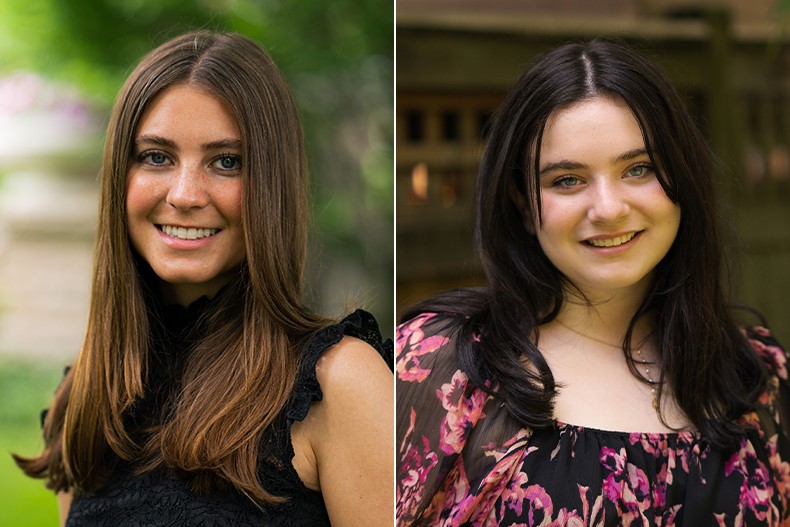
Two local teens win national recognition
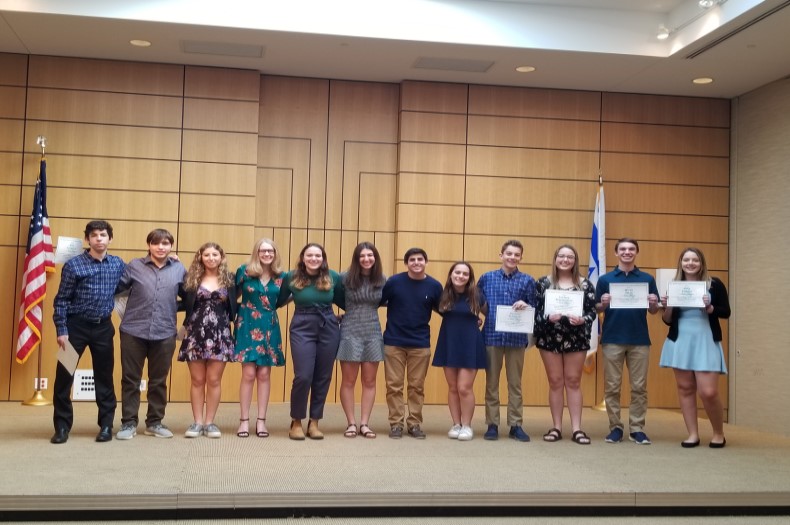
Recipients of the annual Diller Teen Tikkun Olam Awards
Read more -
Celebrating six young award winners cultivating the community
Introducing young adult award winners
Read more -
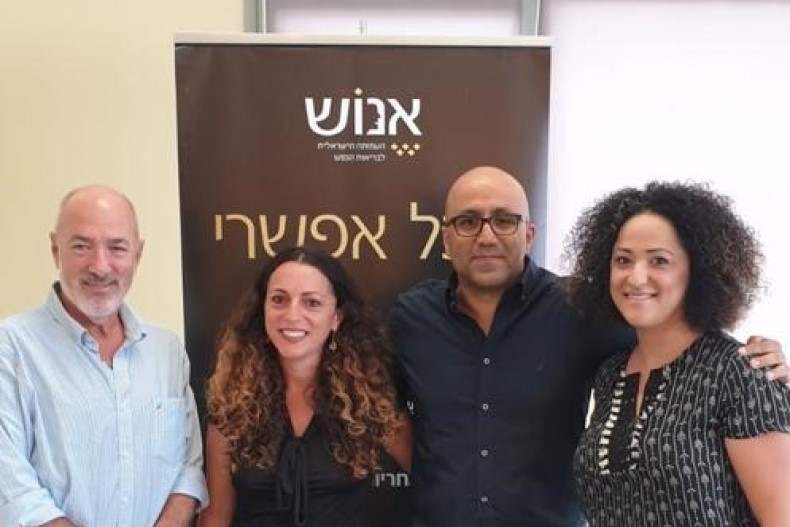
“JUF has changed the life of my adult son, and I am grateful to the Chicago community.” These are the words of Miri, whose 30-year old son lives with mental disability.
I was privileged to represent JUF at the graduation ceremony of a program called Re-Start, helping adults with mental disabilities join the work force. Through JUF’s Breakthrough Fund, Chicago’s Jewish community provided the needed support for this transformative program run by Enosh, the Israeli Mental Health Association, a well-known and respected non-profit.
At the Re-Start graduation, I had the privilege of meeting 10 graduates who now have the additional tools and enhanced self-confidence to secure gainful employment and greater independence. For each one of them and for their proud family members who attended the modest ceremony, this program offers life-changing possibilities. For JUF, it was one more opportunity for our donors’ generosity to do good for those who need it most here in Israel.
Enosh is unique because it supports people with psychiatric disabilities as well as their family members. It is supportive family members who carry the unrelenting responsibility and yet are too-often an over-looked piece in the multi-dimensional service formula. Respite care is essential for the family.
Enosh, with more than 60 service centers, has been leading cutting-edge rehabilitation programs all over the country for the past four decades. Their personalized approach ensures that individuals receive customized, comprehensive support. One size does not fit all. The goal is to enable all people with mental illness to have every possible opportunity as anyone else to pursue meaningful, independent lives.
The organization’s work is carried out by some 700 professionals and hundreds of volunteers. Together they provide services ranging from employment assistance to social skills and from family counseling to home economics. Each individual supported by Enosh leads his or her own recovery plan, with emphasis on helping individuals integrate as easily as possible into the larger community. Enosh, recognizing the centrality of the family to both providing the day-to-day safety net and realizing the plan’s success, works hand in hand with the family throughout the program. Thanks to these programs, participants gain a greater self-esteem, self-reliance, sense of security, and a feeling of belonging.
The innovative and intensive Re-Start program meets with participants as a group as well as individually five days a week for four months, helping them pave their way towards gainful employment. The course teaches the cognitive skills required in the labor market as well as how to manage one’s budget. It helps participants research the employment market, identify their relevant strengths, and map out their career prospects. The program teaches computer skills-a tool that is becoming a requirement in almost every field of work. Participants also learn how to interview for a job and work on their interpersonal skills.
Enosh also runs the Mind & Fitness program in JUF’s Partnership Together region of Kiryat Gat, Lachish and Shafir. The program, which JUF has supported since 2017, offers a new holistic rehabilitative approach to promoting a healthy lifestyle among people with mental health disabilities, focused on physical activity, healthy living education, and mindfulness exercises.
Finally, as the leading and largest organization in Israel providing mental health rehabilitation services, Enosh also runs an educational effort to increase Israeli society’s awareness of the needs of people with mental health issues and to enact legislation in the Knesset to bring about the desired public and private results. While Israel is certainly advanced in its treatment of people with challenges, there are still many areas in which legislation is required. Enosh is promoting that effort, working with all political parties and educating lawmakers about the need for our society to be as inclusive as possible. JUF is a proud supporter of this effort in our Partnership region and throughout the country.
In the words of Miri, the proud mother of an adult with mental disability, “if it weren’t for the Jewish community of Chicago, my son would never have even contemplated seeking a job.”
Ofer Bavly is the director general of the JUF Israel Office.
Other stories
-

Mother’s Day, Father’s Day, and the Jewish way
Let us pause and consider what it means for us to truly honor our parents
Read more -
Each time we study Torah, we experience the revelation
The mystical tradition of Judaism that lifts up the number 600,000 from the Exodus
Read more -
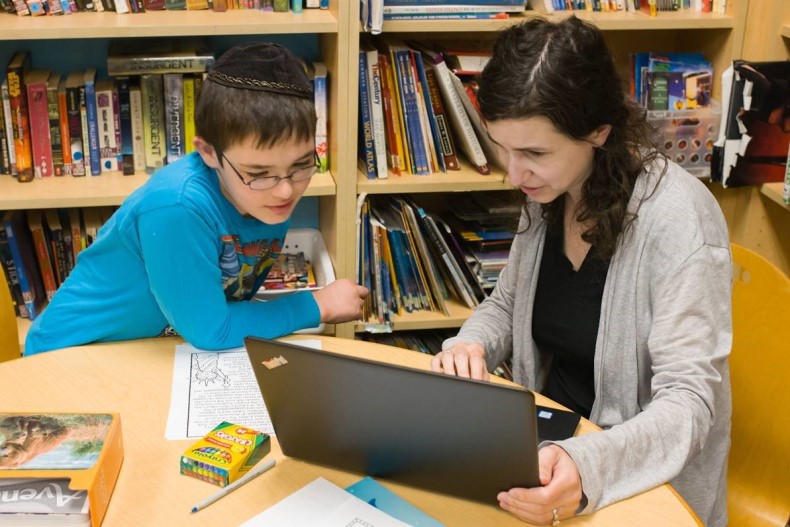
The school known for decades as the JCFS Therapeutic Day School and Yeshiva is now called the Knapp School and Yeshiva. The name honors the Knapp family, whose consistent involvement with JCFS Chicago has enabled the agency to provide services to many students.
“We’re very glad to have a name attached to the school for the first time,” said Rabbi David Rosenberg, the school’s coordinator of Jewish educational services and Orthodox community liaison. The Knapp family has been active in philanthropy and foundational support of JCFS Chicago, including the Esther Knapp campus and the Joy Faith Knapp Children’s Center.
The Knapp School is an option for students who struggle in public or private school. With a staff of 80, including teachers with LBS-1 certifications, social workers, speech and occupational therapists, a reading specialist, a special education gym teacher, and a therapeutic dog, students are supported in their journey towards reintegration in their original schools.
“Our goal is for our students to gain skills necessary to be successful outside of our walls,” said Rachel London, the school’s admissions marketing coordinator. In the process of gaining these skills, students gradually transition back to their original schools, with plenty of support from staff.
Knapp School students achieve their goals in small mixed-year classrooms with integrated opportunities to learn valuable life skills as well as an age-appropriate curriculum. The school’s 17 classrooms have no more than 10 students each, which ensures each student receives substantial attention from teachers and other support staff.
Beyond the classroom, the Knapp School also features a life skills classroom with kitchen and laundry equipment, a sensory gym, and time-away spaces for kids to regroup. There is also a state-of-the-art Snoezelen room, a multisensory room designed to help students receive the sensory input they need to become calm and focus in the classroom.
Another key part of the Knapp School is the yeshiva, the only facility of its type in the Midwest. In the yeshiva program, students learn Hebrew, Bible, Talmud, and Mishnah, and pray daily in the Beit Midrash, which includes an aron kodesh (Ark for the Torah).
The students receive the same supports as the main school students, and students in both programs follow an Individualized Education Program (IEP) to ensure the greatest success in their social, emotional, academic, speech, and therapeutic goals.
Each student’s path at the Knapp School is unique, and “the child is a big part of the process” to determine what this path looks like, Rosenberg said.
The staff takes a team approach to help the students, which includes the involvement of family members and other JCFS staff with specific expertise. Data collecting and record keeping are important at the Knapp School, where the “very collaborative interdisciplinary work” helps each child meet their goals, London said.
During the 1.7 years an average student spends at the Knapp School, they receive a wonderful education as well as the life skills they will need to succeed beyond the school. After their time in the school is over, they may continue to receive relevant services from JCFS Chicago.
For more information, visit jcfs.org/tds or contact Rabbi David Rosenberg at [email protected] or (773) 467-3926.
Other stories
-
Two local teens win national recognition
Recipients of the annual Diller Teen Tikkun Olam Awards
Read more -
Celebrating six young award winners cultivating the community
Introducing young adult award winners
Read more -
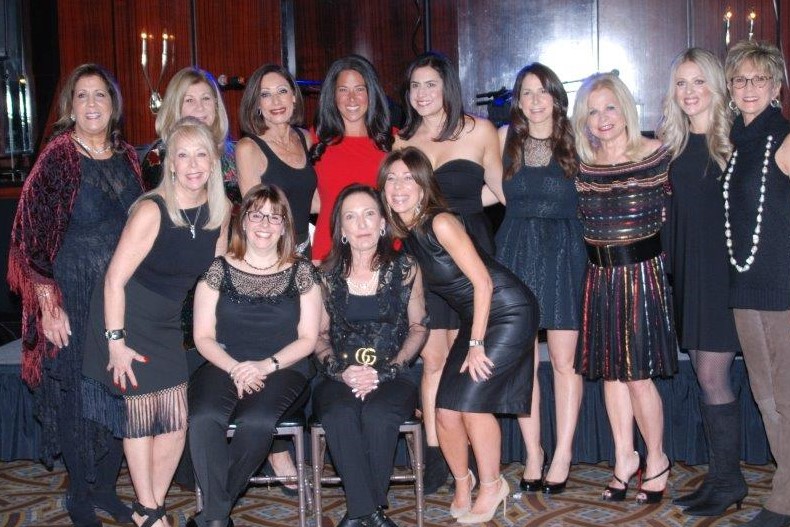
A century of contributions to the welfare of children is both an extraordinary milestone and a powerful legacy–and this year the North Shore Auxiliary of JCFS Chicago celebrates that very special centennial.
This volunteer women’s auxiliary has been an “essential” part of the agency, said JCFS CEO Howard Sitron.
“For two-thirds of JCFS’ 160 years, the organization has been behind our work, completely volunteer-driven, incredibly dedicated to the kids in our care and ensuring they’re well taken care of,” he said. “We cannot express our appreciation adequately for the work that they do. Their work has significantly impacted our ability to lead our mission and successfully serve the people who come to us for care.”
In addition to fundraising, the NSA supports JCFS through hands-on volunteering at the Knapp School. “The most important thing we do is give the students a better life and style of living, teaching them skills, and give them the ability to mainstream into high school or public life,” said long-term board member Lori Lavin. After hearing advice to “do everything” when she joined the board 29 years ago, she quickly discovered that “there isn’t anything our board does that I don’t want to get my hands on.”
“What appealed the most was that we had the ability not only to do well for the families and kids, but as a board member, I was able to get my hands dirty, to go to the schools and do the pizza reward lunches and graduation parties,” she continued. “There are a lot of children’s boards in the city, but we are a unique board to have senior members who still participate in all the things that we do.”
The NSA board is also unique for its legacy board members, who are family members of previous board members. Wendy Kleper, a board member for 35 years, became inspired to join when she watched her late mother, Jeanne Kleper, and her friends host events.
“They were the movers and shakers of Chicago,” she said, and the creative fundraising programs they launched like the dinner dance and shopping spree card with local businesses continue to this day.
“My mother’s generation,” Kleper said, “set the standard for what the organization is, and we’re proud to follow in their footsteps.”
“The greatest gift we have is to go to graduation each year and to see where these students have taken themselves. Like our own children, it’s wonderful to watch them progress and see them go to college or industrial school and feel comfortable in their own skin.”
The NSA’s current president, Jennifer Riback, also enjoys seeing the fruits of her labor–and is eagerly looking ahead to the organization’s future. “In the future, we’d like to expand our ability to fundraise so we can always be a great source of support to JCFS Chicago. We feel very proud to be able to be a constant support to them,” she said. “We’d like to build on the momentum we have and make it even bigger.”
And JCFS is very appreciative: “I, in my years with them, have been awed by their dedication, generosity, and creativity,” said JCFS COO Stacey Shor, who previously served as a liaison from JCFS to the NSA. As for how the auxiliary has thrived over a full century, Shor believes it the perfect combination of honoring tradition and dreaming for the future.
The North Shore Auxiliary Dinner Dance celebrating the 100th anniversary will take place at 7:30 p.m. on Dec. 7 at JW Marriot, Chicago. For more information, visit jcfs.org/donate/north-shore-auxiliary .
Other stories
-
Two local teens win national recognition
Recipients of the annual Diller Teen Tikkun Olam Awards
Read more -
Celebrating six young award winners cultivating the community
Introducing young adult award winners
Read more -
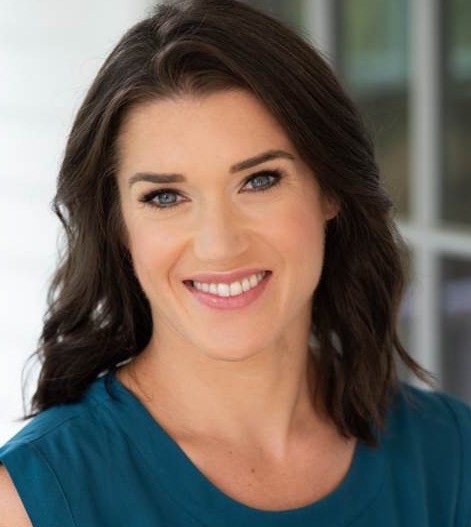
For many people, progressively losing both sight and hearing would be a catastrophic diagnosis. For psychotherapist and motivational speaker Rebecca Alexander, these diagnoses have helped her to live an active, fulfilling, and meaningful life.
Diagnosed at 12 with a degenerative vision condition called retinitis pigmentosa, Alexander found out while in college that she was also losing her hearing. She suffered from Usher Syndrome, but didn’t learn that it was the rarest type until consulting with researchers in Helsinki, Finland. “When I was diagnosed, they said because you have both progressive vision and hearing loss, this is what it is, but we’ve never seen this as it’s presented itself in you,” she said. “I am case number one.”
Alexander, who is Jewish, will share her remarkable story from her diagnosis to her current life at the Norton & Elaine Sarnoff Center for Jewish Genetics’ annual Jean Therapy event on Oct. 30. Originally held in a denim boutique, where the event received its name, Jean Therapy is designed to be “an educational, engaging, and low barrier approach to learn more about Jewish genetic disorders,” said Sarnoff Center assistant director Sarah Goldberg.
On that night, Alexander said, “my goal is to have people know that we’re all living with something. I have an Ashkenazi genetic disorder, and I hope to normalize what we all go through.”
“We live in a world that’s constantly reminded of all the things that we’re not and what we don’t have, as opposed to focusing on what we do have,” said Alexander, who uses her experience to educate about living a meaningful life in the face of adversity. “We live in a world where everything is on social media and people take for granted that they can see a photo on Instagram and read the caption; they just think about how many likes they can get. But when you live with something like this, it makes you think. I’m tremendously grateful that I have something that forces me to understand what’s really important.”
Currently, although she has lost the majority of her sight and is deaf without her cochlear implants, “I live a busier, more packed life than many people who are fully sighted and fully hearing. I don’t focus on what I don’t have; I focus on what I do have.”
Along the way, she studied American Sign Language and tactile sign language used by deaf-blind people, determined to retain her ability to communicate. She has also become involved in the deaf and deaf-blind communities. Although the adjustment process has been “humbling, sad, and difficult,” it has also been “incredibly rewarding” for Alexander. She has also discovered small pleasures of her condition, like taking out her implants at home and enjoying the peacefulness of deafness.
In addition to her talks across the nation, Alexander has also shared her journey in a memoir, Not Fade Away: A Memoir of Senses Lost and Found , where she explored the ideas of the human condition and coming to terms with her diagnosis. Initially reluctant to write a book, she decided to tell her story in print because “there was nothing out there about anyone living with Usher syndrome, and I wanted people to know that they weren’t alone. I wanted people to relate to someone whether they had vision loss or hearing loss.” The book is now being turned into a movie to help her message reach even more people.
Jean Therapy will take place on Oct. 30 at Stagg Court at the Chicago Athletic Association hotel (12 S. Michigan Ave., Chicago). Doors open for a reception at 6 p.m. and the program will begin at 7 p.m. An American Sign Language interpreter will be present. Tickets are $25 each or two for $36 and include Kosher hors d’oeuvres, drinks, and a raffle ticket. Register at juf.org/JeanTherapy .
For more information about Usher syndrome, visit ushersyndromesociety.org/ . To learn more about Rebecca Alexander and her journey, visit rebalexander.com/ . For more about other Jewish genetic disorders, visit jewishgenetics.org .
Other stories
-
Two local teens win national recognition
Recipients of the annual Diller Teen Tikkun Olam Awards
Read more -
Celebrating six young award winners cultivating the community
Introducing young adult award winners
Read more -
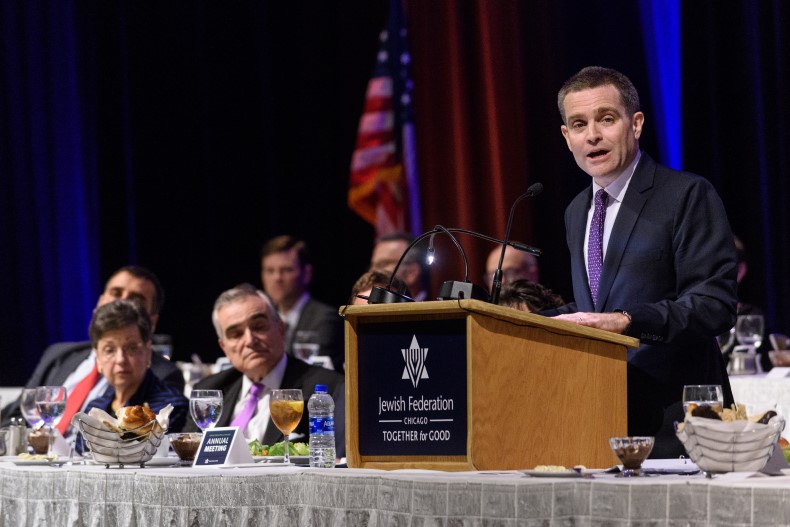
At Federation’s Annual Meeting, a milestone, a vision and a major surprise
JOEL SCHATZ
It was the Jewish Federation’s 119th Annual Meeting.
But there’s never been one quite like this.
For starters, it was the first presided over by new President Lonnie Nasatir, just the fifth chief executive in Federation’s long history. (A snippet of his wonderful State of the Federation address, which received a standing ovation, is below.)
Then there was that unprecedented surprise:
In mid-speech, Nasatir announced that this year’s Julius Rosenwald Memorial Award honoree, Bill Silverstein, and his family had made a special gift of $100,000-which would be shared equally by every non-profit-Jewish, non-Jewish and secular alike-that had staff at the event.
More than 1,200 witnessed the moment at the Hyatt Regency Chicago on Sept. 17. Federation leaders, of course. And representatives of many of the 100-plus agencies and programs Federation partners with. But also government officials-city, state, and federal. Members of Chicago’s consular corps, representing Israel and 14 other nations. Representatives of the United Way, Urban League, civic and refugee organizations. Catholic and other Christian clergy. And nearly 200 students from seven Jewish day schools, getting a taste of the community’s vibrance.
Wherever you turned, you were surrounded by the breadth and depth of Chicago and its Jewish community. Regardless of background, belief or political view, they were there. Together. For good.
Excerpts from President Lonnie Nasatir’s State of the Federation address; Julius Rosenwald Memorial Award honoree Bill Silverstein’s acceptance; and the speeches of the four young leaders honored, follow.
State of the Federation
President Lonnie Nasatir
Presiding over his first, and the Federation’s 119 th , Annual Meeting, President Lonnie Nasatir shared an inspiring vision of the Jewish future.
“…today, let us vow to listen to young people, always, with an open mind and an open heart.
With their global mindedness, generosity of spirit, creativity, and passion, I believe the Millennials and Generation Z can take our community to new heights. They have already started.
Jewish life today is dynamic and exciting-and looks different today than it did 1,000, 100, or even 10 years ago. As we pass down our heritage L’dor V’dor , from generation to generation, our traditions are reclaimed and reimagined.
A new spirit of community is emerging in these next generations and I am so proud to partner with exciting new programs that are both a part of that new spirit and helping to fuel it.
From OneTable and Moishe House to Trybal Gatherings and Sketchpad, from YLD Pride and UpStart Chicago to Honeymoon Israel and Base Hillel, young people are embracing the joy in Judaism.
They are building community one Shabbat dinner, one Israel trip, one study group, one workshop, one minyan at a time. We are at the dawn of a renaissance in Jewish life in this community-and it’s a wondrous thing.
It may be different, but we can’t be afraid of difference. We at Federation need to be nimble, relevant, and accommodating to new ideas and ways to express our Jewishness and neshamas .
Our newly launched Fund for the Future, which has now raised over $50 million, is poised to provide the appropriate resources necessary to meet the growing and potentially changing needs of our community.
What will it look like to be Jewish and act out Jewishly in the next 5 or 10 years? I’m not so sure. There may be as many answers as there are Jews-and that’s not a bad thing.
Actually, it’s a wonderful thing.
The success of Silverstein Base Hillel is one exciting example. Each Base Hillel has quickly emerged as a welcoming, pluralistic hub of Jewish life for young adults, both in college and after they graduate.
With hundreds and hundreds of participants streaming through their doors, the Base Hillels in Lincoln Park and in the South Loop are operating at capacity and serving as models for other cities nationwide. Plans are underway to open a third Base location in 2020, with the goal of five Base Hillels across Chicagoland engaging 4,000 young adults by 2024.
Let’s stop and think about that: four THOUSAND young Chicagoans enthusiastically connecting to Jewish life, Jewish community, Jewish tradition…and one another.
Base Hillel is a wonderful reminder-let’s not be afraid to talk about the joy as well as the oy…”
Watch Nasatir’s entire speech online atjuf.org/StateoftheFederation2019 .
Julius Rosenwald Memorial Award
Bill Silverstein
Former JUF/Federation Board Chair, current Jewish Community Relations Council Chair, founding supporter Base Hillel/Chicago
Our Jewish community is bigger than any individual. It is a master painting-a canvas consisting of 120 years of brushstrokes that tells a story. This painting was started by our great grandparents, and continued by our grandparents and parents, and is in the care of my generation today.
Whether as chairman of the board of JUF, or as a volunteer at The ARK, or at a committee meeting at your synagogue … or simply making a contribution to your favorite charities … each of these acts is an opportunity to add your brushstrokes to our community painting.
And I am excited for my children, and for all of our children, to grab the brush and put their stroke on our brilliant communal picture.
Davis, Gidwitz & Glasser Young Leadership Award
Stacey Dembo
Attorney, Immediate Past Chair, JUF’s Community Legal Services Clinic
“JUF was always in the air when I was growing up. My mom, Lisa, was an intern while in college. My dad, Harold, was on the JCC board. Growing up, we would deliver packages with Maot Chitim and serve meals at the Uptown Cafe. My brother and I learned through osmosis the value of serving our community and supporting JUF.
I’ve been lucky to be able to marry my professional skills with my JUF involvement through the JUF Community Legal Services Clinic. … providing pro-bono legal representation to Holocaust survivors and children and adults with disabilities. We [represent] about 100 members of our community each year. Working with JUF staff and my fellow volunteer attorneys has truly showed me what it means to be ‘together for good.'”
Davis, Gidwitz & Glasser Young Leadership Award
Josh Liss
Chair, Metro Chicago Hillel Board, and long active in JUF and the Jewish Federations of North America’s National Young Leadership Cabinet
“While in Budapest [on a national mission], we visited an older Jewish woman who survived the Holocaust. She was homebound and lived in a very small, dilapidated apartment. We learned how hard her life had been growing up Jewish in Hungary. We also learned that, with her current medical condition, if not for us she would not have any visitors, hot food, or medicine. She told us with tears in her eyes that we literally saved her life.
As we left, I gave her a hug and walked down the steps thinking-How many more Jews need our help, our time, our dollars? For so long, I had just given to give. It was at that moment I realized what all of this is really all about.”
Samuel L. Goldsmith Young Professional Award
Anna Hartman
Director, Early Childhood Excellence at JUF and Director, The Paradigm Project
“Those of you here today know that Jewish preschools are places where children and their families experience never-ending joy and wonder, forge relationships of true caring, and develop lasting connections to the friends, communities, and traditions that will enrich their lives for years to come. Families get this long-lasting spiritual nutrition in an environment that meets their immediate needs for childcare and high-quality education.
What you may not know is that where there is potential, the Chicago Jewish community invests. Because Jewish early childhood education is vital, JUF will lead the charge to sustain it. To paraphrase the words of my supervisor, Dr. Scott Aaron: 1) What does the community need? 2) What is a vision for getting there? And 3) Nu ? What’s stopping you?”
Samuel L. Goldsmith Young Professional Award
Rabbi Michelle Stern, BCC
Rabbi and Chaplain, CJE SeniorLife
“I opened up a Torah scroll to the Priestly Blessing in front of my students-memory care residents and adult day program clients. I told them that when the priests said, ” Yvarechecha -May God Bless You,” they were acknowledging the holiness in each person in the community-and that included them.
Restoring and reminding people with dementia of their dignity, that they matter, takes a fair amount of patience and creativity. Jewish tradition is rich with possibilities for how to do this, how to fulfill the mitzvah of Hiddur Pnai Zakeyn , glorifying elders.
May we continue as a community to lift up our older adults. As we bless our elders with our service and care, I promise you, they will bless us in return.”
Other stories
-
Two local teens win national recognition
Recipients of the annual Diller Teen Tikkun Olam Awards
Read more -
Celebrating six young award winners cultivating the community
Introducing young adult award winners
Read more -
Fifty security professionals from JUF and Jewish Federations across North America joined law enforcement partners here in Chicago the week of Sept. 9 for the Secure Community Network ‘s annual Homeland Security Summit.
The two-day event focused on a range of security issues in advance of High Holy Days, including attack prevention and monitoring threats from white supremacists and Islamic terrorists. Attendees also heard SCN leaders and security directors review the response to the attacks at the Tree of Life Synagogue in Pittsburgh last October and at the Chabad of Poway in April.
“More than ever our community recognizes the need for better security awareness and planning,” said SCN National Director and CEO Michael Masters. “The summit is a way for security directors to learn from each other and better serve the Federations they work in so the Jewish community can be better protected.”
Founded in 2004, SCN is the official security arm of the Jewish Federations of North America and the Conference of Presidents of Major American Jewish Organizations.
“SCN is a valuable national partner in JUF’s own efforts to make our local community safer,” said Jay Tcath, JUF’s Executive Vice President. “Their resources, counsel, connections to law enforcement, and readiness to help are very helpful. That their CEO Michael Masters happens to be a Chicagoan with whom we’ve worked for many years means that we’re able to exploit their services even more.”
Attendees heard from the Security Director of the Jewish Federation of Greater Pittsburgh, Brad Orsini, about how the security response following the attack at the Tree of Life Synagogue last October saved lives. Masters and SCN Senior National Security Advisor Doron Horowitz briefed attendees on the response in Poway.
In addition to security directors, law enforcement partners including Brian Harrell of the Department of Homeland Security were in attendance. Harrell serves as the Assistant Director for Infrastructure Security in the Cybersecurity and Infrastructure Security Agency, which is responsible for preventing attacks on community organizations.
“Our continued partnership with law enforcement officials and CISA in particular is important to the safety and security of Jewish organizations across the country,” said Masters. “They understand that our community faces unique threats and are committed to ensuring our safety.”
Attendees also heard from SCN Senior Intelligence Analyst Abigail Hall about the organization’s Duty Desk, which monitors incidents and potential treats in partnership with security directors and law enforcement around the country.
Security directors also attended a “Train-the-Trainer” course in best practices for leading drills and trainings, including responding to active shooter events. SCN has seen a significant increase in requests for trainings since the attack in Pittsburgh last fall.
Additionally, the security directors participated in working groups to discuss security issues including planning for special events, security standards and best practices, and information sharing.
Other stories
-
Two local teens win national recognition
Recipients of the annual Diller Teen Tikkun Olam Awards
Read more -
Celebrating six young award winners cultivating the community
Introducing young adult award winners
Read more -
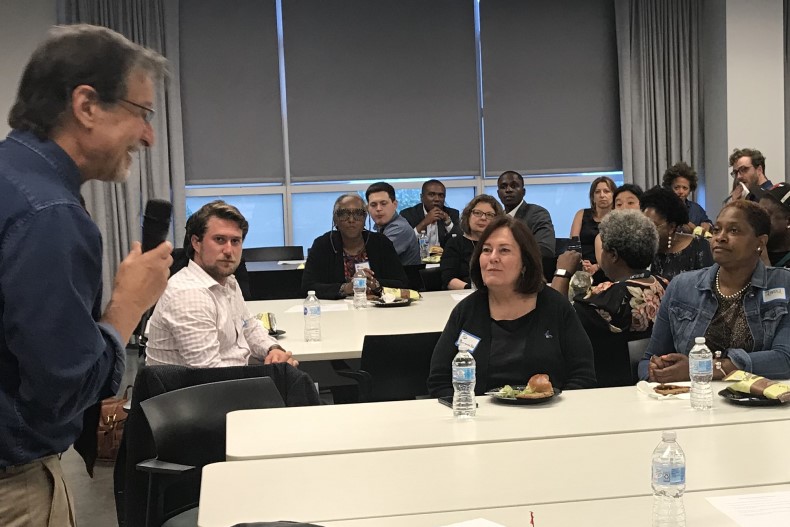
Dinner & Dialogue group looks back at race, economics and Chicago’s housing trap
JANE CHARNEY
Throughout the 1940s, ’50s and ’60s, Black Chicagoans were cheated out of close to $4 billion in today’s dollars. That’s because the fastest method of wealth acquisition – homeownership – was virtually closed to them.
This sobering number and the story behind it are at the heart of Bruce Orenstein’s forthcoming six-episode documentary, ” The Shame of Chicago .”
JUF’s Jewish Community Relations Council and the North Lawndale Historical and Cultural Society screened Episode 3, “The Color Tax,” during a Sept. 10 Dinner & Dialogue program that also included small-group discussions on the intersection of economics and race. About 50 people participated.
“What happened in Lawndale in the ’50s and ’60s is a story many Chicagoans don’t know and don’t tell,” Orenstein said when he introduced the film at the event.
The director has deep Chicago roots: His grandfather lived and worked in North Lawndale, and he grew up in Skokie. He now teaches at Duke University, where he is artist in residence.
His film details how real-estate speculators would buy houses in North Lawndale and then sell them to unsuspecting buyers on contract. The buyers thought they were getting a mortgage. The difference is that contract buyers do not build equity in their home and may be evicted any time. The buyers often paid inflated prices, sometimes twice the value of the home.
Jewish attorney Mark Satter brought attention to this practice after a couple sought his help while facing eviction. Laws did not protect contract buyers, and documentation is scarce. It was not until nearly two decades later that the practice was stopped when neighborhood residents organized into the Contract Buyers League with the assistance of Jesuit seminarian Jack Macnamara. Members of the league pressured contract holders to renegotiate by refusing to pay. The Fair Housing Act of 1968 curbed the practice.
Researcher Alfonso Vaca-Loyola was part of a 10-person team that dug through 73 boxes of documents to come up with the $4 billion figure. He spoke about the research process and the information that was available in Recorder of Deeds records.
“One of the ways racism manifests is the erasure of history,” Vaca-Loyola told the Dinner & Dialogue group. “Contracts weren’t required to be recorded. So for some homes, we don’t have the information about some of the buyers or for some of the time.”
The six facilitated small-group discussions that followed focused on personal stories, the effect of gentrification, neighborhood resources and lack of them. Participants mentioned systemic dis-investment in South and West Side neighborhoods, which led to decreased property values and poor quality of education.
“You can pull yourself up by the bootstraps, but only if you’ve got the straps,” said attendee Bev Copeland, who now lives in Evanston, but has family roots in North Lawndale.
Systemic racism, such as that depicted in “The Color Tax,” has meant that few have the resources to work toward achieving homeownership and the American Dream, attendees said.
“We’ve lost on every line. It’s been going on for five generations now,” said North Lawndale resident and activist Dorothy Goldsmith. “We don’t want any more loss.”
Many of the small groups turned to action steps and potential solutions for the effects of 20 th century racist policies still felt today: education, financial literacy, engaging elected and appointed officials, and economic development.
For his part, Orenstein hopes the series will be a valuable educational tool that inspires people to action.
“I’m a community organizer at heart,” he said. “Once we know the truth about the situation, we can work on solutions.”
Other stories
-
Two local teens win national recognition
Recipients of the annual Diller Teen Tikkun Olam Awards
Read more -
Celebrating six young award winners cultivating the community
Introducing young adult award winners
Read more -
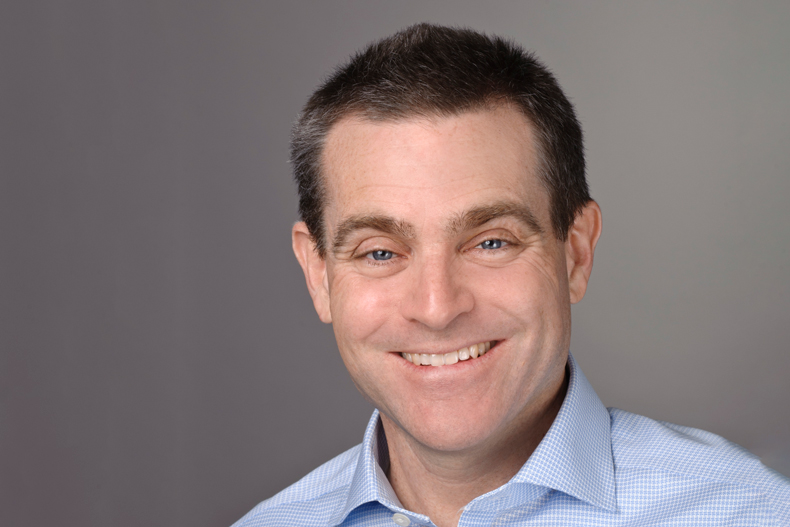
On July 1, Lonnie Nasatir became only the fifth person in JUF’s 119-year history to become President and Chief Executive. He previously served as the Anti-Defamation League’s longtime Regional Director of the Greater Chicago/Upper Midwest area, distinguishing himself as a community leader in fighting antisemitism and all forms of bigotry.
In addition to having big dreams for our community, Lonnie is an avid sports fan who loves a wide range of music, has a passion for Jewish culture and has some surprising hidden talents! Here’s more about his POV — and what keeps him up at night.
Favorite Jewish holiday
Passover — the combination of bringing people together, the food, and telling the story of the Exodus from Egypt is so powerful.
Favorite Jewish food
My wife’s brisket
If you could invite anyone to Shabbat dinner, who would it be?
Carl Reiner and Mel Brooks
Favorite Yiddish word
Schmendrick — it just says it all.
Favorite PJ Library Book
Friday Nights with Nana, which I read to my eldest at least 100 times!
Favorite volunteering memory
Serving food at the JUF Uptown Cafe, and doing it with my children — teaching them the importance of giving back and letting them know there are some people who don’t have the good fortune of having meals every day.
First Israel experience
When I was 16 years old, I went to Israel with three of my good friends from high school, and I was blown away — blown away by the history, blown away by the connection that I felt and, most importantly, it made me really feel for the first time how important my Jewish identity is.
Baseball — North Side or South Side?
South side all the way!
Favorite moment at Comiskey?
When Ron Kittle hit a rooftop home run, which didn’t happen very often.
Favorite in the new park?
While we didn’t win the championship in 2005 at the new stadium, I was at game one when we beat Roger Clemens and the Houston Astros.
Favorite Chicago sports legend
Walter Payton — both the way he played and the way he held himself as a person.
Best Bulls encounter growing up in Highland Park
Seeing Tony Kukoc at Once Upon A Bagel
First job
Coaching baseball, soccer and basketball my sophomore year of high school
Seinfeld or Sandler?
Seinfeld, for sure. Seinfeld to me is the crème de la crème of comedy.
Favorite Seinfeld episode
The Junior Mints® episode
Kugel or brisket?
I’ve got to go with brisket, because it’s more decadent. And with kugel…well, there’s the dairy issue!
Favorite Chicago neighborhood
The neighborhood around Sox Park. I love the energy; I love the passion before a game.
Best festival memory
Chicago Jazzfest the year after I graduated college, when 15 of my closest friends from college came together and listened to great music for three days.
Hidden talents
I have a good jump shot, and I’m actually a decent singer.
Go-to karaoke song
Bob Seger’s Night Moves, much to the embarrassment of my children.
First concert
Styx during the Grand Illusion tour
Favorite Jewish artist
Paul Simon
Favorite JUF event
I love them all, but if I had to pick one, I’ve had a great time over the years at YLD’s Big Event Fundraiser. To see thousands of your people come together for a great cause, have a good time and walk away feeling like they learned a little bit about JUF makes my night.
Best advice you’ve gotten
The art of good listening isn’t waiting to say something.
What do you want people to know about you?
At my core, I really am a collaborator, and bringing people together is something that I have always done, I do it well, and that’s what makes me so excited about this next challenge in my professional life.
What do you want JUF to stand for in the community?
I want JUF to stand for ethics, inclusivity and kindness.
What do you believe Chicago’s greatest social service need is today?
Providing services for children who are the victims of violence or who have seen violence in their everyday life.
What keeps you up at night?
The fact that my daughters will be dating soon! What keeps me up at night from a professional standpoint is: Will our community continue to be strong, to be proud, and to figure out ways that we can connect with all Jews from all different walks of life, and make sure that the experience is rich and that we have a connection with them, no matter where they are on their life path.
What’s the most important issue facing Jewish kids?
The pull to just assimilate and relinquish your religious and Jewish heritage, and that is something that is really specific to each person. We really hope that people, while they want to be a part of something, don’t forget who they are and where they come from.
What’s your point of view on antisemitism right now?
Unfortunately, we are at a time in American history where antisemitism is making its way into the mainstream, which is a real concern. It feels different than it did even five years ago, let alone 10 or 15 years ago, and we as a community — not just the Jewish community, but the overall community — need to stand up and call it out.
How about your point of view on nonprofit world realities?
The reality of the nonprofit space is that there are so many great nonprofits doing such great work, and the role for all of us to figure out is ways that we in the nonprofit space can work together, leverage each other’s strengths and try to figure out ways we can distinguish each other from one another, and make sure the donor understands those distinctions.
Other stories
-
Two local teens win national recognition
Recipients of the annual Diller Teen Tikkun Olam Awards
Read more -
Celebrating six young award winners cultivating the community
Introducing young adult award winners
Read more -