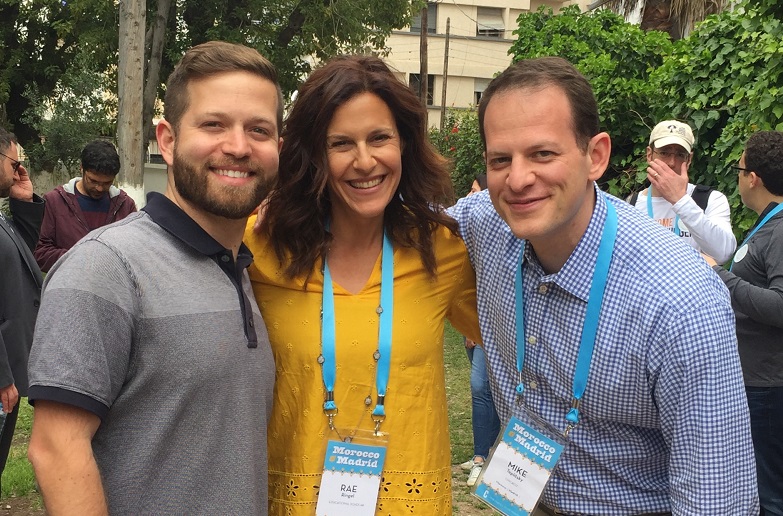
Next generation of JUF philanthropists explores Morocco and Madrid
MICHAEL TEPLITSKY
I recently joined 140 members of the JFNA National Young Leadership Cabinet on a study mission to Morocco and Madrid.
Cabinet is a five-year JUF leadership development program which aims to teach, train, and inspire the next generation of philanthropists so that they can protect, strengthen, and nourish strong Jewish peoplehood in North America, Israel, and worldwide.
Our trip came at a time not only of a global rise in anti-Semitism, but also a fragmentation within the Jewish community at home on several important issues relating to Israel. This mission showed us that co-existence among different religions is possible even in this era of heightened hostility; indeed, Jews, Muslims, and Christians can live in together in peace.
Only 3,000 Jews remain in Morocco today-mostly in Casablanca. The population declined from approximately 300,000 in the 1940s due in large part to emigration to Israel. While Marrakesh once housed 35,000 in the Jewish Quarter, only 110 Jews live there today.
Despite Israel and Morocco not having formal relations since the Second Intifada in 2000, the two countries maintain active political dialogue behind the scenes, carefully maneuvering across the Sunni-Shiite divide. While the Jews of Morocco enjoy religious freedom of expression, the Anti-Defamation League reports that 80 percent of Moroccan’s 20.8 million adults harbor anti-Semitic attitudes.
And yet, Morocco hosts the only Jewish museum in the Arab world; King Mohammad VI maintains Jewish advisors; Jewish schools and synagogues receive government subsidies; and over 45,000 Israeli tourists visit Morocco annually. The King recently instructed that street signs in Marrakesh’s historic Jewish Quarter be restored to their original Hebrew. Similarly, a popular Moroccan daily newspaper lists the Hebrew date on its masthead.
Our delegation was graciously greeted by Nasser Bourita, Morocco’s Minister of Foreign Affairs and International Cooperation who shared his thoughts on Morocco today. He reminded us that Morocco was the first country to recognize the United States of America. Minister Bourita also related that Morocco is a moderate Muslim country and that Morocco prefers soft power and diplomacy over hardline military might.
Continuing our journey, the group filled an entire Royal Air Maroc Boeing 737 for the flight from Morocco to Spain.
As we meandered along the cobblestone streets of Toledo, we walked in the shadows of Yehuda Halevi and Maimonides, Spain’s leading Jewish philosophers from medieval times. The Synagogue of Santa María la Blanca, the former synagogue in Toledo, is the oldest synagogue building in Europe still standing, but has been converted into a church.
Rabbi Isaac Luria, the most influential thinker in medieval Jewish mysticism, taught that every created thing possesses a “spark” of divine energy that constitutes its essence and soul. Luria also taught that tikkun olam (repairing the world) and mitzvot (commandments) fight the forces of evil and restore the good.
This powerful journey unlocked Luria’s spark within each of us. One my peers commented that Cabinet is the place where he’s his “best self.” As we return to our lives in Chicago and across North America, we are more aware, open-minded, and reflective. Most importantly, we are inspired by a renewed global perspective and a shared sense of collective responsibility.
Michael Teplitsky is the co-chair of JFNA’s National Young Leadership Cabinet and is a member of the Wexner Heritage Program. To learn more about Cabinet, contact Sally Preminger at [email protected].
Other stories
-
Chicago to Israel to Kenya
A family’s story of living Jewishly on three continents Michelle Cohen World May 28, 2021 Avital, Tzofia, and Netanel Kaszovitz outside their home in Nairobi on Yom HaAtzmaut. When Avital Kaszovitz prepared to be a Modern Orthodox shlicha (emissary) to the Jewish community in Ke
Read more -
New exhibit spotlights the experience of ‘Shanghai Jews’
Explore a new Illinois Holocaust Museum and Education Center exhibit
Read more -
Europe’s brave new teachers of the Holocaust
Teaching the Holocaust in the modern era has its difficulties and rewards.
Read more
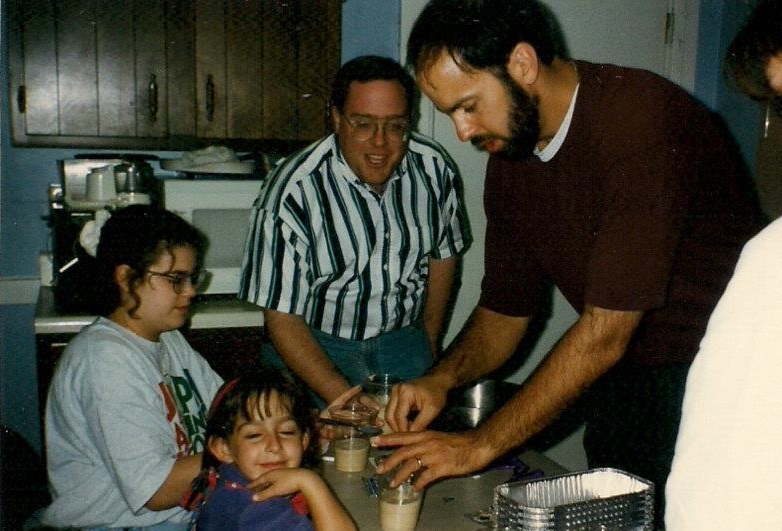
Led by volunteer executive director for 20 years, Bradley Hillel hires first full-time employee
Abby Seitz
As an undergraduate, Seth Katz wasn’t involved with Hillel.
It wasn’t until he entered graduate school at the University of Chicago that he found a place within the campus Jewish organization’s Conservative minyan and Friday night dinner co-op.
“I got my Judaism at graduate school, even though I was raised Jewish growing up,” said Katz, an associate professor of English at Bradley University. “For me, Hillel was a transformative experience. I learned that Judaism wasn’t something you merely believe, but something you do.”
Katz was so inspired by Hillel that he volunteered to serve as Bradley Hillel’s executive director 20 years ago in hopes of inspiring young adults to find their place in the Jewish community.
“Judaism has this power, and we don’t do an adequate job of showing young people the power of community,” Katz said. “I’m a teacher, and part of my mission in serving my students became facilitating in creating their sense of Jewish community and their capacity as Jewish leaders.”
While Katz isn’t paid for his time, he finds the job rewarding in other ways.
“[My favorite part] is when students get excited about things and find their passions,” Katz said. “Seeing students, watching them grow, watching them get excited and amped up about something they never knew about or thought about, and watching the transformation a Birthright trip can have on a student-that’s what keeps me doing it.”
Katz’ “kindness, leadership abilities, and knowledge” set him apart, according to Yona Lunken, a Bradley Hillel board member.
“Seth has served the community with his heart and his soul,” Lunken said. “He has guided the organization, put together the board, and he and I have been working together over the last eight years to take the Bradley Hillel to the next level.”
Bradley Hillel will continue to grow this fall, when Matt Lorch assumes the role of director of Student Life. Lorch, currently the assistant director at the University of Oklahoma’s Hillel, will be Bradley Hillel’s first full-time, paid employee.
“I was looking to push myself out of my comfort zone and find new opportunities to grow, and Bradley offers all of that,” Lorch said. “I’m looking forward to everything, like meeting a new group of students with different Jewish identities and I’m excited to see how I can be a part of that.”
Katz is looking forward to working with Lorch as the Hillel continues to explore opportunities for growth.
“I’m not done yet-I’m looking forward to handing some things over to Matt and letting him do things his way and recreate the organization based on his experience and wisdom,” Katz said. “I’m excited to see what he’s going to do.”
Other stories
-
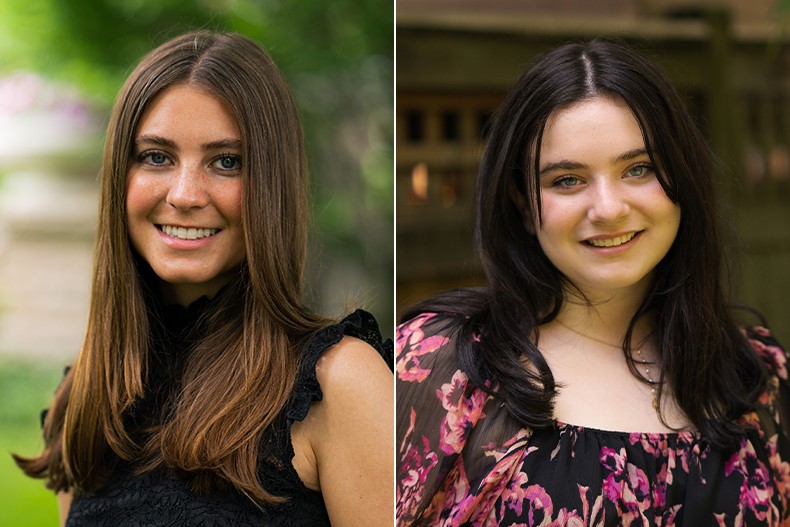
Two local teens win national recognition
Recipients of the annual Diller Teen Tikkun Olam Awards
Read more -

Celebrating six young award winners cultivating the community
Introducing young adult award winners
Read more -
French and German consuls general report on anti-Semitism in Europe
Paul Wieder
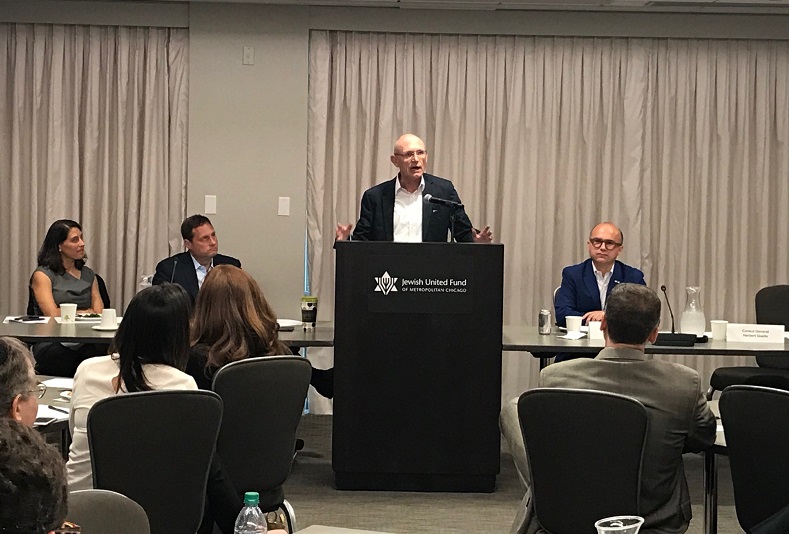
In May, two Chicago-based European consuls general- France’s Guillaume Lacroix and Germany’s Herbert Quelle- presented to JUF’s Jewish Community Relations Council (JCRC). Topics included rising anti-Semitism in Europe, Israel’s security, the E.U.’s stability, and their country’s reactions to the U.S. pulling out of the Iran nuclear deal.
JCRC Chairman, Bill Silverstein opened the meeting by highlighting JCRC’s longstanding commitment to engaging with the local diplomatic corps and advocating on issues of importance to this community and to Israel. “One such area of significant importance,” reflected Silverstein, “is the future of Jewish communities throughout Europe. Shifting political winds including the rise of populist right-wing movements and, with it, anti-Semitism emulating from the Far Left and Far Right, and from Muslim and Arab refugees and European citizens is a cause of grave concern.”
French anti-Semitism “is a problem, but not a new problem,” Lacroix said. He then distinguished between Vichy-era anti-Semitism and a new social media-based version.
The old version, which he grew up around, “has not disappeared, but its extent is limited, and it is vanishing.” The new variety of anti-Semitism, meanwhile, has been “imported from outside” France. While clarifying that Islam is not anti-Semitic by definition, this shift is being faced across Europe, he said, as “all Western E.U. countries” now have a large percentage of their populations with “Muslim backgrounds.”
While he said he personally wishes for people of “all religions”-as well as those “who have no religious affiliation”-to live in France in peace, “that is not entirely the case” in reality, he said. “…French citizens are being killed because they are Jewish by other French citizens.” There have been an unprecedented 11 murders of French Jews in 12 years.
Other unsettling factors, he added, were the feeling that, for the first time, children would not have better lives than their parents. When people “feel that their prosperity is threatened,” he noted, they turn to scapegoating. They feel frightened of their own neighbors. Further, there is the sense that the major 20 th Century powers were being replaced in the 21 st Century.
It is one thing if these dissatisfactions are expressed through the democratic process, Lacroix said. But violence and disorder, which show a distrust in this process, are a “disease,” he said. “If we don’t have shared values, then what is our future?”
In response, he called upon France to address today’s situation with today’s tools. He said the first priority is that there can be “no denial” of the nature of an anti-Semitic attack- “It must be registered as such.” To that end, he said, police need to be trained to recognize the signs that an attack is anti-Semitic in nature, including cases involving Holocaust denial. Further, judges must be given the tools and empowerment to prosecute those responsible, he said.
On the preventive end, he said that “every child needs to feel he or she has a place in society,” and says education is key to promoting tolerance. While hate propaganda is being disseminated online, he noted that “the Internet and social media are not the problem. The people [using them] are the problem.” Their posts threaten security and the fabric of society, he said.
Quelle tied the rise of European anti-Semitism to the economic downturn of 2008, from which the E.U. is only now-a decade later-recovering. One issue that remains unresolved is unemployment.
Throughout history, financial crises have led to a rise in populism, he said. As to this specific time, he noted that today’s issues also include terrorism and mass migration, which are destabilizing. Germany, he noted, has taken in more refugees and asylum seekers than any other country in Europe, adding that today full 20 percent of German citizens do not have a German background.
To respond to the rise in anti-Semitism, he said, Germany has created a new federal-level commission to deal with the problem. One of its first actions was to recognize anti-Israel rhetoric as anti-Semitic. The government of Germany is also boycotting an anti-Semitic group known as AFD, which stands (in German) for “Alternatives for Germany.”
Quelle noted that, since many of the immigrants come from countries with histories of discrimination, teaching them tolerance is a challenge. Rather than focus on anti-Semitism initially, German schools begin with teaching about racism and xenophobia in general, and then move to teaching about the specifics of anti-Semitism.
As to the continued viability of the E.U., both consuls general were optimistic. In a recent poll, 60 percent of Europeans and 79 percent of Germans were pro-E.U.
Both consuls general agreed that their countries are friends and allies of Israel . France’s top priority for Israel, said Lacroix, is “security in its borders. Israel needs to be safe. We have no problem with Israel acting in self-defense.”
Both consuls general also felt that, while imperfect, the Iran nuclear deal was basically sound and should have been upheld.
Silverstein closed the meeting pledging JCRC’s continued engagement with these and other European consuls general on issues facing world Jewry.
Other stories
-
Two local teens win national recognition
Recipients of the annual Diller Teen Tikkun Olam Awards
Read more -
Celebrating six young award winners cultivating the community
Introducing young adult award winners
Read more -
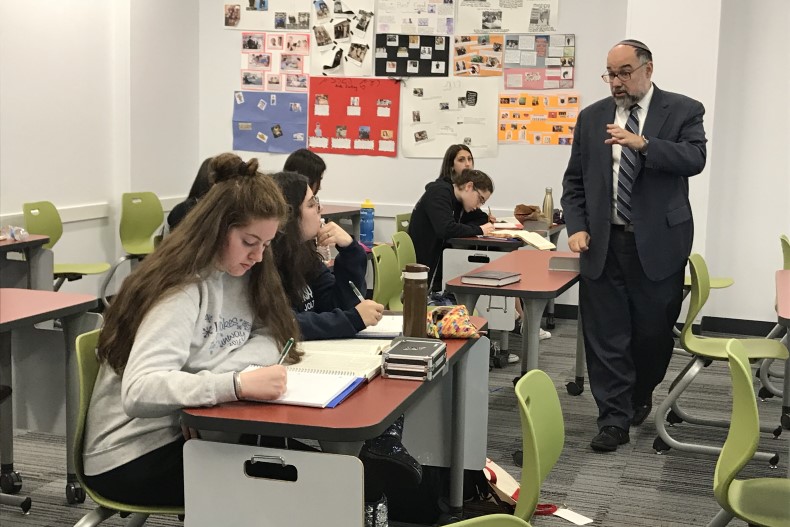
When Rabbi Dr. Leonard Matanky began his undergraduate degree, he was a business student. Halfway through college, Matanky realized his true passion was education. Matanky began teaching at his alma mater, Ida Crown Jewish Academy, in 1981 and became dean in 1996. In addition to his work at Ida Crown, Matanky is also past president of the Orthodox Union’s Rabbinical Council of America, a co-president of Religious Zionists of America, and co-chairman of JUF’s Rabbinic Action Committee. Matanky is also the pulpit rabbi at Congregation K.I.N.S. in West Rogers Park.
Matanky’s service to the Jewish community was recognized in March at Ida Crown Jewish Academy’s 75th anniversary gala. As school was winding down for the year, he sat down with JUF News for a phone interview to reflect on his time as dean at his alma mater.
JUF News: How have you seen Ida Crown grow during your time since you werea student?
Rabbi Dr. Leonard Matanky: The core values of Ida Crown have stayed the same: the sense of community, the commitment to Orthodox Jewish life, the absolute striving for excellence as a college prep high school.
When I was a student, the computer science course was one where we filled out the necessary punch cards to be run, whereas today, every one of our students walks around with an iPad.
The biggest change would be the way the academy has respond to the changing needs of our community. Today, unfortunately, we have to help distinguish higher culture and other aspects of general culture which might be antithetical to the values we have always tried to teach.
What value do you think is most important to instill in the next generation?
The first value is the sense of community that our students need to understand. Not only are they part of a community, but their actions, their innovations, and their passions will help shape our community and guarantee our future. We need to instill in our students that they are part of our glorious tradition that reaches back to Sinai. Their role is critical in bringing the beauty of Torah to the world, and brightening the world with its teachings and its values.
One of the most important things of being part of community is that sense of hope. What we try to foster within our students and our school community is a sense of comfort, of home. A place our alumni come back to visit, and a place where current students know they can turn to teachers for guidance. It’s because of the warmth of Torah that we can achieve some of the greatest things.
What part of your work do you find most meaningful?
The highlights of my days are the classes I teach every day, and the opportunity to help our students find who they are and find their voices and grow and prepare themselves for the next stage in life.
Other stories
-
Two local teens win national recognition
Recipients of the annual Diller Teen Tikkun Olam Awards
Read more -
Celebrating six young award winners cultivating the community
Introducing young adult award winners
Read more -
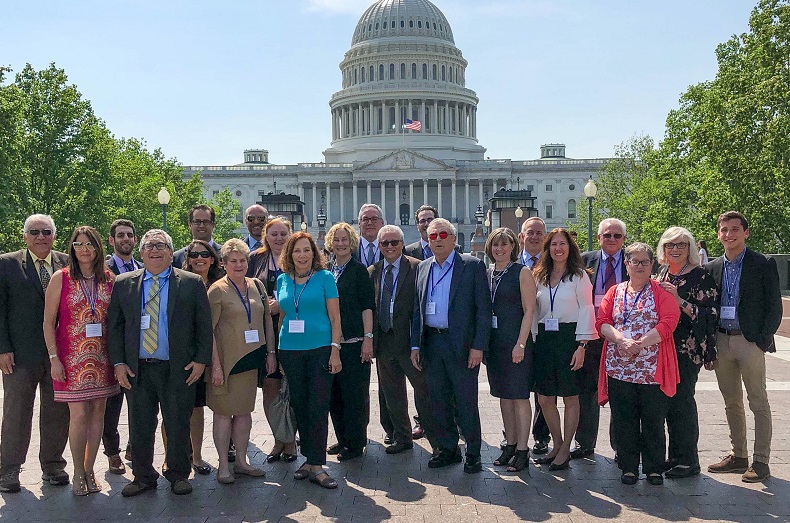
Federal appropriations, Medicaid, SNAP, and gun violence prevention among top domestic priorities of annual DC advocacy mission
Matthew Lustbader
More than 30 Jewish Federation of Metropolitan Chicago agency professionals, volunteer leaders, and professional staff participated in the annual Government Affairs Agency Advocacy Mission to Washington D.C. on May 15-16 during a particularly eventful week for Congress.
During the two-day fly-in, mission participants received briefings from policy experts and met with elected officials on a variety of policies and programs which impact the work of the Jewish Federation system throughout the Chicago metropolitan area.
“Whether it’s back home or in Washington, I always appreciate the opportunity to meet with representatives from JUF to discuss how I can be helpful in Congress to support the work of Federation’s affiliated agencies throughout Illinois,” Congressman Brad Schneider (IL-10) explained. “Their voices on these issues, from funding for Holocaust Survivor care to addressing the issue of gun violence and community safety, are so important for the work we do in Congress.”
Co-chaired by Government Affairs Committee Chair David Golder and Vice Chair Janna Berk, the mission also included participants from the JUF Board of Directors, the JUF Government Affairs Committee, CJE SeniorLife, Jewish Child and Family Services, Sinai Health System, Keshet, and the Dina & Eli Field EZRA Multi-Service Center.
“Our exceptional team of agency professionals and community leaders effectively demonstrated the breadth of our network of services and the impact that federal dollars and policies have on our ability to provide services to vulnerable children, families, and seniors,” David Golder explained.
“Our ability to respond to the issues of the day in Congress and connect them to the work we do at our Federation agencies is critical for our advocacy efforts to have an impact in Washington.”
Participants advocated for the preservation of Medicaid and SNAP as effective and accessible programs for the most marginalized members of our community and discussed the issue of community safety and gun violence with elected officials. Additionally, the group advocated for robust federal funding for the Nonprofit Security Grant Program (NSGP), the Holocaust Survivor Assistance Program, and the Emergency Food and Shelter Program in Fiscal Year 2019.
During meetings with members of the Illinois congressional delegation and their staff, as well as with Representative Ted Deutch of Florida and Greg Link of the Administration on Aging, participants stressed how the people served by the Federation system throughout Illinois would be impacted by proposed policy changes.
“I had the opportunity to meet with a dedicated group of community leaders who came to Washington to advocate on behalf of the Jewish Federation of Metropolitan Chicago on important policy issues affecting the most vulnerable individuals and families,” said Rep. Randy Hultgren (IL-14). “It was encouraging to hear these advocates from JUF affiliated health and human services agencies speak so passionately about protecting programs and services for seniors, children and families throughout Illinois.”
“This trip was an outstanding opportunity to make Federation’s voice heard on a wide variety of policy issues that impact our community,” Janna Berk said. “Our group consisted of a great mix of professionals and volunteers and represented the full scope of Federation’s system.”
Just days after the trip, on Friday May 18th, the House rejected H.R.2, the House Agriculture Committee’s 2018 farm bill, by a vote of 198-213. This bill, which JUF opposed, contained harmful cuts to the Supplemental Nutrition Assistance Program (SNAP) and was a main focus of the group’s advocacy efforts earlier that week.
Heidi Kon, Director of the EZRA Multi-Service Center, added, “SNAP is an essential partner for the work EZRA and many of JUF’s affiliated agencies do throughout Chicago to serve and expand opportunities for people living in poverty. While this fight is by no means over, the House’s rejection of H.R.2 demonstrates the impact our voices, as advocates and community leaders, can have on the legislative process in Washington.
Other stories
-
Two local teens win national recognition
Recipients of the annual Diller Teen Tikkun Olam Awards
Read more -
Celebrating six young award winners cultivating the community
Introducing young adult award winners
Read more -
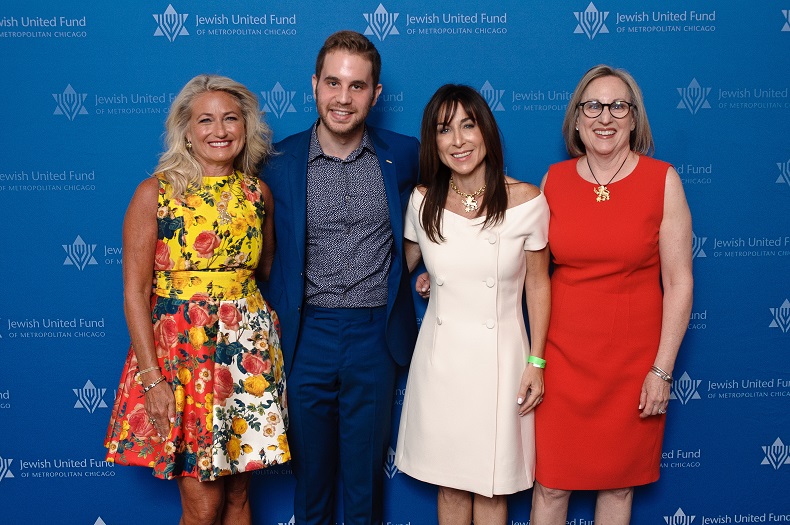
Ben Platt, award-winner and supermensch, delights audience at JUF Women’s Division’s annual Spring Event
Jessica Leving
Grammy and Tony award winner–and more importantly, supermensch–Ben Platt delighted some 1,200 women at JUF’s Women’s Divisions annual Spring Event luncheon at the Hilton Chicago on Wednesday.
In a candid, casual conversation facilitated by his aunt, Wendy Platt Newberger–who also happens to be the Chief Operating Officer at JUF’s partner agency, Jewish Child and Family Services–Platt regaled the audience with tales of camp, holidays, acting, singing, and his love for his Jewish mother. Guests learned that his favorite holiday is Passover, his favorite Jewish food is matzoh ball soup, and his bar mitzvah entrance was choreographed to the song “Walk Like a Man” by the Four Seasons.
Platt also spoke about his deep emotional ties to the Jewish community and the role it plays in his life today.
“A victory for me is a victory for the whole community, and a rough patch for me is a rough patch for the whole community,” he said, sharing how his shows are always packed with a strong contingent of Jewish friends and family members clamoring to be in the audience. “My non-Jewish friends don’t get that.”
Following the discussion, Platt treated attendees to a special musical performance of two original songs from his pending solo album with Atlantic Records.
Susan Berk, Overall Spring Event Chair, also spoke at the event, congratulating the crowd on breaking JUF’s record for largest Spring Event attendance ever. In fact, the event was so much larger than usual that event organizers had to book a larger ballroom.
“Chicago’s Jewish women are a force to reckon with,” said Berk. “A force that has come together for good.”
Platt is known for starring as Benji Applebaum in Universal Pictures’ smash hit Pitch Perfect, as well as breaking new ground starring on Broadway in the title role of the Tony Award winning original musical Dear Evan Hansen, for which he won the 2018 Grammy for Best Musical Theater Album and the 2017 Tony Award for Best Leading Actor in a Musical.
A Los Angeles native, he grew up attending Camp Ramah in Ojai, California, which he has called “the first place that I was allowed to decide for myself what kind of Jew I would be.” His parents, Marc and Julie Platt, are nationally recognized lay leaders and philanthropists in the Jewish community.
Other stories
-
Two local teens win national recognition
Recipients of the annual Diller Teen Tikkun Olam Awards
Read more -
Celebrating six young award winners cultivating the community
Introducing young adult award winners
Read more -
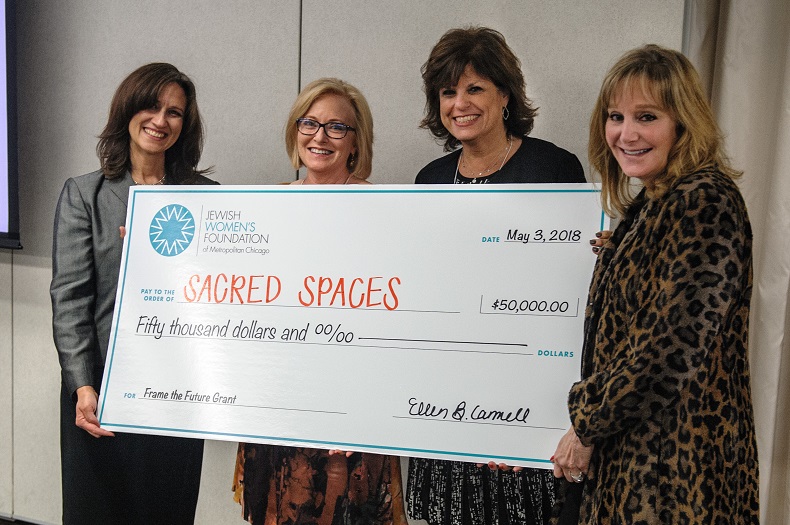
Jewish Women’s Foundation’s pop-up giving circle awards $50K to Sacred Spaces to prevent sexual abuse
Jessica Leving
Sacred Spaces, a group working to systemically address and prevent sexual abuse in Jewish institutions, was the proud recipient of a $50,000 grant at the Jewish Women’s Foundation of Metropolitan Chicago’s first-ever Frame the Future Pop-Up Giving Circle last week. The night featured live presentations by a select group of nonprofits pitching innovative grant proposals in keeping with JWF’s mission of supporting Jewish women and girls, and gave attendees the opportunity to vote for which proposal would receive funding. Nearly 100 women attended the event, raising the $50,000 grant themselves through contributions of at least $500 each in order to participate.
The event was the culmination of a year of special celebrations in honor of the Jewish Women’s Foundation’s 20-year anniversary.
“This is part of a revolution,” said Joelle Berman, a national giving circle expert who facilitated the event. “We are revolutionizing the way that philanthropy happens.”
Sacred Spaces plans to use the award to launch their program in Chicago, uniting local institutions across the denominational spectrum in a guided process for preventing abuse in the community. The process will focus on comprehensive policy development and education for lay leaders, clergy, staff, and the community. Sacred Spaces looks forward to adding its specialized expertise on this critical issue and collaborating with organizations such as Jewish Child and Family Services to reach new collective heights.
“Judaism demands that we protect the vulnerable,” said Sari Steinberg, of Sacred Spaces, in her pitch. “We need to do abuse prevention and we needed to have done it yesterday. This work cannot wait.”
Runners-up included Sharsheret, an organization supporting Jewish women and families facing breast and ovarian cancer, and Orot: Center for New Jewish Learning, which empowers Jews of all backgrounds to discover new entry points into Judaism through mindfulness and immersive learning. Both organizations also received a $1,500 contribution to support their work.
The Jewish Women’s Foundation is an independent project of the Jewish United Fund/Jewish Federation of Metropolitan Chicago. For more information, visit www.juf.org/jwf/ .
Other stories
-
Two local teens win national recognition
Recipients of the annual Diller Teen Tikkun Olam Awards
Read more -
Celebrating six young award winners cultivating the community
Introducing young adult award winners
Read more -
After a brief hiatus, famed legal commentator Nancy Grace returned to television screens last month with fellow legal analyst Dan Abrams for Grace vs. Abrams, a new show on A&E where the pair debate legal cases and timely crimes. Grace also hosts Crime Stories with Nancy Grace on XM Radio’s Triumph station.
In advance of her visit to Chicago, Grace took time for a phone interview with JUF News.
JUF News: What’s different about hosting this show with Dan Abrams as opposed to when you’ve been the sole host in the past?
It’s really two world views on the justice system and particular cases. It’s very exciting. Dan and I have known each other a very long time. It goes back to when I was prosecuting felonies in Atlanta. I ended up on this panel sitting between Johnny Cochran and Roy Black, and of course they got in a big fight. I remember Dan Abrams fighting with Johnny Cochran. We’ve [also] worked together on Good Morning America.
Your work centers around crime cases, which means your days are filled with a lot of talk of death and tragedy. Do you “take your work home with you” or are you able to leave the thoughts of crime at the job?
The answer is both. I knew better than to ever break down and cry in front of a jury. Any display of emotion can be misconstrued. I remember leaving the courthouse and I’d be alone in my car driving away, and I’d have to pull over on the side of the road and just cry and cry and cry over what I saw happen to people and the cruelty in the world. It really tore me apart.
…It wasn’t jubilation at the end of a case, it wasn’t celebration. It was relief. The guy is behind bars and can’t hurt anyone for a while. Onto the next.
What makes you dedicate your life to uncovering these crimes?
The murder of my fiancé. I was in school, studying to become a literature professor. I dropped out of school. I couldn’t eat. I was wasting away. I decided I wanted to become a prosecutor and help other crime victims [because] I believe one person can make a difference.
You’ve covered a lot of high profile cases like Elizabeth Smart and Caylee Anthony. Which one has had the most profound effect on you?
That’s like picking which child I love most — there’s no true answer. Every victim has affected me in a different way. It pains me to see the way victims are treated. There are cases that are more famous than other cases, but that doesn’t mean they’re more important or impacted me less than cases no one has ever heard of.
—
The Jewish United Fund’s Trades, Industries, and Professions Annual Dinners run Thursday, May 10, to Tuesday, June 5, all held at the Hyatt Regency Chicago. Here are the sequence of speakers and dinners:
Thursday, May 10
Medical Professionals and Educators Dinner
Featuring: Col. (Res.) Dr. Ofer Merin, commander of Israel Defense Forces (IDF) Mobile Field Hospital and director of the Trauma Unit at Shaare Zedek Medical Center in Jerusalem.
Thursday, May 31
Financial Services, Real Estate, High Tech, Marketing, and Media Dinner
Featuring: Magic Johnson, basketball legend, entrepreneur, and philanthropist.
Tuesday, June 5
Lawyers, Government Officials, Foods, Hospitality, Wholesalers, Retailers, and Manufacturers
Featuring: Dan Abrams & Nancy Grace. The new A&E show Grace vs. Abrams features Abrams, legal analyst, attorney, and author; and Grace, legal analyst, former prosecutor, and victims’ advocate.
There is no charge to attend these events. Thanks to the generous support of our Corporate Partners, every dollar raised will go directly to JUF programs and services. All guests are encouraged to make a gift to the 2018 JUF Annual Campaign. For more information, contact [email protected]. To register, visit juf.org/TipDinners.
Other stories
-
Two local teens win national recognition
Recipients of the annual Diller Teen Tikkun Olam Awards
Read more -
Celebrating six young award winners cultivating the community
Introducing young adult award winners
Read more -
When Israel deployed more than 250 physicians and search-and-rescue experts to Nepal after the earthquake in 2016, Dr. Ofer Merin was the man behind the mission. As commander of the IDF Field Hospital Unit, Merin leads Israel’s humanitarian missions around the world. Merin is also head of the trauma unit and emergency preparedness for mass casualties program at Jerusalem’s Shaare Zedek Medical Center.
JUF News interviewed Merin by phone in advance of his visit to Chicago.
JUF NEWS: How is Israel’s humanitarian assistance unique?
Dr. Ofer Merin: What makes Israel unique is a few things: First, our ability to deploy quickly. We are usually one of the first countries to arrive. We adapt to the conditions. The medical care you are giving in a disaster area is not the same you’re giving in Chicago or Jerusalem. You have to adapt to different challenges. You have to adapt to the culture of the place.
You wear a lot of hats — what does a typical day look like for you?
I respond to any major trauma incidents, whether that’s terror or urban incidents like car accidents. I’m also a cardiac surgeon and operating twice a week. There’s no typical day for me. Every day is different, which is what’s nice about my work.
How do Jewish values inspire your work?
We treat everyone the same way. We are in Jerusalem, so we are treating Jews, Arabs, Muslims, Christians. We’re treating terror victims as well as the perpetrators. There are a lot of values we keep. The work we do abroad is unique because we are coming and giving a helping hand to total strangers. There’s a lot of Jewish values in the work we are doing both in Israel and abroad.
—
The Jewish United Fund’s Trades, Industries, and Professions Annual Dinners run Thursday, May 10, to Tuesday, June 5, all held at the Hyatt Regency Chicago. Here are the sequence of speakers and dinners:
Thursday, May 10
Medical Professionals and Educators Dinner
Featuring: Col. (Res.) Dr. Ofer Merin, commander of Israel Defense Forces (IDF) Mobile Field Hospital and director of the Trauma Unit at Shaare Zedek Medical Center in Jerusalem.
Thursday, May 31
Financial Services, Real Estate, High Tech, Marketing, and Media Dinner
Featuring: Magic Johnson, basketball legend, entrepreneur, and philanthropist.
Tuesday, June 5
Lawyers, Government Officials, Foods, Hospitality, Wholesalers, Retailers, and Manufacturers
Featuring: Dan Abrams & Nancy Grace. The new A&E show Grace vs. Abrams features Abrams, legal analyst, attorney, and author; and Grace, legal analyst, former prosecutor, and victims’ advocate.
There is no charge to attend these events. Thanks to the generous support of our Corporate Partners, every dollar raised will go directly to JUF programs and services. All guests are encouraged to make a gift to the 2018 JUF Annual Campaign. For more information, contact [email protected]. To register, visit juf.org/TipDinners.
Other stories
-
Two local teens win national recognition
Recipients of the annual Diller Teen Tikkun Olam Awards
Read more -
Celebrating six young award winners cultivating the community
Introducing young adult award winners
Read more -

Creating vibrant Jewish experiences in Southern Illinois
ROCHELLE NEWMAN RUBINOFF
Small Jewish communities often are often forced to become strong Jewish communities-perhaps not in number, but in spirit and devotion. Such is the case for the Jews in Southern Illinois.
“Despite it being a small community, it is still a committed one that sticks together,” said Aaron Hadley, executive director of the Jewish Federation of Southern Illinois, Southeast Missouri, and Western Kentucky, called SIMOKY for short.
As is the case with many smaller communities, the Jewish population SIMOKY serves is shrinking, according to Hadley. Some synagogues have shuttered their doors, and overall access to Jewish life can be challenging.
Hadley said their community may be small, but it’s still mighty. “The community remains steadfast,” he said. “Everyone is in touch with neighbors and friends. The community basically functions like an extended family.”
There are still several synagogues in the region. One of them, Congregation Beth Jacob, in Carbondale, remains operational and holds services every Friday night.
Jack Wides’ family helped found the synagogue in the 1940s. “We can’t afford a rabbi now, but we have a lot of members who are very talented with Judaic knowledge,” he said. Wides, president of Beth Jacob, estimates there are some 30 families who are currently members, down from 40 families at its height.
He grew up in nearby Murphysboro, but has lived his entire adult life in Carbondale, where he raised his son and daughter. “I’ve always had a strong Jewish identity, and in all my years here, I’ve never experienced any anti-Semitism,” said ” said Wides, a retired businessman.
In addition to Friday night services, Beth Jacob throws periodic potluck dinners, hosts community Seders, and celebrates lifecycle events together. “Like any community, we come to together to help people when they need it,” Wides said.
The synagogue and SIMOKY are closely aligned. But due to the changes in demographics, SIMOKY focuses the majority of its resources and energy on the program that provides the most meaningful Jewish experiences for the children of the area: Camp Ben Frankel.
Never heard of it? Neither have most people, readily admitted Hadley, who is the camp director in addition to his leadership role at his Federation.
In fact, it may be one of the best-kept secrets in Jewish camping.
Located on 3,000 acres of beautiful forested lakefront property in Makanda, Ill., adjacent to Carbondale, the camp can serve 100 campers at full capacity. It has everything any other camp has-horseback riding, a ropes course, sports, a rock band, theater, fine arts, even air-conditioned cabins-but there’s something intangible too.
Indeed, there seems to be something very special going on at Camp Ben Frankel.
“The camp has been very important in the children’s lives in southern Illinois,” Wides said. “Kids from various towns get to be friends and this continues that community feeling.”
They have a strong alumni community, where former campers participate in both their family camp and send their own children to Camp Ben Frankel.
One alum is Jonathan Thursby, who grew up in Decatur, Ill., halfway between Chicago and St. Louis. From the moment he arrived at the camp as a camper in the mid-1980s, he was hooked. “I formed immediate friendships, just real sincere, right out of the gate.” He spent the next decade at camp progressing from camper to counselor to head counselor to program director.
Living in an area with few Jews during the school year, it was summers at the camp that gave Thursby a concrete sense of his Judaism. “I was always the only Jewish person in my school,” he said. “But going to a place where everyone is Jewish and all from small Jewish communities-just like me-gave me a safe place to explore my Judaism.”
Now a father of two, Thursby sends his children to the camp, and they, like him, love it there. In fact, this summer, since Thursby and his kids are currently based in London, his kids hope to win the award for campers who travel the farthest distance to attend camp.
As was the case for Thursby as a kid, many of the campers have few other Jewish experiences during the year.
“We work with a lot of kids where this is their primary Jewish experience,” said Hadley, who also attended the camp when he was young. The camp has daily services, intended to make Judaism accessible to everyone.
Camp Ben Frankel attracts kids who wouldn’t have thought Jewish camping was an option for them. They offer a unique and competitive pricing model with four levels of pricing; people are encouraged to pay what they can, and SIMOKY and camp scholarships help with the rest. “We want the camp to be an option for everyone,” Hadley said.
“Camp used to be considered more of a privilege,” he said. But he emphasized that now it is much more than recreational. “It inspires Jewish identity and continuity. It was true then and it is even more important now.”
There are still openings for Camp Ben Frankel’s 2018 season, running June 24-July 22. For more information, visit www.campbenfrankel.org.
Rochelle Newman Rubinoff is a freelance writer living in the northern suburbs of Chicago.
Other stories
-
Two local teens win national recognition
Recipients of the annual Diller Teen Tikkun Olam Awards
Read more -
Celebrating six young award winners cultivating the community
Introducing young adult award winners
Read more -