Allegiance
Boom! (2015)
Deal with It
The Ex List
The Four: Battle For Stardom
Greenhouse Academy
Homeland
Hostages
In Treatment
Phenomenon
Rising Star
Traffic Light
Who’s Still Standing?
Wisdom of the Crowd
Your Family or Mine
Other stories
-
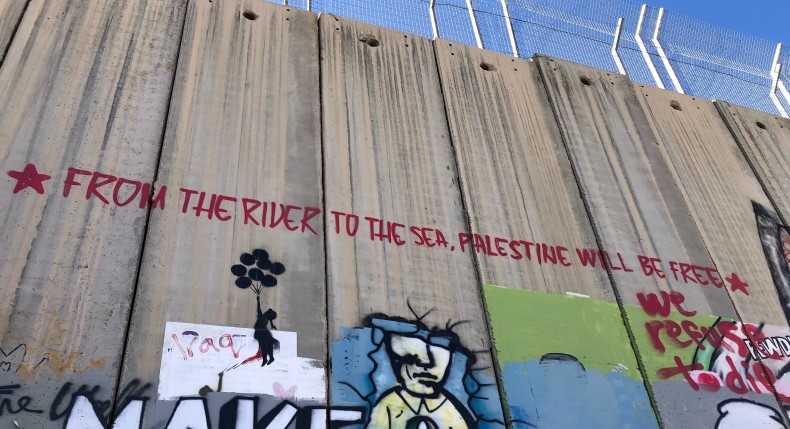
Is there hope?
JCRC’s executive director, Daniel Goldwin, reflects on conversations with Palestinians on a recent trip to Israel.
Read more -
Israel@70: 10 Israeli Movies (and Their Directors) That Vied for Oscar's Affection
The movies Israel makes, and the directors who make them, definitely have caught the attention of the Academy of Motion Picture Arts & Sciences nominators.
Read more -
Israel@70: 10 Celebrities Who Got Their Start (in Life) in Israel
Whether stars of cinema, symphony, sports, rock or runway, all were born in the Jewish State.
Read more
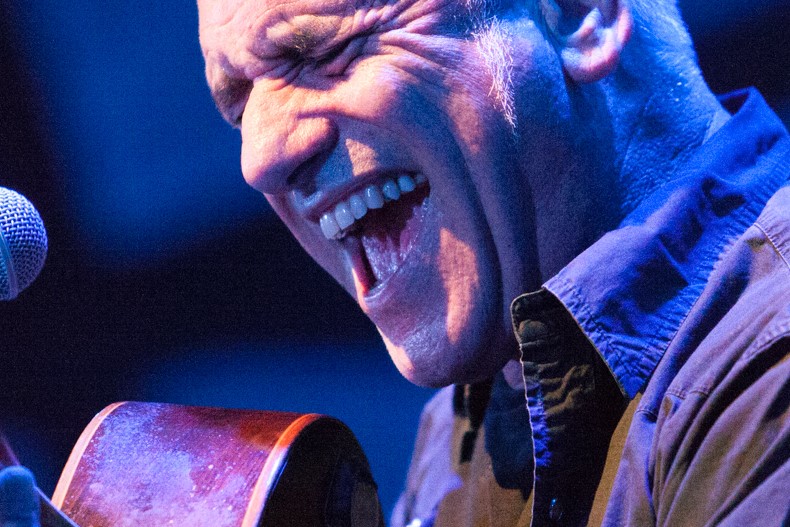
Israeli star David Broza headlines Chicago’s Israel@70 celebration
PAUL WIEDER
The Yom Ha’atzmaut/Israel Independence Day celebration presents David Broza & Friends, with a special appearance by the Chicago Children’s Choir, on Wednesday, April 18, at the Harris Theater for Music and Dance, 205 E. Randolph St. in Chicago. Doors will open at 6:30 p.m., and the concert starts at 7:30 p.m. The evening also will feature Titi Aynaw, the first Israeli-Ethiopian to win the Miss Israel title.
The celebration, co-chaired by Lynn and Skip Schrayer, is presented in partnership with the Consulate General of Israel to the Midwest. Tickets prices are $36 and $70, and $18 of each ticket will help at-risk children in JUF’s Israeli partner region, providing academic enrichment, psychological and emotional therapies, and after-school activities.
Asked about his feelings on Israel’s milestone anniversary, Broza said, “Seventy is a big number. But in historical terms, Israel is a fresh, young country. Israel is in headlines everywhere, every day. For thinkers, writers and commentators everywhere, it’s still a fresh reality.”
Broza’s fondness for Chicago began more than 10 years ago, when WTTW TV aired a sunrise concert of his staged on Masada, with guest star Jackson Browne. “Part of Chicago has been in me” ever since, said Broza.
While noting that Chicago boasts a diverse population, Broza said that Israel is even more eclectic. “The demography changes constantly, with a vastness of different people from every corner of the world. It’s so diverse-there are some 120 nationalities in Israel.”
Broza sings in Hebrew, English and Spanish, singing both original lyrics and poetry from around the world that he sets to music. His virtuosic guitar playing pulls from Middle Eastern and flamenco sounds as well as blues, folk and rock.
Israel influences infuse Broza’s art as well. “Israel is something to be inspired by. It has developed so much music-Idan Raichel, Noa, rappers Hadag Nahash. The scene is very rich; there is everything from folk to jazz, rock to country. It has some of the most important stages. It produces movies seen worldwide. On an artistic level, there is so much going on.”
Through Israel’s embrace of Jews from around the world, there is now a place where Jews can “blend and infuse society with new talent. When you look at all Israel has achieved in just 70 years, only imagine what comes next!”
For more information or to get tickets, visit www.juf.org/Israel70 .
Other stories
-
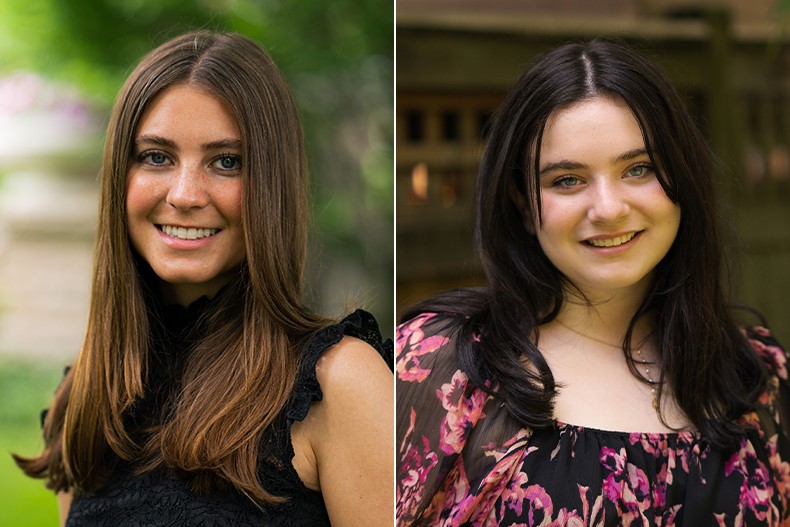
Two local teens win national recognition
Recipients of the annual Diller Teen Tikkun Olam Awards
Read more -
Celebrating six young award winners cultivating the community
Introducing young adult award winners
Read more -
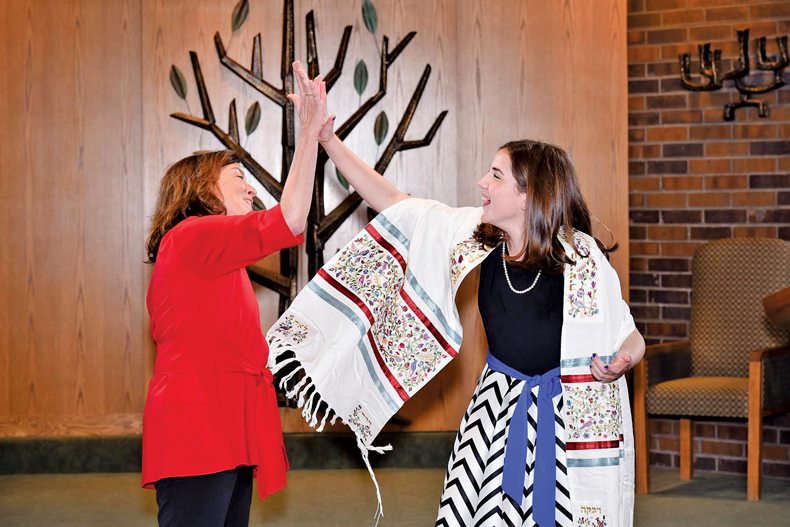
Rabbi Debra Newman Kamin to be installed as second-ever female president of Rabbinical Assembly
MIMI SAGER YOSKOWITZ
As the first Conservative female congregational rabbi in Chicago, Rabbi Debra Newman Kamin is used to being the one who breaks the “stained glass ceiling.”
In 1990, she became assistant rabbi at Am Yisrael Congregation in Northfield. Four years later, she took over as sole rabbi at Am Yisrael, and for many years her pulpit was the largest in the Conservative Movement to be led by a woman.
On April 23, Rabbi Newman Kamin’s devotion and passion for her work will be recognized when she is installed as the second female president of the Rabbinical Assembly (RA), the international association of Conservative rabbis. Newman Kamin says she is excited to be second this time around.
“At a certain point, you have to sort of sit back and say, ‘if you’re always the first, and there’s never a second, that means that actually there’s no progress being made,'” she explains. “So I’m very proud to be the second. More than proud, encouraged that it’s no longer a novelty in the Conservative Movement to have female leadership.”
Newman Kamin says she feels privileged to have paved the way for others in her work as a female rabbi, but she says she no longer sees herself as a trailblazer because in her own congregation she’s “just the rabbi.”
Still, the Rabbinical Assembly remains a male-dominated organization with women making up just 20 percent of its worldwide membership, according to Rabbi Elliot Schoenberg, senior vice president and global director of Rabbinic Career Development at the Rabbinical Assembly.
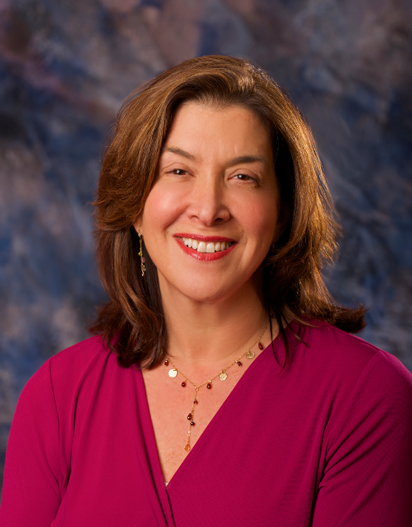
“Being a woman president of an organization, which is still 80 percent male is still being a trailblazer,” says Rabbi Schoenberg. “It’s also being a role model.”
For the past two years, Newman Kamin served as vice president of the Rabbinical Assembly, during which time she co-chaired the strategic planning process to take the RA into its next chapter.
“What we learned in the strategic plan is that rabbis want to connect to rabbis,” explains Rabbi Schoenberg. “And there couldn’t be anyone better suited to that than Debra because Debra is a connector. She fits in perfectly to the strategic plan.”
Technology will play a key role in helping the RA become what Newman Kamin calls a “networked organization” where rabbis from around the globe can connect no matter their distance from each other. She also says they have “affinity circles,” which links up rabbis who share something in common, such as being an assistant rabbi or raising a child with special needs.
“What really excites me is the chavruta, the bringing people together for meaningful experiences as rabbis,” says Newman Kamin.
In addition to connecting rabbis within the RA, Newman Kamin says she is working hard to collaborate and partner with other branches of the Conservative Movement such as United Synagogue and the Masorti Movement in Israel.
Her installation will take place at this year’s Rabbinical Assembly convention, which she convinced them to hold in Chicago for the first time since 1948. JUF provided a grant to help sponsor the event.
“I think for a lot of people on the East Coast and West Coast, they have no idea about the vibrancy of Jewish life (and) the Conservative Movement in Chicago,” she says, “and I’m looking forward to helping educate them about the really special amazing community that we have.”
That community includes access to kosher butchers, Jewish day schools, and the support of other fellow rabbis. It also includes her own family and congregation, both of whom make up the foundation of Newman Kamin’s support system.
Part of her community is a uniquely close relationship with JUF. “The entire Chicago Jewish community is proud that one of our finest rabbinic leaders is being installed as president of the Rabbinical Assembly,” said Dr. Steven B. Nasatir, JUF President and one of Newman Kamin’s congregants. “Debra’s installation is especially meaningful to me, as she is not just my colleague, but my friend, rabbi, and confidant. The Rabbinical Assembly has chosen well.”
She is married to Daniel Kamin, an adjunct professor at DePaul University, and together they have three children, Shai, Zachary, and Charlotte, as well as daughter-in-law, Sahar Segal. Newman Kamin says that growing up with a mom as a rabbi presents its own challenges, but she is proud they all turned out to be “menschy adults.”
“They tell me that they’re really proud of me, and it’s incredibly gratifying to launch all of these adults,” she says. “I think their life was enhanced by having a rabbi mom. Of course, not as much as my life was enhanced by being able to be their mom.”
Just as Rabbi Newman Kamin’s own family had to share her over the years with her congregation, so too now her congregation will have to share her time with her presidency of the Rabbinical Association. They have been “extremely generous” in supporting her being able to serve in both roles, and the deep relationship they have developed since she first started at Am Yisrael in 1990 is fundamental to all of her work.
“I really love being a rabbi. I love my congregation. I have had the most wonderful experience, and that’s really what fuels my passion for wanting to help and support other rabbis.”
Rabbi Newman Kamin’s installation as President of the Rabbinical Assembly will take place on Monday, April 23 at 8p.m. at the North Shore Center for the Performing Arts in Skokie.
Other stories
-
Two local teens win national recognition
Recipients of the annual Diller Teen Tikkun Olam Awards
Read more -
Celebrating six young award winners cultivating the community
Introducing young adult award winners
Read more -
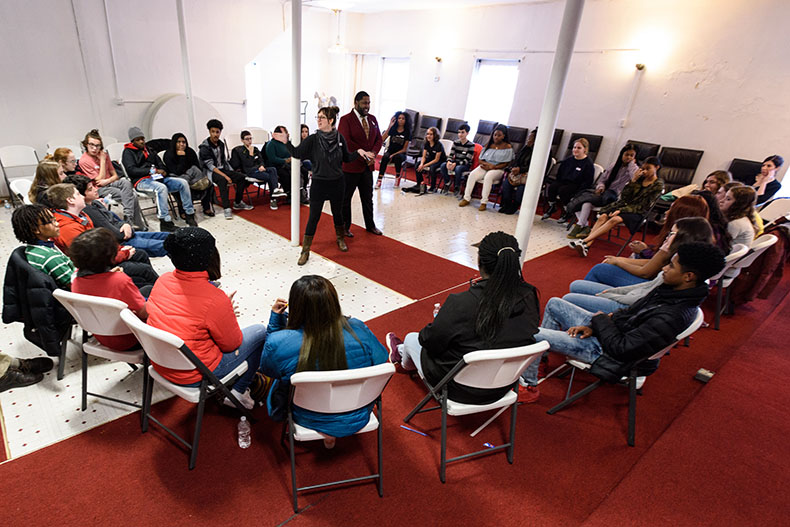
African-American and Jewish teens journey together to learn about their shared past, present — and hopeful future
On a Sunday afternoon in late winter, Chicago high school students — some African American and others Jewish — sit in a wide circle at the Bright Star Church on Chicago’s South Side. During one of several icebreaker exercises, the teens were, literally, asked to trade places.
“Tell me something interesting about yourself and then go switch seats with a person who isn’t the same color as you,” directed Pastor Christopher T. Harris, Sr., the charismatic spiritual leader of Bright Star Church and a longtime friend to the Chicago Jewish community.
“I’m a bundle of joy!” one African-American student shouts out with a giggle and runs over to a chair across the room, changing seats with a Jewish student.
“I can almost write as well with my left hand as my right,” a young man declares and switches places with someone else.
Once all the students have changed seats, Harris explains the exercise: “We need to be willing to trade places. We need to understand each other’s communities.”
After a teen trip in March, understanding one another is exactly what these teens are learning to do. In the first program of its kind, African-American and Jewish teens from Chicago-a city known for its segregated communities-traveled together to the nation’s South on a bus trip called “Let’s Get Together: An Interfaith Journey Toward Justice.”
This shared journey was the longtime dream of Harris, and his good friend-who the pastor calls his “brother from another mother”-Rabbi Michael Siegel, spiritual leader of Anshe Emet Synagogue.
For program creators, what’s most energizing about the trip is the chance for the teens to meet people they might not have met otherwise. “The most exciting thing is these are kids…who never would have met each other — kids from neighborhoods that are so deeply segregated,” said Anshe Emet’s Rabbi D’ror Chankin-Gould, who led the team in creating and executing the trip. “[They are] people who for the first time are talking to someone from the South Side, from the North Side, who is Jewish, who is white, who is black, having an actual conversation.”
“Let’s Get Together” is part of the Springboard School Break Program, made possible through a collaboration between Anshe Emet, the Anti-Defamation League, Bright Star, Bright Star Community Outreach, Chicago Urban League, and JUF’s Jewish Community Relations Council.
The collaboration between the sponsoring organizations is part of what the staff hopes to model to the students. “The strength, perspectives, and experience we all bring to the table is generating radically unique energy in both of our communities, and I am honored to be able to model such partnership for our young people,” said Stephanie Goldfarb, JUF’s program director for youth philanthropy and leadership.
The 36 students — all 9th through 11th graders — were selected through an application process, including a short video submission about their community and a mentor recommendation, with scholarship money available to anyone in need.
On their journey, the students explored their shared past, present, and future.
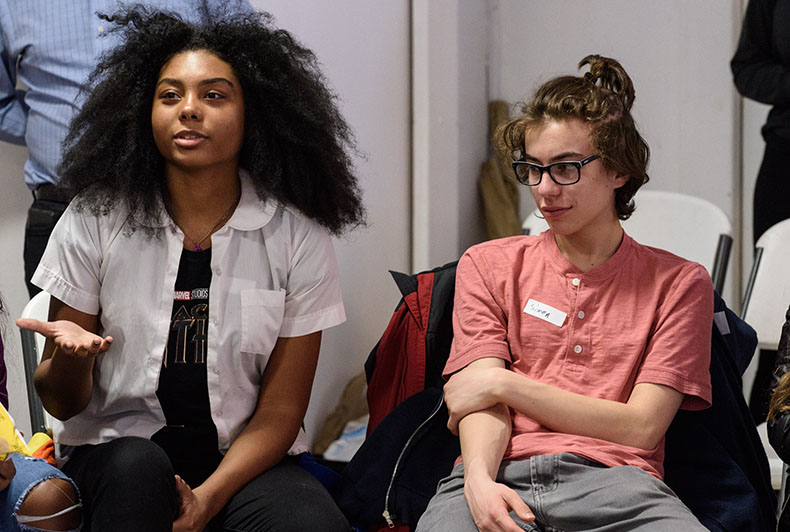
First, they learned about their shared history during the Civil Rights era, a time when both Jews and African Americans marched arm in arm. As part of that education, they visited the National Civil Rights Museum in Memphis, Tenn., and the Little Rock Central High School in Arkansas, the site of mandated school desegregation.
As they made their way back north, the teens stopped in St. Louis, Mo., to see a production of The Color Purple , the Tony-winning musical adapted from the Alice Walker novel about African-American women living in the South.
Throughout the four-day trip, the teens learned about racial and social justice and discussed how to tackle present-day obstacles for the two communities, meeting with faith leaders at Citadel of Deliverance in Memphis and Central Reform Congregation in St. Louis.
Finally, looking toward the future, the teens ended their journey with a stop in Springfield, Ill., where they learned about activism and advocacy.
Back home in Chicago, the teens will attend follow-up sessions to keep the dialogue going and continue to advocate together for substantive change. Of course, less formally, there’s a hope that they will maintain friendships with teens whose skin color is different from their own.
Kristian Walker, an African-American sophomore at the Latin School of Chicago, explained that before the trip he didn’t have any Jewish friends. But after even the first meeting with other teens from the trip, he said he felt bonds between him and the Jewish students.
“I’m ecstatic to get to know different people from different backgrounds,” Walker said. “We’re all the same. There are so many different barriers blocking us, but [really] we’re all the same, we’re all humans.”
Other stories
-
Two local teens win national recognition
Recipients of the annual Diller Teen Tikkun Olam Awards
Read more -
Celebrating six young award winners cultivating the community
Introducing young adult award winners
Read more -

Between brainstorming conversation starters and buying enough groceries to nourish a table of friends, planning a Shabbat dinner can be hard. OneTable, a national organization, removes the challenges hosts and guests may experience so they can come together on Friday nights for a stress-free Shabbat.
“OneTable is an online and in-person platform that helps young adult Jews find and host unique Friday night experiences in their city,” said Marissa Freeman, OneTable’s Chicago hub manager. “That can mean anything from an intimate dinner for five people in someone’s home, or something large like an experiential Shabbat dinner, like a farm-to-table dinner or a partnership with a cool chef in town. We’re a community of people who value ending the week with good food, good wine, and good people.”
OneTable, which launched in New York in 2014, has hubs in seven cities across the country. Chicago’s hub opened in June 2015 with funding from the JUF Breakthrough Fund. Since its inception, more than 700 hosts in Chicago have held 1,100 dinners.
OneTable’s target demographic are post-college millennials who haven’t started families and don’t have a regular Shabbat practice.
“If someone feels like they’re wanting to host dinner and share that experience with others, they’re the type of person we want to be hosting Shabbat dinners with OneTable,” Freeman said. “I think a lot of people assume a host has to be this amazing cook, or have a big apartment, or be able to have 15 people over for dinner, but a host is passionate about getting people together for a shared deep breath at the end of the week.”
Shabbat Coaches ease new hosts’ anxieties by offering one-on-one support for any questions hosts may have. Chicago’s hub has 15 coaches-some are rabbis, while others are community members who have found leadership through OneTable.
“I mentor new hosts and existing hosts in various ways,” said Lauren Orlofsky, a Chicago Shabbat Coach. “Sometimes it’s helping them plan a meal, sometimes it’s brainstorming a theme for dinner. A lot of times, I’ll help them with questions to start conversation.”
To make hosting financially accessible, OneTable offers Nourishment Credits. Credits can be used to purchase food, decorations, and other necessities through a variety of resources ranging from Whole Foods to Etsy.
“The fact that they sponsor dinner and give you funds to host, it encourages you to do something special,” said OneTable host Adam Rubenfire. “The nourishment, coaching, and inspiration from other dinners that are hosted empowers people to make really cool experiences.”
Kadi House hosts dinner every couple months. Some of her dinners have incorporated musical jams and themes such as Friendsgiving and a Blockbuster/90s movie night.
“Originally the draw to OneTable was that you post your meal online and you can have it open, so you can meet new people,” House said. “People I don’t know always come. It’s a nice way to bring my friends together, end the week, relax, and meet new people.”
OneTable also partners with community organizations and restaurants to host large-scale Shabbat dinners. In December, OneTable hosted a Revival Food Hall Chanukah Shabbat Dinner with Aloha Poke Co.. A dozen vendors offered appetizers, dinner, and desserts to 65 guests.
“It was a really elevated experience,” Freeman said.
In addition to planning events, managing partnerships, and monitoring Chicago dinners, Freeman follows up with hosts to see how the dinner went.
“I can’t even begin to express the pride and warmth I feel when I read these emails from hosts who are finding Fridays to be a moment when they can take a deep breath,” Freeman said. “That feeling of soul nourishment that happens when you’re surrounded by good people coming together to share a beautiful meal is something that this world needs more of, and we’re doing it in Chicago and all over.”
Other stories
-
Two local teens win national recognition
Recipients of the annual Diller Teen Tikkun Olam Awards
Read more -
Celebrating six young award winners cultivating the community
Introducing young adult award winners
Read more -

Inspiring Israeli-Ethiopian former Miss Israel to speak at Israel@70 concert
Cindy Sher
In 2013, Titi Aynaw became the first Israeli-Ethiopian to win the Miss Israel title. Through that accomplishment, she paved the way for Ethiopian models in Israel, challenging advertisers in Israel to rethink their attitudes toward black models.
A television personality and Israeli advocate, Aynaw will appear alongside David Broza and friends at the Community’s Yom Ha’atzmaut/Israel@70 Celebration on April 18.
Born in the Gondar province of Ethiopia, Aynaw always dreamed of moving to Israel. After losing both of her parents by age 12, she and her brother moved to Israel to live with their grandparents in Netanya, in northern Israel.
An Israeli advocate from an early age, she founded and helps fund the “Titi Project,” to provide extracurricular activities for Ethiopian kids in need in Netanya.
She later served in the Israel Defense Forces as a Company Commander with the rank of Lieutenant and then joined the Military Police, with 300 men and women under her command.
Aynaw, currently on leave from IDC University (Interdisciplinary Center Herzliya), is touring U.S. colleges, sharing her story and promoting a positive image of Israel. In advance of her appearance in Chicago, she did an interview with JUF News by email.
JUF News: How do you think you have helped open the door to other black models in Israel?
Titi Aynaw: I opened the door for black models in Israel to be on magazine covers and made Israel aware and open to accepting black models in all areas of beauty. Ethiopian girls and other minorities [now] have the confidence to enter the Miss Israel contest and become models.
What does your service in the Israel Defense Forces mean to you?
The IDF helped [me] build character and develop my sense of being. I learned to be a leader, teacher, and a stronger person… It gave me an opportunity to make a difference in the lives of the soldiers I commanded.
What does Israel turning 70 mean to you?
Israel has grown to be a strong country, which impacts the world through contributions to agriculture, medicine, technology, the environment, [etc]. We are a small country moving forward with one success after another. Are we perfect? No, [but] I am very proud of my country and to be an Israeli.
What is the most important message you convey to students on American college campuses?
I tell the students to chase their dreams and set high goals for themselves. I let them know that if a new immigrant from Ethiopia can achieve her dreams and goals in Israel, they can do it as well. It’s important for me to deliver a positive message [of] Israel, one which is often much different from what [people] hear and read in the media.
What’s next for you?
In the next few years, I want to focus on becoming an international model. Down the road, I see myself entering the public sector and maybe one day become a Member of Knesset.
Other stories
-
Two local teens win national recognition
Recipients of the annual Diller Teen Tikkun Olam Awards
Read more -
Celebrating six young award winners cultivating the community
Introducing young adult award winners
Read more -
After a year of intensive and persistent advocacy by JUF professionals, volunteers and agency professionals, many of JUF’s top funding and policy priorities were included in the $1.3 trillion spending bill , which passed Congress and was signed by President Trump this week to fund the federal government through the end of the fiscal year. Several of these priorities have been the focus of JUF’s federal advocacy efforts since last year’s Washington DC Advocacy Mission and are big wins for our community.
“While work remains on many important issues, the inclusion of several of our key priorities in this funding package is a testament to the work we’ve done over the past year, beginning with our Washington Mission last March and continued through the ongoing advocacy efforts of our professional staff and volunteer leadership” said David Golder, JUF Government Affairs Committee chair.
“From increased support for the Non-profit Security Grant Program and Holocaust survivors services to additional funding for Israel’s missile defense program, these decisions made in Washington have a big impact on our community and our priorities around the world,” he said. “It is, therefore, so important that we continue to have a seat at the table to advocate for these issues and keep policymakers informed of all the work that we do both locally and abroad.”
Funding for the Nonprofit Security Grant Program was increased from $25 million in Fiscal 2017 to $60 million in Fiscal 2018, ensuring that nonprofit and Jewish communal institutions within the JUF system and around the country can take the necessary precautions to ensure their safety and security. Additionally, funding for the Holocaust Survivor Assistance Program was doubled to $5 million, and funding for the Emergency Food and Shelter Program was maintained at $120 million.
The funding package also adds $3.3 billion to address the opioid and mental health crisis in Fiscal 2018. This includes $1 billion for a new State Opioid Response Grant program, a $160 million increase in the Mental Health Block Grant, and a $350 million increase to the Centers for Disease Control and Prevention (CDC) for opioid overdose prevention, surveillance, and improving state prescription drug monitoring programs.
It’s also important to note that bill did not weaken or eliminate the Johnson amendment, which prohibits charities from participating in political campaigns for public office.
On the foreign policy front, the Taylor Force Act, which JUF has advocated for, was also included. This bipartisan bill restricts financial aid to the Palestinian Authority unless the Department of State confirms that the PA is taking steps to end attacks on U.S. and Israeli civilians, publicly condemns and investigates these attacks, and has terminated payments to terrorists and their families.
Congress additionally agreed to continue funding for the State Department’s Office of the Special Envoy to Monitor and Combat Anti-Semitism, which advances the United States’ foreign policy on anti-Semitism, and add at least $1 million for programs to combat anti-Semitism abroad. Congress also included $3.1 billion for military assistance to Israel, as provided in the Memorandum of Understanding (MOU) between the U.S. and Israeli governments set to expire this fiscal year (2018) and to be replaced by the new 10-year MOU which calls for $38 billion in aid over the next decade beginning in 2019.
Also included in the bill was $705.8 million, an increase over FY 2017 spending, for the U.S.-Israel cooperative missile defense program to support Iron Dome, David’s Sling and Arrows 1,2 and 3. Lastly, the bill includes $47.5 million for joint anti-tunneling technologies which Rep. Brad Schneider (IL-10) spearheaded in a letter to the House Appropriations Committee leadership.
One key area not included in the spending bill is protection for DACA (Deferred Action on Childhood Arrivals) recipients. JUF will continue to urge members of the Illinois congressional delegation to pass bipartisan legislation to provide permanent status protection for undocumented youth.
Other stories
-
Two local teens win national recognition
Recipients of the annual Diller Teen Tikkun Olam Awards
Read more -
Celebrating six young award winners cultivating the community
Introducing young adult award winners
Read more -
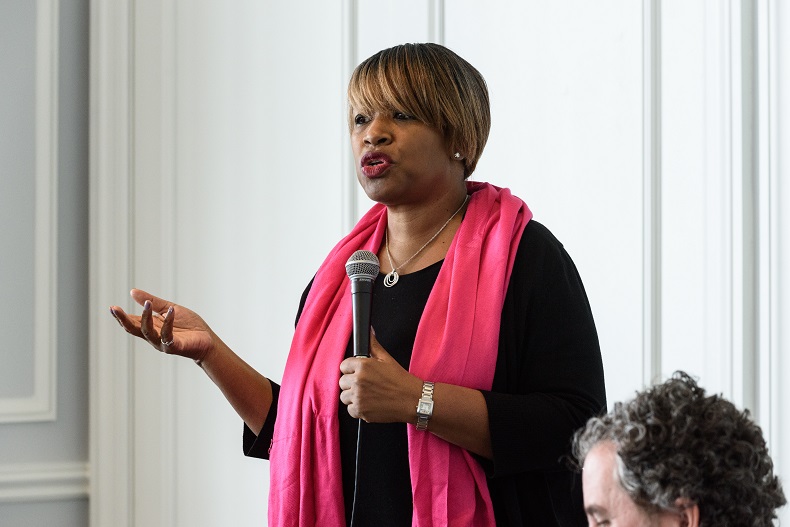
JUF Women’s City Council focuses on ways to curb gun violence
ROBERT NAGLER MILLER
Young men of color in Chicago, ages 15 to 34, are more likely to die of homicide than any other cause, according to 2013 data from the Centers for Disease Control. Gun violence claimed the lives of 650 Chicagoans last year and injured more than 3,400 others, according to statistics released by the Chicago Police Department. Life expectancy in Chicago’s Austin neighborhood is 16 years lower than in other parts of the city, according to the Institute for Nonviolence Chicago.
Those were among the sobering facts learned at a JUF Women’s City Council (WCC) gathering in March. Approximately 100 women came together for the event, “Taking Aim at Gun Violence in Chicago: How You Can Become Part of the Solution,” to hear from local experts about ways that they might contribute to an abatement of gun violence in Chicago through work already under way in some of Chicago’s most violent neighborhoods.
Teny Gross, who founded the Institute for Nonviolence Chicago (INVC) in 2016, and Rev. Dr. Marcenia Richards, a local pastor, educator, and motivational speaker who established Fierce Women of Faith several years earlier, talked about steps their organizations are taking to address gun violence on the local and state levels-and how WCC members and friends could assist in their efforts. They were joined by Jane Charney, director of Domestic Affairs of JUF’s Jewish Community Relations Council (JCRC), who facilitated the discussion.
“As Jews, as Chicagoans, we cannot ignore the people impacted by gun violence,” said Charney at the outset. “Jewish tradition teaches us that if you save one life, you save the world.”
Gross, an Israeli-American who served in the Israeli Defense Forces, outlined INVC’s multi-pronged approach to curbing violence in Chicago. Much of it, he said, entails creating support systems for people in communities with the highest levels of violence-particularly for the youth in those areas-and developing better relationships with police and other local law enforcement officials. It also involves reaching out to victims to make sure that their voices are heard and needs are met.
“This is not flashy work, showing up every night when there is a shooting,” Gross said. “It takes dogged determination.”
A community’s failure to act, he observed, will result in tremendous costs to the entire society. “We’re paying for a hotel called jail,” said Gross.
Richards, whose Fierce Women of Faith trains women of all religious backgrounds to work for peace through advocacy and develops anti-violence educational programs for children of all ages, said coalition building was vital in efforts to stem gun violence in Chicago neighborhoods such as Austin, Roseland, and Englewood, where there is a “common thread of hopelessness.”
“When people see all groups coming together,” she continued, “that has made a significant difference.”
Richards implored WCC members and friends to visit afflicted communities and make a difference in the lives of young people through mentoring, tutoring, and other programs. Volunteers and community members should pay particular attention to young girls, she said, who are often overlooked in discussions about gun violence, since the vast majority of those who kill and injure with guns, as well their victims, are young men of color.
Nevertheless, both Gross and Richards agreed, females are as greatly affected by gun violence as males, since the trauma left in its aftermath is both gender- and age-neutral. Most of the five- and six-year-olds with whom she has worked, added Richards, have observed gun violence.
In closing the meeting, Charney reminded those gathered that there was one more activity in which they could make a positive difference: advocacy. She noted that the State Legislature is debating gun safety bills including licensing gun dealers, banning “bump stock,” and a lethal violence order of protection and investments in mental health. On its annual Advocacy Mission in April, the Jewish Federation will talk about increasing the safety of our community and other communities through legislation in meetings with the Governor, the Speaker, and other legislators.
Robert Nagler Miller is a journalist and editor who writes frequently about arts- and Jewish-related topics from his home in Chicago.
Other stories
-
Two local teens win national recognition
Recipients of the annual Diller Teen Tikkun Olam Awards
Read more -
Celebrating six young award winners cultivating the community
Introducing young adult award winners
Read more -
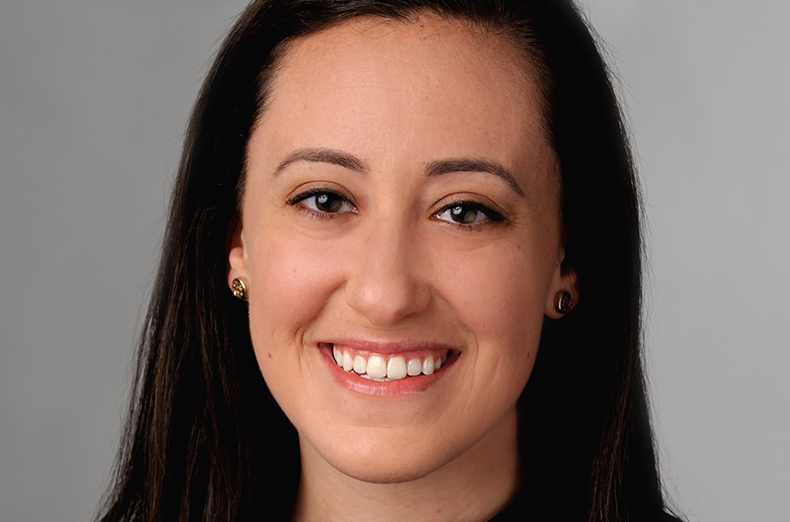
Sally Preminger, Assistant Vice President, Next Gen Initiatives for Chicago’s Jewish United Fund, has been named a Next Gen Jewish Federation Fellow.
The 18-month program of the Jewish Federations of North America has been launched to position key Federation staff across the continent as innovators in working with the next generation of leaders in the Jewish community. The program is made possible by a generous investment from the Jim Joseph Foundation.
Preminger, of Evanston, previously was director of JUF’s Young Leadership Division, and before that worked at Chicago Opera Theater and the Illinois Medical District Guest House Foundation. She is a graduate of Washington University in St. Louis, and originally is from Chapel Hill, N.C.
Other stories
-
Two local teens win national recognition
Recipients of the annual Diller Teen Tikkun Olam Awards
Read more -
Celebrating six young award winners cultivating the community
Introducing young adult award winners
Read more -
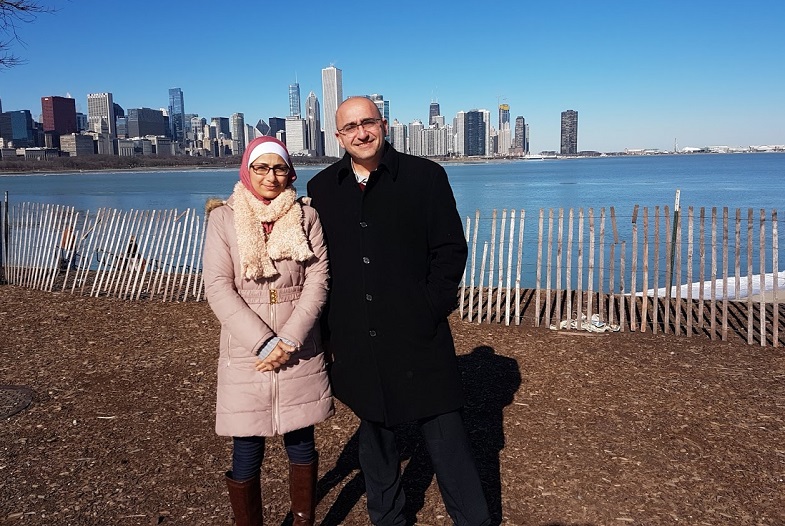
Two doctors-Adi Leiba, who is Israeli, and Khadra Salami, who is Palestinian-visited Chicago in February. They were on tour to promote Project Rozana.
When a medical case becomes too difficult for a hospital in the West Bank or Gaza to handle, the patient must be transferred to an Israeli hospital. This requires transportation, paperwork, and many expenses.
Enter Project Rozana. This effort, established in 2013, seeks to ease this transfer process on the one hand, and make it less necessary on the other. To do so, Project Rozana focuses on what it calls “The Three Ts:” Training, Treatment, and Transportation.
The lack of subspecialists in Palestinian hospitals is one major reason these transfers are necessary. In response, Palestinian doctors and nurses have begun training at Israeli hospitals; they will then take their new knowledge back to their own facilities. Additionally, Israeli therapists are training their Palestinian counterparts in mental healthcare, with a focus on Post-Traumatic Stress Disorder.
Until enough subspecialists can be trained, however, some Palestinian patients will still have to come to Israeli hospitals for treatment, with their families. Project Rozana raises funds to help hospitals and families cover those costs. Professional medical translators are also being hired to help streamline the treatment of Palestinians in Israeli facilities.
Even getting from their homes to the Israeli hospitals is a challenge for many. First, there is the trip from their homes to the nearest checkpoint, then another to the hospitals inside Israel. A cab ride from a checkpoint to a hospital can cost a Palestinian worker an entire month’s salary.
As Dr. Salami pointed out, “Navigating checkpoints is a major challenge. Time is key for treatment, but a 15-minute drive can turn into an hour-and-a-half at a checkpoint.” To address this challenge, Project Rozana works with a non-profit called Road to Recovery, which organizes volunteers to take patients from checkpoints to Israeli hospitals.
While in Chicago, Leiba and Salami made a presentation at JUF for local activists and clergy from several denominations. They also spoke to some 75 healthcare providers at Mt. Sinai Hospital. They were escorted on their North American tour by Mark Anshan, an attorney who serves as the director of Project Rozana’s Canadian arm.
Rabbi Steven Bob, the Rabbi Emeritus of Congregation Etz Chaim of DuPage County, helped bring the Rozana doctors to Chicago. His brother, Kenneth Bob, serves on Project Rozana’s board of directors, as well as the Jewish Agency for Israel’s International Board of Governors. After attending their presentation at JUF, Rabbi Bob said, “This is the definition of ‘grassroots’ organizing.”
“Sinai Health System was thrilled to be asked by JUF to host the Rozana Project at Mount Sinai Hospital,” said Karen Teitelbaum, Sinai Health System President and CEO. “Consistent with JUF’s mission, Sinai Health System stands for inclusion, diversity, and tikkun olam , as do these physicians. Our medical professionals, caregivers, and guests were inspired by the way in which Rozana’s doctors stood unified in healing those in need.”
Over 12 days, the Rozana delegates visited Toronto and seven American cities-ending with Chicago. They spoke to nearly 1,000 medical professionals, clergy of all stripes, and other leaders. They spoke in houses of worship, hospitals, universities, community centers, and homes, even on Capitol Hill.
Project Rozana was named for a Palestinian 4-year-old, Rozana Salawhi, who needed to be transferred to an Israeli hospital for treatment in 2013 after she fell off a balcony. Thanks to cooperation between Israelis and Palestinians, she lived. Her story touched an Australian doctor, Ron Finkel, who started the project to help ease such transfers for those in Rozana’s situation.
“People recognize that healthcare can build bridges to peaceful coexistence between Israelis and Palestinians,” said Finkel. “This initiative-which emerged from the leadership of Hadassah Australia- provides the Palestinian community with the best training and treatment available in Israel, so Palestinian society can provide it for its people. Project Rozana has been fully endorsed by the Palestinian Authority, and has the support of the Israeli Government.”
Salami, a pediatric oncologist, attended Al Quds Medical School and studied in hospitals in Israel and Jordan. She now practices at Augusta Victoria Hospital in Jerusalem. Her main focus is bone marrow transplants, which she had to go to Israel to study.
“[Project Rozana] is a very good chance for our doctors to get training to help our own health infrastructure. Through medicine, we build bridges,” Salami said. She became involved after Project Rozana visited her hospital only a few months prior to representing it in the United States.
Leiba agrees. “You can connect to experts in other places in other ways. But if we do it together, we understand each other better. When you meet people, you become friends with them.”
Leiba, who was born in Romania, practices at Assuta Ashdod, Israel’s the first new hospital in 40 years. He studied at the Technion-Israel Institute of Technology and Michael Reese Hospital and practiced in Boston. Leiba served with the Israel Defense Forces as a doctor for decades, on the peaceful borders with Egypt and Jordan. Just before he completed his service, however, he began working on the borders in the West Bank.
“We treat everyone,” Leiba concluded. “Medical care is universal, above everything.”
Other stories
-
Two local teens win national recognition
Recipients of the annual Diller Teen Tikkun Olam Awards
Read more -
Celebrating six young award winners cultivating the community
Introducing young adult award winners
Read more -