
SketchPad draws up to the future: Creating a new shared workspace for Jewish organizations
Irene Sandalow became convinced that working out of her home was no longer-working. But she is an organizer, so her second thought was: “I bet I’m not the only one with this problem.”
The solution? SketchPad. While this shared workspace for the Jewish nonprofit community in Chicago will reduce overhead costs, SketchPad is also designed to become an intellectual, cultural, spiritual, and socially conscious hub, promoting collaboration and providing an appealing space open to the public.
Sandalow’s brainstorm struck in 2015, and this May, SketchPad officially signed its lease. The facility encompasses 5,500 square feet, and is located at 4700 N. Ravenswood, near both the CTA Brown Line and a Metra station. “It’s a shared office and program space, with meeting rooms and a kitchen,” Sandalow explained. “There will also be professional learning and training opportunities” for all participants.
Its founders hit upon the name “SketchPad” to evoke their vision of a laboratory for innovation, experimentation, and creative outputs. The act of sketching is fundamental, tentative, and exploratory, they decided, representing the innovative mindset and culture they envision for this space.
SketchPad offers the amenities of a traditional shared workspace, while also serving the specific needs of Chicago’s Jewish nonprofit community, like a beit midrash – a Jewish study space with a library.
Three organizations anchored the project: The Jewish Council on Urban Affairs (JCUA), which combats poverty, racism, and anti-Semitism; Kahal, which connects American Jewish students to world Jewry; and Avodah Chicago, which supports social change through tomorrow’s Jewish leaders.
“SketchPad presents a unique opportunity for us to build stronger and more holistic joint programming, making the Jewish community broader, more cohesive, and more effective in our combined efforts to create change,” said Judy Levey, executive director of JCUA.
“What makes these spaces unique and revolutionary is not the space-sharing; anyone can get together to save a few bucks,” agreed Kahal’s executive director, Alex Jakubowski, who has visited other Jewish shared spaces, particularly in Europe. “What is truly amazing is the collaboration between organizations and movements that no one ever dreamed was possible. There are countless examples of collaborations arising from sharing a lunch together, attending a program, or just bumping into one another at the copier.”
“Intentional, Jewish, innovative collaboration is the future of Jewish social justice,” said Leah Greenblum, Chicago community director for Avodah. “We must work together to build bridges and support one another’s work for a common cause. We are proud to be coming together with like-minded organizations to create something truly unique in Chicago. SketchPad will undoubtedly shape our collective Jewish future, and we’re really excited to be a piece in this supportive puzzle.”
SketchPad’s other partners include: UpStart, which partners with innovators to redesign the experience and expression of Jewish life; the Orot Center for New Jewish Learning; InterfaithFamily/Chicago; and SVARA: A Traditionally Radical Yeshiva. Newer additions are the American Jewish World Service, a community of Jewish global citizens committed to repairing the world, and The Workmen’s Circle, focused on building Jewish communities and improving the world through activism. Other partners are signing on to partner with SketchPad in the future.
SketchPad is supported by a JUF Breakthrough Fund grant, the Crown Family Philanthropies, the Jack Miller Family Foundation, former JUF Board chairs Bill Silverstein and Midge Perlman Shafton, Gregory Rothman, and an anonymous donor.
For more information, contact Irene Lehrer Sandalow, SketchPad Project Director, at (312) 659-7466 or [email protected], or visit
SketchPadChicago.org.
Other stories
-
Two local teens win national recognition
Recipients of the annual Diller Teen Tikkun Olam Awards
Read more -
Celebrating six young award winners cultivating the community
Introducing young adult award winners
Read more -
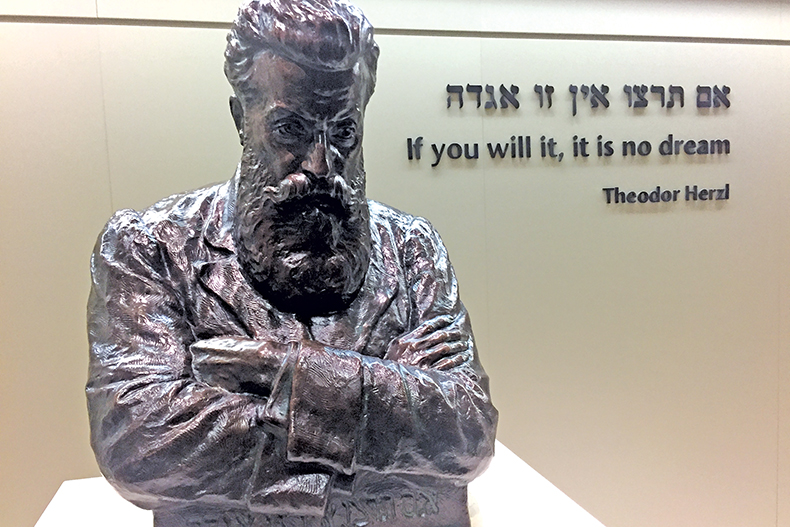
This November marks the 100th anniversary of two great revolutions that overtook the Jewish people in 1917 and forever altered the course of Jewish history. To this very day, we live with the profound consequences of these two revolutions.
On Nov. 7, 1917, the Bolshevik Communist revolution succeeded and the Union of Soviet Socialist Republics (USSR) was established. By the time the Communists took over the Czarist Russian Empire 2.5 million Jews had moved to the United States from eastern and central Europe.
When the dust settled and its borders were defined, approximately 2.5 million Jews were trapped behind the Iron Curtain. These Jews were subject to one of history’s most vigorous erasures of Jewish life in all its expressions: traditional Judaism, right, left, and center Zionism, Jewish socialism, and secular ethnic Jewish identity, Yiddishism. The Jewish population would grow to about three million on the eve of World War II. The Germans murdered 1.3 million Soviet Jews. The consequences of the Soviet Revolution were staggering. Were it not for the Bolshevik’s thoughtless decision to identify every Russian by ethnicity in Line Five of their internal passport, Jews would have assimilated in ever greater numbers.
Pobedonostsev, counselor to the Czar Alexander III, when asked in the 1890’s, “What will become of the Jews?” delivered one of history’s most devilish and possibly accurate prophecies. He said, “One third will be killed; one third will immigrate; one third will assimilate.” That happened. Between Stalin’s regime and the murderous Germans, approximately one third were murdered. Approximately one third assimilated. Approximately a third did migrate.
What neither the Czars, nor Pobedonostsev, nor the Communists, after they created their new world and perfect society could imagine was that nearly a million and a half Jews-270,000 in the 1970’s and 1.25 million in the 1990’s-would successfully leave and reunite with their brothers and sisters in the State of Israel and in North America. Never before in Jewish history did the Jewish people lose a community, fight for its liberation, and enjoy reunion. The struggle for the liberation of Soviet Jewry was one of American Jewry’s finest hours.
The Balfour Declaration was dated November 2, 1917, five days before the Bolshevik Revolution. It was published on November 9, 1917, two days after the Bolshevik Revolution. It proclaimed to the world: His Majesty’s government view with favor the establishment in Palestine of a national home for the Jewish people, and will use their best endeavors to facilitate the achievement of this object… This is surely a remarkable document. It surely played a determinative role in the establishment of the State of Israel some 31 years later. However, the Balfour Declaration had long been imagined and dreamed of by Zionist leaders and activists many decades prior to 1917. In order to appreciate it let us step back a moment.
When the Polish-Lithuanian Commonwealth was gobbled up in 1795 by the three great empires of Europe-Prussian, Austro-Hungarian, Russian-something remarkable happened to Czarist Russia. When the Russians took the lion’s share of the Polish-Lithuanian Commonwealth-meaning Latvia, Lithuania, present-day Belarus, Ukraine, Moldava, and that densest of Jewish population centers, eastern and central Poland-it came to the Jews by moving the border of the Russian Empire westward. The Jews did not come to Russia. Russia came to the Jews.
This Polish-Lithuanian-Jewish population, which had been flourishing for centuries, is the place in which Zionism took root and flourished. To be sure, the great original Zionist manifesto was written in the German language by a Western Jew, Theodor Herzl. The first Zionist Congress was held in Basel, Switzerland. Zionism, however, did not flourish in Western Europe. In Western Europe, the Jews had achieved emancipation, and some of the benefits of citizenship. This was not the case for the millions of Jews of Eastern Europe. It is no exaggeration to say that the single greatest accomplishment of Polish Lithuanian Jewish civilization, a part of the Russian Empire since 1795, was the State of Israel itself.
Indeed, many Mensheviks-that is to say democratic socialist Jews who were driven out of Russia by the antidemocratic dictatorial Bolsheviks-were indeed the ones who built Jewish civilization and communal life in Eretz Yisrael in what became the State of Israel.
It is 100 years since the Bolshevik Revolution and the Zionist Revolution’s great document, the Balfour Declaration. Everything that the Jewish people in Czarist Russia and subsequently the Soviet Union, tried to achieve through the Zionist Revolution was opposed by the Soviet Union. Zionist Jews and Hebrew loving Jews were hunted and hounded.
Fifty years after the Bolshevik Revolution it was the Zionist Revolution that inspired the Jews of the Soviet Union following the victory of the 1967 Six-Day War, to rise up and to leave for that land and that State envisioned by the Balfour Declaration. It is 100 years later, yet memory still defines and inspires who we are. We dare not forget the Bolshevik Revolution and what the Soviet Union did to us. At the same time our greatest dreams are realized in the Zionist Revolution. Let us remember the Revolutions of November.
Rabbi Yehiel E. Poupko is the Rabbinic Scholar of the Jewish United Fund of Metropolitan Chicago.
Other stories
-

Mother’s Day, Father’s Day, and the Jewish way
Let us pause and consider what it means for us to truly honor our parents
Read more -
Each time we study Torah, we experience the revelation
The mystical tradition of Judaism that lifts up the number 600,000 from the Exodus
Read more -
Remembering Freedom Sunday, celebrating Russian-speaking Jewish Chicago today
Lisa Pevtzow
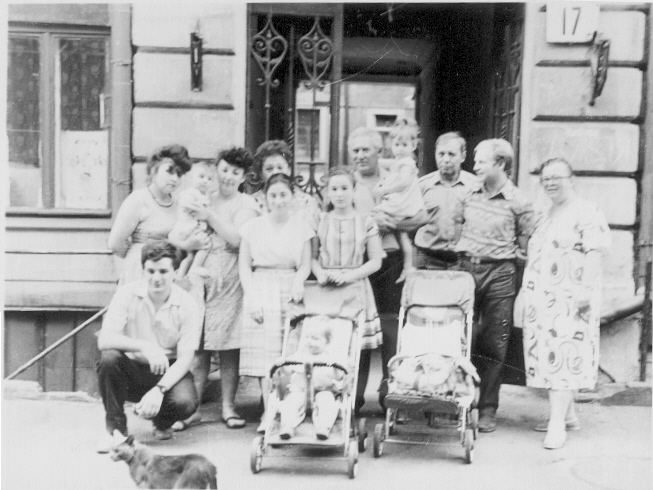
On a freezing Sunday 30 years ago, 250,000 Americans-Jewish and non-Jewish-gathered on the National Mall in Washington, D.C. It was the eve of a summit between President Ronald Reagan and Soviet Premier Mikhail Gorbachev, and they stood together to free millions of Soviet Jews.
Longtime JUF and Chicago Jewish leader Harvey Barnett was part of a large group from Chicago on the mall that day. A leader of the Free Soviet Jewry Movement, he was so moved, he said, that he wept. “In my heart of hearts, I knew that it was a major turning point and the gates would open.”
And open they did. Freedom Sunday, as the rally was called, helped end the Cold War, reunify the Jewish people, and change the world.
On Nov. 30, JUF’s’ Russian Jewish Division (RJD) will hold its first Gala Fundraiser. The dinner will remember the historic march, celebrate the tremendous success of the Russian-speaking Jewish immigrant community in Chicago, and recognize outstanding leaders. The Gala will take place at The Standard Club at 6:00 p.m.
The keynote speaker will be Natan Sharansky, chairman of the Executive Board of the Jewish Agency for Israel, Prisoner of Zion, and human rights activist. A worldwide symbol of human rights, Sharansky addressed the crowd during Freedom Sunday.
JUF’s Russian Jewish Division is funded in part by Genesis Philanthropy Group, a private foundation focused on developing and enhancing a sense of Jewish identity among Russian-speaking Jews worldwide. Today, RJD provides programs and events for young families and professionals from the former Soviet Union. The Gala’s host committee is made up of 26 Russian-speaking leaders of Chicago’s Jewish community.
“The American Jewish community said ‘Let my people go,’ and the Soviet government listened,” said Alex Turik, the chairman of the RJD’s Advisory Board and a member of JUF’s Board of Directors. Turik himself immigrated from the former Soviet Union.
In a historic rescue, Jewish Federations across the country raised nearly $1 billion through the Operation Exodus campaign to resettle the refugees, and then took out another $1 billion in loans, said Dr. Steven B. Nasatir, JUF President and a leader in the Free Soviet Jewry Movement.
Nasatir was also on the mall at Freedom Sunday. It was an incredibly important moment for the American Jewish community, as well. “The sense of Jewish peoplehood coming together is something I had never experienced before,” he said.
Nearly 40,000 Soviet Jewish refugees came to Chicago alone. They left with little more than a suitcase and about $90 per person — all that the Soviet Union permitted them to take with-to make better lives for their children.
Alex Treyger was just 12 in August 1989 when she and her family boarded the train that took them from everything they knew. It was a jump into the unknown, she said. Her parents and the younger children were able to leave, but the Soviet government barred her oldest brother from going, separating the family. Treyger remembers the terrible worry and stress and fear that they would never see him again.
“We could tell no one we were leaving. I could not tell my friends or my school,” said Treyger, now the director of Technology and Digital Learning and a science teacher at Chicago Jewish Day School. “No one at my parents’ job could know, not even our neighbors.”
In the U.S., Treyger’s parents both worked several jobs as they went to school to learn English, took care of their children, and adapted to a very different world. The children didn’t know what Halloween was. Even medical care was a struggle because they didn’t know what the doctors were saying, Treyger said.
“It takes a tremendous amount of courage to walk away from your life and go into the unknown,” she said. “We jumped off a cliff and hoped for the best.”
The Chicago community was completely committed to the new arrivals, Nasatir said. Through JUF and partner agencies, they were provided with housing, food, job training, English lessons, medical care, and education for their children — in short, everything necessary to make a new start.
“They opened their arms for us,” said Treyger. “Yes, they brought us here, but they also made sure that children were in school. They offered people whatever was needed to feel at home. The JCC — as small as this seems — organized dance parties for the young people. I can’t even tell you how many people met at them.”
In Chicago, resettlement became a community effort. Chicagoans, like Nasatir’s mother, Alyce, volunteered teaching English to the refugees. More than 1,000 families volunteered as host families through the JCC’s Family to Family program. Many of the families built incredibly strong connections that have lasted decades, like the Hefters and the Millers.
After fighting for so many years for Jews to leave the Soviet Union, Steve and Janice Hefter felt they had to help those who came to Chicago. Through the Family to Family program, they were matched with the Miller family, who came in the late 1980s with three young children. Today, one of them — Elina Marchenko — is a television producer and a member of the RJD Gala Fundraiser host committee.
Over the years, the two families have forged a deep friendship. “We have gotten as much out of this relationship as we gave,” Janice Hefter said. “They are part of our family.”
“We have come full circle from Freedom Sunday,” said Nasatir. “They’re making good lives for themselves and their children. They have become part of Chicago’s Jewish community and the greater American community.”
“It makes my heart feel good.”
In addition to JUF and Genesis Philanthropy Group, the RJD Gala Fundraiser is partially underwritten by corporate sponsors. For more information and to register, please visit juf.org/GALA or email [email protected].
Other stories
-
Two local teens win national recognition
Recipients of the annual Diller Teen Tikkun Olam Awards
Read more -
Celebrating six young award winners cultivating the community
Introducing young adult award winners
Read more -
The elections in Germany held last Sunday, Sept. 24, resulted in victory for Chancellor Angela Merkel, who won a fourth term in power, but also for the far-right Alternative for Germany party (AfD).
Winning nearly 13 percent of the vote, this is the first time a far-right party will sit in Germany’s national parliament since the end of World War II. Formed in 2013 by conservatives — many from Merkel’s own center-right Christian Democratic Union — they opposed the CDU’s perceived shift to the center and the use of German funds to support a bailout of Greece.
Also, Merkel’s decision to accept a million migrants, the majority of whom are Muslim, shifted the focus of AfD to national security and immigration. Candidates repeatedly have called the refugees “invaders” and Merkel’s policy “the beginning of the destruction of the German nation.” Most alarming the tone has become more nationalist, populist, racist, and anti-Semitic.
Leaders of the party have promised to restore a sense of national pride and strengthen domestic security, eliciting charges that party officials are flirting with Nazism. Statements by party officials who will now sit in parliament have called on Germans to stop feeling guilty and apologizing for the actions of the Nazis, and Alexander Gauland, a founder and co-leader of the party, has said Germans have “the right to be proud of the German soldiers in two world wars.”
Gauland added that he hadn’t met with Jewish leaders, but was “ready at any time” to do so, claiming “there is nothing in our party, in our program, that could disturb the Jewish people who live here in Germany.” Implicit in such a formulation is that German Jews are not fully German, but merely reside in the country.
He also questions Merkel’s strong support for Israel’s security. Gauland claimed such a commitment would need to include sending troops to the Middle East to defend Israel, adding that this was a “difficult topic.”
Chancellor Merkel will now begin the task of building a governing coalition. The Social Democratic Party, which formed a coalition with Merkel’s Christian Democratic Union after the last election, declared it will sit in the opposition this time, thus depriving the third place AfD from leading the opposition and the platform in parliament such status provides. Merkel will thus need to reach an agreement with the liberal Free Democrats and the Green party, a much more challenging coalition for her to lead.
Protests against Alternative for Germany erupted throughout the country following the announcement of the election results. At Berlin’s Alexanderplatz, near a victory party for AfD, protesters chanted slogans such as “Racism is not an alternative,” “AfD is a bunch of racists” and “Nazis out!”
Charlotte Knobloch, chair of the Munich Jewish community and a former president of the Central Council of Jews in Germany, said “I am greatly concerned about democracy in our country. This result is a nightmare come true, a historical change. For the first time [since the end of WWII], an extreme-right party will be strongly represented in parliament.”
The election of AfD follows the rise of other populist, extreme right-wing parties in France, Holland and Austria, and assuming power in Hungary and Poland, whose democratic institutions have been severely weakened.
JUF, along with colleagues in the national organizations, will continue raising concerns with the leaders and representatives of these countries and with elected officials. We will continue to monitor the situation on the ground, educate the community and maintain strong relationships with European-Jewish brothers and sisters.
Steven Dishler is JUF’s Assistant Vice President of International and Public Affairs.
Other stories
-
Chicago to Israel to Kenya
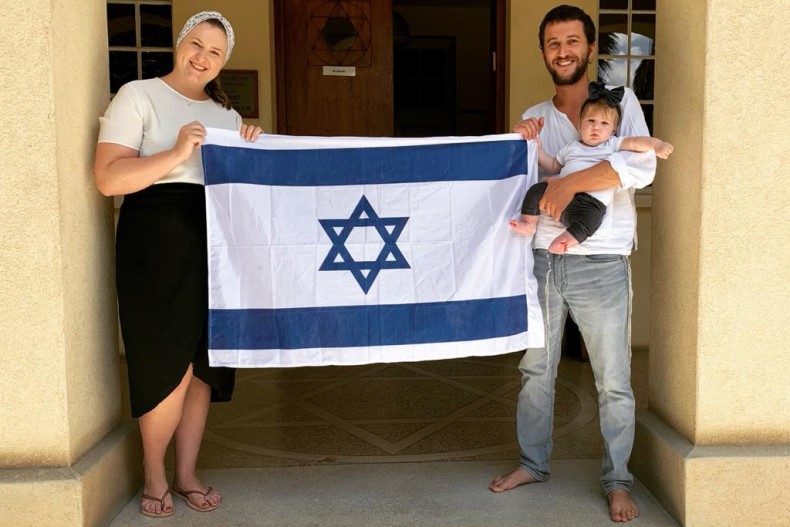
A family’s story of living Jewishly on three continents Michelle Cohen World May 28, 2021 Avital, Tzofia, and Netanel Kaszovitz outside their home in Nairobi on Yom HaAtzmaut. When Avital Kaszovitz prepared to be a Modern Orthodox shlicha (emissary) to the Jewish community in Ke
Read more -
New exhibit spotlights the experience of ‘Shanghai Jews’
Explore a new Illinois Holocaust Museum and Education Center exhibit
Read more -
Europe’s brave new teachers of the Holocaust
Teaching the Holocaust in the modern era has its difficulties and rewards.
Read more
Federation honors volunteer and professional leaders, highlights community-wide inclusion project
Christine Sierocki Lupella
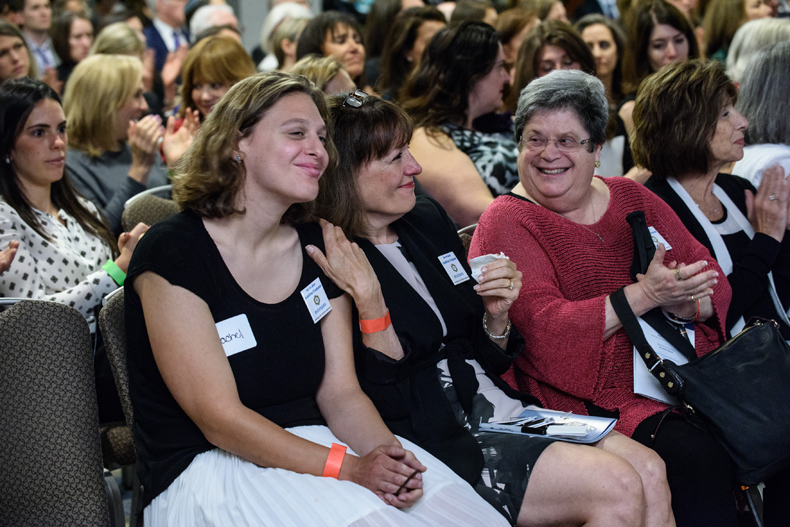
Four rising volunteer and professional leaders were honored for their exemplary service to the Jewish community during the Jewish Federation of Metropolitan Chicago’s 117th Annual Meeting, held Sept. 18 at the Hyatt Regency Chicago.
Prior to the presentation, made during the morning business meeting, those in attendance unanimously elected the 2017-18 JUF/Federation Board, and outgoing directors were honored for their service. (Read about the afternoon luncheon program featuring keynote speaker Dr. Daniel Gordis. )
Davis, Gidwitz and Glasser Young Leadership Award
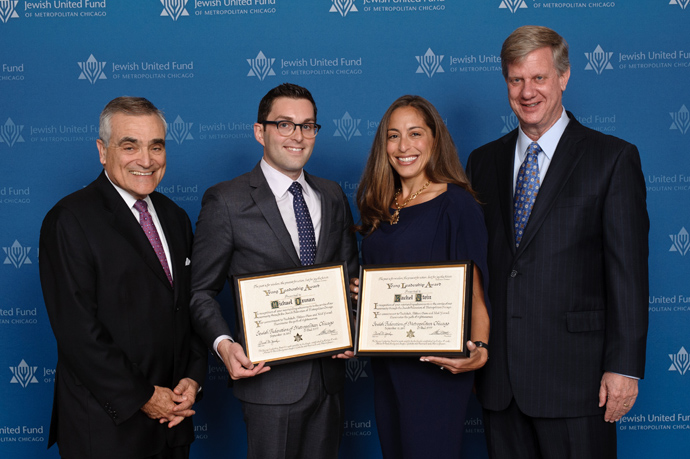
Michael H. Zaransky, chairman of the JUF/Federation Board of Directors, presented the annual Davis, Gidwitz and Glasser Young Leadership Award to Michael Oxman and Rachel Stein. The award honors young adult volunteers who have demonstrated exemplary dedication and made significant contributions to Chicago’s Jewish community. Honorees have the opportunity to attend the annual General Assembly of the Jewish Federations of North America, which this year takes place in Los Angeles Nov. 12-14.
Michael Oxman: Building a movement
Oxman, 33, serves on the JUF Professional Advisory Committee. He has been a member of the JUF Young Leadership Division (YLD) Board, serving as president from 2015 to 2016. As the YLD Campaign vice chair from 2014 to 2015, he helped raise more than $1.78 million from over 5,500 donors. He also served on the JUF Executive and Legacies & Endowments committees.
During his first year on the YLD Board, Oxman led the creation of YLD Pride, an LGBTQ outreach group, which just completed its fourth year of programming and has brought more than 400 people together for social, volunteer and educational events. He helped establish a leadership committee of 12 members to guide the initiative. The program has become a model for Federations around the country. In 2012, he was among the first cohort of YLD and Oy!Chicago’s 36 Under 36 list of the Chicago area’s outstanding young Jewish leaders.
He traveled on the Jewish Federations of North America’s first-ever LGBT Mission to Israel in the summer of 2016, serving as bus captain for the national group. He just completed his first year on JFNA’s National Young Leadership Cabinet, and traveled to India on the spring study mission. He was nominated to lead the newly created LGBTQ Inclusion portfolio for the 2017-18 Cabinet Year.
An Alpha Epsilon Pi brother, Oxman continues to be involved with the fraternity as a regional governor. He is also a current Wexner Heritage Fellow.
In his remarks (watch the video above), Oxman said that YLD Pride has helped make JUF more accessible, particularly because it has been many participants’ first introductions to JUF.
“I knew that having a single event would not be enough. We needed to build a movement,” he said. “JUF provides the infrastructure, resources, and willingness to participate, but it is up to us to bring people in. Events don’t engage people — people engage people.”
Professionally, Oxman is Associate Vice President and Financial Advisor at the Cohn Weisskopf Oxman Group at Morgan Stanley.
Originally from Mequon, Wis., a northern suburb of Milwaukee, Oxman graduated from Northwestern University in 2006 with degrees in economics and political science.
Rachel Stein: Advocating for justice
Stein, 40, serves as board advisor for JUF’s Young Women’s Board, after just completing her term as president. She also serves on the JUF Community Building and Jewish Continuity Commission, and participates in the Wexner Heritage Program.
Previously, she served on the JUF Young Women’s Executive Board as vice president of campaign, and vice president of area development. She has served on the event committee for many Women’s Division and Young Women’s Board events, chaired the YWB Campaign Event in 2012, and was a co-chair for the 2016 Spring Event. She participated in the second cohort of the Jewish Leaders Institute. In 2013, she was named to YLD and Oy!Chicago’s 36 Under 36 list.
In addition to her work with JUF, Stein serves on the Youth and Family Community Committee at North Shore Congregation Israel on its Early Childhood Task Force, and teaches Strollers, Stories and Celebrations, a class for toddlers; and a preschool enrichment class for 3- and 4-year-olds, highlighting Shabbat and Jewish holidays. She also helped manage its JUF Breakthrough Fund mini-grant.
She also serves on the Family Service of Glencoe Executive Leadership Council. She has planned the Glencoe Parent Teacher Organization’s major spring fundraiser, and has previously been involved with the JCC Women’s Auxiliary Board. She previously ran the early childhood program at the Mayer Kaplan JCC.
In her remarks, Stein talked about the examples set by her parents and grandparents, to advocate for what is right — even when those ideas are unpopular.
“In every role I play and every journey I take, I face challenges, as we all do. Challenges of those around me not sharing the same values or beliefs in doing what is right,” she said. “Lean on people around you for inspiration and strength, and have the courage to stand up to the apathy, indifference and negativity. I have faith in what we can do together, as a collective, from generation to generation, to make this world a better place.”
Stein grew up in Maplewood, N.J., and graduated from the University of Michigan with a bachelor’s degree in early childhood and elementary education, and received a master’s degree in child development from The Erikson Institute.
Samuel A. Goldsmith Award
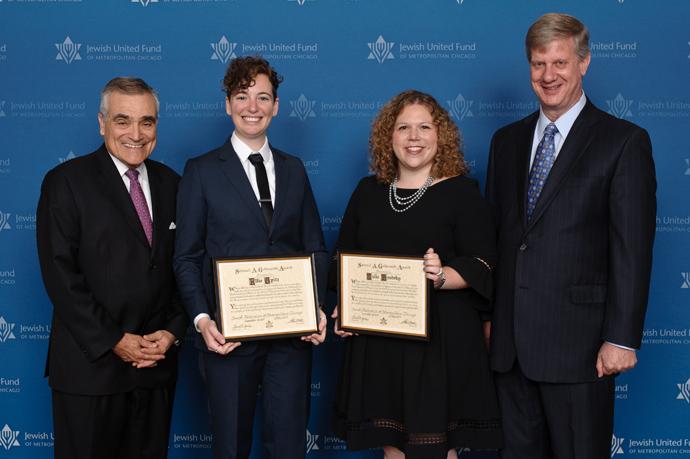
Julie Brodsky and Ellie Spitz received the Samuel A. Goldsmith Award, given to exceptional young professionals who have shown outstanding performance at a Jewish agency in the Chicago area.
Julie Brodsky: Connecting families to community
Brodsky, 40, is assistant vice president of new parent engagement at JUF. A lead member of the JUF Young Families staff, she oversees jBaby Chicago, a Slingshot Award-winning program that has been described as a “game-changer for how parents connect to Jewish community.” This JUF outreach and engagement program is open to new parents and parents with children ages 0-2. She also helped launch new initiatives that have become prototypes for Jewish communities across the country. During her five years at JUF, she has taken on numerous responsibilities, first serving as the program associate for PJ Library, then as program director. In 2015, she became the director of new parent engagement and was recently promoted to her current position.
Prior to JUF, Brodsky was employed for 10 years at a synagogue preschool where she taught in the classroom for four years, and was assistant director for six.
During her address, Brodsky, a Memphis native, said that like many of the Jewish parents she works with, her first connection to the Chicago Jewish community eight years ago was through PJ Library and related events. “It was nice to do a Jewish activity as a family, but we were still searching for our village,” she said.
After she began working at JUF, a study focusing on the needs of young Chicago Jewish families was conducted. The data showed that local parents wanted the same thing — to connect to the Jewish community more deeply — and in 2014, jBaby was born. Since its inception, jBaby has engaged over 1,900 families — and two-thirds of those families have indicated that jBaby is the only Jewish activity with which they are currently involved.
“I have seen first-hand how jBaby Chicago is changing the landscape for families with young children,” she said. “The opportunities that are available to us as new parents are so much bigger and greater than what was available just eight years ago. I know that our community will be stronger and more vibrant in years to come because of these connections made today.”
Brodsky also is a member of the Beber Camp Alumni Association Executive Committee. She graduated from Indiana University with a Bachelor of Science in early childhood education and a Jewish studies certificate.
Ellie Spitz: Investing in people
Spitz, 28, is the Director of Community Engagement and Wellness at Mishkan Chicago, where she facilitates community building, volunteer development, and immersive experiences, and designs and implements many of Mishkan’s programs. She also is director of Maggie’s Place, Mishkan’s holistic wellness center. She began her work as the Community Mobilizer for Mishkan, spearheading the “LOCALS” effort, funded by a two-year JUF Breakthrough Fund grant, which invites members of the Jewish community and others to participate in an open and accepting Jewish space.
During her remarks, she said that investing in people — in relationships — builds Jewish community.
“I see a Judaism full of diversity, full of people who crave a connection with spirituality and culture, full of people who actually prioritize Jewish community and Jewish learning over the plethora of other options life has for us,” she said. “Let’s stretch ourselves to meet people where they are at, to shake up our traditions, rituals and models. Let’s take the deep and rich Judaism we know and love and make it accessible to everyone who is interested.”
Spitz graduated from the University of Illinois Urbana-Champaign with highest honors in human development and family studies, and dual minors in sociology and Jewish culture and society. She received her master’s degree in social work from Washington University in St. Louis, and holds a certificate in Jewish leadership from Spertus Institute for Jewish Learning & Leadership and Northwestern University. Spitz was a 2013 James M. Holobaugh Honor recipient for her advocacy and service to the St. Louis metro LGBTQ community. She is a Licensed Clinical Social Worker.
Working toward an inclusive community
In addition to the election and awards presentations, Rabbi Michael Schwab of North Suburban Synagogue Beth El, Highland Park, highlighted a community-wide, cross-denominational initiative focused on creating a more inclusive environment for individuals with disabilities. Schwab and JUF Board member Marc Roth co-chaired the Synagogue Inclusion Project, which engaged more than 25 congregations to increase their efforts for people with disabilities.
“One in five Jews in Chicago lives with a disability,” Schwab said. “This statistic includes people with a wide range of disabilities, from physical impairments to sight and hearing loss, to aging-related conditions and mental illness.
“(And) the vast majority of Jews with disabilities — more than half — do not participate in synagogue or Jewish communal life because they believe that they are perceived as disruptive,” he said. “People with disabilities want what everyone in this room wants — to have the right and the opportunity to participate in and contribute to our community.”
Over the past two years, the JUF Synagogue Federation Commission partnered with Jewish Child & Family Services Encompass to research barriers and opportunities for inclusion in congregations. With funding support from JUF, Encompass helps raise community awareness, and coordinate planning with Jewish organizations, including JUF, CJE SeniorLife, JCC Chicago, JCFS, JVS Chicago, Keshet, the Libenu Foundation, Yachad, and a number of other organizations.
In addition, JUF this fall is partnering with Encompass and the community to launch the Community Endowment for Jewish Adults with Disabilities, with an initial fundraising goal of $10 million.
Partnerships between government, service providers, community and family are critical to ensuring that Jewish adults with disabilities receive the financially sustainable services they need. Yet the reality is that for Chicago Jews living with disabilities, the needs outpace available resources.
“Public funding sources are grossly inadequate to meet the costs associated with these needs,” Schwab said, noting that the state of Illinois ranks 48th in the country for the “abysmal” amount of funding it provides for adults with intellectual and developmental disabilities. The Community Endowment for Jewish Adults with Disabilities is a step toward meeting those current and future needs.
“Our Jewish community can and must do better,” Schwab said. “And through JUF, its agencies, our local synagogues and community partners, we will,” he said. “Our goal must be no less than making inclusion a reality for everyone.”
Other stories
-
Two local teens win national recognition
Recipients of the annual Diller Teen Tikkun Olam Awards
Read more -
Celebrating six young award winners cultivating the community
Introducing young adult award winners
Read more -
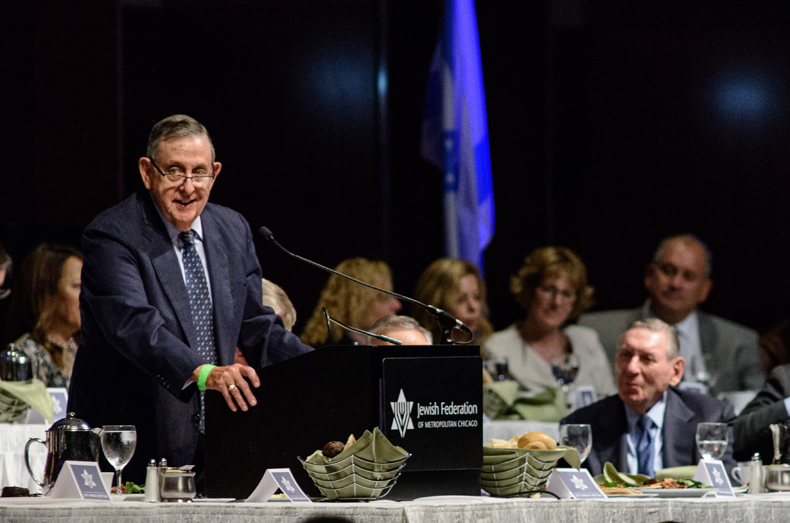
‘Dreaming big, doing good’ at the 2017 Jewish Federation Annual Meeting
Paul Wieder
The 117th Annual Meeting of the Jewish Federation of Metropolitan Chicago was held at the Hyatt Regency Chicago on Sept. 18, just days before the start of the Jewish New Year. Award-winning author, columnist, and Israel expert Dr. Daniel Gordis delivered the keynote address.
The Federation recognized Theodore F. Perlman with its highest honor, the Julius Rosenwald Memorial Award. The luncheon session of the two-part meeting featured the annual State of the Federation address by President Steven B. Nasatir. Andrea Grostern chaired the event. (Read about the morning business meeting featuring the recognition of two young adult volunteer leaders and two young Jewish professionals.)
In presenting the Shofar Award to Larry Levy for his work as chairman of the 2017 JUF Annual Campaign, Federation Chairman of the Board of Directors Michael H. Zaransky praised Levy’s “energy and creativity” and “charismatic personality.” Levy “constantly seeks interesting new ways to engage community members in Federation’s important work,” he said, “inviting everyone to collaborate for the same goal.”
In accepting the award, Levy said that he was grateful to be in a position to call on people to support JUF, and to set up programs to help those in need, from Syrian refugees to hurricane victims. “Anywhere there is a problem, JUF is there” to help, he said.
Zaransky also welcomed King Harris as the incoming chair of the 2018 JUF Annual Campaign. Meanwhile, Zaransky will remain board chairman for the coming year.
More than 1,300 people attended the luncheon, including city, state, and U.S. officials; members of local law enforcement; representatives from United Way and other human service agencies, and numerous consular officials, including Aviv Ezra, Israel’s Consul General to the Midwest. Students from area universities also attended, along with those from Akiba-Schechter Jewish Day School, Arie Crown Hebrew Day School, Bernard Zell Anshe Emet Day School, Chicago Jewish Day School, Ida Crown Jewish Academy, Rochelle Zell Jewish High School, and Solomon Schechter Day School.
Theodore F. Perlman becomes 54th annual Rosenwald Award recipient
In recognition of his lifetime of service to the Jewish community in Chicago and around the world, the 54th annual Julius Rosenwald Memorial Award — JUF’s highest honor — was presented to Perlman. Honoring the memory of Chicagoan Julius Rosenwald, one of America’s great philanthropists, the award is presented to an individual who has advanced the goals of the Federation and the welfare of the overall Jewish community.
As JUF General Campaign Chair, Perlman led the 2010 JUF Annual Campaign during the throes of the Great Recession, and rallied the community to close the Campaign at more than $1 million over the previous year, with 1,000 new gifts.
A former and vice chairman of the JUF/Federation Board of Directors, Perlman also served as JUF’s Advance and Major Gifts co-chair; the Trades, Industries & Professions (TIP) co-chair; the JUF Briarwood Country Club Chair; and on numerous JUF committees and commissions. He currently is a member of the Hillels of Illinois Board of Directors and serves on the board of the Spertus Institute of Jewish Learning & Leadership.
In addition to his work with JUF, Perlman serves on the Anti-Defamation League Foundation Executive Committee; as Vice Chairman Emeritus of Beber Camp; President of The Perlman Family Foundation; as well as the BBYO International Board of Directors; the Weizmann Institute of Science in Israel; and he serves the Jewish community as Treasurer and Board of Trustee member for North Shore Congregation Israel in Glencoe.
“The day, nearly 70 years ago, that he and his family stood with tens of thousands of Jews in a packed Chicago Stadium, raising funds to support Israel’s independence, had a profound effect on him,” Zaransky said. “That experience connected him to his Jewish family here and around the world, and created in him a passion for mobilizing collective giving within our community for nearly seven decades.”
Accepting the award, Perlman said that it was not about him, but “how we stretch ourselves to meet the needs of others,” and that it would “increase his momentum to support others in need.” He thanked his parents for raising him with philanthropic values despite his growing up during the Great Depression. He also thanked his wife, family, and business associates.
Perlman then laid out some lessons he had learned, that applied in all areas of life, including delivering on one’s promises, engaging others with respect, giving to others, and that “understanding your weaknesses is a great strength.” In any situation, one must decide whether to be the leader, follow the leader — or challenge the leader, he said.
Nasatir highlights a year of successes, challenges and dreams
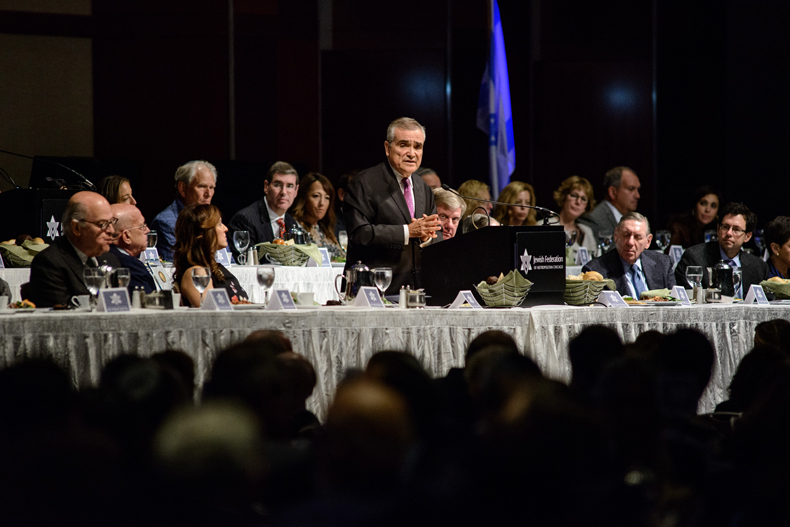
In his State of the Federation remarks (watch the video here), Nasatir noted that last year, Federation allocated $221 million, “but this is Chicago — going big and doing good for many is what Federation is all about.”
He then enumerated the challenges Federation confronted in 2017, and expects will continue in the coming year: “…anti-Semitism, violence in Chicago, [government] gridlock, and, in Jerusalem, enduring, and emerging challenges. At the end of the day, our core work is to feed the hungry, house the homeless, teach Torah to the next generation, and connect them to the land and people of Israel.”
Nasatir lamented that, despite Illinois now having a budget, spending cuts would mean service shortfalls. He did note that “Federation still carries hundreds of millions of dollars in loan guarantees to help ensure continuing service delivered by our agencies.”
One 2017 event provided a major boost to some of Chicago’s most vulnerable — the multi-media performance of “Defiant Requiem: Verdi at Terezin,” which, in one evening, raised over $4.6 million to provide Holocaust survivors with food, medicine, and socialization.
“On our watch, no Holocaust survivor in Chicago will go to bed hungry,” Nasatir vowed.
This year being the 30th anniversary of Freedom Sunday, the 1987 march in Washington, D.C. aimed at freeing Soviet Jews, Nasatir noted the remarkable success of the Russian Jewish community in Chicago. Later this year, JUF’s Russian Jewish Division itself will mark the anniversary with its first-ever gala fundraiser. The group of “young adults whose parents fled oppression and came here to pursue the American dream,” Nasatir pointed out, are now doctors, teachers, and successful businesspeople.
He then compared their circumstances with those of the “Dreamers” — those brought into the U.S. illegally as children, who only know this country as their homeland — stating that “providing permanent protections for this group should in no way be a partisan issue.”
Nasatir then focused at length on the issue of rising anti-Semitism, bringing to light FBI reports that Jews are still the single largest target for religion-based hate crimes in the U.S.
On college campuses, Nasatir was heartened to see that “[JUF’s] Israel Education Center helped students defeat more student government initiatives than those which were passed. And no university has divested or boycotted Israel institutions. The connection between Israel and our Midwest institutions of higher learning has become stronger. The BDS movement — the campaign to boycott, divest, and sanction the world’s only Jewish state and the Middle East’s only democracy — is a failure on campus.”
However, he felt that complacency was not warranted: “Anti-Zionism is today’s anti-Semitism, and campus is where the disease is spreading … students at U of I returned to campus to chants of ‘No KKK, no fascists, no Zionists.’ Disgusting!” In response to such ongoing bigotry, he said he personally met with the presidents of each of the five largest universities in Illinois.
After one vandal smashed a window and placed swastikas at the Chicago Loop Synagogue in February, over 1,000 Jews, Muslims, and Christians came together in a powerful display of unity at the “Love Thy Neighbor: Interfaith Gathering Against Hate.”
“Standing together in that historic sanctuary, we affirmed then, and we affirm now, that an assault on one is an assault on all,” Nasatir asserted. “Anti-Semitism has no place on any campus. And no place anywhere in our country — and that includes Charlottesville, Champaign, or a Chicago parade.”
Federation’s response has been, as always, to combat divisiveness with unity. He noted the 10 community dinners JCRC held this past summer with members of other religious and ethnic communities, the Combatting Violence Summit JUF convened, and the security summit JUF organized to hear assessments by the FBI and other security professionals.
On the issue of gun violence in Chicago, Nasatir was adamant: “With over 500 murders and 2,100 gunshot victims already this year, enough is enough! We will not stand idly by as our neighbors bleed and children are killed. When one Chicago child is shot, none of our children are safe.”
Nasatir concluded by turning toward the future and quoting the late Shimon Peres, who, on his last visit to Chicago, said, “You’re as young as your dreams. We are an ancient people who will never grow old because we never stop dreaming.”
Dr. Daniel Gordis details a century of Jewish evolution since the Balfour Declaration
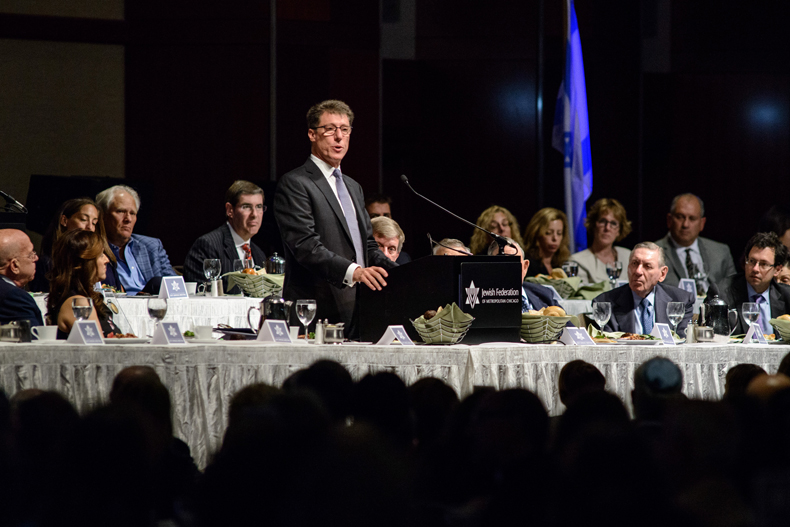
The keynote was delivered by Senior Vice President and the Koret Distinguished Fellow at the Shalem Center in Jerusalem, Dr. Daniel Gordis, who writes a column for the Jerusalem Post and is a regular contributor to The New York Times . Since moving to Israel in 1998, Gordis has written and lectured throughout the world on Israeli society and the challenges facing the Jewish state. Gordis is the author of numerous books on Israel and Jewish subjects; his most recent book, Israel: A Concise History of a Nation Reborn , was the 2016 National Jewish Book Award’s “Book of the Year.”
Gordis noted the speed with which the Zionist movement achieved success. It was only 20 years between the first Zionist Congress in 1887 to the Balfour Declaration in 1917, and then only 30 years until the UN voted for Israel’s creation in 1947. Gordis remarked that this rate of success was predicted by Theodor Herzl himself, who in 1897 wrote in his diary that he expected the project of recreating a Jewish homeland to take 50 years at the most. There were 65,000 Jews in pre-state Israel in 1917, he said — and 6.5 million today, just 100 years later.
With this year being the 100th anniversary of the Balfour Declaration, Gordis said that was a fitting moment to reflect on the larger impact of the Zionist movement. Aside from establishing a modern Jewish state, reviving the Hebrew language, and proving that “intellectual capital” was a “natural resource,” Zionism achieved yet another one of its goals: redefining how Jews were perceived, both by others and by Jews themselves.
“The most important thing Zionism did was reimagine what it means to be a Jew,” Gordis asserted. It turned Jews from being scholars who largely lived in fear into self-sufficient, strong people of the land. It turned Jews from being “pawns” into being “players,” who determined for themselves where they would live. He contrasted that to historic Jewish expulsions from England, Spain, and Germany.
Gordis related a story of his students’ reaction to what happened Charlottesville in August. Watching news footage of a white supremacist saying his aim was “to kill Jews,” the Israelis, most of whom had been commanders in the IDF, laughed — a reaction he noted would not have happened before 1967.
Israel must remain a priority for Chicago’s Jews, Gordis concluded — and ensured the ability not just to survive but to thrive — because Israel “changed the world in which we live, how we see ourselves, and how others see us.”
Other stories
-
Two local teens win national recognition
Recipients of the annual Diller Teen Tikkun Olam Awards
Read more -
Celebrating six young award winners cultivating the community
Introducing young adult award winners
Read more -
Chicago Federation expands funds to support disaster relief in Puerto Rico and Mexico
As we begin the Jewish new year, a series of natural disasters continues to take its toll on millions in the United States, the Caribbean and Mexico. In just four weeks, hurricanes and earthquakes have caused extraordinary destruction, and the need continues to grow.
Thus far, Chicago’s Federation has raised over $800,000 to support efforts to rebuild homes, institutions, communities and lives in Texas and Florida. Moving forward, donations to the Jewish Federation Disaster Relief Fund also will support hurricane relief efforts in Puerto Rico and the wider Caribbean, and earthquake relief efforts in Mexico.
As always, the Federation will absorb all administrative costs, so that 100 percent of funds collected will provide relief for the thousands impacted by these disasters.
Contributions can be made online at www.juf.org/DisasterRelief . If you would like to designate your donation to a particular location, please specify in the comments section.
Funds raised support the efforts of our partners who have boots on the ground in these locations — the Jewish Federations of North America, NECHAMA: Jewish Response to Disaster, IsraAID, the American Jewish Joint Distribution Committee and the local Jewish Federations — as well as food drives and volunteer missions. As members of the Jewish Coalition for Disaster Relief, we continuously are informed about areas of greatest need.
Hurricane Harvey delivered some of its worst blows to Houston’s Jewish community. Nearly three-quarters of the city’s Jewish population lives in areas that received extensive flooding, and communal infrastructure is devastated. And while the impact of Hurricanes Irma and Maria still is being assessed, people in Florida, Puerto Rico and the wider Caribbean have been forced from their homes, or are without food, power and other basic needs. In Mexico, rescue efforts are underway after a series of earthquakes caused hundreds of fatalities, thousands of injuries and destroyed tens of thousands of buildings.
In partnership with Federation, Chicago’s Maot Chitim held a special drive to deliver kosher food and personal items to Houston in time for the High Holidays. And the Federation is donating 200 mezuzot to Jewish communities in Houston and Florida that are rebuilding homes.
Most recently, Chicago’s Federation allocated $100,000 directly to efforts in Florida, Puerto Rico and the wider Caribbean to provide food, water and basic hygiene items, as well as psychological support for children and initial clean up from the storm. A portion of those funds will go to the Greater Miami Jewish Federation to provide relief to the general and Jewish community affected in that area, as well as toward repairs of a synagogue in St. Augustine and a Jewish cemetery outside of Tampa. And $50,000 was sent to Mexico, to provide assistance on the ground in rescuing and providing medical aid to victims trapped in the rubble.
In-person efforts also are in the works. The Chicago Federation’s TOV Volunteer Network is organizing a series of missions, beginning in late-October, to help with recovery efforts in hard-hit Houston. For more information, visit the TOV website .
Donations also can be made via hotline, (312) 444-2869 , or by sending a check payable to the Jewish Federation Disaster Relief Fund to 30 S. Wells Street, #3015, Chicago, IL 60606.
Other stories
-
Chicago to Israel to Kenya
A family’s story of living Jewishly on three continents Michelle Cohen World May 28, 2021 Avital, Tzofia, and Netanel Kaszovitz outside their home in Nairobi on Yom HaAtzmaut. When Avital Kaszovitz prepared to be a Modern Orthodox shlicha (emissary) to the Jewish community in Ke
Read more -
New exhibit spotlights the experience of ‘Shanghai Jews’
Explore a new Illinois Holocaust Museum and Education Center exhibit
Read more -
Europe’s brave new teachers of the Holocaust
Teaching the Holocaust in the modern era has its difficulties and rewards.
Read more
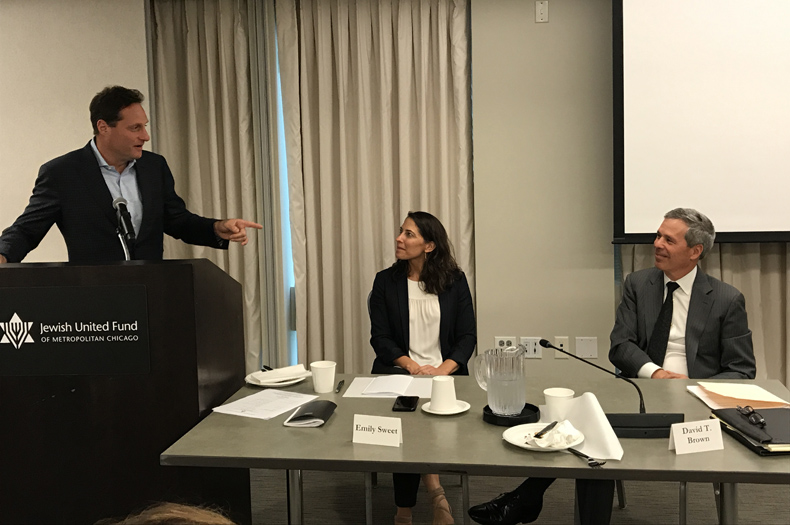
Considering Israeli and Diaspora viewpoints on issues of pluralism in Israel
Jane Charney
Fifty Jewish community leaders and professionals gathered to learn more about the critical issues facing Israel and Diaspora Jews at the Sept. 13 meeting of JUF’s Jewish Community Relations Council.
The main discussion focused on the recent controversy surrounding the egalitarian prayer space at the Kotel in Jerusalem as well as recognition for non-Orthodox conversions. JCRC Chair David T. Brown, who also chairs the Israel and Overseas Commission of the Jewish Federations of North America, and Deputy Consul General of Israel to the Midwest Itay Milner shared their perspectives on the issue.
Brown said that although Diaspora Jews have tended to stay away from internal Israeli politics, issues connected to pluralism and Jewish practice should involve North American – and world – Jewry.
“It’s critically important that the Jewish homeland is a Jewish homeland for everybody,” he said. “At the same time, we have to continue to support the State of Israel and its people, even if we disagree with a specific government policy.”
Brown was part of a JFNA and Jewish Agency for Israel delegation that met with Israeli Prime Minister Benjamin Netanyahu’s office in late June to discuss North American Jewish community’s concerns over the Kotel and a Knesset bill addressing non-Orthodox conversion in Israel.
For his part, Milner assured attendees that an egalitarian prayer space at the Kotel will still be built. In fact, $20 million has already been set aside for construction, he said. Milner also highlighted the disconnect that often happens between Israelis and Diaspora Jews when it comes to issues of pluralism.
“The Israeli public doesn’t always understand why these issues are important to North American Jews,” Milner said. “It’s critical to remain engaged with the Israeli government, the Israeli public and decision-makers.”
The meeting also included a report from JCRC Executive Director Emily Sweet about JCRC’s robust relationship-building work as well as efforts that seek to counter the anti-Israel Boycott, Divestment and Sanctions movement.
John Lowenstein, JUF Vice President of Campus Affairs and Executive Director of Hillels of Illinois, briefly spoke about the atmosphere on campus as students return to colleges and universities throughout Illinois.
This meeting also marked the last of Brown’s tenure as chair, and attendees thanked him for his leadership and commitment to JCRC’s mission. Incoming Chair Bill Silverstein presented Brown with a tzedakah box in appreciation of his work over the past two years.
Other stories
-
Two local teens win national recognition
Recipients of the annual Diller Teen Tikkun Olam Awards
Read more -
Celebrating six young award winners cultivating the community
Introducing young adult award winners
Read more -
Government Affairs Committee hosts Illinois Senate leaders, honors State Rep. Elaine Nekritz
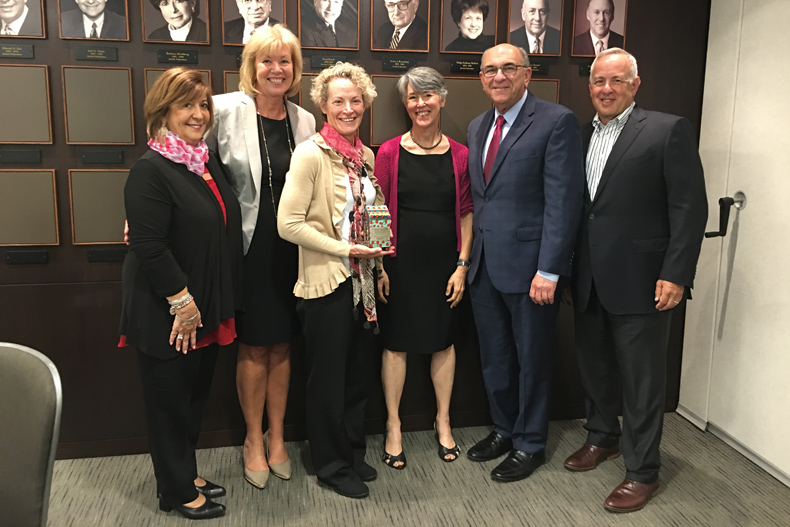
Illinois Senate Republican Leader Bill Brady and Senate President John Cullerton discussed Illinois’ current and future challenges to a crowded room of more than 70 community leaders and agency executives on Sept. 11. The state’s backlog of bills, the recent bipartisan school funding reform legislation, and the upcoming debate over the hospital assessment topped the list of key issues.
Once the formal remarks were completed, JUF leadership and members of the Jewish Caucus including State Sen. Julie Morrison, and State Reps. Laura Fine, Lou Lang and Sara Feigenholtz recognized State Rep. Elaine Nekritz, who is retiring after serving 14 years in the General Assembly.
Speaking on behalf of JUF, Government Affairs Committee Chair David Golder presented Nekritz with a tzedakah box as a token of the community’s gratitude.
“Representative Nekritz has been a true leader in the General Assembly, and someone we have always been able to count on to seek solutions to the most challenging problems facing our state,” he said.
In her closing remarks, Nekritz thanked her colleagues and members of the Jewish community for their support and this acknowledgement. “I have never had a tzedakah box before, and it means a great deal to me that my community has giving me this gift.”
Other stories
-
Two local teens win national recognition
Recipients of the annual Diller Teen Tikkun Olam Awards
Read more -
Celebrating six young award winners cultivating the community
Introducing young adult award winners
Read more -
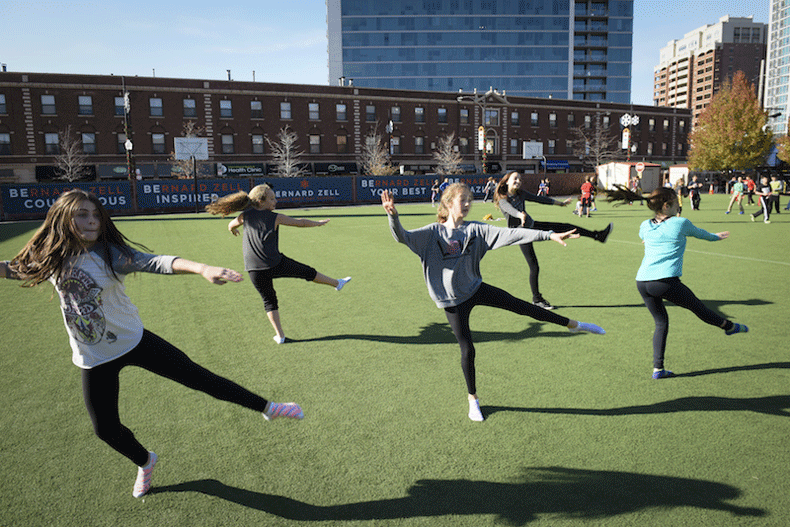
This fall, Rachel Nasatir is headed to one of the city’s top high schools. In June, she graduated from Lakeview’s Bernard Zell Anshe Emet Day School, a place she has called home for the past eight years.
“This school is such an amazing place, so it’s sad to say goodbye,” she said.
While at Bernard Zell, she took advanced math classes even tackling statistics, played the part of Rafiki in the school production of The Lion King , and went rafting along the Jordan River during a two-week class trip to Israel.
Add another accomplishment to that list-surviving the city’s competitive high school admissions process and getting into her first choice, Jones College Prep. “I’m excited about starting a new school,” she said. “I don’t know where I’d be without my math teacher, Mr. Daar.”
Nasatir is among the nearly 90 percent of Jewish Day School students who apply to the city’s selective enrollment high schools and get accepted, according to Prizmah, Center for Jewish Day Schools. Many are outperforming their public school peers on standardized tests like MAP and the ACT. When it comes to reading, 96 percent score above the national average on the MAP test, compared to 86 percent of CPS students. In math, 95 percent score above the national average compared to 79 percent of CPS students.
“It’s not your Zayde’s day school; it’s not the day school of 20 to 30 years ago,” said David Goldenberg of Resolute Consulting, Inc. in Chicago and JUF board member. “These schools are academic powerhouses.”
Yet, many young Jewish parents in the Chicago area are unaware of this academic excellence. In 2017, Resolute’s Goldenberg and Kelsey Larson interviewed over 100 young Jewish parents in the city and suburbs as well as Jewish education leaders about their perceptions of Jewish day schools. The results were surprising. When it came to top school choice criteria like character development and Jewish values, parents gave high ratings–but not on rigorous academics.
College-bound Lexi Levin, of Highland Park, sings the praises of former teachers at Solomon Schechter Day School of Metropolitan Chicago. “I don’t think I’d be going to Cornell University if it weren’t for the academic confidence that Schechter gave me,” she said. “They taught me how to think, how to ask questions.”
Sixth grade English instructor, Roberta Chernawsky, taught her how to be a strong writer. “I entered the year with an assignment on loose-leaf paper with a note at the bottom saying, ‘I need help with the ending.’ By the end of the year, I was writing pages and pages of essays on my own,” she recalled.
Since Levin graduated from day school, 21 st Century learning and STEM education have become a priority.
In 2016, Solomon Schechter’s academics earned the Northbrook school a National Blue Ribbon Award. “This award is a real indicator of how we’re strengthening our curriculum,” said Linda P. Foster, CEO/Head of School.
The school’s J-STEAM initiative, which integrates Jewish studies, science, technology, art and math, is a big step forward. There’s also the new Innovation Studio (think the Genius bar at your local Apple store). Equipped with a 3D Printer, iPad Pros, Chromebooks and dry erase walls, it’s a place for collaboration, creativity and experimentation, said Foster.
At Bernard Zell, teachers and students are excited about M’Kom Drisha, a new, state-of-the-art science lab and new coding and circuitry classes. “We have the goal that every student will know how to talk to computers by the time they graduate,” said Beth Sanzenbacher, a Science Instructional Coach.
Cortney Stark Cope, Director of Admissions at Chicago Jewish Day School, isn’t sure what jobs will exist in 20 years. But she’s confident that CJDS students will have the life skills to be successful. “They know how to advocate for themselves, how to solve problems, how to readjust when things they don’t go their way and how to have grit,” she said.
When the school relocates to its new Irving Park campus in 2018, it brings a track record of success built over the last 14 years. “We’ve had kids go to great high schools like Whitney Young, The Latin School, Lane Tech, and Jones College Prep,” she said.
Student-driven, experiential learning, and multi-age classrooms are integral to Akiba-Schechter’s philosophy. “We are committed to teaching students and not subjects. The children become leaders of their own learning, are constantly supported, and stretched by their peers and Judaism and learning come alive for them and our teachers,” said Dr. Eliezer Jones, Akiba’s new Head of School.
Parents from Israel, China, and Japan have heard about the school’s stellar academics from colleagues, said Carla Goldberg, Akiba’s Director of Early Childhood. “But we also want to find families who have not thought about Jewish day schools but should,” she said. “In the city of Chicago, what a wonderful option to have.”
Check out discoverjewishdayschools.org, a new website launched in April 2017, that features the four participating schools-Akiba Schechter in Hyde Park, Bernard Zell in Lakeview, Chicago Jewish Day School in Edgewater, and Solomon Schechter. Find school data, videos, and photo galleries at any of the participating schools.
Jennifer Brody is a freelance writer living in Chicago.
Other stories
-
Two local teens win national recognition
Recipients of the annual Diller Teen Tikkun Olam Awards
Read more -
Celebrating six young award winners cultivating the community
Introducing young adult award winners
Read more -