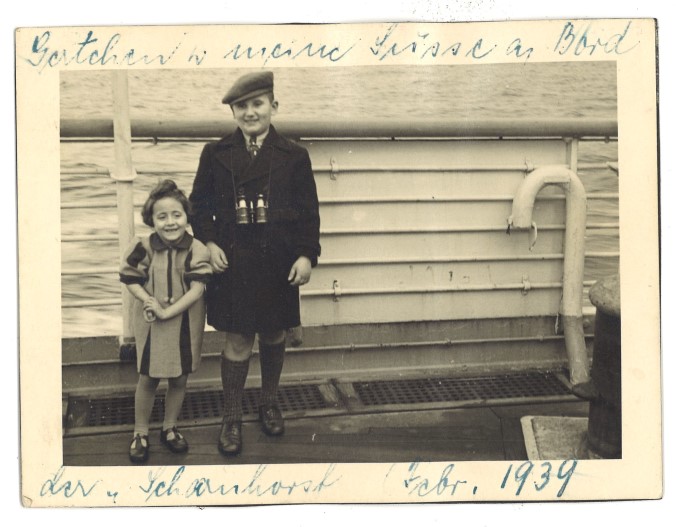
A new Illinois Holocaust Museum exhibition offers a glimpse into the daily lives of the approximately 20,000 Jewish “stateless refugees” seeking sanctuary in China in the 1930s and 1940s who found refuge from the Nazis in Shanghai’s Hongkew ghetto.
Shanghai: Safe Haven During the Holocaust features large-scale photographs by renowned American Jewish photojournalist Arthur Rothstein, along with local survivors’ artifacts from the Museum’s permanent collection.
Running July 15, 2021 to Sept. 5, 2022, the exhibition showcases everyday life in Shanghai’s 1-square-mile Hongkew District, where immigrants fleeing the Holocaust found sanctuary and community in the most trying of times. Rothstein’s images depict refugee families struggling to survive in overcrowded communal housing, washing laundry in cluttered courtyards framed by grimy buildings, searching lists of concentration camp survivors, and cooking over improvised stoves with U.S. Army field rations.
“These photos provide a window into the lives of refugees who found temporary sanctuary during the turbulent years of World War II,” said Chief Curator Arielle Weininger. “The exhibition is a tribute to human endurance, capturing both the enormous hardship and fierce perseverance of these refugees and their families, as they managed to survive.”
The objects on display will include immigration documents, professional papers, and personal keepsakes. Visitors will learn the stories of these moving items, accompanied by photographs and brief biographies of their original owners, all Holocaust survivors who immigrated to the Chicago area.
While the story of the Shanghai ghetto as a haven during the Holocaust is little-known, there are survivors in Chicagoland who lived in the ghetto and tell their story.
Judy Kolb and Doris Fogel both eventually settled in the Chicago area. Kolb was born in the ghetto after her parents emigrated to China following the events of Kristallnacht, “The Night of Broken Glass.” Fogel, who entered the ghetto at four years old with her mother, aunt, uncle, and cousin, remained there until they left for California when she was 13.
The striking combination of photographs and artifacts will tell the unique story of Jewish refugees in Shanghai while drawing parallels with contemporary refugee experiences.
“Sharing one room with four other people for five years, going without tap water for nearly a decade, using a bucket as a lavatory [in] the poorest, poorest part of Shanghai made me tough,” said local Shanghai ghetto survivor Doris Fogel. “It made me street smart. It made me learn how to take care of myself.”
European Jews, who were shut out of country after country while trying to escape Nazi persecution in the 1930s and 1940s, found a beacon of hope in Shanghai. In 1938, hundreds of Jewish refugees arrived in Shanghai, with thousands more following in the coming years. By 1941, around 20,000 Jews found refuge there.
Even so, living in Shanghai wasn’t easy for the refugees. “Life in Shanghai was primitive. Staying healthy was a constant problem. Food was rationed and obtained mostly from a soup kitchen,” Fogel said. “I remember fighting with my cousin about a piece of bread. I was so undernourished that at the age of 13 when I came to the U.S., I weighed 65 pounds.”
In early 1943, Shanghai was under Japanese occupation, and Japanese authorities relocated all stateless refugees–Jews who had arrived after 1937–into the Shanghai ghetto. The ghetto was cramped, disease-ridden, and dirty, but ultimately safe for its Jewish inhabitants, who were treated humanely by their Chinese neighbors. For the remaining years of the war, they were confined to the ghetto and could leave only with passes issued by Japanese authorities.
For more information, visit ilholocaustmuseum.org .
Other stories
-

Chicago to Israel to Kenya
A family’s story of living Jewishly on three continents Michelle Cohen World May 28, 2021 Avital, Tzofia, and Netanel Kaszovitz outside their home in Nairobi on Yom HaAtzmaut. When Avital Kaszovitz prepared to be a Modern Orthodox shlicha (emissary) to the Jewish community in Ke
Read more -

Europe’s brave new teachers of the Holocaust
Teaching the Holocaust in the modern era has its difficulties and rewards.
Read more -

We’ll always have Paris… and Normandy:
This year remains special for tourists who cannot help but recognize two momentous celebrations: The 75th anniversaries of the D-Day and the liberation of Paris.
Read more
We have all heard the analogies, “Put on your own oxygen mask first before you help others,” and “You cannot pour from an empty cup.” I’ve never related to them much, because while they give me permission to take care of myself, it never feels instinctual to do so, and the fear of letting others down often overrides my desire to tend to my own needs. However, given some recent occurrences in the “Schwartz Home,” I’ve been thinking it is time to reconsider my perspective on self-care.
It wasn’t until recently that I realized I reached a new, all-time low. I began crying during my 6-year-old’s parent-teacher conference. Just like that. It wasn’t even five minutes into our Zoom meeting, and I found myself sobbing at the mere mention of my daughter reading at a Level C when “they” would expect her to be at a Level F. I’m not even sure I fully understood what that meant. I’m not even sure who “they” are. All I knew was the tears streaming down my face were causing her teacher to look worried, and my husband was staring at me like I had three heads!
For those of you whom I’ve never met before, I am an Early Childhood Social Worker. I spend my days reassuring parents that all children develop at their own pace, and that what’s most critical in the early years is supporting their social-emotional skills; particularly their ability to label and express emotions, their capacity to navigate peer relationships and conflict, and their development of empathy. I know that reading and math will come in due time. So why had I broken down so badly at the most inopportune time and why couldn’t I take my own advice around my daughter’s development?
It didn’t take long for me to spiral down a long road of “if-only’s.” If only I spent more time reading to her every day. If only I worked with her and practiced her sight words more often. It was about me and the guilt I was feeling. I was beating myself up about not being the perfect mother. Not living up to the Super Mom persona I expected of myself. Not cutting myself any slack, even knowing that I am managing a full-time job and three children–all in the middle of a worldwide pandemic. Something was about to give, and I couldn’t let it be my sanity!
Was my breakdown during conferences a sign that I wasn’t practicing putting my own oxygen mask on first? Should I be exploring self-care in a more meaningful way? Many moms I have spoken to about self-care hear those words and think about manicures, lattes, yoga, and massages. After all, it’s a billion-dollar industry.
But I couldn’t kick the feeling that I wasn’t being fair to myself. That self-care also involves the messages we send ourselves, and mine were all negative: “I am not doing a good enough job.” “I am letting my daughter down.” “I am not doing enough to support her reading skills.” So, I asked myself, “Would I allow my daughter to talk to herself this way? Would I let her treat herself so unkindly?” The answers were a resounding NO! This was a pivotal moment for me.
While establishing clearer boundaries between work and home, saying “no” more often to others, taking time-outs for myself, and meditating to quiet the many outside distractions are all still self-care practices I embrace, I am tending to myself differently these days. I am listening to myself better, and when I hear my inner voice being negative, I try to reframe it the way I would if my daughter asked me for advice. I am trying to bring awareness to my internal thoughts and be more cognizant of my mindset.
As I embrace a more positive perspective, I realize it takes practice. I realize I am making a choice every day, and I will continue to fight this internal battle because my children deserve a role model who they can respect and who respects themselves.
JCC Chicago is a partner with the Jewish United Fund in serving our community.
Rachel Schwartz, LCSW, is the Director of Social Services for Early Childhood at JCC Chicago.
Other stories
-

Two local teens win national recognition
Recipients of the annual Diller Teen Tikkun Olam Awards
Read more -

Celebrating six young award winners cultivating the community
Introducing young adult award winners
Read more -

While the warmer weather typically inspires feelings of a fresh start on health and wellness, somehow this summer seems to do so more than ever.
The good news: No fancy equipment or gym memberships are needed. The consensus this year is to take advantage of what Mother Nature has to offer.
Health and wellness coach Honey Bronson said take advantage of the great outdoors for your workout. “I really encourage people to get outdoors all year long because it’s so good for your mental health and your physical health,” she said. “But even if you have been exercising inside, spring’s the time to start thinking about moving your exercise outside. There are so many benefits to being outside. It’s good for your mental health in that it boosts your mood. It also boosts your immunity. Spring is just such a great time to reorganize your exercise and to start again if you’ve kind of given it up.”
As far as our diets go, Bronson notes that most of us start to eat differently in the summer. “There’s so much more variety of fruits and vegetables,” she said. “It’s a wonderful way to get more color in your diet. Summer is also a great time to go to farmer’s markets or even start to your own garden.”
Karen Goodman Minter-a certified yoga instructor who also used to own her own personal training company-said that her mindset about exercise has changed a lot since the pandemic. “My perspective about exercise has shifted to one of wellness, and I think that that was only reinforced during the pandemic,” she said. “Pre-pandemic, I had a health club membership. I was doing classes and using exercise equipment. And for safety reasons, I put my health club membership on hold and began walking. Really, walking became my exercise of choice. And I feel that this is something that I will continue with even as restrictions ease. It is just a great option to not only get in shape and to improve your wellness, but it also offers a lot of opportunities to connect with others while you’re doing it.”
Ron Krit pulls triple duty as senior director of endowment for JUF in addition to working as a personal trainer and as a fitness writer. He is a big advocate of not overthinking exercise. “A lot of people search for ‘I need a fat burner work out.’ Or ‘I need this.'” Krit’s advice? “Just start moving and do it slowly. If you’re already exercising, look for some new movements you don’t do regularly. Whether it’s on YouTube or seeking the help of a professional via Zoom, try something new.”
Krit advises to ease into exercising. “If you haven’t been exercising in while, start off with 20 minutes of walking, or if there are steps in your house, go up and down the steps a few times. Just try to find a day and time where you can make it a habit,” he said.
Of course, all the working out in the world will not completely counter poor eating practices. Licensed dietician/nutritionist Sheryl Gray’s first recommendation is to begin by reducing added sugars and simply paying more attention to the labels. The other big recommendation is to keep your immune system healthy. “A lot of disease stems from our gut health,” she said. “I’ve been recommending that people make sure to get probiotics.” The best way to do that is through eating yogurt and fermented foods. Or if all else fails, take a probiotic supplement once a day.
Gray is a big advocate of movement throughout the day. “We want to try and get the metabolism going,” she said. “The 30 minutes or so that we formally do is wonderful for all different reasons, but it’s a tiny part of our calorie burning. It’s what we do the rest of the day that’s important.”
To learn more from the experts, visit honeybonsonhealthcoach.com; fitwwithkrit.com; and professionalnutritionservices.com.
Rochelle Newman Rubinoff is a freelance writer living in the northern suburbs of Chicago.
Other stories
-
Two local teens win national recognition
Recipients of the annual Diller Teen Tikkun Olam Awards
Read more -
Celebrating six young award winners cultivating the community
Introducing young adult award winners
Read more -

When the pandemic hit, group fitness instructor Paula Kooperman’s first thought was, “How can I keep my community together?”
Over 38 years of teaching at a variety of health clubs, Kooperman met people in the Chicagoland area and beyond who she knew would be looking for something to take their minds off the growing uncertainty. As an experiment, she organized a workout class on Facebook Live that was attended by 35 people.
Over the following weeks, attendance doubled, then increased to more than 100 people-and Kooperman had another idea. She hired several other instructors and turned her online fitness business into a series of daily classes “like a virtual health club,” she said.
In the first week, over 140 people signed up for a membership to PSK4LIFE, and hundreds more have joined since then. PSK4LIFE’s tagline- “fitness that fits in your life”-reflects Kooperman’s strategy about online classes. Participants have the option to attend 20-25 live classes of various durations each week as well as access a video library with hundreds of past classes.
“People are so appreciative,” Kooperman said. “It’s truly an escape for people. In my classes, I promise to make you smile and sweat!”
Staying happy and upbeat is also an integral part for Ari Craven’s WERQ classes. When he teaches classes for the Chicago-founded dance fitness program focusing on pop and hip-hop music, “we build a lovely little community” with people from around the country, he said.
WERQ classes adapted well to Zoom thanks to the nonverbal cues Craven uses to guide participants in lead-follow dance moves. “When you’re dancing over Zoom and there’s loud music streaming, it can be harder to be able to scream at everyone to do something,” joked Craven, who has enjoyed teaching classes with his roommate.
Even though it can feel harder to interact with people like Craven does in the two studios where he taught pre-pandemic, “It’s definitely more accessible, in the sake of its low barrier of entry. All you need is to move your couch over and make some space and log on at the right time.”
Craven teaches twice a week, and his classes are often joined by people around the country. “Someone can be dancing in New York, Chicago, and the middle of Ohio, and we’re all connected in that one moment, all doing the same thing,” he enthused. He builds on these connections in after-class activities like commentary, chitchat, and a “yearbook photo” at the end of each class.
Communication is also crucial for Deb Wineman, a yoga instructor of 15 years who uses yoga to teach and embrace Jewish principles. One example of this combination she uses every day is saying the Modeh Ani prayer about gratitude while doing sun salutation poses that help her start the day with a grateful mindset.
Wineman teaches classes with Orot Center for New Jewish Learning that focus on “cultivating the qualities of the holiday rather than the poses,” she said. For Passover, she taught about feeling freedom in the body, and for certain Torah portions and teachings, specific poses help participants tap into deeper meaning.
During the pandemic, Wineman has been teaching virtually with Orot as well as Yoga View and North Shore Yoga studios and Am Shalom in Glencoe. Describing the classes as “a lifeline for so many of us, keeping us connected,” Wineman has enjoyed that people from different states attend, including some who were not interested in trying yoga in a studio.
In addition, she finds that it’s easier to model the poses for participants and get a sense of the skill levels of her students over Zoom. “Ironically, even though you’re looking through the screen, you can really connect and see people in a different way,” she said.
For more information, visit psk4life.com, patreon.com/aricraven, and debwinemanyoga.com.
Other stories
-
Two local teens win national recognition
Recipients of the annual Diller Teen Tikkun Olam Awards
Read more -
Celebrating six young award winners cultivating the community
Introducing young adult award winners
Read more -
One third of adults are not getting enough sleep, and sleep deprivation is costing the country some $400 billion in productivity each year. These are the findings of a 2016 study by the Centers for Disease Control. Getting poor sleep may also increase the risk for cardiovascular disease, memory problems, diabetes, and stroke. This is why we should value and protect our sleep whenever we can. One major way that we can control this with our own actions is to practice good sleep hygiene.
Sleep hygiene refers to good habits to practice in one’s daily sleep routine in order to improve or maintain sleep health. It may not always be possible to follow all these recommendations consistently every night, but they will keep one on the right path to better, more restorative, sleep.
1. Maintain consistent bedtimes and wake times daily to ensure at least 7 hours of sleep per night, or at least the number of hours you need on a consistent basis to function your best. The consistency enhances your circadian drive for sleep and reinforces the regularity of your drive for sleep. Avoid spending extra hours in bed that you are not actually asleep, as too much time in bed can decrease sleep quality on subsequent nights.
2. Avoid naps during the daytime hours. If you are going to take naps, keep them under an hour and avoid taking them too late in the afternoon; otherwise, it may be harder to fall asleep at your intended bedtime.
3. Get regular exercise every day, preferably an activity that causes sweating. It is important to make sure the exercise ends at least 2-ideally, three hours before bedtime.
4. For ideal sleep conditions, ensure that your bedroom is dark, quiet, and cool/well ventilated. You may need to switch to black-out shades to keep even small cracks of light from entering the room or a noise cancellation or white noise device to block out disruptive sounds.
5. Start a wind-down routine 2-3 hours prior to intended bedtime. This includes avoiding bright lights and stimulating activities. Computer and phone screens as well as TVs emit blue light, which is the more “alerting” wavelength on the color spectrum. If you cannot avoid screens, make sure you turn on the “nighttime mode” on your displays. This reduces blue light emission from the screen. For added relaxation you may also partake in a hot bath or hot drink to help calm you during this preparatory phase.
6. Your bedroom should only be used for sleep and sex. Do not engage in work or other activities that prolong arousal. Go to bed only when sleepy.
7. If you have to get up in the middle of the night, DO NOT expose yourself to bright light. DO NOT look at the clock either. When it is time to get out of bed in the morning, DO expose yourself to sunlight within 30 minutes.
8. Substances: Do not smoke to get to sleep. Nicotine is a stimulating drug. It is best to avoid smoking altogether, but if you are a smoker, do not smoke after 7 p.m. Avoid caffeine after 12 p.m. (or 10 hours prior to bedtime) or avoid it entirely. Minimize use of alcoholic beverages, as alcohol can fragment sleep, particularly in the second half of the night.
9. Avoid heavy meals within 2 hours of bedtime. This could worsen reflux or indigestion and lead to worsened insomnia. A light bedtime snack may be helpful.
10. DO create a bedtime ritual. Even light reading before lights out, as long as not work-related, can help.
11. Seek help from a sleep professional if you may be having disruptions in breathing during sleep, frequent middle of the night awakenings, or continued sleep difficulties despite following the above recommendations.
Dr. Lori Lovitz is a fulltime physician at Evanston Hospital, NorthShore University HealthSystem specializing in Neurology, Sleep Disorders, and Clinical Neurophysiology. She is also Member at Large of the Executive Board of JUF’s Young Women’s City Council.
Other stories
-
Two local teens win national recognition
Recipients of the annual Diller Teen Tikkun Olam Awards
Read more -
Celebrating six young award winners cultivating the community
Introducing young adult award winners
Read more -
Shavuot is the festival that celebrates the giving and the receiving of Torah. The theological pillar of the festival is revelation. Revelation of the words of Torah and a revelation that continues to this very day when each day we have the opportunity to study, reflect, and meditate. Every time we study Torah, we can experience this revelation. At Pesach, we take to heart the injunction to see ourselves as if we were personally redeemed from Egypt, that we were one of the 600,000.
There is a beautiful teaching found in the mystical tradition of Judaism that lifts up the number 600,000 from the Exodus and brings to light an incredible point of personal and communal connection. The Zohar Chadash states that there are 600,000 letters in the Sefer Torah each of which correspond to the 600,000 souls of the 12 tribes of the Jewish people at the time of the Exodus. Building on this teaching, the Megaleh Amukot writes that the soul of every Jew stems from one of the 600,000 letters in the Torah. The name ” Yisrael ” itself is an acronym for the words, ” Yesh Shishim Ribo Osiyot La-Torah ” (“there are 60 myriads (600,000) of letters in the Torah”).
What an incredible idea to bring forward today. Each of us is to imagine that we were one of the 600,000 redeemed from Egypt. Each one of us is represented in the Torah by one of the 600,000 letters. Now before we get too far ahead of ourselves. We know that the exact number of the letters in a Sefer Torah is a little more than half of 600,000.
For our sages of blessed memory this is not a challenge but an opportunity to derive even more meaning. In the Jerusalem Talmud, Rabbi Pinchas taught-in the name of Rabbi Shimon ben Lakish-the Torah which the Holy Blessed One gave to Moses was white fire inscribed with black fire; fire mixed with fire, cleaved from fire and given from/by fire, as it is written: “From God’s right a fiery law to them.”
Rav Abraham Isaac Kook, wrote, “When we think about a Torah scroll, we usually only consider the letters themselves, written in black ink. Yet, the Talmud rules that every letter in a Torah scroll must be completely surrounded by parchment…the white parchment around the letters is an integral part of the Torah; without it, the Torah scroll is disqualified.” So, too, are each and every one of us an integral part of Torah and a part of the community of Israel. May our celebration of Shavuot connect us more deeply to Torah as we see ourselves written within and our souls intertwined with one another.
Rabbi Paul F. Cohen, D.Min., D.D. is Senior Rabbi of Temple Jeremiah in Northfield.
Other stories
-

Mother’s Day, Father’s Day, and the Jewish way
Let us pause and consider what it means for us to truly honor our parents
Read more -
-

JUF has launched a new program to increase awareness of the issue of infertility in the Jewish community–and to develop new support systems to help community members on their paths to parenthood.
Infertility is a challenge that impacts one in six couples in the Jewish community in some form, a rate that is 25% higher than in the general population. Some of this is due to family planning and delays in parenthood common among Jewish young adults because of career and education advancement.
And that’s not including members of the Jewish community who need to consider alternative family-building strategies for other health-related reasons, such as carrier status for one of the genetic disorders more common among persons of Jewish descent.
Now, encouraged by generous donors and community interest, JUF is seeking to raise the profile of this issue and to expand assistance to individuals and couples as they pursue their parenthood options.
“Of course, friends and families are the first line of support for anyone facing these issues. But we believe there is a need and a place for a more organized Jewish community response,” said Paula Harris, JUF Associate Vice President of Community Outreach and Engagement. “In 2019 we created JUF’s Path to Parenthood initially to provide financial assistance for family building-related medical treatments, and now in 2021, we are expanding this program to include other kinds of resources and support.”
JUF volunteer and donors David and Melissa Grund Sarnoff provided the initial funding for medical treatment assistance, and –to date–11 families have received grants. To evaluate candidates and distribute funds to treating physicians, JUF works with a local partner organization, the Chicago Coalition for Family Building (CCFB). The next round of financial assistance will open in late April and will include additional funding to support adoption expenses.
To begin its expansion beyond financial assistance, JUF’s Path to Parenthood will present a series of educational programs, beginning with a webinar titled, “Every Conceivable Way,” produced in collaboration with JCFS Chicago, on Monday, April 19 from 7-8:30 p.m.
“JCFS Chicago has a long history of providing support to couples who experience challenges building their families,” explained Jason Rothstein, a member of JUF’s executive staff who helped bring this project to fruition. “We are fortunate to have such an incredible asset within our community, and we anticipate working more in depth with JCFS Chicago as we build on these initial efforts.”
The free webinar will feature an interactive panel of distinguished local experts: Dr. Eve Feinberg, CCFB president and Northwestern reproductive endocrinologist will offer an update on the latest developments in fertility treatments. Attorney Dena Levy, of Levy Law Solutions, will explore legal questions related to adoption and reproductive medicine. Dr. Sylvia Schneider Fox, Reproductive Psychologist and Founder of Fertility Resilience, will address psychosocial considerations. Rabbi D’ror Chankin-Gould, of Anshe Emet Synagogue, will moderate the panel and provide a Jewish lens on these issues.
“It is our hope that this webinar serves as a launch pad for input on additional topics and support services needed in the community as well as provide greater awareness of this critical topic.” Harris said.
The program was initiated by David and Melissa Grund Sarnoff, who provided the seed money for a three-year pilot program. The program has received additional funding from the Eli & Dina Field Family Foundation, and the Harry and Sadie Lasky Foundation.
Registration for the April 19 webinar can be found at juf.org/parenthood . For financial assistance application and guidelines, visit coalitionforfamilybuilding.org . For questions, email [email protected] .
Other stories
-
Two local teens win national recognition
Recipients of the annual Diller Teen Tikkun Olam Awards
Read more -
Celebrating six young award winners cultivating the community
Introducing young adult award winners
Read more -

An 87-year-old Vietnam War veteran and his 86-year-old wife had no luck finding vaccines for COVID-19 until their daughter reached out to 14-year-old Benjamin Kagan, founder of Chicago Vaccine Angels. Thanks to Kagan, a Chicago Jewish high school freshman, the couple got their first shots the next day.
This couple is only one example of the people–primarily age 65-plus–Kagan has helped. After he helped his grandparents get their COVID shots, he watched a local news program about a Facebook group called Chicago Vaccine Hunters. “I saw people who needed help, and I knew how to do it,” said Kagan, who joined the group, learned tricks of how to get vaccine slots in various venues, and then started dispensing advice.
Over time, Kagan learned that, although there is no one universal tip–other than being flexible–“there are things you pick up along the way,” like checking clinic websites where you can pre-fill your information before slots become available. He started learning and sharing his advice with people he knew, and soon, his inbox was flooded with messages from strangers.
After seeing his helpful posts online, vaccine seekers without resources, time, or computer savviness, started sending requests for further help. Many seniors were still having trouble and requested that he book their appointments directly. Kagan agreed and founded Chicago Vaccine Angels, a subgroup of Chicago Vaccine Hunters, to organize these requests.
In order to sign up, eligible Chicagoans fill out a Google Form that leads them to a spreadsheet. The 50 volunteers at Chicago Vaccine Angels locate appointments and match them up with vaccine seekers’ logistical preferences. So far, Chicago Vaccine Angels has connected over 1,200 seniors to vaccine shots.
“It just felt so good to know that I can help these people who are struggling,” said Kagan, who has personally helped over 200 people. “Their lives are possibly being saved or they can resume their normal lives. It feels incredible!”
For more information, or to request help, contact [email protected].
Other stories
-
Two local teens win national recognition
Recipients of the annual Diller Teen Tikkun Olam Awards
Read more -
Celebrating six young award winners cultivating the community
Introducing young adult award winners
Read more -
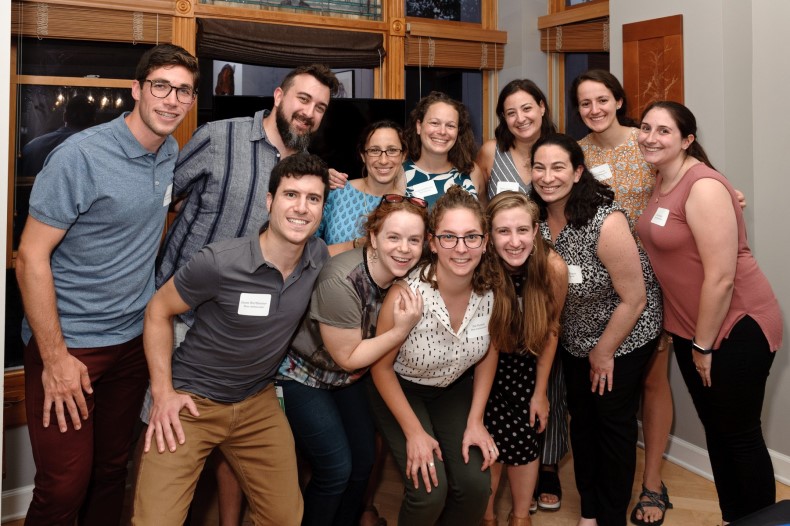
A recent online discussion titled “Understanding Your Millennial Children” empowered parents to better appreciate young adults’ views on Jewish life, independence, and hot-button issues like antisemitism, Jewish identity, and interfaith marriage.
The hour-long forum, held in March, was the latest offering of Silverstein Base Hillel, a home away from home where students and young adults connect, learn, and grow in an inclusive, warm Jewish setting. Siverstein Base Hillel–administered by JUF’s Metro Chicago Hillel–“is so accessible to everyone,” panelist Robin Lieberman noted. “Silverstein Base is really my primary source of Jewish connection in the Chicago community… I also think Judaism is blended into my everyday life now… [and] who I am as a person.”
At the heart of Silverstein Base Hillel are two rabbinical families who open their homes, providing hospitality, learning, and service to local Jewish young adults. The first location opened in Lincoln Park in 2016 with Rabbi Megan GoldMarche and her wife Paige offering programming and Jewish connection: “We’re providing pluralistic Judaism for young adults,” GoldMarche said.
In 2018, a second Silverstein Base Hillel location opened in the West Loop, overseen by Rav Ezra Balser and his wife Laura Elkayam. “Part of the tremendous joy of Silverstein Base is that we get to welcome so many people into our home for collective and holy moments,” Balser said.
Pre-pandemic, Silverstein Base Hillel offered a busy schedule of in-person classes, social events, and Shabbat get-togethers that reached hundreds of young Chicagoans. Over the past year, it has transitioned seamlessly to offering socially distanced programming; hosting online classes; running outdoor activities when weather and social distancing guidelines allow such as small outdoor Shabbat dinners; and delivering Passover seder meals and Purim hamantaschen bags.
“We want folks to feel someone is taking care of them,” GoldMarche noted. In the runup to Passover 2021, Silverstein Base Hillel empowered parents to buy Passover treats for their Chicago-based children, organized and distributed by the group.
Phil Trachtenberg, a 20-something West Loop resident, started attending Silverstein Base Hillel during the pandemic and describes their COVID-era programming as “pretty incredible” at connecting people. Thanks to their efforts, he said, “we can still connect and build community during this time.”
Today’s millennials don’t necessarily want a traditional synagogue membership like previous generations, said Suzanne Lampert, a Glencoe resident and Metro Chicago Hillel board member, whose daughter and future son-in-law live in Chicago and enjoy Silverstein Base Hillel events. Even so, said Lampert, “they are still looking for a way to connect and a way to learn.”
Silverstein Base Hillel’s rabbinic families provide a way for young Jews to connect in a deeply personal way with the Jewish community. “What’s so great about them is they facilitate this space where you can connect over societal issues that are going on right now–when you can bring in Torah study with a rabbinic couple,” Lampert explained.
Hundreds of young adults have found community and connection through Silverstein Base Hillel, tuning into programs on mental health, spirituality, history, and racial justice–and the unique lessons that Jewish thought can shed on these pressing issues. In the past year, GoldMarche began a community for young adults who have lost parents and are grieving during the pandemic. A new b’nai mitzvah program has also given young Jews an added way to connect.
In the past, in-person events were the mainstay of Silverstein Base Hillel. During COVID, online learning has provided a key sense of routine and community. Whether in person or remote, Silverstein Base Hillel is revitalizing the Jewish community across Chicago, bringing together millennial Chicagoans.
“This year we have had to change the direction a bit,” Balser noted. “Encounters that were previously quite deep and personal became all the more so. The magic of Silverstein Base during the pandemic is that we are, through our screens, being welcomed into our ‘Basers” homes for these same holy moments.”
The Silverstein Base Hillel is made possible through generous support from the Silverstein Family, the Crown Family, and Anonymous.
Yvette Alt Miller, Ph.D. lives with her family in the northern suburbs of Chicago.
Other stories
-
Two local teens win national recognition
Recipients of the annual Diller Teen Tikkun Olam Awards
Read more -
Celebrating six young award winners cultivating the community
Introducing young adult award winners
Read more -

Clocking countless hours, days, and months of social distancing has magnified how many people feel about their homes–what they love, what they loathe, and how one chooses to live within a space. For many, these last 12 months have been spent reimagining the possibilities of their homes, and how to bring calmness, happiness, and harmony to their spaces.
Suzanne Falk is the owner of Suzanne Falk Interior Design, a full service residential interior design firm, based in Riverwoods. She was also a “ghost designer” for DIY/HGTV networks Kitchen Crashers and Flip or Flop Chicago (Big City Charm) from 2013-2016. “At the beginning of the pandemic, people were excited about editing and organizing,” she said. “They had the gift of time. I saw many people being more resourceful and creative than they ever were before.”
Falk said her clients became increasingly focused on function and how they live within their homes, in order to bring greater happiness and peace of mind in the very space they treasure most. She helped her clients think about what they really need–whether a place for work, school, exercise, or even solitude–and then helped them get there by rethinking the use of often overlooked areas of the home including basements, garages, and closets. In doing so, Falk said, people were realizing the full potential of their homes to get the function and feel they craved.
“Think about how you will use a room,” she advises. This means not just what the room is for, but how you will live in the space. She said this can include where someone will sit, put their feet, and of course, the feel that’s invoked when we walk into a space. She added that paint color and lighting are so important in bringing harmony to any space. But it’s important to remember that everyone is drawn to their own color.
Diane Golin, the principal of Color Harmony and a certified True Colour Expert™, agrees. She uses her specialized paint color expertise to help homeowners select the right color the first time.
“Color can be very personal and what feels Zen-like for some may not for others,” Golin said. “The mood of a room can come from many elements, paint color being an important one. Wall color can help to create synergy in an environment–connecting the individual furnishings together. Selecting the right colors allows us to feel harmony within our spaces. Color can prompt emotion–for example, yellow evokes happiness; blues and greens can be calming.”
Most people will not be starting from scratch when redesigning a room. Golin said the most important considerations when selecting a paint color are the fixed elements, meaning items that you cannot move such as flooring, counter tops, tile, and existing furniture. “They become the ‘boss’,” she said.
Fabric and texture are also key elements that should not be overlooked, according to Falk. A fabric headboard, an area rug, textured wallpaper, and linen window coverings can all help complete a look and bring calm and coziness to a space.
Falk said thoughtful design is important in achieving the desired look, feel, and function of a space. “People want to love their homes,” she said.
Elizabeth Abrams is Assistant Vice President of Communications for the Jewish United Fund.
Other stories
-
Two local teens win national recognition
Recipients of the annual Diller Teen Tikkun Olam Awards
Read more -
Celebrating six young award winners cultivating the community
Introducing young adult award winners
Read more -