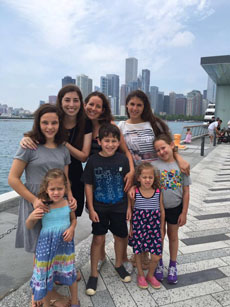
A group of Israeli teens visited Chicago this week as part of a special North American trip organized by the IDF Widows and Orphans Organization (IDFWO). The Israeli youth are all children of fallen soldiers who recently celebrated their bar and bat mitzvahs at a group IDFWO ceremony in Jerusalem.
It is customary among Israeli families to take their children abroad for a fun vacation to celebrate their coming of age, but for families broken by war, this is often not possible.
In Chicago, the young adults were hosted by families from Congregation B’nai Tikvah in Deerfield. Highlights of their weekend in Chicago included a tour of the city, a Chicago White Sox game, a pool party and a visit to Six Flags Great America.
“This trip will leave lifelong memories in the hearts and minds of these teens, who have felt so much pain and hardship from so early on in life,” said IDFWO Youth Director Shlomi Nahumson, who led the trip. “The IDFWO does its utmost to be present at all major lifecycle events and this is an integral part of our work to support and comfort these families and prepare them for a brighter future. We are extremely grateful to our partners in Chicago for opening their hearts and homes to us.”
In addition to visiting Chicago, the teens will also spend time in Toronto and New York.
IDFWO is the sole non-profit organization recognized by the State of Israel that represents and supports the widows and orphans of Israel’s fallen soldiers. The organization provides social, emotional and financial support to widows and orphans who have suffered a great loss: that of a husband and/or father. From the moment that the family is informed of the tragic news, until the child graduates university, the IDFWO is on hand to support and help those left behind.
Other stories
-
Meet Andrew S. Hochberg, 2021 Julius Rosenwald Memorial Award recipient
Celebrate Andy Hochberg at the virtual Annual Meeting on Sept. 14
Read more -
Two local teens win national recognition
Recipients of the annual Diller Teen Tikkun Olam Awards
Read more -
Celebrating six young award winners cultivating the community
Introducing young adult award winners
Read more
JUF’s Jewish Community Relations Council Chair David T. Brown and Executive Director Emily Sweet issued the following statement in response to the murder of Father Jacques Hamel in Normandy, France.
We are horrified by the killing of Fr. Jacques Hamel, 85, a Catholic priest, who was brutally murdered by terrorists while conducting mass, and offer our deepest sympathies and condolences to the community of St.-Étienne-du-Rouvray in Normandy, France.
This unspeakable crime against a man of God in a house of worship is an assault against every faith. It is an assault against every house of worship.
It is an assault against every person of faith. It is an assault against all who gather in prayer.
The Jewish tradition teaches us that in the face of evil we must choose good; that in the face of death we must choose life; that in the face of barbarism we embrace righteousness.
We join with leaders of all faiths in condemning such acts of terror which have been plaguing our society, and reaffirm our shared commitment to pursuing God’s work in creating a peaceful and just world.
Other stories
-
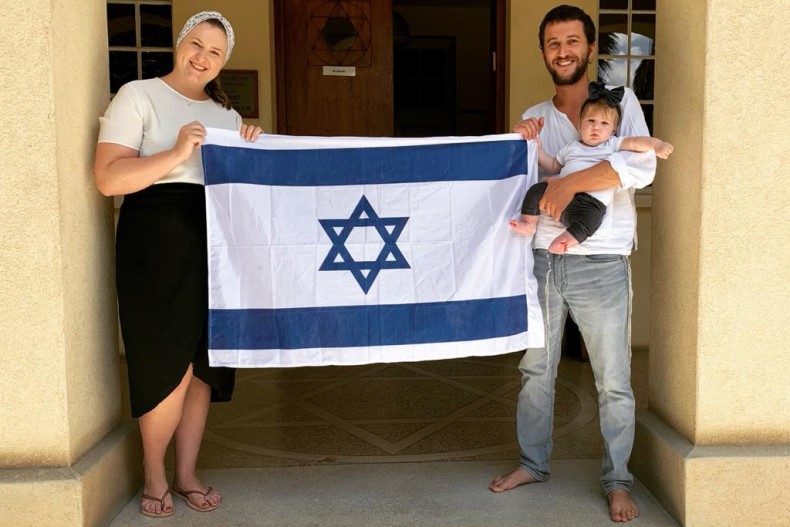
Chicago to Israel to Kenya
A family’s story of living Jewishly on three continents Michelle Cohen World May 28, 2021 Avital, Tzofia, and Netanel Kaszovitz outside their home in Nairobi on Yom HaAtzmaut. When Avital Kaszovitz prepared to be a Modern Orthodox shlicha (emissary) to the Jewish community in Ke
Read more -
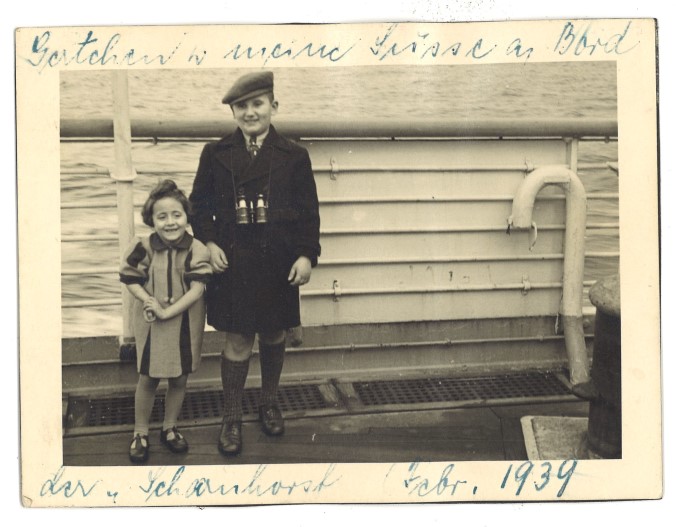
New exhibit spotlights the experience of ‘Shanghai Jews’
Explore a new Illinois Holocaust Museum and Education Center exhibit
Read more -
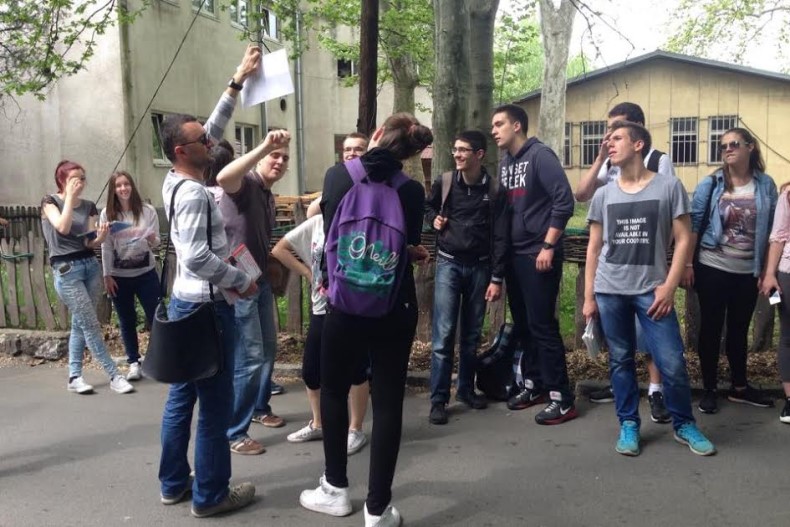
Europe’s brave new teachers of the Holocaust
Teaching the Holocaust in the modern era has its difficulties and rewards.
Read more
Virginia and Norman Bobins and Karyn and Bill Silverstein have been named chairs of the Jewish Federation’s gala presentation of “Defiant Requiem: Verdi at Terezin ,” which makes its Chicago premiere Thursday, March 23, at Symphony Center in Chicago.
The powerful production is a one-time effort to raise significant funds to benefit the Federation’s Holocaust Community Services program; 100 percent of the proceeds will benefit this critical program to serve Holocaust survivors in need.
Sponsorship opportunities are available now. For more information, call Rachel Sternberg at (312) 444-2893.
“ Defiant Requiem,” created and conducted by Maestro Murry Sidlin, is the story of how, in the depths of the Holocaust, within the notorious Terezin (Theresienstadt) concentration camp, one man’s dream gave birth to an unparalleled act of defiance.
The multi-media production, complete with full concert choir and orchestra, commemorates the courageous Jewish prisoners who-with little or no prior musical training-learned, mastered, and performed Verdi’s “Requiem Mass” as a statement of defiance and resistance.
It brings to life the tale of Raphael Schächter, a young conductor deported to Terezin from Prague, who was the force and inspiration behind the performances. From a single smuggled score, he taught a choir of 150 Jewish inmates the two-hour requiem by rote. Despite suffering from hunger, disease, and forced labor, the prisoners performed the famous oratorio 16 times in the camp-including one concert before senior SS officials and a Red Cross delegation.
When sung by prisoners rather than worshippers, the words of the requiem became a condemnation of the Nazis. Confronting their captors face to face, these Jews sang to the Nazis what they could not say.
In retelling the events, “Defiant Requiem” features a complete performance of the Verdi Requiem, combined with elements of on-stage drama, video interviews and authentic film from the era. The Chicago production features actors Jeremy Piven and Tovah Feldshuh, the Chicago Philharmonic Orchestra, the Chicago Vocal Artists Ensemble, soprano Jennifer Check, mezzo-soprano Ann McMahon Quintero, tenor Zach Borichevsky, and bass Nathan Stark.
Tickets go on sale in January.
Since its debut in 2002, some 65,000 people have experienced Defiant Requiem, which has been performed across the U.S. and around the globe, most notably in New York, Boston, Washington, D.C., Budapest, Prague, Berlin, Jerusalem-and on the grounds of Terezín.
The Federation’s Holocaust Community Services program provides safety-net services to rescue local Holocaust survivors from material and social poverty. Holocaust Community Services delivers food, medical care, dental care, financial aid, and in-home care to Holocaust survivors in need, and creates a sense of extended family and community through regular socialization opportunities and weekly support groups. Every month, the number of survivors diminishes, but the needs of those who remain continue to grow. Holocaust Community Services must increase its resources today to ensure that Chicago’s Holocaust survivors can live in comfort and dignity tomorrow.
Other stories
-
Meet Andrew S. Hochberg, 2021 Julius Rosenwald Memorial Award recipient
Celebrate Andy Hochberg at the virtual Annual Meeting on Sept. 14
Read more -
Two local teens win national recognition
Recipients of the annual Diller Teen Tikkun Olam Awards
Read more -
Celebrating six young award winners cultivating the community
Introducing young adult award winners
Read more
JUF-Federation allocates over $153 million to continue critical life-enhancing work in FY 2017
CHRISTINE SIEROCKI LUPELLA
For 116 years, the Jewish United Fund/Jewish Federation of Metropolitan Chicago has been at the forefront of social action-helping Jews and others in need, creating Jewish experiences, and strengthening community connections.
“We operate from the core belief that we are all responsible for each other,” said Bill Silverstein, JUF/Federation Chairman. “No matter how overwhelming the needs may be, our generous community consistently comes together to help people in distress, protect human dignity, rescue endangered Jews around the world, advocate for Israel, and so much more.”
Community lay and professional leaders, working in partnership, have allocated $153.5 million to continue this work in Fiscal Year 2017. The largest share of funding will come from the JUF Annual Campaign, which last year raised $83.1 million. In addition, JUF/Federation distributes funds received from government agencies, foundations, endowments, donor advised funds, the United Way and other sources.
Addressing human needs
Nearly $24.6 million will be directed to human services delivered through Jewish Child & Family Services, CJE SeniorLife, HIAS Chicago, Jewish Vocational Service, Sinai Health System, the Dina & Eli Field EZRA Multi-Service Center, and The ARK, which are among JUF/Federation’s network of approximately 70 agencies and programs.
This funding provides emergency financial and medical assistance, supports advocacy and protection programs, sustains Holocaust survivors and people with disabilities, and makes available numerous other services addressing basic human needs.
“Each year, we impact the lives of 300,000 Chicagoans of all faiths through its network of social service agencies and brings relief to 2 million Jews around the world,” Silverstein said.
Supporting Israel and overseas programs
Approximately $34.9 million will go to help vulnerable populations in Israel, Ukraine and elsewhere overseas, providing significant support for Jews in crisis through JUF/Federation partner agencies and programs that include Jewish Federations of North America, American Jewish Joint Distribution Committee, Jewish Agency for Israel, and World ORT.
This allocation strengthens overseas initiatives and programs such as Partnership Together, which assists the most vulnerable in Israel’s Kiryat Gat-Lachish-Shafir region. JUF Israel Children’s Zone-located in the Partnership Region-is the flagship educational intervention program developed by Israeli education experts in cooperation with JUF’s team in Israel, and is currently available in part in all 17 schools in the region.
“Our Chicago Jewish community’s commitment to tikkun olam -repairing the world-has an enormous impact on millions of Jewish lives, not only at home, but in Israel and everywhere around the world,” said Steven B. Nasatir, JUF/Federation President.
Recently, the City of Kiryat Gat recognized JUF and the Chicago Jewish community for 20 years of continued support. Mayor Aviram Dahari conferred on JUF the title of ” Yakir Kiryat Gat ,” which roughly translates to “Beloved of Kiryat Gat.”
Overseas funding also enhances educational programs operated by the streams of Judaism in Israel: Progressive (Reform), Masorti (Conservative), and Modern Orthodox. In addition, JUF supports programs in the Former Soviet Union such as the Kyiv Kehilla Project that addresses hunger and supports formal and informal Jewish education programs in Ukraine.
Creating a dynamic community
JUF/Federation ensures a vibrant Jewish community by engaging Jews of all ages through an outstanding array of program, initiatives, and service opportunities. Over $18.5 million has been allocated to agencies, organizations and programs that create Jewish experiences and strengthen community connections, thereby promoting Jewish continuity. Jewish Community Center of Chicago, Associated Talmud Torahs, 16 Chicago area Jewish elementary and high schools, Spertus Institute for Jewish Learning and Leadership, and Hebrew Theological College are among the agencies and beneficiaries that rely on JUF for significant funding.
Programs like JUF Young Families, including jBaby, JUF Right Start, and PJ Library, bring Jewish families together to participate in Jewish life; Taam Yisrael, which connects eighth-graders to Israel; Hillels of Illinois, which invites college students on 16 campuses to explore and celebrate their Jewish identities; and opportunities for young adults to build leadership skills or network with their peers, all engage the next generation in Jewish life. In addition, the Jewish Community Relations Council promotes collaboration, bringing together 49 major Chicago area Jewish organizations to advocate on behalf of the Jewish community with civic and community organizations, government officials and the media.
An additional $5.5 million has been allocated to efforts promoting Jewish identity through Israel outreach, advocacy and cultural connections at the local and national level. These include combating anti-Israel campaigns; maintaining Israel study programs on college campuses, and sponsoring JUF Birthright Israel trips. Funding also supports academic scholarships and fellowships, and agencies such as the Illinois Holocaust Museum and Education Center.
Enhancing innovative programming
Approximately $1.1 million has been allocated to the Breakthrough Fund, which awards grants to a wide array of innovative initiatives in Chicago’s Jewish community. Breakthrough grantees focus on themes such as inclusion of teens with special needs; raising awareness about mental illness; crisis intervention and self-sufficiency for at-risk Israeli young adults; professional development for those working in the Jewish community; and engaging new Jewish experiences for local bar and bat mitzvah students, college students and congregants.
Other JUF/Federation FY ’17 allocations reflect distributions from donor-advised funds, community programs and services provided directly by JUF/Federation, support services to affiliated agencies, and operational expenses.
Assessing community needs and prioritizing funding involves collaboration between community leaders and JUF/Federation and agency professionals. Members of the Health and Human Services, Israel and Overseas, and Community Building and Jewish Continuity Commissions of the JUF/Federation Overall Planning and Allocations Committee (OPAC) identify needs, assess impact and recommend allocations for the future.
“Through our contributions to the JUF Annual Campaign, our community year after year demonstrates the power of the collective,” said Andrea R. Yablon, JUF/Federation Overall Planning and Allocations Chair. “Although each person’s individual contribution is significant, when we pool our resources and act collectively, we can effect great change together.”
JUF/Federation commission chairs and co-chairs include Marcie Hemmelstein and Hilary Greenberg, Health and Human Services; Dana Hirt, Israel & Overseas; Deborah Schrayer Karmin, Community Outreach & Engagement; Scott Heyman and Gita Berk, Community Building and Jewish Continuity; and Marc Roth and Rabbi Michael Schwab, Synagogue-Federation.
Other stories
-
Meet Andrew S. Hochberg, 2021 Julius Rosenwald Memorial Award recipient
Celebrate Andy Hochberg at the virtual Annual Meeting on Sept. 14
Read more -
Two local teens win national recognition
Recipients of the annual Diller Teen Tikkun Olam Awards
Read more -
Celebrating six young award winners cultivating the community
Introducing young adult award winners
Read more
Abner Mikva—congressman, federal court judge, and advisor to presidents—dies at 90
PAUL WIEDER
One of the most-told stories in Chicago involves a law-school student who tried to volunteer for then-gubernatorial candidate Adlai Stevenson. “Who sent you?” the ward boss challenged him. “Nobody,” admitted the student. The boss famously replied, “We don’t want nobody nobody sent.”
That student later became The Honorable Abner Mikva-and nobody’s “nobody.” In fact, he “sent” many other people on their way to becoming somebodies. Mikva mentored Chicago Mayor Rahm Emanuel, Congresswoman Jan Schakowsky, and Supreme Court Justice Elena Kagan. And Mikva has mentored President Barack Obama since Obama was an Illinois state legislator.
Mikva spent his life in public service. He served his city as a U.S. Congressman for nine years. He served his state as assemblyman for five terms. He served his country as the chief judge of the U.S. Court of Appeals for the District of Columbia. He served his profession by practicing law and teaching it.
In 1994, President Bill Clinton made him White House counsel. In 2014, President Obama bestowed him with the Presidential Medal of Freedom, the highest American civilian honor. Ultimately, he became one of the few people in American history to serve in every branch of government.
Judge Mikva died July 4, at 90. The son of Yiddish-speaking Ukrainian immigrants, he would one day monitor a Ukrainian national election.
Over the years, Mikva was very supportive of JUF’s work. He shared his knowledge and insight with everyone from the Women’s Board of the Young People’s Division (now YLD) to JUF’s Board of Directors. He participated in the Walk with Israel, and addressed the 1981 Festival of Hope for Soviet Jews. As U.S. Congressman, he corresponded regularly with JUF leadership regarding issues from English-language training for refugees to housing for the elderly.
“Abner Mikva was a great public figure,” said retired State Senator Arthur Berman. “He fought for positive policy for all people, and set a great example of being an outstanding citizen.”
“I found him to be a dedicated public servant, and brilliant,” agreed State Senator Howard Carroll. “He had a wonderful relationship with those coming behind him, and was a symbol” for them.
Mikva was born in Milwaukee in 1926 and grew up in the Great Depression. During World War II, he enlisted in the Army Air Corps; the war ended the day before he was deployed. But he was eligible for the GI Bill, and attended Washington University in St. Louis, where he met his wife, Zorita “Zoe” Wise. They would be married for nearly 70 years.
Mikva earned his law degree in 1951 from the University of Chicago Law School, where he would teach decades later. He went on to clerk for Supreme Court Justice Sherman Minton. Back in Chicago, he practiced law, at Goldberg, Devoe, Shadur & Mikva.
Mikva was elected to the Illinois House of Representatives in 1956; his Springfield roommate was future senator Paul Simon. Mikva became a member of Congress in 1969, serving Illinois’ 2 nd and 10 th districts during his five terms in the House of Representatives.
In 1979, President Jimmy Carter appointed him as a judge on the U.S. Court of Appeals for the District of Columbia. He served for 15 years, including five years as chief judge, a level to which he was raised by Clinton. As chief judge, Mikva struck down the Pentagon ban against gays serving in the U.S. military-and played a Supreme Court Justice in the comedy movie Dave .
His daughter, Rabbi Rachel S. Mikva, Ph.D., is the Herman Schaalman Chair in Jewish Studies at the Chicago Theological Seminary. She spoke of her father’s “longstanding commitment to Israel” and noted that his congressional campaigns, which emphasized direct voter contact, “involved tremendous numbers… of the Jewish community in the political process.”
His “capacity to inspire others to work for the betterment of the community is a great legacy,” she added, “now continuing through the Mikva Challenge, which he spearheaded with my mother. His lifelong partnership with her contributed greatly to his success.”
The Mikva Challenge, a non-profit organization encouraging teens to become active in politics, was founded in 1997 by Mikva and his wife; there are now chapters in Los Angeles and Washington, D.C.
“My father was the primary caretaker for my mother from the time she had her first stroke seven years ago until just weeks before he died,” said his daughter Laurie, a clinical assistant professor of law at Northwestern University. “He was a very devoted husband… and father and grandfather.”
In 1998, Mikva received the Chicago History Museum’s “Making History” award. In 2006, Illinois Governor Rod Blagojevich named Mikva chair of the Illinois Human Rights Commission.
Besides his wife, he is survived by their daughters- Judge Mary Mikva, Professor Laurie Mikva, and Rabbi Rachel Mikva-and seven grandchildren. There will be a public memorial in August.
Other stories
-
Meet Andrew S. Hochberg, 2021 Julius Rosenwald Memorial Award recipient
Celebrate Andy Hochberg at the virtual Annual Meeting on Sept. 14
Read more -
Two local teens win national recognition
Recipients of the annual Diller Teen Tikkun Olam Awards
Read more -
Celebrating six young award winners cultivating the community
Introducing young adult award winners
Read more
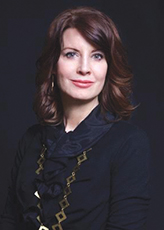
Writing their stories: Reversing the culture of silence around gender-based violence
ABIGAIL PICKUS
Decades before a sexual assault victim had the courage to fight back against her Stanford attacker in a powerful letter that made headlines around the globe, a young woman named Anne K. Ream was looking for other women who had also gone through the harrowing experience of sexual assault.
“I remember thinking: if only one of these women had gone through what I have, I would feel I could be OK,” said Ream. “But back then, [in the ’90s] it was as if society had ‘disappeared’ these stories. We rarely knew the names of survivors, saw their faces, or had a sense of who they were as people.”
Ream is far from alone. According to RAINN (Rape, Abuse & Incest National Network), one of every six women in America has been the victim of an attempted or completed rape in her lifetime.
“This is an issue that affects millions of people,” said Ream. “One of the most painful things for me to witness over and over is the burden of silence that has been placed on people and what it has done to them.”
Ream has been steadily reversing that culture of silence, beginning with her book, Lived Through This: Listening to the Stories of Sexual Violence Survivors (produced with documentary photographer Patricia Evans.)
In 2006, Ream founded The Voices and Faces Project, a nonprofit whose mission is to create a national network of survivors willing to speak out about sexual violence to create social change.
Its signature program is a two-day writing workshop for survivors of gender-based violence and other human rights violations called The Stories We Tell.
“We understood that stories are the most powerful tool for changing minds and hearts,” said Ream.
The Ellie Fund at the Jewish Women’s Foundation of Metropolitan Chicago (JWF) understood that, too.
For the second year, the Ellie Fund has allocated $25,000 to The Stories We Tell. The workshops will be held in the fall at the Illinois Holocaust Museum & Education Center in Skokie and the University of Chicago’s Pozen Center for Human Rights.
“We are so grateful to the Ellie Fund for allowing us to make our workshops a regular thing in Chicago and for offering us support back when we were just starting out,” said Ream.
The Ellie Fund was established at the Jewish Women’s Foundation of Metropolitan Chicago by JWF Lifetime Trustee Ellen “Ellie” Block to support initiatives and programs that promote safety, security, equal rights, equal voice, and equal opportunity for girls and women.
She created the fund as part of her membership in the Women Moving Millions community-a global community of women philanthropists committed to donating $1 million or more for the advancement of women and girls.
It both supports and extends JWF’s reach and scope, according to JWF Executive Director Ellen B. Carmell.
For Block, the president of Nonsense, Inc., a gift and accessories art consultant business, the establishment of the Ellie Fund is a continuation of her work that began with children and families.
“It has become increasingly clear to me that a woman’s ability to make transformative change for her children, her family, her community, and herself in any society, at any level, depends on her having a voice and the right to self-determination,” she said.
Block was among a small group of visionary women on the board of the Jewish United Fund’s Women’s Division who founded the Chicago Jewish Women’s Foundation in 1997. JWF is now one of the largest Jewish Women’s Foundations in the country.
What especially resonated with the Ellie Fund Advisory Committee was The Voices and Faces Project’s understanding of the connection between testimony and social change.
“The Voices and Faces Project’s stories are critical to raising the consciousness of the public about how violence against women is occurring everywhere, every day, in every corner of our society,” said Block.
For a form of violence that is prevalent, hard to prevent, and often hidden, giving survivors a platform to share their stories makes it personal.
“For most of us, understanding an issue from the perspective of what one person has gone through makes it easier to comprehend than hearing about what millions have gone through,” said Carmell.
Since launching the first Stories We Tell in 2011, the organization has run dozens of the two-day workshops across North America and its 225 alumni have gone on to use their storytelling skills in a variety of ways- from writing a young adult novel to lobbying on Capitol Hill. Voices and Faces currently houses the largest known archive of personal narratives by survivors of gender-based violence, with over 400 stories.
According to the workshop’s creator and instructor, author R. Clifton Spargo, the aim is to make participants confident and skilled storytellers. “The mission of the project is to use testimony to influence policy and decision makers to ultimately create a groundswell and influence in gender-based violence,” he said.
For Janet Goldblatt Holmes, a Jewish survivor of sexual violence from Canada, discovering The Voices and Faces Project back in 2006 was like a “door had opened and I was able to begin to deal at what had happened to me,” referring to being date-raped 40 years ago at the age of 16.
Once she had finally broken her own “burden of silence” and the floodgates broke she found herself writing and writing. She soon became involved with the project and now serves as the writing workshop outreach coordinator. She also speaks about sexual violence to the Jewish community.
As for Ream, the success of her project is the answer to her wish from long ago.
“I have spoken about this project in 48 states and four continents and I don’t know if I’ve ever spoken at any event where a survivor of gender-based violence hasn’t come up to me after and said, ‘I’ve never shared this with anyone but …,” she said.
“Anne’s project teaches us all about the importance of having a voice and the impact we can make when we use it,” Block said. If we all step forth and claim our voice for a better future, we will make a better world for our daughters, our sons, the Jewish world, and the world as a whole.”
For details on The Stories We Tell and to apply, visit www.voicesandfaces.org or email: [email protected]. The workshops will be free courtesy of the Ellie Fund.
The Jewish Women’s Foundation is an independent project of the Jewish United Fund/Jewish Federation of Metropolitan Chicago.
Other stories
-
Meet Andrew S. Hochberg, 2021 Julius Rosenwald Memorial Award recipient
Celebrate Andy Hochberg at the virtual Annual Meeting on Sept. 14
Read more -
Two local teens win national recognition
Recipients of the annual Diller Teen Tikkun Olam Awards
Read more -
Celebrating six young award winners cultivating the community
Introducing young adult award winners
Read more
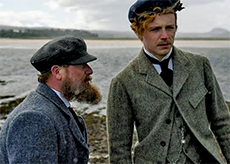
Local venture capitalist and golf enthusiast Keith Bank has produced his second motion picture. Titled Tommy’s Honour , it portrays the amazing true story of Old Tom Morris and Young Tom Morris, the father and son pioneers of the modern game of golf. Shot entirely on location in Scotland, the film recently had its world premiere as the opening night gala film at the Edinburgh International Film Festival. “It was extremely well received by the 3,000 attendees, with extended loud applause at the end of the showing,” Bank said. He expects the film to have its U.S. debut in theaters in spring of 2017, just before The Masters golf tournament. Bank previously produced Heaven is a Playground , a basketball movie set in Cabrini-Green. He is active in JUF and has participated on two Nachshon Missions to Israel, as well as serving as Chairman of the Board of NASDAQ-traded Israeli specialty pharmaceutical company SteadyMed Therapeutics.
Other stories
-
Meet Andrew S. Hochberg, 2021 Julius Rosenwald Memorial Award recipient
Celebrate Andy Hochberg at the virtual Annual Meeting on Sept. 14
Read more -
Two local teens win national recognition
Recipients of the annual Diller Teen Tikkun Olam Awards
Read more -
Celebrating six young award winners cultivating the community
Introducing young adult award winners
Read more
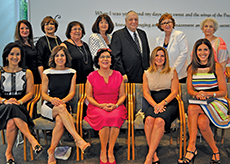
On March 2, 1966, The Dick van Dyke Show aired a remarkable event: Buddy Sorrell’s bar mitzvah. The writers of that episode probably had no idea what was coming. By the 1970s, there were a lot of changes in the Jewish communal world. In 1972, Sally Priesand became the first female rabbi. The first gay and lesbian synagogue Beth Chayim Chadashim was founded in Los Angeles that same year. The Soviet Jewry movement was gaining steam and impact.
A few years after Buddy’s bar mitzvah on national TV, something else was getting started: the adult bar/bat mitzvah. Rabbi Albert Axelrad from Brandeis University is credited with holding the first “belated” bar mitzvah ceremonies. The initial interest in this new ritual came from men, feeling that they missed out on some crucial aspect of their developing Jewish identity. Soon, of course- as women began to take more active roles in the ritual life of the community- they too lined up to take part in something that was denied to them when they were girls.
The motivation hasn’t changed much in the intervening decades. Today’s students come from a variety of backgrounds, they engage in community service projects, they lead some or all of the service, learn to chant Torah and Haftorah… and experience something 13-year-olds may not.
Take Carol Mackoff and Jane Lippow from Anshe Emet Synagogue in Chicago. They began a deep friendship when they each decided to have an adult bat mitzvah. Mackoff’s upbringing was in a culturally Jewish home, but there were no synagogue activities outside the High Holidays. She came from proud socialists who weren’t actively Jewish. And of course, Jewish girls in the middle of the 20th century just didn’t have bat mitzvahs. Lippow said she realized she missed out on something, and although was raised in an identified, Reform Jewish home, the opportunity to learn something new was a powerful lure.
When their grandchildren started their bat mitzvah training, Mackoff and Lippow could no longer resist; they jumped in with both feet, finding community, connection, and each other. Years later, these two women still study together weekly, and are still involved in the social justice cause they began as part of their bat mitzvah experience.
Watching one’s (grand)children become a bar/bat mitzvah is a powerful motivating factor for many. Amy Stein is in her 40s and just completed her bat mitzvah earlier this summer, at B’nai Joshua Beth Elohim, in Deerfield. She was raised in a Reform family, and chose Confirmation over bat mitzvah when her parents gave her the option. She never felt like she was missing something until her children became b’nai mitzvah. As they became more and more involved with their youth groups, trips to Israel, and taking part in services, it was sitting through other adults’ celebrations of their *b’nai mitzvah that sealed the deal. She began attending classes for two hours each week, learning Hebrew, liturgy, and the parasha the entire class would be reading.
Another common motivation is conversion. Tim Jacobs, of Bnai Tikvah, in Deerfield, said that after his conversion to Judaism, he just knew that he had another step to take. The conversion experience was profound, but he wanted more skills in Hebrew, more familiarity with the Shabbat service, and deeper connection to the community he had joined. His son was preparing for his bar mitzvah, so rather than “take his spotlight,” Jacobs delayed his own bar mitzvah. The experience cemented his place in the congregation; he and his family are regular Friday night and Shabbat morning attendees.
Another Jew by Choice, in the Anshe Emet community, will begin her bat mitzvah training this fall. Her maternal great-grandparents were Jewish. She began her conversion journey 18 years ago. After finally finishing that process, she looks forward to becoming more fluent in Hebrew, increasing her familiarity with the liturgy, and becoming more active in the community at large.
A common theme for all of these b’nai mitzvah is how profound the experience is for them. They all felt that 13-year-olds can’t appreciate this life-cycle event the way they do. Kids, they said, tend to go through the motions sometimes, or do it “for the party.” As adults, they have clear visions of their own spiritual paths, the have a very personal and internal commitment, and they bring their adult passions to learning something new. They know more people when they walk into their buildings, and they’re interacting with their clergy in a more meaningful way.
Buddy Sorrell’s bar mitzvah may have been played for laughs, as something he hid from his friends and family until he was ready. For today’s adult b’nai mitzvah “travelers,” this is a meaningful, public acknowledgment of Jewish literacy, identity, and commitment. And some of them even have parties.
Anita Silvert is a freelance teacher and writer, living in Northbrook. You can read more of her weekly Torah musings on her blog, Jewish Gems, at www.anitasilvert.wordpress.com .
*B’nai mitzvah is the plural for bar/bat mitzvah.
Other stories
-
Meet Andrew S. Hochberg, 2021 Julius Rosenwald Memorial Award recipient
Celebrate Andy Hochberg at the virtual Annual Meeting on Sept. 14
Read more -
Two local teens win national recognition
Recipients of the annual Diller Teen Tikkun Olam Awards
Read more -
Celebrating six young award winners cultivating the community
Introducing young adult award winners
Read more
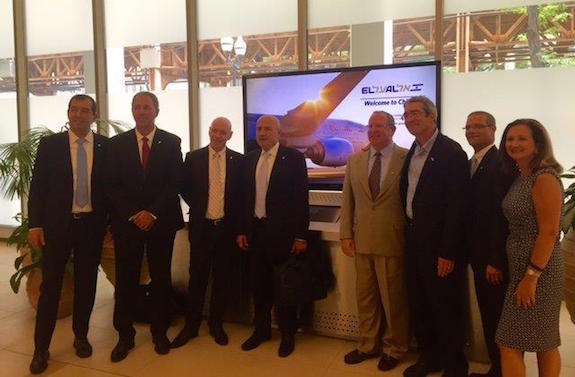
Photo: El Al officials along with officials from JUF, the Israeli Consulate and the Chicago Department of Aviation pose for a photo in the JUF lobby.
Chicago is making its case to bring El Al flights to and from the city direct from Tel Aviv.
Earlier this week, JUF leaders, outgoing Consul General of Israel to the Midwest Roey Gilad and officials from the Chicago Department of Aviation hosted a visiting delegation of officials from the Israeli airline. Local rabbis, along with business, high-tech and finance professionals and leaders in the African-American community, joined for a luncheon.
The Israeli carrier recently purchased a fleet of Boeing 787 Dreamliner planes and is looking to add a new direct flight destination in the United States. Chicago is a finalist.
El Al is expected to announce its decision soon. Flights — as frequent as three times a week — could begin in 2017 or 2018.
Other stories
-
Meet Andrew S. Hochberg, 2021 Julius Rosenwald Memorial Award recipient
Celebrate Andy Hochberg at the virtual Annual Meeting on Sept. 14
Read more -
Two local teens win national recognition
Recipients of the annual Diller Teen Tikkun Olam Awards
Read more -
Celebrating six young award winners cultivating the community
Introducing young adult award winners
Read more
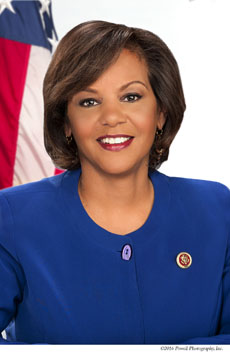
Rep. Robin Kelly discusses Israel, new anti-violence initiative with JUF leadership
MARA RUFF
Rep. Robin Kelly met with leaders of JUF’s Government Affairs Committee and Jewish Community Relations Council this week to discuss her recent trip to Israel and her new initiative to reduce gun violence.
A longtime supporter of U.S.-Israel relations, this was Kelly’s second trip to Israel. On each trip, she was surprised to experience such a rich culture of diversity (and delicious Israeli food).
Kelly expressed hope and optimism about the future of Israel. She backs a two-state solution and supports Israel’s ongoing security needs. During the discussion, JUF leaders educated Kelly on the growing Boycott, Divestment, Sanctions movement on college campuses in Illinois and the continued need to educate students on Israel.
Although the meeting was centered on the Kelly’s impressions of Israel, her first question to the group was on the impact of the state budget impasse on Federation agencies and health and human services in general. She expressed concern about declining resources and job opportunities in her community, and the impact on rising levels of violence.
Kelly’s “UP Initiative “ is a new collaborative that seeks to create partnerships at all levels of government to reduce gun violence and increase economic opportunities.
“The only way to reduce the gun violence on our streets is to increase economic growth in our communities, including strengthening our schools, mental health provider network, and employment opportunities,” she said.
At the meeting’s end, Government Affairs Committee Federal Vice-Chair David Goldenberg thanked Kelly for her longstanding leadership in the community and her ongoing commitment to advancing JUF priorities, which dates back to her time in Illinois state government in the Treasurer’s Office and Illinois House of Representatives.
A key player in Washington, Kelly is a growing influence within the Congressional Black Caucus and Illinois Caucus. Moving forward, JUF will continue to make itself available as a resource for her and her office.
Other stories
-
Meet Andrew S. Hochberg, 2021 Julius Rosenwald Memorial Award recipient
Celebrate Andy Hochberg at the virtual Annual Meeting on Sept. 14
Read more -
Two local teens win national recognition
Recipients of the annual Diller Teen Tikkun Olam Awards
Read more -
Celebrating six young award winners cultivating the community
Introducing young adult award winners
Read more