
It’s been 15 years since the courageous Holocaust studies professor and historian Deborah E. Lipstadt battled infamous British Holocaust denier David Irving in a landmark legal case.
The quest for truth, light, and justice in that British courtroom has become an even more meaningful legacy since that time, as so many firsthand witnesses to the Holocaust have passed away, and we strive to educate the younger generations about the atrocities without the survivors here to share their stories.
Back in 1996, Irving accused Lipstadt of libel, arguing she ruined his reputation by characterizing him–along with others–as a Holocaust denier in her 1993 book Denying the Holocaust: The Growing Assault on Truth and Memory .
Irving, who had made revisionist claims such as denying that Jews were systematically killed in the Auschwitz gas chambers, sued Lipstadt and her publisher, Penguin Books, stating that Lipstadt destroyed his reputation and career by claiming that he distorted historical data to fit his own assertions.
Then, in the winter of 2000, Lipstadt and Irving duked it out in London’s Court of Royal Justice in a trial that lasted nearly three months, the biggest judicial exploration of the Holocaust since the Adolph Eichmann trial 40 years earlier.
Home to one the largest Holocaust survivor populations in the country, the Chicago Jewish community, and specifically JUF’s Holocaust Community Services and the Illinois Holocaust Museum and Education Center, have always been committed to serving the survivor community and teaching Holocaust awareness and education. In fact, the Jewish Federation of Metropolitan Chicago provided $50,000 toward Lipstadt’s defense, one of the first contributions she received in connection with the trial.
“Going back to the time of the trial and then the verdict, I remember thinking that at a time when the number of eye witnesses to the Holocaust grows smaller, it was essential that those who would attempt to distort history be properly identified,” said Steven B. Nasatir, JUF President. “An alternative verdict in the case, while not changing historical realities, could have had a disastrous and intimidating effect on scholars and the media. We were enormously relieved when that did not happen and very proud to be an early supporter of Deborah’s courageous effort to stand up for the truth.”
In American law, the burden of proof in libel cases lies with the accuser. Conversely, in British law, the burden rests with the accused, in this case Lipstadt and her publisher, to prove that what she said about Irving was true. Still, even with the daunting task to take down Irving, Lipstadt was victorious.
Justice Charles Gray declared that Irving falsified history, calling him an “an active Holocaust denier,” “anti-Semitic and racist,” and one who “associates with right-wing extremists who promote neo-Nazism.”
As The New York Times reported back then, “History has had its day in court and scored a crushing victory.”
After all this time, Lipstadt, whose trial will soon be depicted in a feature film, will speak to the Chicago Jewish community at the Jewish Federation’s 2015 Annual Meeting on Thursday, Sept. 17. In anticipation of her speech to the community, Lipstadt, the Dorot Professor of Modern Jewish and Holocaust Studies at Emory University in Atlanta, sat down for a phone interview with JUF News.
JUF News: What sort of connection do you feel with the Chicago Jewish community?
Deborah E. Lipstadt: The Chicago Jewish Federation’s support of me at my trial was unbelievably generous, forthcoming, and wholehearted. Chicago was one of the first communities to stand up in such an uninhibited way, and I’m very grateful for that.
Tell me about your Jewish upbringing on Manhattan’s Upper West Side.
My parents were absolutely committed to Orthodoxy and tradition, but also believed in living in this world-theater, museums, and novels. They very much believed that you did both and one did not preclude the other. The synagogues we worshiped at and our rabbis influenced me too. All of that informs my life to this day.
You are not the child of Holocaust survivors. So, what then, inspired you to enter the field of Holocaust studies?
I went to Israel as a student in 1966, 20 years after the Holocaust. Survivors were all around you, and the Holocaust was very present. I was also there during the Six-Day War in 1967. Both [factors] had a huge influence on me.
What has 15 years hindsight taught you about the trial and your victory?
It confirms my inclination that you can’t fight every evil, but when you see certain evils, you can’t turn away from them. You really have to take them on and challenge them.
Was there ever a thought that maybe you should back down from challenging Irving?
One depressing day, early on in the fight…a group of leading Jews in England said I was doing the wrong thing by fighting him. And it took one short conversation with a member of my legal team [to convince me to fight]. I said, ‘Oh my God. I must have gone crazy–I don’t know what I drank last night.’ And I never thought twice about it again.
How is the surge in anti-Semitism in Europe in recent years different than during World War II?
First, during the Holocaust, the State–Germany–was sponsoring anti-Semitism, destruction, and persecution. Today, in many places where we see anti-Semitism–France for example–the State is clearly against what is happening. Whether it’s doing enough, or saying the right thing is open to debate. Second, today government is speaking out about anti-Semitism…. It wasn’t condemned in the 1930s. Third, we have the State of Israel. The State of Israel has one of the most powerful armies in the world, and the State of Israel is committed to protecting Jews as well as itself. And we have memory–we know what happened, we know what can happen. All those things make a big difference.
How dangerous are the comparisons made to the Holocaust within the Boycott, Divestment, and Sanctions (BDS) Movement narrative?
BDS is very dangerous. It was started by people, I believe, who would like to see the destruction of the State of Israel. That doesn’t mean everybody who supports BDS believes that, but I think that’s the ultimate goal of the people who created BDS. They have been absolutely right on target from their perspective in terms of how they have phrased it with the right language, a Democracy language, anti-persecution language, so that kids who can’t find Israel on a map think that this is a no-brainer, just as being against Apartheid was a no-brainer.
Iran often makes statements about delegitimizing the Holocaust and wiping Israel off the map. What can our community do to counter Iran’s threats?
We have to keep speaking out, to keep pointing to them as a regime that engages in Holocaust denial, a regime that calls for the destruction of Jews, that [also] calls for the destruction of Israel…
How do you feel about the new film in production that will dramatize your trial?
In Hollywood, you got to wait. When it opens on the screen, I’ll be ready for it, but until then I’m waiting to see what happens. I consulted in the earlier periods when the script was being written. It’s a terrific script by David Hare, one of Britain’s, if not the world’s, leading contemporary playwrights…
You’ve done so much to educate people about the Holocaust but it seems like we’ve taken a few steps backwards in the past decade. Do you still feel hope?
We’ve made great strides, and my trial was part of those great strides….Today, there is far less of what I call “hard-core” Holocaust denial–people saying it didn’t happen and that there were no gas chambers, etc. That has been proven to be just ludicrous and anyone who makes that kind of statement, every time [former Iranian President] Ahmadinejad attacks the United States and makes that kind of statement, people just laugh at him.
What we do have is “soft-core” Holocaust denial-false analogies to the Holocaust whether it’s animal lovers [talking about] a Holocaust on your plate when you eat chicken, or people talking about the abortion Holocaust. Or people talk about the genocide of the Palestinians–you can think that Israel policies are completely wrong, you can think that they’re misguided–but there is no genocide of the Palestinian people. They’re suffering and they’re living in dire circumstances, and we can debate why, but it’s not a genocide.
This more subtle denial can be just as dangerous because it’s dressed up in sheep’s clothing, right?
Exactly. It’s what I call “squishier.” It’s harder to pin down. It reminds me of what a member of the Supreme Court, Justice Potter Stewart, said about pornography. ‘I can’t define it, but I know it when I see it.’ So at some level, the “soft-core” stuff is sometimes hard to pin it down, but in your gut, you know [it].
All these years later, do you still love your work?
I feel very lucky, even though we live in very trying times for us as a community, for us as a people, and for Israel. Nevertheless, I feel blessed that I get a chance to get up each morning and write about, teach about, and speak about something that means a heck of a lot.
In addition to Lipstadt’s keynote address at the Annual Meeting on Sept. 17, the featured program of the Annual Meeting will be the commitment to helping Holocaust survivors live with dignity through JUF’s Holocaust Community Services (administered by CJE SeniorLife in collaboration with Jewish Child and Family Services)
To register for the 2015 Annual Meeting, visit juf.org/annualmeeting . For information, call 312-357-4876 or email [email protected]
Other stories
-
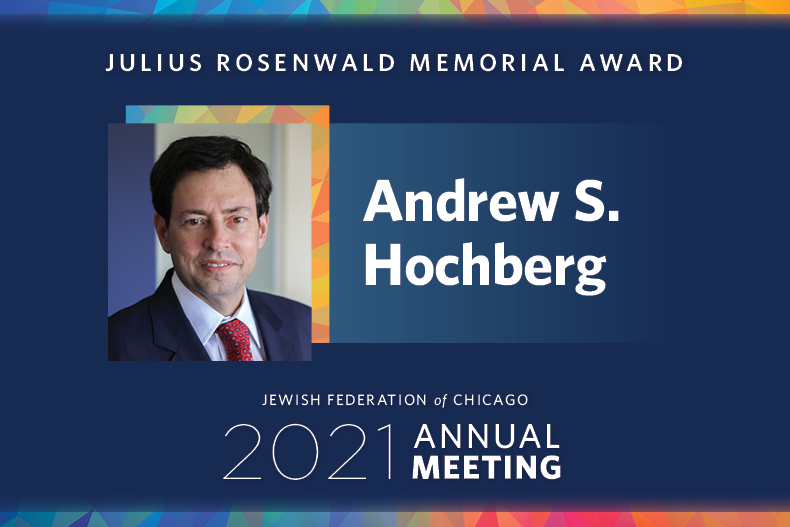
Meet Andrew S. Hochberg, 2021 Julius Rosenwald Memorial Award recipient
Celebrate Andy Hochberg at the virtual Annual Meeting on Sept. 14
Read more -

Two local teens win national recognition
Recipients of the annual Diller Teen Tikkun Olam Awards
Read more -

Celebrating six young award winners cultivating the community
Introducing young adult award winners
Read more