Laying foundations, finding roots
PAUL WIEDER
In the 1980s and ’90s, Operation Exodus– run and funded by North America’s Jewish Federations– rescued and resettled nearly one million Jews fleeing oppression in the former Soviet Union (FSU). They fled from a dozen Soviet states to Israel, Europe, and the U.S.; tens of thousands of Jews were welcomed by Chicago’s Jewish community and its own JUF.
Jewish traditions and scholarship run deep in Eastern Europe, but they were erased by the Nazis, and then even the memory of them was suppressed by the Soviets. Therefore, many Jews from the FSU only learned that this rich heritage of theirs even existed once they arrived in Western Europe, the U.S., and Israel, where those traditions continued. One of the grassroots efforts that provided that education here was the Heritage Congregation.
Its leader, Rabbi Eliezer Dimarsky, taught the immigrants how to pray, study, and celebrate Jewish holidays, in accordance with their deep Eastern European Jewish traditions. Over the years, the congregation grew to 100 families strong– and outgrew its storefront home.
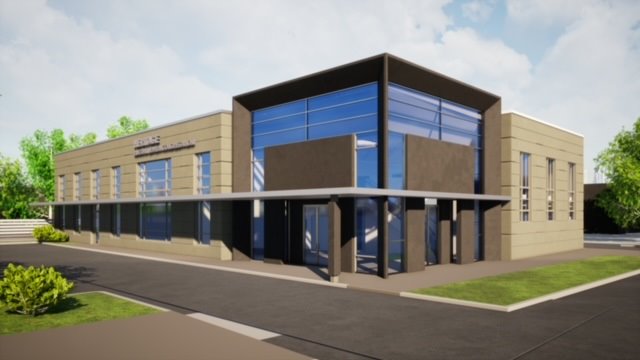
Today, a brand-new edifice is being built, on the corner of Touhy and Francisco Avenues in West Rogers Park. Designed and executed by an architect and a builder from the FSU, it will house a sanctuary, two social halls, a library, and classrooms. Heritage hopes to ready the facility by the High Holidays.
“We view it as a center for Jews immigrating from the FSU. I want them to feel it is their place,” Dimarsky said. The congregation includes many who have been in the U.S. for 30 years, but still speak Russian, and also their American-born children. Many have followed Dimarsky since he founded the congregation, 25 years ago.
Ukraine-born Yana Feyganova has been attending for five years, but when she first arrived, “I had no idea how to pray,” she said. Since she began to participate more fully, she has attended a JLife Shabbaton, frequents the Moishe House, and serves on the board of JUF’s Russian-speaking Jewish Division (RJD).
She worked in the Jewish community in Ukraine, and now works for a private charitable foundation here. She fled to the U.S. when Russia invaded the Donetsk region in 2014. More recently, she wanted to reconnect with her roots, and found them at Heritage.
“It has such a beautiful and radiant atmosphere,” she said, adding, “It feels like home,” as she found everything from her language to her favorite foods there. She has also become more observant, because she feels that, “the more traditions you keep, the more rewarded you are. I really care about our heritage. Your journey starts with your heritage.” She is looking forward to the new building and promises that, when the time comes, “I will have my chuppah there.”
And she could. The new sanctuary will hold 170 people, but can expand to seat 300. Dimarsky hopes to hold everything from High Holiday services to city-wide Purim celebrations in the new venue. “We will finally be able to hold everyone!” he said.
The facility will also hold classes in Jewish studies, and may resume Heritage’s Sunday school. It will host singles events and refusenik speakers. Everything from Maot Chitim food deliveries to trips to Israel and Europe will emanate from its halls.
Dimarsky was born in Kyiv and attended high school there. After studying in an Israeli yeshiva, he came here, earning his smicha (ordination) at Telshe Yeshiva Chicago. In 1989, he decided, “I can’t keep living my own private life,” and started teaching classes and hosting dinners, which all evolved into the Heritage Congregation of today.
Dimarsky also is a chaplain, working with JCFS Chicago and specializing in Russian-speaking cases. He has also coordinated activities with RJD, and has worked with CJE SeniorLife, providing services to Holocaust survivors.
“I am very proud of the history of Russian Jewry,” he said. “Everything I do is for the immigrants from the FSU.”
And now he’ll have a better place to do… everything he does.
For more information, visit BuildingOurHeritage.com, e-mail [email protected], or call 773-973-1800. To learn more about community services for Russian-speaking Jews, contact Sofia Jouravel, director of JUF’s Russian-speaking Jewish Division, at [email protected] or 312-673-2351.