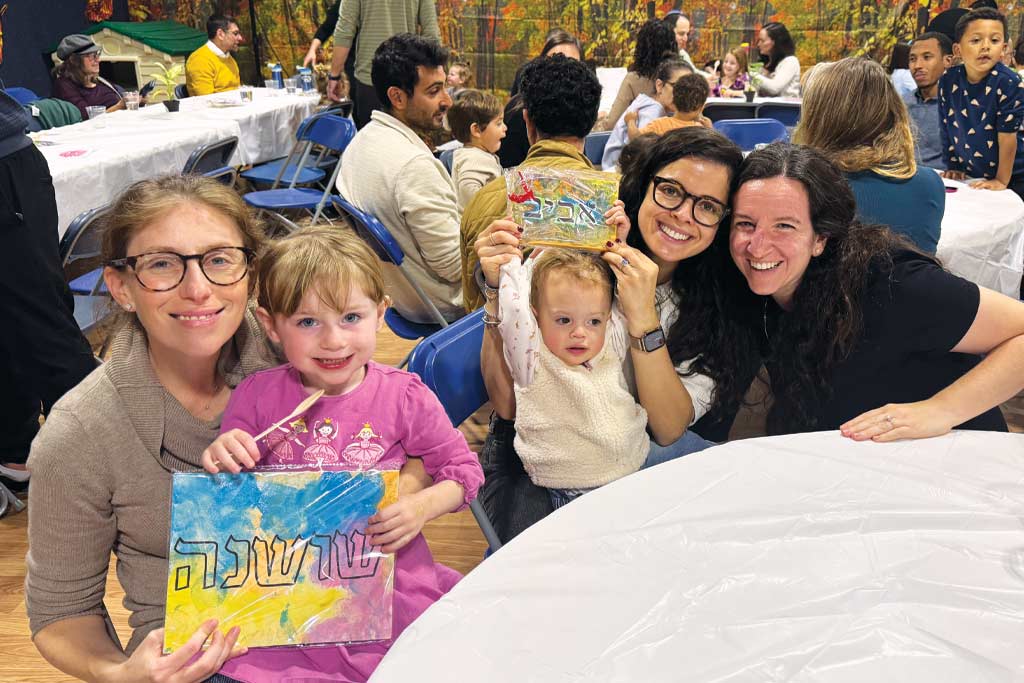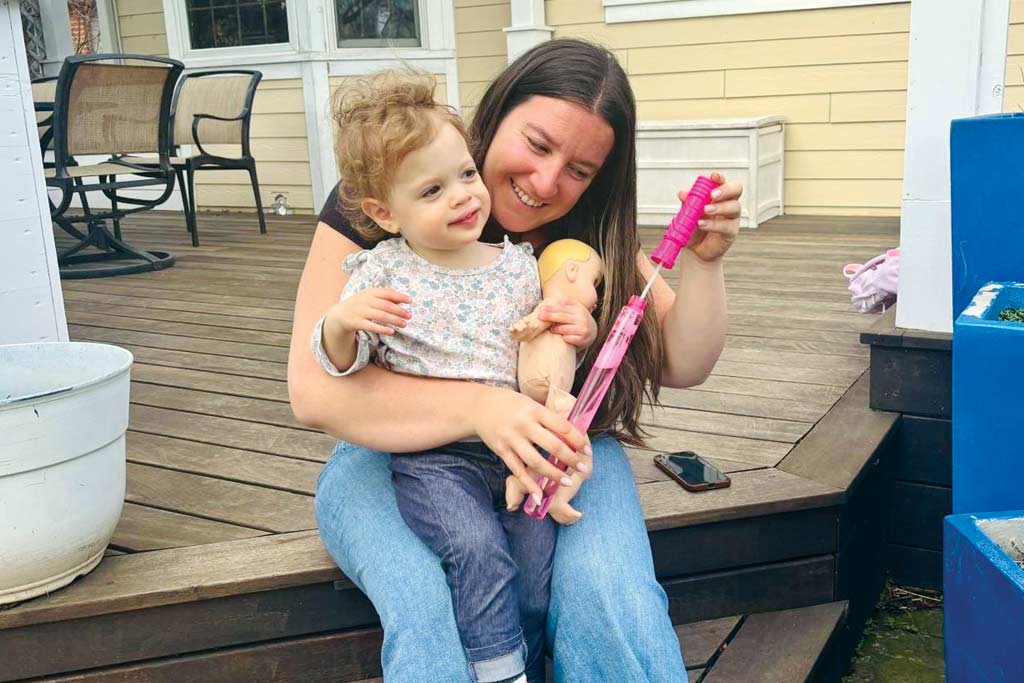
The author and her niece in the yard of Kayla’s childhood home.
What struck me hardest the first time I flew back to Chicago, after moving to Israel, was not the feeling of arriving. It was the feeling of leaving.
For months, I had referred to the trip casually as “going home.” Home meant Chicago. Home meant family, the street I grew up on, the house I grew up in. But somewhere between arrival and departure, I began feeling unsettled, like I no longer belonged entirely to one place.
This disorienting feeling accompanied me on my journey. It checked the same luggage as me at the gate, and used my passport to get through security. It barely said “excuse me” as it scooted past my lap to take the seat next to me on the 12-hour plane ride. This feeling kept the overhead reading light on the entire flight and went barefoot. It showed no mercy while I was bleary-eyed and homesick upon arrival, and it followed me aimlessly while I roamed around here, a stranger in a strange new land that is somehow both a bone-dry desert and a swampy marsh all at once, where concepts like personal space and standing in line are silly suggestions instead of rules.
At first, a new place feels transactional. You learn it through necessity: which bus to take, which grocery store stays open late, which pharmacy carries the laundry detergent I like. But slowly, and almost imperceptibly, that disorienting feeling quietly fades.
You catch yourself reaching for your favorite coffee mug, in a cabinet where you put it. Your shoes collect outside the front door. Your perfume lingers in the linen closet, on your sheets. And one day, without ceremony or fanfare, the new place stops feeling so new.
Home is so much more than physical walls. It’s the kitchen where your baby took her first steps just as news broke that a new pope had been announced. It is the scratched-up base of the wood-framed bay windows from your dog’s relentless attempts to intimidate every squirrel that ever dared to exist. It is the plume of black silt around an outlet where, as a child, you learned the hard way to never unplug a hot toaster with a fork.
For Jews, the concept of “home” has always been more complicated than just geography. Our story begins with displacement, when G-d tells Abraham:
“Go forth from your country, from the place of your birth, from your father’s house, to the land that I will show you” (Genesis 12:1).
The command itself is striking. Abraham is not merely told to travel to a place; he is told to detach from a place, as well. To leave behind land, birthplace, and family home in pursuit of something not yet visible to him. The first Jew is introduced to us not as someone rooted in certainty but as someone suspended between departure and arrival.
And perhaps that is why our relationship to “home” sometimes carries contradiction within it. For centuries, Jews built lives in the diaspora while orienting spiritually toward a North Star. We built homes in Chicago, Iraq, Warsaw. We filled them with recipes, traditions, accents, photographs, and family lore. But woven through Jewish life was always the idea of another home entirely—Israel as a homeland, a rebirth, a promise.
Even Moses, the figure most associated with leading the Jewish people “home,” spent his life caught between identities and places. Born a Hebrew, raised in Pharaoh’s palace, exiled to a strange land, and ultimately left standing at the edge of a homeland he would never enter himself, Moses understood that home is more than just where you are for a moment in time. Jewish history is, in many ways, a history of movement: exile and return, ruin and rebuilding, arrival and departure.
Maybe that is the quiet evolution of Jewish belonging in this season of life. The realization that home is not only one place, one thing. That one home can be inherited while another is chosen. That one can live in memory while another unfolds around you now. That home is not erased by distance but simply expands, until one day you realize home is not about choosing between places but recognizing yourself in both of them, or wherever your mugs happen to live now.
Kayla Kirshenbaum, who currently lives in Tel Aviv, is a freelance writer and strategic communications professional with experience in public affairs at JUF.e.