122nd Annual Meeting celebrates first return to in-person since COVID
Michelle Cohen
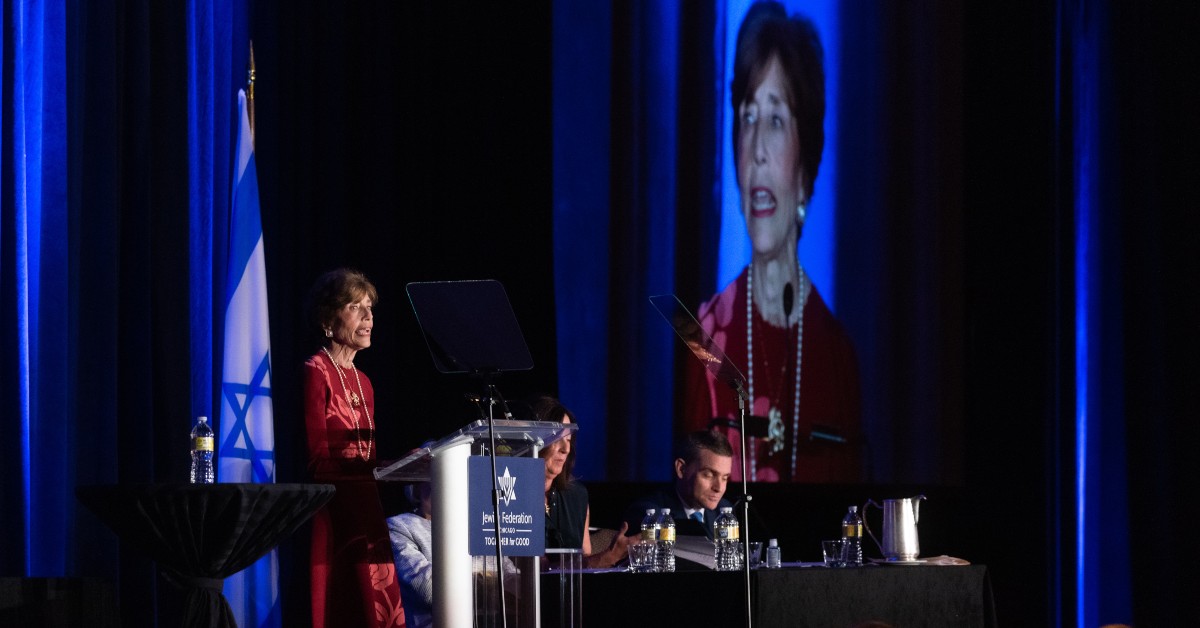
For the first time in three years, the Jewish Federation of Chicago was able to hold its Annual Meeting in person. With 700 in attendance–500 in person and 200 more on Zoom–the meeting brought Chicago’s Jewish community together; to reflect on the community’s challenges, and celebrate its accomplishments and commitment to tikkun olam both locally and abroad.
“It is such a pleasure to be back together in person, once again,” said Midge Perlman Shafton, chair of the annual meeting. “We don’t take that for granted anymore.”
In recognition of a lifetime of service to the Jewish community in Chicago and around the world, Ann-Louise Kleper was presented with the 59 th annual Julius Rosenwald Memorial Award–JUF’s highest honor. The award honors the memory of Chicagoan Julius Rosenwald, one of America’s great philanthropists and a two-term president of the forerunner of JUF.
Kleper was introduced by Andy Hochberg, the recipient of last year’s award. He described her as “unsurpassed in the depth and breadth of her interests, passions, and commitments to Jewish life,” and detailed the variety of commitments she has made to the Jewish community. In her 20 years of board service, Hochberg said, “I dare say no other leader in our community’s history has served on such a vast array of diverse committees and commissions in so many capacities.”
Kleper expressed her gratitude to those who have helped her in her Jewish journey as well as to Chicago’s Jewish community for providing her with myriad opportunities to serve. “It is an unbelievable gift to be recognized and rewarded for doing what I love, what brings me such joy and fulfillment,” she said.
The Davis, Gidwitz & Glasser Young Leadership Awards, honoring extraordinary young volunteers, was presented to both Danny Gutman and Amy Siegel. Both of this year’s winners have been 36 Under 36 honorees and members of JUF’s Ben Gurion Society Advisory Council. The Samuel A. Goldsmith Awards, spotlighting exemplary young Jewish agency professionals, were presented to Joelle Kelenson and Jordyn Scorpio.
Pam Friend Szokol, who completed her two-year term as Board Chair, was recognized for her exceptional leadership during a challenging time. Szokol handed off leadership to incoming Board Chair David Golder.
The Shofar Award was presented to Steve Miller, 2022 Annual Campaign Chair, was honored with the Shofar Award, and Carey Cooper was introduced as the incoming Chair of the 2023 Annual Campaign.
In the annual State of the Federation address, JUF President Lonnie Nasatir described this year’s in-person meeting as “a wonderful first step toward normalcy” after “the most stressful, complex, and difficult three years of the last half century.” Nasatir focused on Jewish unity in the face of global challenges including the war Ukraine; gun violence in Chicago; rising antisemitism; and the mental health crisis that has exploded in the years since the pandemic began.
Nasatir celebrated the people in the room as “the most generous, committed community in the world. You are my personal inspiration and the heart of JUF’s success.”
“Because of you,” he concluded, “the Jewish future is bright.”
Remarks from the 2022 honorees
“It is said that to be a Jew is to be grateful. The Hebrew word for the Jewish people, Yehudim, stems from Ho’da’ah, meaning gratitude. Today, this Jew’s gratitude is overflowing.
I am grateful to those who chose me as this year’s Rosenwald Award recipient. To be in the company of the previous recipients is my highest honor.
I am grateful to those with whom I have interacted on the Federation Board, its committees, and its agencies–devoted, tireless volunteers, and dedicated, talented professionals, who have taught me, guided me, and inspired me to do more and to do better.
I am grateful to my family and friends for their love and support. . .
I am eternally grateful to my parents, Freda and Herman Foreman, z”l, who were my first teachers and role models. They ensured that I had a strong Jewish education, both formal and at Hebrew-speaking camps, and they ignited within me a passion for Israel which has greatly intensified through the years. I frequently say that just as I followed my dad into the law, so I followed him into leadership roles in the Jewish community and its institutions.
I am forever grateful to my late husband Dennis, whom I met through the national Young Leadership Cabinet. Thirty-five years ago, he brought my children and me to Chicago and to this Jewish community, which I truly love and of which I am immensely proud. He was my best cheerleader, biggest fan, and greatest supporter in everything I did in the Jewish world.
I am grateful for the extraordinary opportunities I have been given through the Federation system. Whether it was visiting Refuseniks in what was then the Soviet Union…or later participating in Operation Exodus, which brought and resettled more than a million Soviet Jews in Israel…or greeting planeloads of rescued Ethiopian Jews on the Israeli tarmac during Operation Moses, I felt the power of our collective.”
– Ann-Louise Kleper, Rosenwald Award Honoree
***
“Despite losing most of their respective families in the Holocaust, my grandparents never lost sight of what was important. They came to America, found work, and raised a family. Given what they endured, simply existing would have been enough. But it wasn’t. Not only did they rebuild their life, they re-established a commitment to their community, to something more than themselves.
My grandparents instilled their belief in community and giving back in my father, and while there are many things I look up to in my parents, their selflessness and commitment to helping others tops the list.
It would be an understatement to say that the past couple of months have been challenging. That said, I have never been prouder of my mom. Day in and day out while at the hospital after the [Highland Park] parade, she never stopped thinking about and caring for everyone else in her life. It was an extraordinary window into her relentless desire to be there for others.
Luck has been a word I have admittedly struggled with lately, but I know how lucky I am to have such strong examples of what giving back looks like in my parents, and a partner in my wife, Carlee, who is equally committed to JUF’s work as a member of the Young Women’s Board. I also know how lucky I am to be a part of this JUF community doing what we can for others in good times and bad.”
– Danny Gutman, Davis, Gidwitz & Glasser Young Leadership Division Award Honoree
***
“At 17, after not getting the job I wanted at the camp I grew up at, just north of Montreal, I made a decision to go work at a new camp, outside of Boston. There, I made friends who didn’t take being Jewish for granted, who chose Jewish camping so they could connect to the Jewish people, faith, and values. That summer, I made three fundamental vows that led me here today.
One – I was going to leave Montreal and find a place where I could build my own community.
Two – I committed to actively taking steps to be a stronger professional: To work hard, explore as much as possible, learn all I could, and make change for the better.
Three – I promised myself to never be put in a situation where politics or apathy would come between what I loved to do and felt was right.
In the years that followed, I grew from staff to supervisor at camp. Lived in Israel for a year. Earned three degrees. Started my first job. Returned to working at overnight camp, where I discovered a new passion–making sure campers of all abilities find their own Jewish connections and identity. A year ago, I left overnight camp to work at Keshet. Now I can say, I have fulfilled the three vows I made 15-ish years ago.”
– Joelle Kelenson, Goldsmith Award Honoree, Director of Recreation at Keshet
***
“In addition to feeling honored, I am sincerely grateful to be here because I hope this speech can be your reminder, maybe not today, maybe not this week or next, but one day, that domestic abuse does not discriminate. It happens in our Jewish community, among all denominations, ages, socioeconomic statuses, ethnicities, and sexual orientations. SHALVA exists and our clinicians and staff work so hard every day, because of this fact…
I get the opportunity to try to lessen the work of my colleagues who directly serve survivors, through prevention education. I truly believe that talking about and modeling healthy relationships creates a ripple effect where people can recognize when their relationship isn’t healthy, and they can get out early, or find the support to get out safely. It can also help couples form a realistic expectation of how to manage the inevitable roller coaster that life brings in a caring, communicative way…
I want to leave you with a few reminders: Check on your friends you are worried about. Model and talk about healthy relationships. Trust your gut. Finally, I want to empower you to call SHALVA if you’re worried about your own relationship or someone else’s or if you want to help bring this conversation to your network. The more we can all be talking about this, the safer and more loving our Chicago Jewish community can be.”
– Jordyn Scorpio, Goldsmith Award Honoree, Director of Community Education for SHALVA
***
“As I reflect on the events I have attended, I must say the Valor event was one which resonated the most for me. Perhaps since the word “valor” holds a special place in my own Jewish history; it reminds me of the prayer Eshet Chayil. Eshet Chayil describes a woman of valor as having attributes of strength and honor; someone who never gives up on the action or passion of her time. It is a prayer read to express appreciation. I have always aspired to be a woman of valor; however, I would be remiss if I didn’t recognize that while working on making a difference, I found it making a difference in me. I have learned to give not just what I have, but who I am; and to always express my appreciation.
I am so flattered to receive this recognition as I know it recognizes my spirit of giving back. And while I accept this honor graciously, it is not mine alone. In 2011, when I moved to Chicago, I knew very few people and was unfamiliar with my surroundings. I knew I had to find a way to introduce myself to others and find my niche in a city the size of which was at first overwhelming. I immediately turned to the Jewish community as experiences taught me the Jewish community is warm and welcoming. And I found everything I expected and more.”
– Amy Siegel, Davis, Gidwitz & Glasser Young Leadership Division Award Honoree
From the 2022 State of the Federation Address
“The pandemic was a trigger for people struggling with anxiety, depression and addiction. Mental health is the #1 health care need in Chicago’s Jewish community today. The horrific July 4 violence in Highland Park only exacerbated this reality.
Mental illness impacts people of all genders, ages and incomes. One in five U.S. adults experience mental illness each year, as does one in three young adults ages 18-25.
Anxiety, the most common challenge, sidelines thousands. Participating in Jewish life and other social situations can be especially overwhelming, and I’d like to give a shout-out to those people for whom coming here today was an act of bravery.
Addiction is another challenge we need to talk about. Drug overdoses were up 29% last year across the nation, and we saw the same heartbreaking increases here in our Chicago community.
Depression is also on the rise. We are losing too many beautiful young people to suicide–which is the second-leading cause of death for people ages 10-34.
Our JUF agencies say that a week doesn’t go by without a call from a local rabbi worried about a congregant–or a congregant’s child.
Here’s the tachlis : Every person in our community is either struggling themselves or has a friend or a loved one who’s experiencing a mental health crisis.
If you or your child is struggling with your mental health, we see you.
Moving forward, it is a top priority for JUF–and for me personally–to increase funding, expand services, and make wait lists for mental health care disappear.
Eliminating wait lists is one facet of meeting our community’s mental health needs. Another is talking about them openly.
One of the outstanding things about our Jewish community is that we don’t avoid discussing tough subjects. There’s no topic we won’t tackle if it helps save lives. So let’s talk about mental illness without apology or shame, and with determination and hope.
Let’s make talking about anxiety and depression as common and comfortable as talking about diabetes or asthma!
It’s one more way we can harness the power of our community to come together for good.”
– Lonnie Nasatir, President, Jewish United Fund/Jewish Federation of Chicago