A Druze teen joins March of the Living
Zahi Youseff
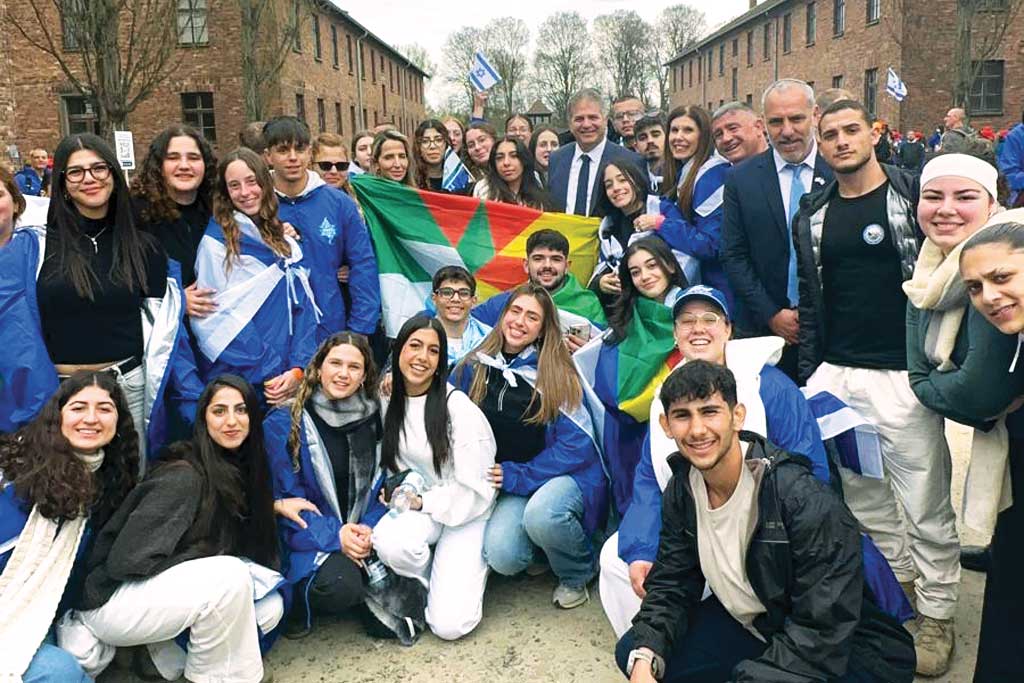
Israel’s Ministry of Education youth delegation, pictured with the Minister of Education, Yoav Kisch.
Zahi Youssef, a Druze teen, is a participant in the Sanabel Druze Leadership Program—a JUF initiative in partnership with The Edmond de Rothschild Partnerships, a subsidiary of The Rothschild Foundation. Sanabel aims to nurture a group of accomplished young people, empowering to lead their community’s integration into Israeli society.
This past spring, Youssef was chosen to travel on the March of the Living in Poland as part of a delegation from the Israeli Ministry of Education. The March of the Living brings students from around the world to Poland, where they explore the remnants of the Holocaust.
My name is Zahi Youssef. I am a driven and community-minded young person who believes in leadership, responsibility, and standing with others in their pain.
In April, I had the honor of joining the March of the Living in Poland as a Druze teenager, an Israeli, and a human being who wanted to understand, remember, and stand beside the Jewish people.
Even before we left, this journey already meant a great deal to me. Our group from northern Israel met several times, both in person and on Zoom, and we understood that this would not be an ordinary trip.
Because of the war and the security situation, we were not even sure the delegation would happen. At first, it was canceled. That was painful for me, because I felt that this journey was something I truly needed to experience. Then, only a few days before departure, we were told that we had permission to go, and I was overwhelmed with joy.
From the moment we arrived in Poland, history stopped being distant. It became real. We visited places where Jewish life had once flourished with faith, culture, and strength, and we learned how brutally it was destroyed.
But what moved me most was not only seeing the places themselves. It was walking through them together, as young people carrying memory forward.
At Auschwitz and Birkenau, I felt something words can barely describe. Seeing the train tracks, the barracks, the ruins of the gas chambers, the shoes, the suitcases with names written on them, and the hair of women and children was deeply painful. It was not like learning history in a classroom. It was standing inside the evidence of evil.
In one quiet moment at Birkenau, I sat alone and thought not only about the Holocaust, but also about the Druze in Syria, and the fear they faced when chaos spread after the regime changed. In that moment, I understood again how quickly tragedy can come when minorities are left unprotected. I also felt deep gratitude to the State of Israel and to the IDF for standing by the Druze and helping protect them. That moment made me understand more deeply why a Jewish state is not only important, but necessary.
The March of the Living itself was one of the most meaningful experiences of my life. Walking among thousands of Jews and supporters from all over the world, I felt the power of memory and unity. I met Jews from many countries, spoke with them, learned about their lives, and traded small items with some of them as a way of creating a connection. Although we came from different places, we were walking together for the same purpose: to remember, to honor, and to promise never to forget.
I was especially proud to walk with the Druze flag on my back and an Israeli hat on my head. Many people asked me about the Druze flag, and I had the chance to explain who we are, and to speak about the bond between the Druze community and the Jewish people.
Meeting Holocaust survivors was one of the most important parts of this delegation. To sit with them, hear their voices, and ask them questions was something I will carry with me forever. This journey made me realize that we are the last generation that can still meet many of the survivors in person. That gives us a duty.
As Elie Wiesel, himself an Auschwitz survivor, said, “To forget the dead would be akin to killing them a second time.” Our responsibility is to keep telling their stories, to teach our children what happened, and to preserve memory in order to build a better future.
I went to Poland as Zahi Youssef from Beit Jann. I came back with pain, pride, and responsibility—and with a promise to remember.
Zahi Youssef, age 18, is a 12th-grade student from the Druze village of Beit Jann in northern Israel.