A forgotten opera, a pianist's wit, a prize-winning play, and a choreographer's patience
Hedy Weiss
Fans of many of the great Hollywood movies of the late 1930s and ’40s might be familiar with the scores of composer Erich Wolfgang Korngold. And television viewers of the 1950s might recall the acerbic humor of pianist Oscar Levant, who made memorable guest appearances on the programs of Jack Paar, Jack Benny, and others. But in addition to reviving aspects of those formidable talents of the past, the coming weeks will give audiences the chance to discover both a new, prize-winning play about a Jewish family, and the premiere of a work by a Jewish choreographer. Here is a closer look at all four events:
Staging an homage to Erich Korngold
The list of Jewish composers who perished during the Holocaust is long and painful to read. But there were some lucky souls who managed to flee Europe just in time, and they often ended up working in Hollywood where they devised a winning hybrid musical style for film scores.
A formidable example of just such a composer is Austrian-born Erich Wolfgang Korngold (1897-1957), a child prodigy who became a sensation even before he entered his teens, and whose most famous opera, Die tote Stadt (“The Dead City”), premiered in Hamburg and Cologne when he was just 23. Also during the 1920s he revised and “nearly re-composed” several operettas by Johann Strauss II. And it was those musical roots that served him well during his Hollywood years when he composed the scores for 16 movies (among them The Adventures of Robin Hood , Green Pastures , and The Sea Wolf ), was hailed as one of the major forces behind film music and received two Oscars for his work.
Now, Korngold Rediscovered, an encyclopedic celebration and exploration of Korngold’s life, times, and music is aiming to correct that. The project, running April 1-10, is a collaboration between the University of Chicago (organized by Prof. Philip V. Bohlman) and Chicago’s Folks Operetta. And it will feature everything from chamber music concerts to scholarly symposia, lectures, and film screenings. But its centerpiece will be a semi-staged revival of Die Kathrin in its American premiere, complete with stellar singers and a 64-piece orchestra when it is performed April 7 and 10 at the U of C’s Riva and David Logan Center for the Arts.
Slammed by antisemitic critics when it debuted in Vienna in 1938, the opera, rarely performed since then, spins the complex love story of a Swiss woman and a young French street singer/soldier.
For complete Festival details, visit korngoldfestival.org .
A night on the air with Oscar Levant
In 1958, Jack Paar, the immensely popular host of NBC’s The Tonight Show , introduced his guest, Oscar Levant. A man of countless talents, Levant was both a superb concert pianist known for championing the work of George Gershwin, and an uncensored comedian with a brilliantly acerbic wit. And as Paar quipped: “To put it mildly, he is as nervous as he is clever [and], for every pearl that comes out of his mouth a pill goes in.”
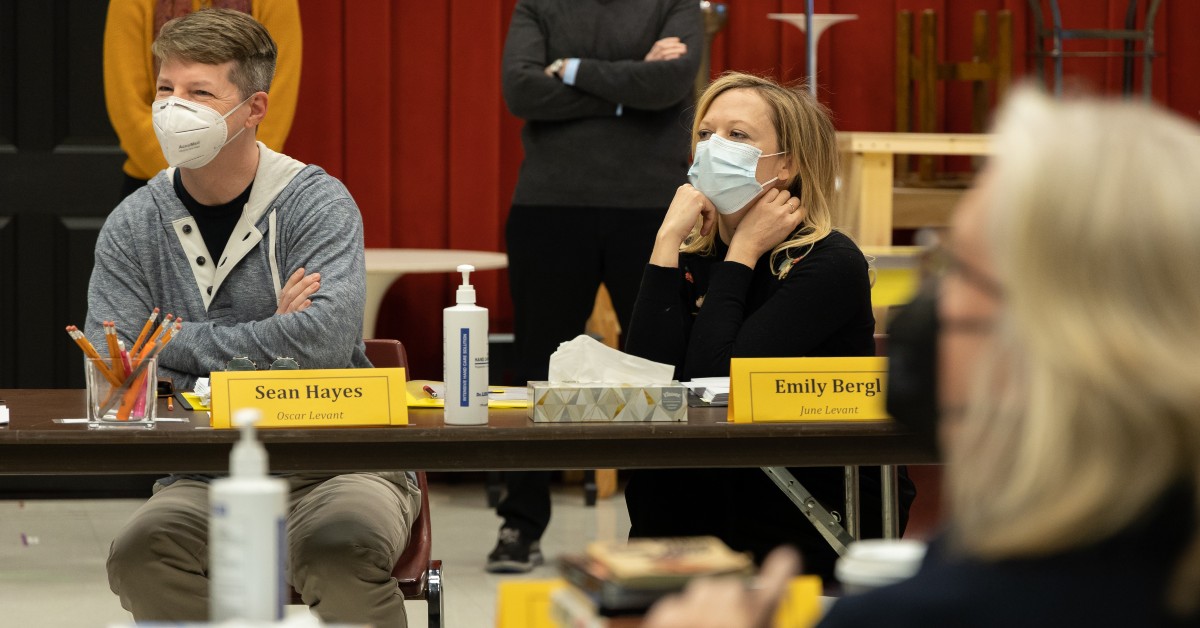
In fact, Levant–the son of Orthodox Jewish parents from Russia–suffered from the mental illness (a taboo subject at the time) and spent considerable time in mental hospitals, and his appearance on Paar’s show that particular night came courtesy of a four-hour pass that released him from one of those institutions. What transpired on the show is a crucial element of Good Night, Oscar –the play by Pulitzer Prize winner Doug Wright–now in its world premiere at the Goodman Theater, with Sean Hayes, of Will and Grace fame, starring as Levant.
Good Night, Oscar runs through April 24 at the Goodman Theatre, 170 N. Dearborn. For tickets visit GoodmanTheatre.org or call 312-443-3800.
A prize-winning play set for a Seder
Arriving on the Victory Gardens Theater stage just in time for the Passover season is the world premiere of Ali Viterbi’s play, In Every Generation , which won the 2019 National Jewish Playwrighting Contest (and is now part of the National New Play Network’s Rolling World Premiere program that will see other productions of the work at theaters in Maryland and San Diego).
Viterbi’s play considers the familiar question posed at every seder: “Why is this night different from all other nights?” And as it homes in on members of the Levi-Katz family who gather each year for the holiday but never seem to arrive at the answers to such questions as “If trauma is generational–spanning four millennia–must we be defined by it, and will we ever be free?” Directed by Devon de Mayo, with a cast that includes Carmen Roman, David Dillon, Eli Katz, Esther Fishbein, and Sara Lo, the show runs April 2-May 1 at Victory Gardens, 2433 N. Lincoln Ave. For tickets visit victorygardens.org or call 773-871-3000.
Lin Batsheva Kahn’s new work
Lin Batsheva Kahn is an innovative member of the faculty of the DePaul Theatre School where she teaches contemporary dance, improvisation, and choreography. Her new piece, Solo Cello & Choreography: Dance to Selections from Bach’s ‘Unaccompanied Cello Suites ,’ will be performed by Payton James and Emily Rice, accompanied by Stephen Balderston, an esteemed Professor of Cello at DePaul’s Music School. The one-time (free) event will take place at 8 p.m. on May 5 in DePaul’s Gannon Hall, 2330 N. Halsted. For reservations call 773-325-7260.
As Kahn explained: “My work was inspired by the concept of mussar , a Jewish practice of development and transformation to correct parts of the soul called middot developed among Orthodox Jews in Lithuania in the 19th Century. One soul trait is called savlanut (Hebrew for “tolerance”), something considered important, and especially needed throughout the pandemic.”
Hedy Weiss, a longtime Chicago arts critic, was the Theater and Dance Critic for the Chicago Sun-Times from 1984 to 2018, and currently writes for WTTW-TV’s website and contributes to the Chicago Tonight program.